
In This Article
Speed cubes for beginners are lightweight, pre-lubricated, usually magnetic 3×3 puzzles built to turn smoothly and “corner-cut,” meaning they finish a turn even when the layers are slightly misaligned, instead of jamming. They typically cost between $10 and $40, adjust to your hands, and make learning to solve dramatically less frustrating than a classic toy-aisle cube.
Here’s the secret the toy aisle never tells you: the cube you remember fumbling with as a kid is a different animal from the one real cubers use. Speedcubing is a genuine competitive sport, with the 3×3 as its flagship event, and the hardware has evolved accordingly. Manufacturers like GAN, MoYu, YJ and QiYi have spent years refining internals so that a modern cube glides where the old ones grated. The best part? That tech now trickles down to cubes costing about as much as a pizza.
A quick note on honesty before we dive in. Everything below comes from spec comparisons and aggregated reviewer sentiment gathered during research, not from claimed hands-on testing. Where review data is thin, I’ll say so.
This guide covers seven real picks across budget, mid-range and premium tiers. You’ll also get a plain-English walkthrough of cube lubricant and tension, and, for parents, honest advice on brain teaser puzzles for 10 year olds, single player logic games for 6 year olds, and solo screen-free games. Buckle up. Your fingers are about to get faster.
Quick Comparison: Speed Cubes for Beginners at a Glance
| Cube | Price Range (check current price) | Magnets | Best For |
|---|---|---|---|
| MoYu RS3 M V5 | Roughly $10-$25 by version | Yes, adjustable | Best overall value |
| GAN 356 M | Mid-$20s to around $30 | Yes, strong | Buyers who want a premium feel |
| QiYi MS | Budget tier, usually under $20 | Yes | Cost-conscious families |
| YJ MGC Evo | Budget-to-mid tier | Yes, adjustable | Beginners planning to improve |
| Monster Go 3×3 | Around $10 | Yes | Testing the hobby cheaply |
| YuXin Little Magic 3×3 | Budget tier (check variant) | Check variant | Younger kids, gentle feel |
| GAN V100 Maglev UV | Around $40 | Yes, MagLev and core magnets | Long-term “grow into it” buyers |
Looking at the table, the MoYu RS3 M V5 and Monster Go 3×3 cover the “spend little, learn lots” end, while the GAN V100 Maglev UV is the only pick that asks for real money. If your child is the solver, the YuXin Little Magic 3×3 trades some performance ceiling for a calmer, more forgiving feel. Magnets matter here because they snap layers into alignment, which hides the sloppy finger work every new solver has.
💬 Just one click — help others make better buying decisions too!😊
Top 7 Speed Cubes for Beginners: Expert Analysis
1. MoYu RS3 M V5 — best all-round value for first-timers
This is the cube that gets handed to most people buying their first “real” cube, and the reasoning holds up. It’s a magnetic 3×3 whose tension and magnet strength both adjust, so the same puzzle that suits you at three minutes per solve still suits you at forty seconds. On paper, adjustable magnets mean you can start with a firm, self-aligning feel and loosen it as your fingers speed up.
Based on the spec comparison, the version choice matters: a spring-tension version and a pricier ball-core version both circulate, and community chatter suggests the ball-core is less forgiving of drops. Reviewers of the RS3 M family consistently praise the value, with one long-term owner of the 2020 model describing years of use before upgrading. A common note is that the factory feel can be a touch dry, so a drop of lube transforms it.
Pros:
- ✅ Adjustable tension and magnet strength
- ✅ Outstanding performance for the price
- ✅ Widely recommended starter cube
Cons:
- ❌ Factory feel can be slightly dry
- ❌ Ball-core version dislikes being dropped
Price: roughly $10-$25 depending on version. Verdict: the default answer for most buyers.
2. GAN 356 M — premium feel without flagship pricing
GAN is the name cubers associate with polish, and the GAN 356 M is its accessible magnetic model. Guides describe it as light, fast, tunable, and fitted with strong magnets that click each layer home. That click is the real-world benefit: you feel when a turn is complete, which trains accurate fingers.
Here’s the catch worth weighing. Comparisons of brands note that GAN cubes are very fast, and speed is a double-edged sword for beginners, who can overshoot turns and lose control. One buying guide suggests the step up to GAN is most worthwhile once you’re consistently solving under about thirty seconds. Still, others argue its build keeps its feel long after cheaper cubes loosen, which matters if you’re buying once.
Pros:
- ✅ Premium build and refined internals
- ✅ Strong magnets give a satisfying layer click
- ✅ Tunable feel as skills grow
Cons:
- ❌ Fast turning can cause beginner overshoots
- ❌ Costs noticeably more than budget rivals
Price: mid-$20s to around $30. Verdict: worth it if you want one cube for years.
3. QiYi MS — the budget magnetic workhorse
The QiYi MS keeps showing up on beginner lists as a budget magnetic 3×3 that punches above its price. In plain terms, you get magnets, decent corner-cutting and out-of-the-box smoothness without paying for features you can’t yet use. That’s the right philosophy for a first cube: spend on the learning curve, not the leaderboard.
What the spec sheet won’t tell you, but brand comparisons do, is that QiYi cubes tend to offer fewer customization options than MoYu or GAN. Fewer tuning dials means less to fiddle with, which can feel liberating or limiting depending on your personality. Reviewers consistently describe QiYi’s budget line as dependable, though I couldn’t verify a large review pool for this exact model, so treat that praise as general brand sentiment.
Pros:
- ✅ Magnetic performance at a budget price
- ✅ Simple, low-fuss setup
- ✅ Well-regarded budget brand reputation
Cons:
- ❌ Fewer customization options
- ❌ Limited ceiling for ambitious solvers
Price: budget tier, usually under $20. Verdict: a smart pick for cost-conscious families.
4. YJ MGC Evo — room to grow without the flagship tax
Positioned between budget and mid-range, the YJ MGC Evo is described as a feature-rich option with adjustable magnets, smooth turning and high stability. Translation: it feels steady in the hand, so a solver learning finger tricks isn’t fighting wobble. That stability is exactly what you want when your muscle memory is still forming.
My analytical take: this is the “step up” choice for buyers who already know they’ll stick with the hobby. Reviews I found were less plentiful than for the RS3 M family, so I’d weigh it as a considered upgrade rather than a default. Brand-level feedback on the YJ MGC line frames it as slightly nicer than pure budget cubes, which squares with the spec-based picture.
Pros:
- ✅ Adjustable magnets for personalized feel
- ✅ Stable, controlled turning
- ✅ Strong performance for the tier
Cons:
- ❌ Smaller review pool than top rivals
- ❌ Pricier than the cheapest starters
Price: budget-to-mid range; check current price. Verdict: great if you’re already committed.
5. Monster Go 3×3 — the cheapest way to feel a real cube
At around $10, the Monster Go 3×3 exists to answer one question: will you actually enjoy this? Guides note that even a $10 cube now has magnets and corner-cutting, which would have been flagship territory a few years ago. For a parent buying on a “might be a phase” budget, that’s a gift.
The sensible analysis: treat it as a low-risk test drive, not a forever cube. Expect fewer tuning options and less community track record than established lines. Because the Monster Go 3×3 is cheap, losing it or having a sibling destroy it won’t ruin anyone’s weekend. Aggregated guide sentiment calls it the best cheap way to feel what a real cube does, though individual review volume appears modest.
Pros:
- ✅ Magnets and corner-cutting at rock-bottom price
- ✅ Low risk for hesitant buyers
- ✅ Easy upgrade path later
Cons:
- ❌ Smaller review pool than major brands
- ❌ Likely outgrown as speed improves
Price: around $10. Verdict: perfect “try before you commit” pick.
6. YuXin Little Magic 3×3 — gentlest feel for small hands
Not every beginner wants a cube that snaps like a mousetrap. The YuXin Little Magic 3×3 is recommended as a simple starter for younger children because it turns well, survives drops, and doesn’t overwhelm a new solver with an aggressive feel. For a seven-year-old with developing grip strength, that’s the whole ballgame.
The spec-to-reality translation: a calmer feel means fewer accidental “pops,” those dramatic moments where a cube explodes across the carpet and tears follow. Durability reduces frustration, and lower frustration keeps kids at the puzzle longer. Variants differ, so check whether your version includes magnets before ordering.
Pros:
- ✅ Survives dropped-cube drama
- ✅ Forgiving, non-aggressive turning feel
- ✅ Great for younger solvers
Cons:
- ❌ Lower performance ceiling than flagships
- ❌ Magnet features vary by variant
Price: budget bracket; check current price. Verdict: the kid-first choice.
7. GAN V100 Maglev UV — the flagship to grow into
The GAN V100 Maglev UV is described as a superlight 55 mm cube with MagLev, core magnets and a UV coating, built for fast, accurate turning with simple, repeatable tuning. MagLev swaps traditional springs for magnetic repulsion, which reduces friction and gives a floaty, quiet feel.
Is that sensible for a beginner? Mostly if you’re buying once and plan to stay. Guides generally advise saving flagship cubes until you have a consistent method and know what feel you prefer, and that advice is sound. Still, a cube that never limits you can’t be outgrown, which has real value if you’re confident the hobby will stick. Remember that even MagLev cubes still need lubricant.
Pros:
- ✅ Lightweight MagLev design
- ✅ Simple, repeatable tuning
- ✅ Won’t be outgrown quickly
Cons:
- ❌ Highest price on this list
- ❌ May feel twitchy to brand-new solvers
Price: around $40. Verdict: buy it if you’re all-in.
| Cube | Turning Feel | Tuning Options | Growth Room |
|---|---|---|---|
| MoYu RS3 M V5 | Smooth, adjustable | Tension and magnets | High |
| GAN 356 M | Fast, precise | Tunable | High |
| QiYi MS | Steady, simple | Limited | Medium |
| YJ MGC Evo | Stable, controlled | Adjustable magnets | High |
| Monster Go 3×3 | Light, basic | Minimal | Low-medium |
| YuXin Little Magic 3×3 | Gentle, forgiving | Basic | Medium |
| GAN V100 Maglev UV | Floaty, ultra-fast | Simple, repeatable | Very high |
The pattern is clear: tuning range tracks growth room almost one-for-one. The MoYu RS3 M V5 gives the most adjustability per dollar, whereas the QiYi MS and Monster Go 3×3 trade flexibility for simplicity. If you can’t decide between two cubes, choose the one with more tuning options, because that flexibility lets one purchase cover more skill levels.
How to Choose Speed Cubes for Beginners: 6 Steps
Choosing well isn’t about brand loyalty. It’s about matching a handful of traits to your situation. Work through these in order:
- Set a budget first. Anything between $10 and $25 gets you a legitimately good starter. Spending more only pays off if you’re sure you’ll continue.
- Insist on magnets. Magnets self-align layers, which forgives imperfect fingers and shortens the learning curve noticeably.
- Check adjustability. Adjustable tension and magnet strength let one cube stretch across months of improvement instead of weeks.
- Match feel to the solver. Kids and cautious learners usually do better with a gentler, controlled feel; adults chasing speed can handle sharper turning.
- Prefer stickerless or durable builds. Stickers peel with use, and stickerless cubes avoid that irritation entirely.
- Consider size and weight. Smaller hands benefit from lighter cubes, and standard 3×3 sizing sits around the mid-50-millimeter range.
One more filter: popularity is useful evidence. When a cube has been recommended by multiple guides and vendors for years, as the RS3 M line has, the odds of a nasty surprise drop sharply. Think of review volume as free insurance.
3×3 Cube for Beginners: Why Size and Setup Matter
The classic 3×3 is the right starting point, and not only because it’s what everyone pictures. It’s the sport’s flagship event, per the World Cube Association’s history, and nearly every tutorial, method guide and competition revolves around it. If you’re shopping a 3×3 cube for beginners, you’re buying into the largest knowledge base in cubing.
So what separates a good 3×3 cube for beginners from a mediocre one? Three traits. First, consistent turning, meaning no sticky spots. Second, corner-cutting, so imperfect turns don’t lock up. Third, adjustability, because your preferences will change faster than you expect. A 3×3 cube for beginners should also feel comfortable, since you’ll hold it for hours.
Should you jump straight to a 4×4? Probably not. Guides suggest the 4×4 is a natural next challenge once you can solve a 3×3, because it introduces parity and centers. Master the 3×3 first, and the bigger puzzles feel like expansions rather than ordeals.
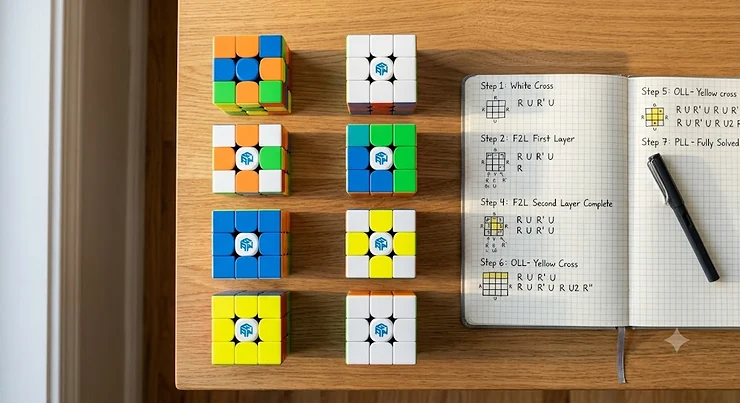
As for solving method, beginners typically learn a layer-by-layer approach, then graduate to CFOP, the method most commonly used in speedcubing today. Don’t worry about CFOP yet. Your first goal is simply a clean, repeatable solve, and a decent 3×3 cube for beginners makes that goal reachable within a few weeks of casual practice.
Cube Lubricant and Tension: The Beginner Setup Guide
Here’s where beginners can quietly level up for under ten dollars. Most speed cubes benefit from lubrication, and tension is the other half of the equation. Think of cube lubricant and tension as the volume and bass knobs on your cube: small tweaks, big audible difference.
Lubricant basics. Silicone lubes are rated by weight. Lower weights (around 1-2) are thin and runny, speeding a cube up, while higher weights (4-5) are thick and slow it down for added control. Reviewers of budget cubes often note a dry factory feel, so a light lube is the simplest upgrade. MagLev cubes still need lube too, with lighter formulas generally working best. If you’re brand new, ask for a low-to-medium weight silicone and use it sparingly. Silicone sprays are tempting shortcuts, but some forum advice cautions that they aren’t pure silicone and shouldn’t be mixed with other lubes.
Tension basics. Tension is how tightly the pieces are held together via the adjustment screws. Tighter generally means more stability and a slower feel; looser means faster turning with more risk of pops. One broad rule from tuning guides: if corners twist during solves, you likely have too little tension or too much lubricant.
A simple routine:
- Start with the factory tension.
- Add a couple of drops of light lube to the pieces.
- Do 50-100 slow, deliberate turns to break it in.
- Adjust tension one small step at a time until it feels controllable.
For a visual walkthrough, well-known cubers such as Feliks Zemdegs have published tutorials on tensioning. Patience beats perfection: tune a little, solve a little, repeat.
Real-World Scenarios: Three Buyers, Three Cubes
Specs mean little until they meet a real life. Here are three profiles and the logic behind each match.
The curious parent with a nine-year-old. Budget is tight, enthusiasm is unproven, and the cube must survive a backpack. The Monster Go 3×3 or MoYu RS3 M V5 fits: low cost, real magnets, and no heartbreak if it gets lost. Add a small bottle of light lube, and the cube feels dramatically better for pennies.
The college student commuting by bus. They’ve got twenty minutes each way and a short attention span for fiddling. The GAN 356 M suits the goal of steady improvement, because its precise feel rewards consistent practice and it should hold its feel across thousands of solves. Weight and size matter on a crowded bus, and a lighter cube is easier to hold one-handed.
The committed hobbyist who already knows they’re hooked. Rather than buy twice, they go straight to the GAN V100 Maglev UV. Higher upfront cost, but fewer upgrades later. The honest caveat: if their interest fades, the money was spent faster than it needed to be.
The small-handed seven-year-old. The YuXin Little Magic 3×3 wins on forgiveness. A calmer feel keeps small fingers from fighting the puzzle, and its reported durability means fewer tears over cracked pieces.
The common thread? Match the cube to your tolerance for risk, not your ambition on day one.
✨ Don’t Miss These Exclusive Deals!
🔍 Take your cubing journey to the next level with these carefully selected products. Click on any highlighted item to check current pricing and availability. These cubes will help you build smooth, confident solves your whole family will love!
Problem → Solution: Fixing the First 30 Days
New solvers hit the same walls. Here’s how to knock them down.
Problem 1: The cube keeps popping apart. Cause: too little tension or aggressive turning. Fix: tighten the adjustment screws slightly, and slow down. Both the MoYu RS3 M V5 and GAN 356 M offer tuning for exactly this.
Problem 2: It feels scratchy or dry. Cause: factory lubrication that’s lighter than you like. Fix: add a drop or two of light silicone lube, then break it in with slow turns. The MoYu RS3 M V5 is a frequent candidate, since reviewers sometimes note a dry out-of-box feel.
Problem 3: You overshoot turns. Cause: a cube that’s faster than your fingers. Fix: tighten tension, use a slightly heavier lube, or choose a gentler cube like the YuXin Little Magic 3×3. Overshooting is common on very fast cubes.
Problem 4: Corners twist in place. Cause: low tension or too much lube. Fix: tighten gently and reduce lubricant.
Problem 5: You’ve plateaued. Cause: method, not hardware. Fix: invest time in learning a better approach before buying a pricier cube. A flagship won’t cure sloppy technique.
Each of these fixes costs nothing or next to nothing, which is the whole point. Hardware matters, but setup and practice matter more.
Brain Teaser Puzzles for 10 Year Olds: Where a Cube Fits
Ten is a sweet spot. Kids this age can follow written steps, tolerate frustration for longer, and take genuine pride in a finished solve. Among brain teaser puzzles for 10 year olds, a cube is unusual because it blends logic, spatial reasoning and finger dexterity in one object.
A brain teaser is simply a short challenge designed to make you think in new ways, and a speed cube delivers exactly that, on repeat. Puzzle-play summaries commonly link this kind of activity to spatial reasoning, pattern recognition and persistence, though a cube is hardly the only route.
Building a mix helps. Consider pairing the cube with other brain teaser puzzles for 10 year olds:
- Logic grid puzzles that practice deduction
- Tangrams for shape manipulation
- Sliding-tile puzzles for planning ahead
- Riddle and pattern books for lateral thinking
For motivation, set small, visible goals: “solve one face,” then “solve the first layer,” then “full solve with the tutorial.” A beginner-friendly option like the MoYu RS3 M V5 supports this journey because it keeps pace as your child improves. Among all brain teaser puzzles for 10 year olds, few reward persistence so tangibly as watching a scrambled mess become order.
Single Player Logic Games for 6 Year Olds (And Where Cubes Fit)
Let’s be realistic: a full 3×3 solve is a stretch at six. That doesn’t mean cubes are off the table, but it changes the plan. The best single player logic games for 6 year olds are simple, tactile and quickly rewarding.
Good options include mazes, shape-sorting boards, pattern blocks, simple sliding puzzles, and sorting-and-sequencing challenges. These build the same foundation skills that cubing later draws on, notably spatial awareness and patience. When a child enjoys single player logic games for 6 year olds, they’re practicing problem-solving without realizing it.
Where does a cube enter? Treat it as a parent-and-child project. A gentle cube such as the YuXin Little Magic 3×3 lets a six-year-old simply play: matching colors on a single face, then a second, with an adult handling the tricky bits. A 2×2 is also a popular stepping stone toward the 3×3.
Safety note: cubes contain small parts, and magnets are a concern if a cube breaks. Check the manufacturer’s age labeling, supervise young children, and discard any cube that cracks open. The best single player logic games for 6 year olds are the ones your child can enjoy safely and independently.
Solo Screen-Free Games: Why a Cube Beats a Tablet
Screens are brilliant at holding attention and terrible at building patience. That’s why solo screen-free games are enjoying a comeback among parents, and why a cube earns a spot on the list.
Guides on screen-free play point to benefits such as better focus and a calmer wind-down than fast-paced digital entertainment, though your mileage will vary by child. A cube is the ultimate pocket-sized option among solo screen-free games: no charger, no Wi-Fi, no notifications. It works in a car, a waiting room, or a rainy afternoon.
Another perk is the built-in feedback loop. A solved face is an unarguable win, and a scramble is an invitation to try again. That makes the cube one of the few solo screen-free games where progress is visibly measurable.
For variety, rotate your solo screen-free games: cube on Monday, a tangram on Tuesday, a logic book on Wednesday. Mixing formats keeps novelty high.
What about families who love gadgets? There are smart, Bluetooth-enabled cubes, but they cost noticeably more and reintroduce a screen, so they rarely suit parents hunting for solo screen-free games. Stick with a classic magnetic cube, and let the puzzle do the heavy lifting.
Speed Cubes vs Traditional Rubik’s-Brand Cubes
The Rubik’s Cube is a cultural icon: invented in 1974 by Ernő Rubik, with an estimated 500 million sold by January 2024, and inducted into the National Toy Hall of Fame in 2014. Respect is due. But for learning to solve efficiently, a modern speed cube is a different tool.
| Feature | Classic Rubik’s-Brand Cube | Modern Speed Cube |
|---|---|---|
| Turning feel | Often stiff | Smooth, tunable |
| Corner-cutting | Limited | Strong |
| Magnets | Typically none | Common |
| Adjustability | Minimal | Tension and magnets |
| Best For | Nostalgia, display | Learning and speed |
Any real speed cube tends to beat a classic Rubik’s-brand cube for learning, because corner-cutting prevents lock-ups and pre-lubrication removes the grinding. A pick like the MoYu RS3 M V5 or Monster Go 3×3 will feel like a different species. Some newer Rubik’s-branded speed cubes do add magnets and adjustable tension, which narrows the gap.
For tradition-minded buyers, a classic cube still makes a lovely display piece. For actually learning to solve, though, a speed cube removes the mechanical obstacles so your brain, not your hardware, becomes the limiting factor. In short, speed cubes for beginners are simply easier to love.
Common Mistakes When Buying Speed Cubes for Beginners
Even smart shoppers stumble here. Watch for these pitfalls:
Buying the flagship too soon. Guides repeatedly advise saving premium cubes until you have a consistent method. Speed you can’t control is just chaos with a nicer finish.
Ignoring magnets. A non-magnetic cube makes learning harder than it needs to be. When shopping speed cubes for beginners, magnets are close to non-negotiable.
Skipping lube and tension. A dry cube feels worse than it is. A couple of dollars of lubricant often matters more than another twenty dollars of cube.
Chasing brand names blindly. GAN, MoYu, QiYi and YJ all make solid options. Brand comparisons suggest MoYu is perhaps the friendliest starting point, but that’s a tendency, not a law.
Forgetting the solver. A kid, a commuter and a hobbyist need different cubes, as the scenarios above show.
Trusting “sale” hype. Prices shift constantly, so check current price rather than assuming a deal. The best speed cubes for beginners are the ones you’ll actually practice with, not the ones with the flashiest discount banner.
Long-Term Cost & Maintenance: What a Cube Really Costs
A cube is cheap to buy and nearly free to keep, but let’s do the math anyway.
| Cost Item | Typical Range | How Often |
|---|---|---|
| Starter cube | Roughly $10-$30 | Once |
| Lubricant | A few dollars per small bottle | Every few months |
| Replacement parts/upgrade | Varies | Rarely |
| Premium flagship | Around $40 | Optional |
Even if you buy a starter, a lube, and later upgrade to the GAN V100 Maglev UV, your total stays well below most hobbies. Cost-per-use drops quickly: a cube practiced daily for a year works out to pennies per session. That’s superb value compared with subscription apps or gadgets.
Maintenance is minimal. Wipe the cube occasionally, re-lube when it feels dry or gritty, and re-check tension if it loosens. A durable build like the GAN 356 M reportedly holds its feel longer than cheaper cubes, which reduces upkeep. Should your ambition grow, the World Cube Association, the non-profit that maintains official rankings, is where competitive cubing lives, so budgeting for competition entry becomes a later conversation.
The bottom line: speed cubes for beginners are among the cheapest ways to buy a hobby that rewards you for years.
FAQ: Speed Cubes for Beginners
❓ How much should I spend on my first speed cube?
❓ Can a 6-year-old use a speed cube?
❓ Is a Bluetooth smart cube worth it for a beginner?
❓ How do I know when my cube needs more lube?
❓ What's the best speed cube for a 10-year-old?
Conclusion
Here’s the short version. The right cube turns a frustrating chore into a hobby you’ll actually want to practice. For most people, the MoYu RS3 M V5 is the safest starting point, the GAN 356 M is the polished step-up, and the Monster Go 3×3 is the no-regret experiment. Younger solvers will likely prefer the YuXin Little Magic 3×3, committed hobbyists may eventually want the GAN V100 Maglev UV, and the QiYi MS and YJ MGC Evo fill the sensible middle.
Don’t skip the setup, either. A few dollars of cube lubricant and tension tuning beats an expensive upgrade nearly every time. And if you’re shopping with kids in mind, remember that a cube works beautifully alongside brain teaser puzzles for 10 year olds, single player logic games for 6 year olds, and other solo screen-free games.
Pick one, tune it, and start turning. Your fingers will thank you, and so will your attention span.
✨ Ready to Start Cubing?
🧩 Compare the picks above, check current pricing and availability, and grab the cube that fits your solver. A smooth, satisfying first solve is closer than you think!
Recommended for You
- Coding Robot Vs Robotics Kit For 7 Year Olds: 7 Top Picks 2026
- STEM Kits For 8 Year Olds: 7 Smart, Safe Picks For 2026
- Microscope For Kids: 7 Best Picks In 2026
Disclaimer: This article contains affiliate links. As an Amazon Associate, I earn from qualifying purchases. If you purchase products through these links, we may earn a small commission at no additional cost to you.
✨ Found this helpful? Share it with your friends! 💬🤗
