
In This Article
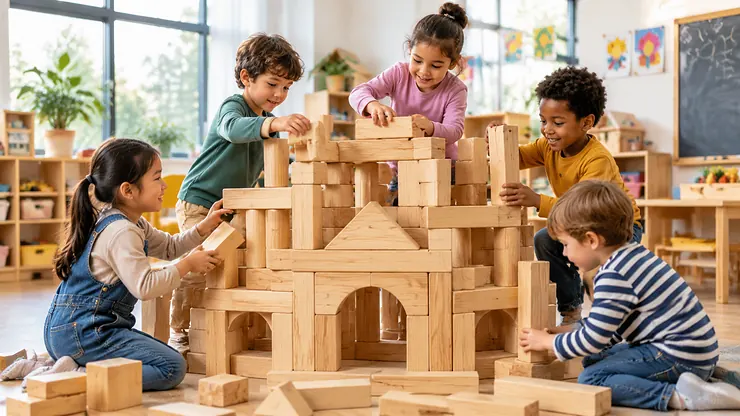
Toddlers don’t build so much as run experiments. Stack, wobble, whack, repeat. That’s why large building blocks for toddlers are the closest thing a playroom has to a lab bench: big enough to grip with a fist, light enough to lift, and forgiving enough to survive a full-body tackle.
But “large” is a slippery word on a box. A set can be oversized and still hide a few pieces that slip into a toddler’s airway. Another can look tough and fold like a lawn chair under a determined two-year-old. This guide compares published specs, retailer listings, and the pattern of buyer feedback across seven real sets. I sorted them by what each does best: cardboard walls for forts, soft cubes for first towers, interlocking bricks for counting, and gears for the five-year-old who has outgrown plain stacking.
Here’s the plan. You get a side-by-side table, seven honest breakdowns, and a plain-English guide to choke-safe block sizes. Then come playbooks for stacking and balancing skills and for blocks for indoor forts. Prices appear as ranges because they move constantly, so check current pricing before you buy.
A word on method: this is synthesis of specs and aggregated buyer feedback, not a claim of lab testing. Where the evidence is thin, I’ll say so.
Quick Comparison: Large Building Blocks for Toddlers at a Glance
| Product | Pieces | Age on Listing | Material | Price Range | Best For |
|---|---|---|---|---|---|
| MEGA BLOKS First Builders Big Building Bag | 80 | 1+ | Plastic | ~$17–$30 | Budget first builders |
| Melissa & Doug Jumbo Extra-Thick Cardboard Building Blocks | 40 | 2+ | Cardboard | ~$35–$50 | Big fort walls |
| Bankers Box At Play Cardboard Building Blocks | 40 | 2–3+ (varies) | Corrugated cardboard | ~$40–$55 | Fast, tall walls |
| LEGO DUPLO Classic Deluxe Brick Box 10914 | 85 | 18 months+ | Plastic | ~$40–$50 | Counting and pretend play |
| ECR4Kids SoftZone Patchwork Toddler Blocks | 12 | 9 months+ | Foam | ~$50–$75 | Soft first stacking |
| Learning Resources Gears! Gears! Gears! Machines in Motion | 116 | 5+ | Plastic | Mid-$40s | Gear-curious older siblings |
| HABA Extra Large Wooden Building Blocks | 102 | Check listing | Wood | Well over $100 | Heirloom, open-ended play |
Read the table by priority, not by piece count. MEGA BLOKS First Builders Big Building Bag wins on price per piece, while the two cardboard sets win on how fast you can wall off a corner of the living room. ECR4Kids SoftZone Patchwork Toddler Blocks costs the most per block, and that premium buys you a gentle landing for first-time stackers. Learning Resources Gears! Gears! Gears! Machines in Motion is the outlier. It’s for the older sibling, not the toddler.
💬 Just one click — help others make better buying decisions too!😊
What Are Large Building Blocks for Toddlers?
Large building blocks for toddlers are oversized stacking pieces, usually foam, plastic, cardboard, or wood. They’re sized for small hands and too big to fit a toddler’s airway. U.S. rules for under-3 toys define that choking line with a test cylinder, so “large” should really mean “fails the cylinder test.”
That definition comes from the Consumer Product Safety Commission’s small parts guidance. It describes a small part as anything that fits entirely inside a cylinder approximating a young child’s fully expanded throat. We’ll unpack the numbers in the section on choke-safe block sizes below.
Four families dominate the category:
- Foam: the softest, quietest, and most forgiving. Cubes are common.
- Interlocking plastic: chunky bricks that click together, so towers get taller and sturdier.
- Cardboard: lightweight bricks that make walls, tunnels, and enclosures fast.
- Wood: heavy, durable, and long-lived, but louder and harder on toes.
No single family is “best.” Each trades off softness, stability, building scale, and cost. The seven picks below cover all four.
Top 7 Large Building Blocks for Toddlers: Expert Analysis
1. MEGA BLOKS First Builders Big Building Bag — best budget starter for first stackers
If you want the lowest-drama entry into large building blocks for toddlers, start here. This 80-piece bag comes in 10 shapes and 9 colors and is labeled for ages 1 and up.
The specs matter more than the marketing. Chunky pieces with plain studs let toddler fingers click and unclick without a wrestling match, and that tug-of-war is where early stacking and balancing skills quietly develop. The included zip bag doubles as a cleanup system, which helps when “tidy up” isn’t yet in anyone’s vocabulary. Based on the spec comparison, this is the set to buy when budget and durability outrank gadgets. The basic shapes are a feature for open-ended play, not a flaw.
Reviewers consistently describe the pieces as easy to grab, stack, and pull apart, and some mention they survive chewing and daily tossing. One review-site roundup warns that the bag itself may not last through years of heavy use.
Pros:
- ✅ Chunky pieces sized for small fists
- ✅ Easy to click together and pull apart
- ✅ Strong piece count for the price
Cons:
- ❌ Basic shapes may bore older preschoolers
- ❌ Storage bag may wear out with heavy use
Typically in the $17–$30 range, which is strong value for 80 pieces.

2. Melissa & Doug Jumbo Extra-Thick Cardboard Building Blocks — the classic brick for fort walls
Cardboard building blocks for making forts don’t get much more recognizable than this 40-piece set. It includes 8 large red bricks (12″ × 6″ × 3″), 8 medium blue (6″ × 6″ × 3″), and 24 small yellow (6″ × 3″ × 3″). The manufacturer says the red blocks hold up to 150 pounds, and the cardboard is FSC-certified with a wipe-clean surface.
What does that mean in practice? Add up the listed lengths and the full set makes roughly 24 feet of single-layer wall. That’s two courses around a 3-by-3-foot den. The bricks fold together from flat, and the brand advises against unfolding them once assembled, so build once and keep them built.
Buyer feedback is split. Many parents report kids happily building towers and knocking them down. Others say the cardboard feels thin, and at least one reviewer was disappointed that 24 of the 40 pieces are the small size.
Pros:
- ✅ Three sizes give variety for walls and towers
- ✅ Lightweight and easy for toddlers to lift
- ✅ Wipe-clean surface for sticky hands
Cons:
- ❌ Some buyers report durability complaints
- ❌ Most pieces are the smallest size
Usually in the $35–$50 range. It’s good value if your priority is fort-scale building and you’ll keep pieces assembled.
3. Bankers Box At Play Cardboard Building Blocks — all medium-to-large bricks for fast walls
This 40-block set skips the small bricks. Listings describe 20 large and 20 medium blocks, in 12″ × 6″ × 3″ and 6″ × 6″ × 3″ sizes. The corrugated board is rated 32-ECT with rounded edges, the set is labeled made in the USA, and it’s rated to hold up to 150 pounds.
With no small bricks diluting the set, walls rise faster. By the same arithmetic, the full set adds up to about 30 feet of single-layer wall. That’s roomy for blocks for indoor forts, and you won’t be hunting for one lost yellow brick under the couch.
Evidence here is thinner. One buyer with a 2- and a 4-year-old reports daily throwing and stomping without failure, and says the blocks make good walls and race tracks. Some retailer pages show few or no reviews yet. Age labels also vary between retailers (2+ or 3+), so confirm the age printed on the box you receive.
Pros:
- ✅ Every block is medium or large
- ✅ Rounded edges suit small hands
- ✅ Made in the USA, per listings
Cons:
- ❌ No small bricks for finer detail
- ❌ Limited review volume and inconsistent age labels
Typically in the $40–$55 range. It’s solid value for fort builders who want bulk over variety.
4. LEGO DUPLO Classic Deluxe Brick Box 10914 — numbered bricks that make counting physical
This 85-piece set is labeled for ages 18 months and up. It includes numbered bricks, a few figures, a car, and a dog, all stored in a green brick-shaped box. LEGO’s own page also mentions an idea booklet with 17 easy models.
Interlocking is the key spec. Unlike loose stacking, studs let a toddler build something that stays standing when bumped, which cuts frustration and extends attention. The numbered bricks turn counting from a recited song into something a child can hold. Add the figures and pretend play follows naturally. It’s a stronger fit than plain blocks for kids who like stories.
Buyers call it a great first set, and they praise the quality and the storage box. The most common gripe is piece count relative to price.
Pros:
- ✅ Numbered bricks introduce early counting
- ✅ Interlocking studs build sturdier structures
- ✅ Storage box doubles as cleanup station
Cons:
- ❌ Some buyers want more pieces for the price
- ❌ Themed pieces nudge toward models over free building
Typically in the $40–$50 range. It’s fair value if you expect to expand the collection.
5. ECR4Kids SoftZone Patchwork Toddler Blocks — softest landing for first towers
Twelve foam cubes, each about 5.5 inches per side, built with CertiPUR-US certified foam. One major retailer lists the set for ages 9 months and up, and the product copy says the lightweight shapes fall safely when knocked over.
Soft cubes change the emotional math of block play. A collapse doesn’t produce a crash or a wail, so the toddler tries again. Foam also grips less than studs, so tall towers lean. That wobble is quietly a lesson in balance, and the cubes are big enough to form low walls for blocks for indoor forts. Each cube is far larger than the cylinder CPSC uses to define a small part, though you should still inspect covers for tears over time.
Ratings across retailer pages are generally high. The honest limitation is cost per block.
Pros:
- ✅ Soft, quiet, and forgiving when towers fall
- ✅ Lightweight enough for toddlers to carry
- ✅ Certified foam and wipe-clean covers
Cons:
- ❌ Highest cost per block on this list
- ❌ Only one shape limits variety
Often listed from the $50s into the $70s. It’s a good value for the youngest builders and daycare-style use.
6. Learning Resources Gears! Gears! Gears! Machines in Motion — gear building toys for 5 year olds, with a hands-on challenge
Strictly speaking this isn’t one of the large building blocks for toddlers, but it belongs in any household where a toddler shares floor space with an older sibling. The 116-piece set is labeled for ages 5 and up. It includes 46 gears, square pillars, six-way axles, interlocking bases, a crank handle, and extras like a propeller and wrecking ball.
Among gear building toys for 5 year olds, the appeal is cause and effect you can see: turn the crank, watch the machine move. An included activity guide provides guided builds before free play. Buyers split on difficulty. One parent said their 5-year-old enjoyed following instructions and inventing their own machines. Another found the picture-only instructions overwhelming, and a third said an adult was needed for an almost-6-year-old.
The label carries a choking-hazard warning for under 3, so this is strictly a toddler-proof-storage set.
Pros:
- ✅ Visible motion teaches cause and effect
- ✅ Compatible with other Gears sets
- ✅ Activity guide plus open-ended building
Cons:
- ❌ Small parts: not for children under 3
- ❌ Some 5-year-olds need adult help
Around the mid-$40s. It’s good value for a curious older child, and poor value if bought for a toddler.
7. HABA Extra Large Wooden Building Blocks — heirloom wood for open-ended building
The 102-piece set is described as made in Germany, open-ended, and aimed at stacking play. Retail listings put it well over $100, making it the premium pick here. The review pool is small, though what’s there is positive.
I couldn’t verify individual block dimensions from the listings I found. Before buying for a child under 3, check the exact sizes against the choke-safe cylinder rule, and confirm the age label. Wood changes the sensory profile: it’s heavy, solid, and satisfying to place. It’s also louder and less forgiving when a tower comes down on bare toes. Think of it as the set you buy once and hand down, with supervision in the early years.
Pros:
- ✅ Durable wood built to outlast toddlerhood
- ✅ Large piece count for ambitious structures
- ✅ Open-ended shapes grow with the child
Cons:
- ❌ Premium price tag
- ❌ Heavy, loud, and rough on toes when towers fall
Typically well north of $100. It’s worth it only if you want a long-lived, multi-child set.
Top 7 Compared: Specs, Price Ranges, and Best For
| Product | Size/Scale | Key Spec | Price Range | Best For |
|---|---|---|---|---|
| MEGA BLOKS First Builders | Chunky studded bricks | 80 pieces, 10 shapes | ~$17–$30 | Tight budgets |
| Melissa & Doug Jumbo Cardboard | Up to 12″ long | Red blocks rated to 150 lb | ~$35–$50 | Fort variety |
| Bankers Box At Play | 12″ and 6″ sizes | 32-ECT board | ~$40–$55 | Fort bulk |
| DUPLO Deluxe Brick Box | Large studded bricks | Numbered bricks 1–5 | ~$40–$50 | Pretend play |
| SoftZone Patchwork | 5.5″ foam cubes | CertiPUR-US foam | ~$50–$75 | Youngest stackers |
| Machines in Motion | Gear pieces | 116 pieces, 5+ | Mid-$40s | Older siblings |
| HABA Extra Large | Large wooden pieces | 102 pieces | Well over $100 | Heirloom use |
The pattern is simple. If you want to build something a child can walk into, pick one of the cardboard sets: Melissa & Doug Jumbo Cardboard for variety or Bankers Box At Play for bulk. If you want a tower that stays up, DUPLO Deluxe Brick Box and MEGA BLOKS First Builders are the sturdier systems. For a child who just wants to knock things down gently, SoftZone Patchwork is the forgiving option. HABA Extra Large is the long-game purchase, and Machines in Motion serves a different age group entirely.
How to Choose Large Building Blocks for Toddlers
Follow these seven steps, in order. Each saves you from a different regret.
- Check the age label first. If your child is under 3, the pieces should be designed for that age group. Don’t buy “ages 3+” sets and hope.
- Match the material to the play style. Throwers do well with foam or cardboard. Builders do better with interlocking bricks.
- Think about scale. Fort-building needs long bricks. Tower-building needs stable, stackable shapes.
- Check weight and tip risk. Heavy wood is great until it lands on a foot. Choose weight you’re comfortable supervising.
- Count pieces against floor space. Eighty bricks sounds generous until you meet your storage shelf.
- Plan for cleaning. Wipe-clean surfaces beat anything porous when snacks are involved.
- Think two years ahead. Sets that combine with others, such as MEGA BLOKS First Builders, extend their useful life.
Choke-Safe Block Sizes: What the Cylinder Test Actually Means
Here’s the number to remember: CPSC’s small parts cylinder is roughly 2.25 inches long by 1.25 inches wide. If a toy, or a piece that could break off it, fits entirely inside that cylinder without being compressed, it’s a small part. Under federal rules, toys intended for children under 3 can’t be sold with small parts.
For older-child toys that contain small parts, the rule changes to labeling. CPSC’s labeling requirements say these products must carry a warning that they aren’t for children under 3. That’s why Machines in Motion carries a choking-hazard notice while MEGA BLOKS First Builders is labeled for age 1 and up.
Three practical habits matter more than the math:
- Respect the age label. The label is the manufacturer’s statement about which rule applies.
- Inspect for breakage. A cracked foam cube or a chewed corner can produce pieces smaller than the original.
- Separate households of toys. Older siblings’ sets with tiny parts need their own shelf, out of toddler reach.
Choke-safe block sizes aren’t about one magic dimension. They’re about the whole system: an under-3 design, intact pieces, and sensible storage.
Stacking and Balancing Skills: What Blocks Actually Teach
Block play is physics with a smile. When a toddler lifts a block, aligns it, and lets go, they’re running small experiments in gravity and balance. The American Academy of Pediatrics notes that when babies and toddlers handle objects, they act like little scientists, testing properties and checking results. That’s the pediatric case for object play.
Commonly described timelines suggest toddlers manage a stack of a few blocks around 16 to 18 months, with taller towers emerging a few months later. Treat these as rough guides, since kids vary.
Different materials develop stacking and balancing skills in different ways:
- Studded bricks (DUPLO Deluxe Brick Box, MEGA BLOKS First Builders) reward precision. The brick either clicks or it doesn’t.
- Foam cubes (SoftZone Patchwork) reward patience. Tall towers lean, so the child adjusts.
- Cardboard bricks reward planning. Long pieces invite bridges and walls.
Set up on a firm, level surface. A rug works for foam, but wobbly carpet can sabotage a tower, and then the toddler learns the wrong lesson about why it fell.
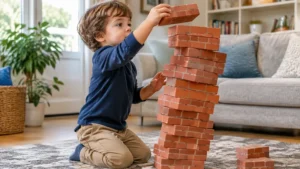
Cardboard Building Blocks for Making Forts: A Practical Guide
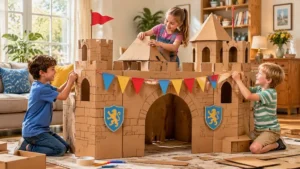
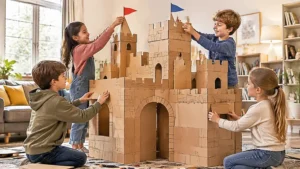
Cardboard building blocks for making forts turn “the floor is lava” into architecture. Here’s the playbook.
Assemble once, assemble well. Fold each brick along its creases and keep it folded. The Melissa & Doug brand explicitly advises against unfolding assembled bricks.
Use a brick-bond pattern. Stagger the seams between layers, like real masonry. A running-bond wall resists toppling far better than stacked columns.
Keep walls low. For toddlers, a wall at knee-to-waist height is plenty. Taller walls become a topple hazard, and a toddler can pull the whole thing down.
Leave a doorway. A fort without an exit invites frustration. Leave a gap at least wide enough for a child to crawl through.
Do the length math. For Melissa & Doug Jumbo Cardboard, the whole set makes about 24 feet of single-layer wall. Bankers Box At Play adds up to about 30 feet. Either is enough for a 3-by-3-foot den with two courses.
Treat load ratings as ceilings, not invitations. The 150-pound rating is a durability claim. Don’t let kids climb a stack of bricks, and keep adult supervision active.
✨ Don’t Miss These Exclusive Deals!
🔍 Take your fort-building to the next level with these carefully selected products. Click on any highlighted item to check current pricing and availability. These sets will help you create the cozy dens your family will love!
Blocks for Indoor Forts: Real-World Scenarios
Three households, three sensible answers.
The small-apartment family (one 2-year-old, rainy-day budget). Floor space is limited, so the plan is a corner den: Bankers Box At Play walls plus SoftZone Patchwork cubes as soft seating. Use the set a few times a week. Because every block is medium or large, the walls go up fast and come down fast, which suits short attention spans.
The mixed-age household (a 2-year-old and a 5-year-old). Here you need two zones. Give the toddler MEGA BLOKS First Builders and give the older child Machines in Motion, stored high. Let the 5-year-old use large blocks as scenery for a machine “factory,” so the collections cooperate without the small gear parts migrating toward the baby.
The grandparents’ house (visits twice a month). Choose a set that stores compactly and wipes clean. Melissa & Doug Jumbo Cardboard folds into a stackable pile of bricks, and a wipe-down handles the usual jam-hands. Keep it in a closet and bring it out for a ritual “fort day.”
In all three cases, the best blocks for indoor forts are the ones that match the room, the child’s age, and the cleanup tolerance of the adults.
Gear Building Toys for 5 Year Olds: When Blocks Aren’t Enough
By five, many kids want things to move. Gear building toys for 5 year olds answer that with visible mechanics: turn a crank, watch a chain of gears respond. Machines in Motion pairs 116 pieces with an activity guide for guided builds, then invites free design.
Three honest points from the buyer feedback:
- Instructions can overwhelm. Picture-only pages pack a lot onto one spread. Plan on sitting down together for the first build.
- Challenge scales upward. One reviewer described the set as challenging at the labeled age, which means it keeps older kids engaged too.
- Expandability matters. The pieces work with other Gears sets, including the Learning Resources Gears! Gears! Gears! Beginner’s Building Set, labeled for ages 3 and up.
For households with a toddler, the rule is simple: gear sets are for the older child, stored out of the toddler’s reach, and cleaned up after every session. The small-part warning is not decoration.
Large Blocks vs Traditional Alternatives
| Type | Choke Margin for Under-3s | Noise | Fort-Building | Best For |
|---|---|---|---|---|
| Large foam (SoftZone Patchwork) | High (very large cubes) | Quiet | Low walls | Youngest stackers |
| Large plastic bricks (MEGA BLOKS First Builders, DUPLO Deluxe Brick Box) | High when labeled for age 1–2+ | Medium | Moderate | Towers and pretend play |
| Large cardboard (Bankers Box At Play, Melissa & Doug Jumbo Cardboard) | High | Quiet | Excellent | Dens and walls |
| Large wood (HABA Extra Large) | Verify sizes | Loud | Good | Heirloom building |
| Small bricks and gear sets (Machines in Motion) | Low, ages 3+ only | Medium | Poor | Older children |
The table shows why “bigger” is the sensible default for under-3s: oversized pieces keep the choking margin wide. Cardboard wins on fort-building, foam on gentleness, and plastic on structural stability. Small-piece sets like Machines in Motion play a different game and belong on a separate shelf.
Problem → Solution Guide: Common Block Headaches
Problem: The tower keeps collapsing. Move to a firm surface, then try studded bricks like DUPLO Deluxe Brick Box to give the child a win. Foam works too, since a collapse costs nothing.
Problem: Everything goes in the mouth. Stick to sets labeled for the child’s age, and inspect pieces regularly. Replace anything cracked.
Problem: Cardboard bricks are crumpling. Assemble once, don’t unfold, and keep them dry. If durability remains a worry after reading buyer feedback, check the return policy before opening.
Problem: The older sibling’s pieces keep appearing. Use a two-zone storage system: toddler-safe on the floor, “over 3 only” up high. Label bins so that the rule is clear to everyone.
Problem: A child refuses to play with blocks. Offer variety. Children progress through block-play stages at different speeds, and a stage-by-stage overview of block play suggests following the child’s lead, inviting building on a firm, level surface, and letting them knock things down.
Long-Term Cost and Maintenance
Cost per piece reveals value better than sticker price. Using the price ranges above, here’s the rough math:
- MEGA BLOKS First Builders: roughly 20–40 cents per piece
- DUPLO Deluxe Brick Box: roughly 45–60 cents per piece
- Machines in Motion: roughly 40 cents per piece
- Melissa & Doug Jumbo Cardboard: roughly $0.90–$1.25 per block
- Bankers Box At Play: roughly $1.00–$1.40 per block
- HABA Extra Large: roughly $1.25 or more per piece
- SoftZone Patchwork: roughly $4–$6 per block
Per-piece cost isn’t the whole story. Cardboard bricks are larger per unit, so they’re doing different work than a plastic stud. And a durable set that survives two siblings is cheaper than one that dies in a year.
Maintenance is simple. Wipe cardboard and foam with a damp cloth, and don’t soak either. Wash plastic bricks in mild soap and let them air dry. Store cardboard flat and dry. Prices vary, so check current pricing at the time of purchase.

FAQ: Large Building Blocks for Toddlers
❓ What size blocks are safest for a 2 year old?
❓ Are cardboard building blocks good for toddlers?
❓ Can a toddler and a 5-year-old share building toys?
❓ How many large blocks does a toddler need?
❓ Do foam blocks work for indoor forts?
Conclusion
There’s no single winner, and that’s good news. For most families, MEGA BLOKS First Builders Big Building Bag is the safest first purchase: affordable, age-1-ready, and easy for small hands. If forts are the mission, Melissa & Doug Jumbo Cardboard brings variety and Bankers Box At Play brings bulk. DUPLO Deluxe Brick Box fits kids who like counting and stories, SoftZone Patchwork suits the youngest stackers, and HABA Extra Large suits families playing the long game.
For the older child in the house, Machines in Motion adds a different kind of challenge, as long as the small parts stay out of toddler reach. Keep the cylinder rule in mind, respect the age label, and build up your collection one set at a time. Prices and availability change often, so check current listings before you decide.
Recommended for You
- 37 Key Keyboard Vs Full Size Keyboard For Kids: 7 Best Picks 2026
- Ukulele For Kids Who Are Beginners: 7 Smart Picks To Buy In 2026
- Xylophone For Toddlers: 7 Best Picks That Stay In Tune (2026)
Disclaimer: This article contains affiliate links. As an Amazon Associate, I earn from qualifying purchases. If you purchase products through these links, we may earn a small commission at no additional cost to you.
✨ Found this helpful? Share it with your friends! 💬🤗
