
In This Article
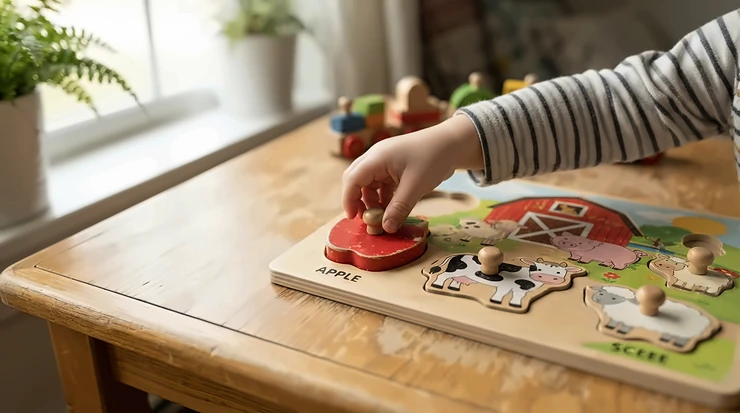
A two-year-old does not “play” with a puzzle so much as put it through a stress test. Pieces get chewed, flung across the room, sat on, and occasionally “washed” in the dog’s water bowl. So the wooden puzzles vs cardboard puzzles for 2 year olds debate isn’t about which one looks prettier on a shelf. It’s about which one is still intact on Thursday.
Here’s the short answer. For the true two-year-old stage, wood is the safer bet for tabletop puzzles with knobs or chunky stand-up pieces. Thick cardboard earns its place a little later, mostly in jumbo floor puzzles, which brands typically label for ages 3 and up. That label matters, and we’ll come back to it.
A quick note on method. This guide is built from published specs, retailer listings, and the aggregated reviewer sentiment I could verify at the time of research. It is not built from a toy lab in my garage, and I won’t pretend otherwise. Where a review pool was thin, I’ll say so instead of padding it.
The sequence itself is well established. University of Illinois early learning resources describe knobbed puzzles for older infants and young toddlers. Tray puzzles come next, and jigsaws arrive as skills grow. That ladder is the spine of this article.
You’ll find seven real products, three tables, and a roadmap from the first knob puzzle to a big-kid floor jigsaw. Prices appear as ranges because they move constantly.
Quick Comparison: 7 Puzzles at a Glance
| Puzzle | Material | Pieces | Age Label | Price Range | Best For |
|---|---|---|---|---|---|
| Melissa & Doug Jumbo Knob Puzzle 2-Pack | Solid wood | 8 + 5 | 12 months–2 years | $25–$35 | First puzzles |
| Melissa & Doug Farm Animals Chunky Puzzle | Wood | 8 stand-up | Toddler (check listing) | Roughly $10–$20 | Pincer-grasp beginners |
| GRINNNIE 6-Pack Peg Puzzles | Wood | 6 puzzles | Toddler (check listing) | Check current price | Variety on a budget |
| Melissa & Doug Dinosaur Dawn Jumbo Floor Puzzle | Thick cardboard | 24 | 3+ | Mid-teens | Growing into floor play |
| Melissa & Doug Underwater Ocean Floor Puzzle | Thick cardboard | 48 | 3+ | Teens to low $20s | Stretching a 3-year-old |
| NASHRIO Wooden Jigsaw 4-Pack | Wood | 4 × 20 | Check listing | Roughly $15–$25 | Peg-to-jigsaw bridge |
| Crocodile Creek Above + Below | Cardboard | 48 | 4–8 | Check current price | Larger-format jigsaws at 4 |
Read the table by age, not by price. The three wooden picks at the top suit a two-year-old right now. The two Melissa & Doug floor puzzles are “grow into it” purchases, since both carry a 3+ label. The NASHRIO Wooden Jigsaw 4-Pack and Crocodile Creek Above + Below sit further along the path. If your toddler is a true two, start at the top and work down.
💬 Just one click — help others make better buying decisions too!😊
Top 7 Puzzles Compared: Wooden Puzzles vs Cardboard Puzzles for 2 Year Olds
1. Melissa & Doug Jumbo Knob Puzzle 2-Pack — fattest, friendliest first puzzle
The standout here is the grip. Each piece wears an oversized wooden knob that a clumsy fist can actually hold.
The set pairs the barn-shaped Large Farm (8 pieces) with the house-shaped First Shapes (5 pieces). Retailers describe the pieces as extra-thick and the board as a solid, chunky slab. In practice, a thick lift-out piece drops into its cutout and stays put, so a beginner gets feedback without a frustrating wobble. Both puzzles show a matching picture underneath, which turns trial and error into a built-in answer key.
My take, based on the specs: this is the cleanest answer to the question of wooden puzzles vs cardboard puzzles for 2 year olds at the youngest end. Few pieces keep the win rate high. The shaped boards add a gentle visual hint, and the knobs sidestep the pincer grasp most toddlers haven’t mastered yet. Expect it to last through a younger sibling too.
I couldn’t verify a large review sample for this exact two-pack. Shopper comments on related Melissa & Doug knob and chunky puzzles, though, repeatedly describe them as sturdy first puzzles. Treat that as directional, not gospel.
Pros:
- ✅ Oversized knobs suit beginner grips
- ✅ Few pieces mean quick early wins
- ✅ Picture under each piece guides matching
Cons:
- ❌ Outgrown quickly by confident toddlers
- ❌ Age label tops out around 2 years
Expect the Jumbo Knob Puzzle 2-Pack in the $25–$35 range. It’s good value if you’ll get a year of use and a hand-me-down.
2. Melissa & Doug Farm Animals Chunky Puzzle — stand-up pieces for tiny grips
The hook is that there’s no knob at all. Each of the eight animals stands on its own, so a toddler can grab the whole body.
The board measures about 12 by 9 inches, and a review roundup notes FSC-certified materials and full-color pictures underneath. Stand-up pieces matter because they skip the controlled pincer grasp entirely. Roundups that rank toddler puzzles single out this format as the one to hand a brand-new solver. A chunky animal also doubles as a pretend-play figure once the puzzle gets boring.
Here’s what the spec sheet won’t tell you, though reviewers hint at it. Chunky stand-ups teach shape matching through silhouette, not through a knob, so they’re slightly more abstract. A child who loves animals will push through that extra step happily. A child who doesn’t may drift off.
Review sentiment on sibling chunky sets in this line is encouraging. One shopper reported dozens of these in their home and called them durable for two destructive boys. Another noted that two-year-olds who were used to jumbo knobs found the chunky format a fresh challenge.
Pros:
- ✅ No fine pincer grasp required
- ✅ Pieces double as pretend-play toys
- ✅ Full-color picture under each animal
Cons:
- ❌ Silhouette matching is more abstract
- ❌ Eight pieces suit a narrow age window
Price: roughly $10–$20, so check the current listing. A very good middle step between pure knobs and tray puzzles.
3. GRINNNIE 6-Pack Peg Puzzles — six themes in one budget box
The standout is the variety. Six different peg puzzles means a toddler can repeat the same skill with fresh pictures.
A product roundup names this multipack as its best wooden peg set and notes ASTM-tested wood. That ASTM mention is a useful signal, since it points to toy-safety testing rather than a vague “non-toxic” claim. Peg handles on small puzzles train the same grasp as knobs, only scaled down for tiny tabletops.
The honest analysis: this is the pick for families who want to rotate puzzles to keep novelty high. Two-year-olds love repetition, but they also love “new,” and six boards in a set feed both. The catch is that individual boards are thinner and lighter than the heavy slabs in pick one, so they slide around a bit more on a slick table.
I couldn’t verify an independent pool of customer reviews for this set, so I won’t characterize reviewer sentiment. If you buy it, inspect the pegs on arrival and tug each one before the first play session.
Pros:
- ✅ Six themes extend replay value
- ✅ ASTM-tested wood noted in roundup
- ✅ Works as a rotation set
Cons:
- ❌ Lighter boards shift on smooth tables
- ❌ Fewer verified reviews available
Price: multipacks like this commonly sit in the $20s. Verify before buying. A smart value pick if your toddler already shows puzzle interest.
4. Melissa & Doug Dinosaur Dawn Jumbo Floor Puzzle — 24 pieces, floor-sized triumph
The hook is the size. Finished, it spans two by three feet, so your toddler works on the floor with their whole body.
It uses 24 extra-thick cardboard pieces, and the brand labels it 3+. Review roundups suggest the sweet spot is roughly 2.5 to 4 years old and praise the cardboard thickness. Here cardboard’s biggest weakness (flimsiness) is partly neutralized by sheer thickness. Thick board resists bending and fraying better than thin boxed jigsaws.
My take: this is the right first cardboard puzzle if your two-and-a-half-year-old has already conquered knob and chunky puzzles. A dinosaur theme gives a reason to keep going, since children can name what they’re building. Do the edge pieces together first, because spatial strategy is the real lesson at this stage.
Reviewer commentary I could verify is mostly roundup-level praise for the thick pieces and the age fit. I couldn’t confirm a large independent review count for this exact title.
Pros:
- ✅ Extra-thick pieces resist bending
- ✅ Floor format suits whole-body play
- ✅ Dinosaur theme sparks naming and talk
Cons:
- ❌ Labeled 3+, so not ideal for a young two
- ❌ Cardboard still absorbs drool and spills
Price: mid-teens at the time of research. Strong value for an eventual floor-puzzle upgrade.
5. Melissa & Doug Underwater Ocean Floor Puzzle — 48 pieces for a bolder challenge
This one’s hook is the wow factor. Forty-eight pieces of sea life stretch across a two-by-three-foot floor.
It’s a jumbo cardboard puzzle labeled 3+, with FSC-certified materials. Review roundups crown it their top overall jumbo pick and cite a high average rating across a large review base, though I’d treat that figure as a reported number, not a verified one. The picture is busy, which makes it easier to find clues but harder to sort by color alone.
The analysis: at 48 pieces, this is a stretch for a pure two-year-old, however bright. It becomes ideal when a three-year-old wants the “big kid” thing. Adults can help by sorting edges and one color family before the child begins. It’s also a good example of cardboard’s honest limit. Thick board lasts, but spilled juice and enthusiastic chewing still shorten its life compared with wood.
Reviewers broadly report that it holds up for repeated play, per the roundups. Nobody should expect an indestructible puzzle, though.
Pros:
- ✅ Thick, heavy-duty pieces
- ✅ Vivid, easy-to-name sea animals
- ✅ Large format for hands-on floor play
Cons:
- ❌ 48 pieces overwhelm most true two-year-olds
- ❌ Cardboard won’t survive repeated drool
Price: teens to low $20s. Best bought for a child who’s already comfortable with 24 pieces.
6. NASHRIO Wooden Jigsaw 4-Pack — four 20-piece wood jigsaws with a tray
The standout is the bridge it builds. Wooden jigsaws arrive at a piece count a preschooler can actually handle.
Roundups describe four 20-piece puzzles, a storage tray, and smooth rounded edges, which matter for little fingers. Wood keeps the durability advantage while the interlocking format begins the real jigsaw skill. Multiple puzzles in one tray mean pieces from one picture can be kept apart, assuming everyone cooperates.
The analysis: a lot of parents search for wooden jigsaw alternatives precisely because cardboard interlocks fade after repeated play. A review roundup of toddler wooden puzzles mentions parents looking for a 20 to 25 piece wooden jigsaw for a 3 to 4 year old for that reason. This set sits right in that target. Check the listing’s age recommendation before treating it as a two-year-old puzzle, because 20 interlocking pieces is a lot for most twos.
Customer review depth wasn’t verifiable to me, so I’ll keep the sentiment claims off the page.
Pros:
- ✅ Four puzzles, each with 20 pieces
- ✅ Rounded edges and storage tray
- ✅ Wood resists drool and bending
Cons:
- ❌ Too advanced for most 2-year-olds
- ❌ Pieces from four puzzles can mix
Price: roughly $15–$25. Excellent value for the ages 3–4 transition.
7. Crocodile Creek Above + Below — shaped-box floor jigsaw for ages 4 and up
The hook is the packaging. The heavy-duty shaped box doubles as storage and keeps pieces together.
It’s a 48-piece cardboard floor jigsaw, about 18 by 24 inches finished, labeled for ages 4 to 8. Compared with the two-by-three-foot giants above, it’s smaller and more portable, so it suits a table or a smaller rug. A “things that go” theme gives sorting clues by environment, with above-ground vehicles and underwater ones in the same picture.
My take: this is the “four-year-old with a bit of help” puzzle. At that age, roundup guidance puts comfortable ranges at about 50 to 100 pieces for kids 4 to 6. A 48-piece puzzle sits at the gentle start of that range.
Reviewer commentary I could find was warm but sparse. A grandparent reviewer reported that their granddaughter loved it. That’s a pleasant data point, though it’s one voice, not a trend.
Pros:
- ✅ Sturdy shaped storage box
- ✅ Theme helps sort by environment
- ✅ Manageable size for tables or floors
Cons:
- ❌ Too hard for a young two
- ❌ Sparse review data to lean on
Price: check current price. A smart “someday” buy for a child who’ll turn four next year.
✨ Don’t Miss These Exclusive Deals!
🔍 Take your toddler’s puzzle shelf to the next level with these carefully selected products. Click on any highlighted item to check current pricing and availability. These picks will help you build confident, patient little puzzle-solvers your whole family will love!
What Are Wooden Puzzles vs Cardboard Puzzles for 2 Year Olds?
Wooden puzzles for two-year-olds are solid, thick-board puzzles, usually with knobs, pegs, or chunky stand-up pieces made for small hands. Cardboard puzzles are printed paperboard jigsaws, ranging from thin boxed sets to extra-thick floor puzzles. For two-year-olds, wood is generally more durable and easier to grip. Cardboard becomes practical in jumbo form.
That’s the snippet-friendly version. The practical version is a bit more nuanced. A wooden knob puzzle trains a grasp and a matching skill, and it doesn’t ask for anything else. A cardboard jigsaw asks for interlocking, orientation, and patience all at once.
In other words, they’re not rivals so much as different rungs on a ladder. The real question is which rung your toddler is standing on today. A child of 24 months and a child of 34 months live in very different puzzle worlds.

How to Choose Wooden Puzzles vs Cardboard Puzzles for 2 Year Olds
Use these steps in order. They carry the most weight at the checkout screen.
- Match the piece count to the child, not the box. For ages 1 to 2, roundups recommend chunky pieces with large knobs, usually fewer than 10 pieces. Under-fives tend to do best with chunky wooden pieces or jigsaws under about 20 pieces.
- Read the age label as a safety signal. Under US rules, toys intended for children under 3 can’t contain small parts. Toys labeled 3+ may, which is why a floor puzzle’s age label deserves respect. The CPSC small parts guidance explains the rule in plain language.
- Test the grip. A knob should be roughly big enough for a full-fist grasp, and a review guide suggests at least three-quarters of an inch across, screw-in, not glued.
- Check the finish and certifications. Look for non-toxic paint and toy-safety testing notes, and avoid anything with flaking color.
- Inspect the picture-under-piece feature. It turns a puzzle from a guessing game into a self-correcting lesson.
- Plan the next rung. Buy a puzzle that fits today and one that stretches slightly, because that small stretch keeps children engaged without overwhelming them.
- Think about cleanup. Wood wipes clean. Cardboard soaks up whatever touches it.
Wooden Puzzles vs Cardboard Puzzles for 2 Year Olds: The Head-to-Head Breakdown
| Factor | Wooden Puzzles | Cardboard Puzzles | Best For |
|---|---|---|---|
| Piece thickness | Thick slabs, knobs, or stand-ups | Thin boxed to extra-thick floor | Wood for age 2 |
| Wet and chew resistance | Wipes clean, survives drool | Swells, frays, delaminates | Wood |
| Piece count | Typically 5–12 | Typically 24–60 | Wood for beginners, cardboard for later |
| Size | Tabletop | Floor-sized | Cardboard for space |
| Age fit | 1–3 years | 3+ typically | Match to child |
| Longevity | Handed down | Frays after heavy use | Wood |
The table makes the trade-off visible. Wood wins on resilience, grip, and the youngest ages. Cardboard wins on scale and piece variety, which is why it dominates the floor-puzzle category. In short, wood fits the early rungs and thick cardboard fits the ones that follow.
Notice how the “Best For” column flips as the child grows. That flip is the whole story. Parents who treat the question as wood versus cardboard, as if there’s one winner, tend to buy the wrong puzzle at the wrong age.
One honest caution on the wood side: not all wood is equal. Thin plywood puzzles can chip, and glued knobs can loosen. Cardboard’s biggest weakness is moisture and teeth. Thick jumbo board mitigates both, but it can’t eliminate them.
Puzzle Durability for Toddlers: What Actually Survives
Puzzle durability for toddlers comes down to three enemies: moisture, mouths, and mechanical stress. Wood handles the first two well. It tolerates a wipe-down, and it doesn’t swell into pulp.
Cardboard starts to fail at the edges. Corners fray, the printed top layer peels, and pieces lose their snap-fit. That’s why parents looking at 3 to 4 year old puzzles sometimes search for wooden alternatives after thin cardboard sets fall apart mid-build.
Durability isn’t only about longevity, either. It’s also a safety issue. A cracked toy can become a choking hazard when a fragment fits inside the small parts cylinder, which is the test used to identify dangerous pieces. A review of recalled children’s products published in a peer-reviewed journal found hundreds of choking-hazard recalls over a twelve-year span, and it notes that parents often can’t detect these hazards by eye.
So build a durability habit. Every few weeks, run your fingers along the edges of each puzzle. Check for splinters in wood, and for peeling layers in cardboard. If a piece cracks, retire it. Puzzle durability for toddlers is a maintenance routine, not a purchase decision.
Chunky Knob Puzzle Pieces: What Actually Matters
Chunky knob puzzle pieces look simple, but small details separate great ones from forgettable ones.
First, the knob itself. A review guide recommends a peg at least three-quarters of an inch across, and it favors screw-in knobs over glued ones. A glued knob is the first thing to pop off under toddler torque.
Second, piece thickness. Retailer descriptions of the Melissa & Doug jumbo line cite half-inch-thick pieces, and that heft helps pieces drop into place with a satisfying thunk. That sound is feedback. Toddlers love a sound that says “yes.”
Third, the cutout depth. A deep recess holds the piece in position, so the child doesn’t have to hover precisely. Shallow recesses frustrate beginners.
Finally, think about whether you even need a knob. Stand-up chunky puzzles skip the handle, which suits children who can’t yet manage a controlled pincer grasp. In other words, chunky knob puzzle pieces are a stepping stone, not a destination. They exist to carry a child from fist-grab to finger-pinch, and the best ones disappear from the shelf at about the right time.
Floor Puzzles for Toddlers: When Cardboard Earns Its Keep
Floor puzzles for toddlers are the one corner of this debate where cardboard is the right material. Their pieces are thick, chunky, and sized to be gripped by small hands, and the finished picture spreads across a rug.
Roundups note that most toddlers can handle simple floor puzzles from around 18 months, but the products in this guide are labeled 3+, so treat the earlier figure cautiously and follow the box. Floor puzzles also add a motor-skill bonus. Large-format puzzles engage bigger muscles, so children crawl, reach, and kneel as they build.
The practical advice is simple. Start with 24 pieces, as in the Dinosaur Dawn Jumbo Floor Puzzle. Move to 48 pieces, as in the Underwater Ocean Floor Puzzle, only when 24 feels easy. A review guide from a parenting site agrees that toddlers thrive on challenges they can conquer, not on the biggest puzzle in the aisle.
Place the puzzle on a rug or foam mat to stop pieces sliding, and keep drinks off the floor. Floor puzzles for toddlers reward patience and space. Give them both.
Progression from Peg Puzzles to Jigsaws: A Step-by-Step Guide
This is where the article earns its transformation value. Here’s a practical roadmap for the progression from peg puzzles to jigsaws, built from the published age guidance.
| Stage | Typical Age | Puzzle Type | Piece Count | Skill Built |
|---|---|---|---|---|
| 1 | 12–24 months | Jumbo knob | 5–8 | Grasp, matching |
| 2 | 2–3 years | Chunky stand-up, small peg sets | 6–12 | Silhouette matching |
| 3 | 3 years | Chunky interlocking jigsaw | 20–25 | Interlocking, edges |
| 4 | 3–4 years | Jumbo floor puzzle | 24–48 | Spatial planning |
| 5 | 4–6 years | Larger jigsaws | 48–100 | Strategy, patience |
Every child moves at their own pace, so treat these ages as signposts. If your toddler is nailing one stage in a few minutes, step forward. If they melt down, step back.
A few ways to make each step easier:
- Sit beside them for the first three attempts. Model, don’t take over.
- Turn pieces right-way-up before handing them over. Orientation is a separate skill.
- Celebrate edge pieces. They’re the first strategy a child can learn.
- Repeat puzzles. Toddlers love doing the same one again, and repetition builds memory.
Notice that the progression from peg puzzles to jigsaws is a change in the type of thinking, not only in piece count. Pegs teach “this goes here.” Interlocking jigsaws teach “this goes here, and only this way.” That second idea is the leap.
Research out of the University of Chicago has linked puzzle play between ages 2 and 4 with stronger spatial skills, which is a good reason to take this ladder seriously.
Large Piece Jigsaw Puzzles for 4 Year Olds: What to Look For
Large piece jigsaw puzzles for 4 year olds sit at a lovely transition point. The child has outgrown knobs, but a 200-piece box would be a tantrum waiting to happen.
Guidance in toy roundups puts kids aged 4 to 6 at about 50 to 100 pieces, with big, easy-to-grip pieces. That’s why Crocodile Creek Above + Below, at 48 pieces and a 4–8 age label, lands in a sensible spot.
Here’s what to check:
- Piece size and thickness. Bigger pieces tolerate clumsy hands and frustration.
- Picture clarity. Distinct color zones help a child sort before they try to fit.
- Shape variety. A review roundup noted that shaped floor puzzles, like the Busy Barn Shaped Floor Puzzle, frustrate younger children and work best around 3.5 and up.
- Storage. A box that closes keeps pieces together, which matters more than people expect.
Large piece jigsaw puzzles for 4 year olds can be wood or cardboard. At this age, a four-year-old is far less likely to chew the pieces, so cardboard’s weakness matters less. A wooden option like the NASHRIO Wooden Jigsaw 4-Pack still wins on longevity if you’ll hand puzzles down to a younger sibling.
Real-World Scenarios: Matching Puzzles to Your Child
These are illustrative profiles, not testimonials. They show how the reasoning plays out.
Scenario 1: The 20-month-old who loves banging things. The budget is modest, the environment is a small apartment, and play happens daily. Pick the Jumbo Knob Puzzle 2-Pack. Heavy wooden boards survive the banging, and few pieces keep the early success rate high.
Scenario 2: The 28-month-old with a puzzle habit and a baby sibling. The family wants durability and variety. Start with the Farm Animals Chunky Puzzle, add the GRINNNIE 6-Pack Peg Puzzles for rotation, and hold the Dinosaur Dawn Jumbo Floor Puzzle until the child is closer to three. Wood survives the baby’s drooling stage too.
Scenario 3: The 3-year-old who finishes everything in minutes. The child needs a stretch. The Underwater Ocean Floor Puzzle offers 48 pieces and a floor-sized payoff, while the NASHRIO Wooden Jigsaw 4-Pack offers interlocking practice on a tabletop. Use both, alternating days.
In every scenario, the logic is the same. Buy for today’s skill, and keep one eye on the next rung.
Common Mistakes When Buying Toddler Puzzles
Buying by piece count alone. A 24-piece puzzle for a child who needs six is a recipe for abandonment. Match the count to demonstrated skill.
Ignoring the age label. Brands label products for a reason, and for under-3 products the label connects to federal small-parts rules. A 3+ puzzle may be a fine purchase, but it isn’t a toy to leave a two-year-old alone with.
Assuming cardboard means cheap and wood means premium. Thick floor puzzles are well made, and thin plywood puzzles can be flimsy. Judge the build, not the material label.
Skipping the inspection routine. Damaged pieces become hazards. Check edges regularly.
Buying one giant puzzle instead of several small ones. Toddlers get more from repeated wins on easy puzzles than from a single hard one. A multipack often beats a big-ticket item.
Forgetting the next rung. The best puzzle collections create a ladder. Plan a sequence, not a pile.
Long-Term Cost: Is Wood Worth the Higher Price?
| Option | Price Range | Typical Role | Value Verdict |
|---|---|---|---|
| Jumbo Knob Puzzle 2-Pack | $25–$35 | First puzzles | High, because it can be handed down |
| Farm Animals Chunky Puzzle | Roughly $10–$20 | Early matching | High |
| Dinosaur Dawn Jumbo Floor Puzzle | Mid-teens | Floor play | Good, with moisture caveats |
| NASHRIO Wooden Jigsaw 4-Pack | Roughly $15–$25 | Jigsaw bridge | High, with four puzzles |
Cost per use is the clearest lens. A wooden puzzle costs more up front, but if it survives two children, its cost per child halves. A cardboard puzzle costs less, but a spilled cup of juice can end its life early.
Based on the spec comparison, the smart move is mixed. Buy wooden puzzles for the ages when chewing and throwing peak, then add cardboard floor puzzles once drooling fades. That approach uses each material where it’s strongest. Total cost of ownership also includes replacement, so a puzzle that falls apart in months isn’t really the cheap option.
Safety Guide: Small Parts, Labels, and Everyday Checks
Safety sits underneath every choice here. US regulations ban toys intended for children under 3 from containing small parts, and the CPSC small parts FAQ explains how the size rules and testing work. The CPSC also notes that children under 3 are the age group most prone to mouthing objects.
Three practical habits help:
- Read the age label and the warning label. A “choking hazard, small parts, not for children under 3” warning on a 3+ puzzle means exactly what it says.
- Separate old and young toys. Keep older siblings’ puzzles in a higher or latched container.
- Retire damaged pieces. A cracked or chewed piece may fit inside the small parts cylinder.
None of this means wood is risk-free or cardboard is dangerous. It means supervision and inspection matter more than material. A thoughtful routine does more for safety than any marketing claim.
FAQ
❓ How many pieces should a puzzle for a 2 year old have?
❓ Can a 2 year old use a cardboard floor puzzle?
❓ Are wooden puzzles worth the extra cost for toddlers?
❓ How many pieces suit large piece jigsaw puzzles for 4 year olds?
❓ When should a child move from peg puzzles to jigsaws?
Conclusion
So, what’s the verdict on wooden puzzles vs cardboard puzzles for 2 year olds? Wood wins the early rounds. It’s sturdy, grippable, wipeable, and sized for hands that are still figuring out how pinching works. Thick cardboard wins later, when floor puzzles turn the living room rug into a construction site for 24 or 48 pieces.
If you want a starting trio, I’d begin with the Jumbo Knob Puzzle 2-Pack for the first rung and the Farm Animals Chunky Puzzle for the second. The NASHRIO Wooden Jigsaw 4-Pack bridges toward real jigsaws, and the Dinosaur Dawn Jumbo Floor Puzzle is the natural floor-puzzle debut once your toddler nears three. The GRINNNIE 6-Pack Peg Puzzles are a budget-friendly way to rotate novelty.
Remember that this is a ladder, not a contest. Buy for the skill your child has today, watch for boredom, and add the next rung before frustration sets in. A little supervision, a little inspection, and a lot of repetition will do more than any single product.
Recommended for You
- Speed Cubes For Beginners: 7 Best Picks, No Regrets (2026)
- Coding Robot Vs Robotics Kit For 7 Year Olds: 7 Top Picks 2026
- STEM Kits For 8 Year Olds: 7 Smart, Safe Picks For 2026
Disclaimer: This article contains affiliate links. As an Amazon Associate, I earn from qualifying purchases. If you purchase products through these links, we may earn a small commission at no additional cost to you.
✨ Found this helpful? Share it with your friends! 💬🤗
