
In This Article
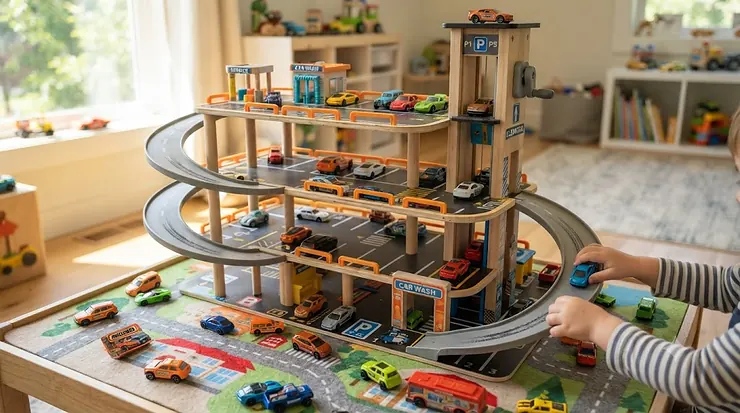
If you’ve ever stepped on a stray Hot Wheels car at 6 a.m., you already understand the appeal of a multi level car garage toy. It’s not just a toy — it’s crowd control for 40 tiny vehicles that otherwise colonize every corner of your living room. A multi level car garage toy is a stackable, ramp-and-elevator playset that stores, displays, and animates a child’s diecast or plastic car collection across two or more floors, often with a working lift, gas pump, or car wash bolted on for good measure. Parents searching for a parking garage toy playset usually want two things at once: real storage capacity and genuine, repeatable play value, not a box that gets abandoned after the unboxing photo.
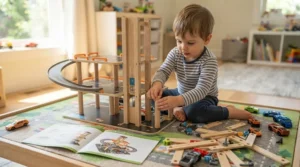
Pretend play research consistently shows benefits in language development, problem-solving, and cognitive flexibility, and a garage toy is one of the easiest ways to invite that kind of play without a lecture. Based on the spec comparisons ahead, the products that hold up over months of play share three traits: sturdy ramps that don’t buckle, an elevator mechanism kids can operate without adult help, and enough parking capacity that the collection doesn’t spill onto the floor by week two.
This guide breaks down seven real, currently available options — wooden and plastic, budget and splurge — plus honest analysis of who each one actually suits. You’ll also find a comparison table, a decision framework, and answers to the buying questions people search for most. <em>Affiliate disclosure: this article contains affiliate links, and we may earn a commission on qualifying purchases at no extra cost to you.</em>
Quick Comparison Table
Before diving into the full write-ups, here’s a fast snapshot of how these seven playsets stack up on levels, capacity, and who they’re built for.
| Product | Levels | Capacity | Age Range | Price Range | Best For |
|---|---|---|---|---|---|
| Hot Wheels City Ultimate Garage | Multi-level | 100+ cars | 4+ | $45-$60 | Big collections, dino-themed drama |
| Matchbox Transportation Center | 5 levels | 20+ vehicles | 3-8 | $35-$50 | Vehicle variety beyond cars |
| BRIO World Parking Garage | 3 levels | Small (starter set) | 3+ | $60-$80 | Toddlers, heirloom wooden quality |
| B. toys Bingo’s Garage | 3 floors | Small-starter | 18mo+ | $30-$40 | Youngest builders, first garage |
| KidKraft Wash-N-Go Garage | Multi-level | Moderate | 3-8 | $50-$65 | Full “service station” role-play |
| Melissa & Doug Service Station | 2 levels | Small-starter | 3+ | $30-$40 | Portable, classic wooden budget pick |
| Saichotoy 4-Level Display Case | 4 levels | Up to 40 cars | 6+ (display) | $25-$35 | Pure vehicle storage playset, diecast display |
Looking at the spread, there’s a clear split between play-first garages (Hot Wheels, KidKraft, B. toys) and storage-first display cases (Saichotoy), with BRIO and Melissa & Doug occupying the “built to last” wooden middle ground. Families with a rapidly growing diecast habit should weight capacity heavily, while households with toddlers under three should prioritize the simpler, chunkier mechanisms on the B. toys and Melissa & Doug sets. If your child already owns dozens of 1:64 scale cars, the Hot Wheels and Saichotoy options solve the storage problem most directly, while the Matchbox and KidKraft sets add more narrative play value per dollar.
💬 Just one click — help others make better buying decisions too!😊
Ready to stop stepping on stray cars? Scroll down to see current pricing on the pick that fits your family best.
Top 7 Multi Level Car Garage Toy Picks: Expert Analysis
1. Hot Wheels City Ultimate Garage — biggest capacity with dino-battle drama
The Ultimate Garage earns its name honestly: it’s built around a multi-level, side-by-side racetrack and a motorized moving T-Rex that turns ordinary parking into an obstacle course. Key specs matter here — the structure stands roughly 35 inches tall, holds over 100 die-cast vehicles at 1:64 scale, and ships with two cars to start. That height means it needs real floor or shelf space, but it also means the vertical ramps generate genuine racing momentum instead of the slow crawl you get from flatter sets. Based on the spec comparison, this is the pick for kids whose collections have already outgrown a shoebox and who want a play narrative, not just a parking lot.
Reviewers consistently report that the track connects with other Hot Wheels sets, which matters if your child is the type who wants to build an ever-expanding city rather than a single self-contained garage. Aggregated feedback also points to well over 8,000 five-star ratings, a volume that suggests durability holds up across normal rough play rather than just first-week enthusiasm — though as with any track set, ramp seams are worth checking after heavy stacking.
Pros:
- ✅ Massive 100+ car storage for growing collections
- ✅ Connects to other Hot Wheels track sets
- ✅ Motorized T-Rex adds replayable stunt drama
Cons:
- ❌ 35-inch height demands dedicated floor space
- ❌ Plastic clips can loosen under rough play
At around $45-$60, this is a strong value pick for a dedicated Hot Wheels household, since the connectivity to other sets extends its useful life well past a typical playset.
2. Matchbox Transportation Center — five levels built for vehicle variety, not just cars
Where the Hot Wheels set leans into cars, the Matchbox Transportation Center leans into variety — this is a five-level structure with kid- and car-activated features, and it ships with a 1:64 scale taxi plus a boat, helicopter, and food vendor accessory. That mix matters in practice: instead of just parking a fleet of identical sedans, kids narrate cargo transfers between land, air, and water levels, which stretches out play sessions considerably longer than a straight parking ramp would.
What most buyers overlook about this model is that the “kid-activated features” mean pressing points trigger sounds or movement, which rewards younger children who aren’t yet coordinated enough to manage a manual elevator crank. Reviewers note the five-level design as unusually tall for the price bracket, and the multi-vehicle format doubles as light education about how different transportation types move cargo — arguably the most literal “car carrier toy vehicle” experience in this lineup, since the included boat and helicopter act as scene-based carriers for smaller props.
Pros:
- ✅ Five levels pack in more play variety per dollar
- ✅ Includes boat, helicopter, and taxi, not just cars
- ✅ Activated features suit younger, less coordinated hands
Cons:
- ❌ Smaller footprint means less total car storage
- ❌ Compatible mainly with Matchbox/1:64 scale vehicles
Priced in the $35-$50 range, it’s a smart mid-tier choice for households that want narrative variety over sheer parking capacity.
3. BRIO World Parking Garage — heirloom-grade wood that plays nice with train sets
BRIO’s 7-piece wooden parking garage includes two cars, a transporter wagon, and wooden ramp tracks, and it’s FSC-certified, meaning the wood is sourced from responsibly managed forests. The three accessible levels are modest compared to the plastic megastructures on this list, but the build quality is where BRIO earns its premium price tag — sanded edges, a stable base, and rounded ramps that won’t crack the way injection-molded plastic sometimes does after a year of use.
Based on the spec comparison, the standout advantage here is cross-compatibility: this set works with all BRIO train sets, so a family already invested in that wooden-track ecosystem gets a garage that plugs directly into existing track layouts instead of sitting as an isolated structure. Reviewers of BRIO’s wooden line tend to highlight longevity over flashiness — these are the sets that survive being handed down to a younger sibling, not the ones replaced after a single holiday season. The trade-off is size: with only three levels and a compact seven-piece footprint, it holds a fraction of what the Hot Wheels or Saichotoy sets manage.
Pros:
- ✅ FSC-certified wood built for multi-year durability
- ✅ Directly compatible with the full BRIO train ecosystem
- ✅ Rounded, sanded edges are gentler on little hands
Cons:
- ❌ Smaller parking capacity than plastic alternatives
- ❌ Premium wooden construction costs more per car slot
Expect a $60-$80 range, positioning this as the “buy once, hand down twice” option rather than the biggest-capacity pick.
4. B. toys Bingo’s Garage — the gentlest first garage for toddlers under two
Bingo’s Garage is built for the 18-months-and-up crowd, and everything about it reflects that: a spiral ramp for gravity-fed rolling, a working elevator, and a three-floor structure sized for small hands rather than large collections. It ships with two toy cars so play starts immediately without needing a separate car purchase, which matters for parents buying a first “toy cars and garage set” rather than an add-on for an existing collection.
Here’s what to weigh: this is intentionally not the highest-capacity option on this list, and that’s the point. The oversized pieces and simplified elevator mechanism are designed to be chunky enough to resist the small-parts concerns that come with 1:64 scale diecast play for toddlers under three. Reviewers of B. toys’ toddler line consistently note the brand’s emphasis on chunky, rounded components that survive mouthing and dropping better than detailed diecast-scale accessories. For a two-year-old testing hand-eye coordination on a spiral ramp for the first time, that durability matters more than parking twenty extra cars.
Pros:
- ✅ Spiral ramp and elevator sized for toddler hands
- ✅ Two cars included, so play starts immediately
- ✅ Chunky components suit the 18-months-and-up range
Cons:
- ❌ Limited parking capacity compared to school-age sets
- ❌ Outgrown faster once kids move to 1:64 diecast
Typically priced around $30-$40, it’s the right on-ramp (pun intended) before a family upgrades to a higher-capacity garage later.
5. KidKraft Wash-N-Go Car Garage Set — the full-service station experience
KidKraft’s Wash-N-Go set packs in 19 accessories — ramps, figurines, a helicopter, and cars — anchored by a functional manual elevator and a spinning-brush car wash tunnel. The garage also includes a dummy fuel station, so a single play session can move a car from wash to fuel-up to parking without leaving the structure, which is a more complete role-play loop than a straight parking ramp offers.
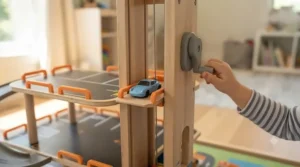
The real-world meaning of “19 accessories” is worth unpacking: that count includes small figures and props, which is genuinely more play content per box, but it also means more pieces to lose under the couch. Reviewers of full-service garage sets in this category tend to highlight the car wash feature specifically as the item kids replay most, since the spinning brushes provide tactile, visible feedback that a static parking ramp can’t match. What most buyers overlook is that manual elevators like this one double as fine-motor practice — the repeated crank-and-lift motion is quietly working on the same hand strength kids use for holding pencils.
Pros:
- ✅ 19 accessories create a full service-station loop
- ✅ Spinning car wash adds tactile, repeatable play
- ✅ Manual elevator builds fine motor coordination
Cons:
- ❌ More small pieces mean more potential to misplace
- ❌ Assembly takes longer than simpler wooden sets
At roughly $50-$65, this lands as the best value pick for kids who like elaborate role-play over pure parking-lot storage.
6. Melissa & Doug Service Station Parking Garage — the classic, portable budget pick
This two-level wooden garage keeps things simple: two cars, a gas pump, an elevator, and a car wash, all built into a compact structure with a service sign that doubles as a carrying handle. That handle detail is a small thing that changes daily use — a garage a toddler can actually carry to grandma’s house or the backseat is a garage that gets played with more often than one confined to a shelf.
On paper this means Melissa & Doug is trading capacity for portability, and reviewers of the brand’s classic wooden line consistently note that grandchildren and toddlers respond well to the simplified, chunky moving parts, with several caregivers reporting the toy remained a favorite for months rather than being a one-and-done Christmas gift. Based on the spec comparison against pricier sets, this one won’t hold a sprawling collection, but for a first garage purchase or a travel toy, the compact two-level layout and low price point are hard to beat.
Pros:
- ✅ Built-in handle makes it genuinely portable
- ✅ Simple elevator and car wash suit young toddlers
- ✅ Classic wooden build at an entry-level price
Cons:
- ❌ Only two levels limit total parking space
- ❌ Not built for large diecast collections
Usually priced under $40, it’s the most budget-friendly wooden option on this list and a smart starter buy.
7. Saichotoy 4-Level Display Case — a dedicated vehicle storage playset for diecast fans
Not every family wants a play-first garage — some just need somewhere to put 40 cars that isn’t the floor. The Saichotoy 4-Level Display Case is built for exactly that: a freestanding diorama-style case with four levels, 24 marked parking spots, LED lighting, and a stated maximum capacity around 40 cars at 1:64 scale. It’s less “play structure” and more “vehicle storage playset with a light show,” which is precisely the appeal for older kids who’ve moved from active play into collecting and displaying.
Here’s what to weigh: because this is a display case first, it lacks the working elevators and ramps of the play-focused garages above, so younger kids looking for hands-on interaction may find it underwhelming. What most buyers overlook is that the built-in LED lighting genuinely changes how a shelf of diecast cars reads in a bedroom — it’s the difference between a cluttered toy bin and something that looks intentional on a shelf. Reviewers of similar diorama-style cases note the LED strips are typically battery-powered and easy to swap, though they’re not a substitute for active ramp-and-elevator play.
Pros:
- ✅ Holds up to 40 cars across four labeled levels
- ✅ LED lighting turns storage into a display piece
- ✅ Freestanding design fits neatly on a shelf or desk
Cons:
- ❌ No working elevator or ramp for active play
- ❌ Better suited to older kids than toddlers
At around $25-$35, this is the most affordable way to solve a storage problem without buying another full playset.
Practical Usage Guide: Setup, First 30 Days & Maintenance
Most multi-level garage toys arrive flat-packed or with the ramps detached, so budget 15-30 minutes for initial assembly, longer for the KidKraft and BRIO sets with more individual pieces. During the first week, supervise elevator use closely — most manual cranks need a specific turning direction, and forcing it the wrong way is the single most common cause of a stripped gear reported across these product lines. A quick trick that extends longevity: test every ramp joint by rolling a car down it slowly before letting a child do so at full speed, since a loose connector is far easier to fix before it’s under active stress.
For ongoing maintenance, wipe wooden garages (BRIO, Melissa & Doug) with a slightly damp cloth rather than soaking them, since standing water can warp pressed-wood ramps over time. Plastic sets tolerate more aggressive cleaning but benefit from an occasional check of any battery compartments, particularly on lighted display cases like the Saichotoy model, where corroded contacts are the most common failure point after six months of use. The most common first-30-days mistake isn’t misuse — it’s overloading a single level with more cars than the ramp width comfortably supports, which causes pile-ups that can chip paint on the vehicles themselves.
Real-World Scenarios: Matching Kids to the Right Playset
Consider a college-adjacent example that scales down nicely: an 8-mile daily walker doesn’t need a cargo van, and the same logic applies here. A two-year-old just starting to understand cause-and-effect doesn’t need 100 car slots — they need the B. toys Bingo’s Garage or the Melissa & Doug Service Station, where every part is chunky, forgiving, and quick to reset after a toddler-style “explosion” of pieces across the carpet.
A six-year-old with an established 40-car diecast collection is a different case entirely. That child benefits most from either the Hot Wheels City Ultimate Garage for active stunt play or the Saichotoy display case if the collecting instinct has outpaced the racing instinct. And for a household with two kids of different ages sharing one space, the KidKraft Wash-N-Go or Matchbox Transportation Center thread the needle — enough complexity to hold an older child’s interest, but simple enough mechanically that a younger sibling can join in without needing help every thirty seconds.
Buyer’s Decision Framework
If you’re short on time, use this simple checklist: if your child is under three, choose a chunky-mechanism set like B. toys or Melissa & Doug because small ramps and cranks match their motor skills. If your child already owns 20+ cars, choose a high-capacity structure like the Hot Wheels Ultimate Garage or Saichotoy case because storage becomes the primary problem to solve. If floor space is tight, choose a compact wooden set like BRIO or Melissa & Doug because their footprint stays manageable on a shelf. And if the goal is a complete toy cars and garage set for a first-time buyer with no existing collection, prioritize sets that include vehicles out of the box, like the Hot Wheels, Matchbox, B. toys, or Melissa & Doug options — all seven picks above ship with at least one vehicle, but these four are built around starting a collection from zero.
How to Choose a Multi Level Car Garage Toy
- Match capacity to the actual collection size — count existing cars before buying, since an undersized garage just creates a second pile on the floor.
- Check the age rating against the mechanism, not just the box art — a spiral ramp and simple crank suit toddlers; motorized features and small clip-on accessories suit school-age kids.
- Weigh material against your family’s play style — wood generally survives longer under repeated stacking; plastic tends to offer more levels and features per dollar.
- Confirm scale compatibility — most garages are built around 1:64 scale diecast, so check this before assuming Hot Wheels, Matchbox, and other brands will interchange.
- Consider floor footprint versus vertical height — taller structures like the Hot Wheels Ultimate Garage need a stable, low-traffic corner, not a wobbly shelf.
- Factor in noise and lights — motorized or LED features add engagement but also add battery upkeep most buyers don’t anticipate.
- Decide if you need play, storage, or both — a display case like Saichotoy solves clutter; a ramp-and-elevator garage solves active play, and it’s rare for one product to do both equally well.
Common Mistakes When Buying a Multi Level Car Garage Toy
The most frequent misstep is buying based on box height alone, assuming a taller garage automatically means more play value, when in practice a shorter set with a better-designed elevator often gets more actual play time. A second common mistake is ignoring scale compatibility — mixing 1:64 diecast cars with a garage built for larger plastic vehicles leads to cars that either don’t fit the ramps or slide through gaps in parking bays. Developmental researchers have also cautioned that heavily structured, adult-directed play can undercut the very autonomy that makes pretend play valuable in the first place, which is a useful reminder not to over-script garage play with rigid “rules” once the toy is unwrapped.
A third mistake: underestimating assembly complexity for gift purchases. Sets like the KidKraft Wash-N-Go with 19 pieces are wonderful once built, but they’re a poor choice for a holiday morning where a child expects to play within minutes of unwrapping — simpler sets like Melissa & Doug or B. toys are safer bets for that specific scenario. Finally, many buyers skip reading the included-vehicle count and end up needing a separate car purchase immediately, which is an avoidable extra cost if checked beforehand.
Multi Level Car Garage Toy vs Road Race Track Set
A multi level car garage toy and a road race track set solve different play problems, even though they often sit in the same aisle. A garage toy is fundamentally about vertical storage and role-play — parking, servicing, and organizing a fleet of vehicles across levels. A road race track set, by contrast, is about horizontal speed and competition, usually built around loops, boosters, and crash points rather than parking bays. Some products blur the line — the Hot Wheels City Ultimate Garage, for instance, includes a side-by-side racetrack alongside its parking structure, giving it a foot in both categories.
For a child whose favorite question is “which car is faster,” a dedicated road race track set will outperform any garage toy on raw excitement. But for a child who enjoys sorting, organizing, and running an imaginary business — gas station attendant, valet, mechanic — the garage format wins because it rewards patience and role-play over pure speed. Many households eventually end up owning both, since a garage with a short connecting ramp to a race track combines storage with the adrenaline a flat garage alone can’t provide.
What to Expect: Real-World Performance
Specs on a box rarely translate directly to how a toy behaves in a living room, so here’s the honest translation. A “working elevator” almost always means a manually operated crank or knob, not a motorized lift, across every set on this list except the motorized T-Rex feature on the Hot Wheels garage — that distinction matters because a manual car elevator garage toy requires more hand strength and patience than marketing photos suggest, especially for kids under three. Expect the first week to include a fair amount of “elevator jamming” as kids learn the correct turning direction and car placement.
Ramp speed also varies more than expected: taller, steeper ramps on the Hot Wheels set generate real velocity, occasionally launching cars off the end, while the gentler grades on BRIO and Melissa & Doug wooden ramps keep cars rolling but rarely airborne. Parents should expect noise levels to range from near-silent (wooden sets) to moderately chatty (any set with sound-triggered features), and battery life on LED display cases like the Saichotoy typically lasts weeks of intermittent use before requiring a swap.
City Garage Toy for Boys (and the Girls Who Love Them Too)
Marketing around a city garage toy for boys is common in this category, but real-world play doesn’t actually sort itself by gender — vehicle play, sorting, and role-play appeal broadly across kids who enjoy spatial organization and cause-and-effect mechanisms, regardless of who’s holding the crank. That said, if you’re shopping specifically within the “boys’ toy” aisle framing that retailers use, the Hot Wheels City Ultimate Garage and Matchbox Transportation Center tend to sit in that marketing category most heavily, largely due to brand tie-ins with existing car and dinosaur franchises kids already recognize.
Imaginative play of this kind supports language development and cooperative skills like turn-taking regardless of which child is playing, so the more useful filter than gender marketing is temperament: a kid who likes narrating stories benefits from the Matchbox set’s varied vehicles, while a kid who likes building and stacking benefits from the sheer scale of the Hot Wheels garage. Framing the purchase around personality rather than the aisle it’s shelved in tends to produce a toy that gets played with longer.
Features That Actually Matter (And Those That Don’t)
Features that matter: ramp width relative to your child’s vehicle collection, a genuinely functional elevator (test it in-store or check return policies before buying online), and included vehicles that match your existing scale. A car carrier toy vehicle accessory — a small truck or trailer that transports several cars at once between levels — is a feature worth seeking out if your child enjoys narrative play, since it adds a transport mechanic that static ramps don’t offer on their own.
Features that don’t matter nearly as much as marketing suggests: exact accessory counts (19 pieces sounds impressive, but a third of those are often tiny figures that get lost within a month) and elaborate sound effects, which reviewers across multiple brands note kids tend to mute or ignore after the first few play sessions. Similarly, extreme height is often oversold — a 35-inch structure looks dramatic in product photos but can be genuinely unstable on soft carpet without a firm base, something worth checking against your actual flooring before buying the tallest option available.
Long-Term Cost & Maintenance
Thinking in terms of cost-per-play-hour changes the calculus here. A $30 Melissa & Doug set that gets played with daily for a year works out to pennies per session, while a $65 set abandoned after a month is a worse value despite the lower unit price seeming reasonable at checkout. Wooden sets from BRIO and Melissa & Doug typically need the least ongoing maintenance — no batteries, minimal moving parts to break — while battery-dependent features on the Hot Wheels and Saichotoy sets add a small recurring cost most buyers don’t factor in upfront.
Replacement parts are the other hidden cost. Plastic clip-together sets occasionally need a replacement ramp connector after heavy play, and these are sometimes available directly from manufacturer support pages, while a cracked wooden ramp on a BRIO or Melissa & Doug set is harder to source individually and may mean replacing the whole unit. Buyers planning to hand a garage down to a younger sibling should weight this durability question more heavily than the sticker price alone.
Safety, Regulations & Compliance Guide
Toys intended for children under three years old are subject to a mandatory small parts ban under federal toy safety rules, meaning they must not contain or release small parts during normal use and abuse testing. This matters directly for multi-level garage toys: 1:64 scale diecast cars and small figurine accessories are exactly the kind of components that trigger this rule, which is why sets marketed for toddlers under three, like B. toys’ Bingo’s Garage, use deliberately oversized cars and parts rather than true diecast scale. Toy safety standards also mandate that products intended for children 12 and younger must not bear paint or surface coatings containing more than 0.009 percent lead, a detail worth confirming on any wooden set with painted details, particularly older secondhand garages that may predate current manufacturing standards. Before buying secondhand or handing down a garage between siblings, checking the CPSC toy safety guidance is a quick way to confirm what age-appropriate small parts rules actually require, and it’s worth doing before assuming an older set is automatically safe for a younger child.
Beyond federal compliance, practical safety comes down to supervision during the first few uses of any elevator or ramp mechanism, checking for pinch points around moving cranks, and periodically inspecting plastic clips for cracking, especially on taller structures like the Hot Wheels Ultimate Garage that see repeated stacking stress.
Frequently Asked Questions
❓
What age is a multi level car garage toy appropriate for?
❓ Do multi level car garage toys work with all diecast cars?
❓ How many cars does a typical parking garage toy playset hold?
❓ Are wooden or plastic car garage toys better?
❓ Can a car garage toy connect to a road race track set?
Conclusion
A good multi level car garage toy earns its shelf space by solving two problems at once: it corrals a sprawling car collection and gives a child a genuine reason to keep playing with it months later, not just on the day it’s unwrapped. Whether that means the sheer scale of the Hot Wheels City Ultimate Garage, the wooden durability of BRIO and Melissa & Doug, the full-service role-play of KidKraft’s Wash-N-Go, or the simple, toddler-safe design of B. toys’ Bingo’s Garage, the right pick depends less on which set looks most impressive in photos and more on your child’s age, existing collection size, and whether they lean toward racing, organizing, or storytelling.
If you’re still deciding, start with the decision framework above rather than the flashiest box on the shelf — a $30 set that gets played with daily beats a $65 set that gets abandoned after week two, every time.
✨ Ready to Find Your Kid’s Next Favorite Garage?
🔍 Take playtime to the next level with one of these seven picks. Click through to check current pricing and availability, and give your little car enthusiast a garage worthy of their whole collection!
Recommended for You
- 7 Best Stunt Car Toys for Boys in 2026: Epic Gravity-Defying Picks
- 7 Best Diecast Cars for Kids in 2026: Tiny Wheels, Big Fun
- 7 Best Monster Jam Toy Trucks in 2026 (Real Amazon Picks)
Disclaimer: This article contains affiliate links. As an Amazon Associate, I earn from qualifying purchases. If you purchase products through these links, we may earn a small commission at no additional cost to you.
✨ Found this helpful? Share it with your friends! 💬🤗
