
In This Article
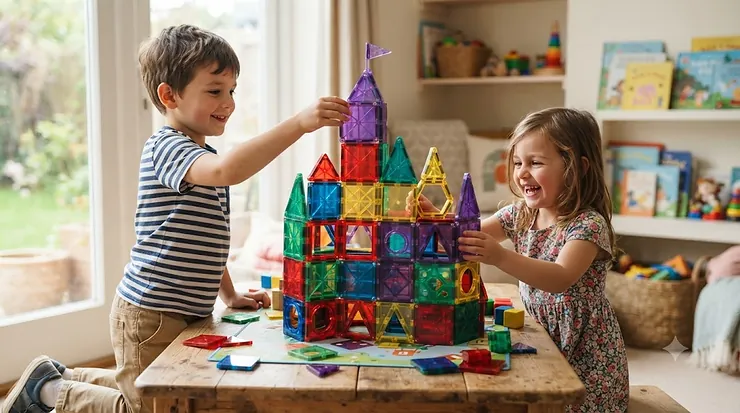
Walk into any toy aisle right now and you’ll see the same scene on repeat: a kid crouched over a pile of glowing plastic shapes, snapping them together into something that used to be a wall and is now, apparently, a rocket ship. That’s the pull of magnetic construction tiles for boys — they turn “I’m bored” into an hour of quiet, focused building before you’ve even finished making coffee. But here’s the catch nobody tells you at checkout: not all tiles are created equal, and the difference between a $25 set that falls apart in a month and a $90 set that survives three siblings isn’t always obvious from a product photo.

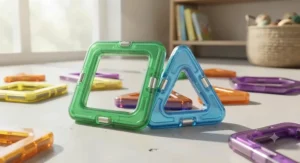
So what is a magnetic construction toy, exactly? It’s a set of geometric plastic panels — usually squares, triangles, and rectangles — with magnets embedded along each edge, so kids can connect them in any direction to build flat mosaics or full 3D structures like towers, castles, and cars. Because the shapes snap together instantly and pull apart just as easily, kids get to experiment, fail, and rebuild without the frustration that comes with fiddly bricks or precision-fit blocks.
This guide is built from real product research, aggregated customer-review patterns, and comparative spec analysis — not a rewritten Amazon listing. We looked at seven actual sets spanning budget, mid-range, and premium price points, including specialty options with motors, transparent panels, and mechanical gears. Before you buy, it’s also worth glancing at CPSC’s magnet safety guidance, since not every magnetic toy is built the same way structurally. Whether you’re outfitting a first-time builder or upgrading a kid who’s already outgrown basic blocks, you’ll find a fit below.
Quick Comparison Table
| Product | Piece Count | Price Range | Best For |
|---|---|---|---|
| PicassoTiles PT42 Clear Starter Set | 42 | Under $30 | First-time buyers, budget builds |
| Playmags 100-Piece Set | 100 | $60-$80 range | Strongest magnet-per-tile ratio |
| Magna-Tiles Classic 100-Piece Set | 100 | $70-$90 range | Riveted durability, brand trust |
| Connetix Tiles 100-Piece Pastel Set | 100 | $90-$120 range | Tall structures, translucent color play |
| PicassoTiles PTW101 Illusion Edition | 101 | $40-$60 range | Gear-driven 3D mechanical building |
| PicassoTiles PTU05 Motorized Car Base | 1 base unit | Under $25 | Adding motion to existing tile sets |
| PicassoTiles PTQ11 Construction Adventure Set | 28+ pieces | $30-$50 range | Construction-vehicle themed play |
Looking at the spread above, the real decision isn’t “which is best” in a vacuum — it’s which price tier and play style matches your kid right now. A first tile set almost always performs better as a 100-piece core set than a small add-on, because volume is what lets kids actually build something satisfying instead of a lonely triangle on the carpet. If motion and mechanics excite your builder more than color and shape, the gear-based and motorized options below punch above their price.
🧲 Ready to start building? Compare current availability on these sets before the good bundles sell out.
💬 Just one click — help others make better buying decisions too!😊
Top 7 Magnetic Construction Tiles for Boys: Expert Analysis
1. PicassoTiles PT42 Clear Magnetic Starter Set — clearest tiles for budget-conscious families
The PicassoTiles PT42 is a 42-piece starter set built almost entirely from see-through tiles, and that transparency is the whole point of the design. The set mixes squares and triangles in a mostly clear, lightly tinted finish, so structures let light pass through and cast colored shadows on the floor or a window — a small detail that turns basic stacking into an actual science conversation about light and color. At 42 pieces it’s intentionally modest; this is a toe-in-the-water set, not a full building system, and PicassoTiles designs it to be compatible with their larger full-size sets so it can grow later rather than get abandoned.
Based on the spec comparison against other entry sets in this price band, the panel walls here run thinner than Magna-Tiles or Connetix, which keeps the manufacturing cost down but also means younger, rougher hands will wear the connector points faster. This makes it best suited to a first purchase for a preschooler or early elementary kid rather than a long-term primary set for an 8-year-old building marathon towers daily. Reviewers consistently note that the clear finish is the standout feature that separates this from other budget entries, with common feedback praising the price point and the novelty of the transparent panels, while a recurring complaint centers on the magnets feeling noticeably weaker than pricier competitors once towers get past a few layers tall.
Pros:
- ✅ Genuinely transparent tiles, not just tinted plastic
- ✅ Compatible with larger PicassoTiles building sets
- ✅ Low price makes it a low-risk first purchase
Cons:
- ❌ Weaker magnetic hold on taller structures
- ❌ Piece count too small for elaborate builds alone
At under $30, this is squarely a starter or gift-add-on purchase rather than a standalone centerpiece. If your kid ends up obsessed after a week with this set, the value verdict is simple: buy it to test interest, then upgrade to a 100-piece core set once you know magnetic building has staying power in your house.
2. Playmags 100-Piece Magnetic Tile Set — strongest magnets pound-for-pound
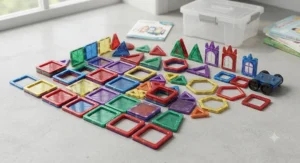
The Playmags 100-Piece Set built its reputation on one thing: magnet strength. Where some budget tiles rely on thin embedded magnets that lose grip over time, Playmags packs noticeably larger magnets into each panel edge, and independent side-by-side comparisons consistently rank it alongside Connetix as the strongest connection of the major brands. That extra pull matters more than it sounds — a stronger magnet means a nine-tile tower doesn’t slump sideways the moment a toddler sibling walks past, and it means kids can build cantilevered, physics-defying shapes without constant collapse.
The 100-piece count covers squares, triangles, and rectangles in a full color spread, and the set is frequently bundled with car-base accessories, which gives it functional overlap with vehicle-style play without needing a separate purchase. What most buyers overlook about this set is that its click-in ABC letter tiles (sold as an add-on in some bundles) quietly turn free-build time into early literacy practice, something few competing brands build into their ecosystem at all.
Aggregated review sentiment across parenting and toy-testing blogs is consistently favorable on durability and magnet strength, with the most common critique being that the color palette runs slightly duller than Connetix’s saturated pastels — a cosmetic complaint, not a functional one.
Pros:
- ✅ Among the strongest tile-to-tile magnetic hold available
- ✅ 100 pieces is enough for genuinely tall, complex builds
- ✅ ABC add-on tiles blend literacy into build time
Cons:
- ❌ Colors read as slightly less vivid than Connetix
- ❌ Bundle pricing varies, so scan listings carefully
In the $60-$80 range, this is one of the strongest value plays in the mid-tier: buyers get near-premium magnet performance without paying the full Connetix or Magna-Tiles premium.
3. Magna-Tiles Classic 100-Piece Set — the most trusted name in magnetic building
Magna-Tiles Classic is the brand every other set on this list gets compared against, and for good reason — it’s the original, and it built a two-decade reputation on one manufacturing detail: metal rivets sealing each magnet permanently into the tile, instead of relying on glue or ultrasonic welding alone. That single choice is why so many households report Magna-Tiles surviving multiple kids and multiple house moves without a single tile cracking open.
The 100-piece Classic set covers four shapes — mostly squares with a scattering of triangles — in bold, saturated primary and secondary colors that read clearly even from across a playroom. Based on the spec comparison, the individual magnets inside Magna-Tiles run physically smaller than those in Connetix or Playmags, which some careful reviewers have measured directly; in practice this means Magna-Tiles hold well for standard building but can feel slightly less “grippy” than newer competitors when kids attempt very tall or top-heavy towers.
What most buyers overlook is that the brand recognition itself carries real resale and gifting value — Magna-Tiles are one of the few toy brands where a well-used set still holds decent resale value, precisely because the riveted construction rarely fails. Aggregated feedback across long-term owner reviews is remarkably consistent: complaints focus almost entirely on the premium price relative to store-brand alternatives, not on product failure.
Pros:
- ✅ Riveted construction rarely breaks, even after years
- ✅ Recognized industry standard, easy to expand later
- ✅ Compatible with most competing tile brands
Cons:
- ❌ Smaller magnets than Connetix or Playmags
- ❌ Premium pricing versus comparable piece counts
At around $70-$90 for the 100-piece set, Magna-Tiles is the safe, well-documented choice — not necessarily the strongest performer on paper, but the one with the longest track record of surviving real households.
4. Connetix Tiles 100-Piece Pastel Set — sturdiest beveled edges for tall towers
Connetix Tiles arrived later than Magna-Tiles but quickly earned a following among parents who wanted stronger magnets and a more refined, jewel-toned color palette. The standout engineering choice here is the beveled edge design: instead of flat panel borders, Connetix tiles have angled edges that increase surface contact between connected pieces, which is the manufacturer’s answer to the common worry that ultra-clear tiles without internal bracing might be structurally weaker. Reviewers and side-by-side testers have repeatedly found the opposite is true — the bevel design actually holds up better under lateral stress than flat-edged competitors.
The 100-piece pastel set leans heavily on translucent panels in soft, saturated tones, which makes it a favorite for light-table play and window-adjacent building where the colors glow. Based on the spec comparison, Connetix and Playmags trade the top spot for magnet strength depending on which independent test you read, but both consistently outperform Magna-Tiles on raw pull force per tile.
Reviewers consistently describe Connetix as the “premium” choice in the category, with common praise centered on color saturation and structural confidence for elaborate builds, while the most frequent complaint is simply price — this is the most expensive set on this list at full retail.
Pros:
- ✅ Beveled edges add real strength, not just aesthetics
- ✅ Vivid translucent colors excel at light-play
- ✅ Compatible with Magna-Tiles and Playmags collections
Cons:
- ❌ Highest price point of the sets covered here
- ❌ Bevel design is a distinct feel some kids need to adjust to
In the $90-$120 range, Connetix is the pick for families prioritizing structural confidence in tall, ambitious builds over saving a few dollars — the long-term cost-per-play-hour analysis later in this guide breaks down whether that premium is worth it for your household.
5. PicassoTiles PTW101 Master Builder Illusion Edition — best for true 3D mechanical building
Most magnetic tile sets are, structurally, flat panels connected at angles. The PicassoTiles PTW101 Master Builder Illusion Edition breaks that mold by building actual moving mechanics into the system: 27 gear wheels, two controller handles, and 22 spinning optical-illusion disc plates that rotate when a connected handle is turned. This is the set to reach for when “stack it taller” has stopped being interesting and a kid wants to understand how motion and mechanisms actually work.
The gear wheels interlock the way real gear trains do, so turning one handle can spin a chain of connected discs at different speeds depending on gear ratio — a genuinely hands-on physics lesson disguised as a spinning-pattern toy. Based on the spec comparison, this set trades raw piece-count for mechanical complexity; with 101 total pieces split across foundation plates, columns, gears, and discs, it builds smaller structures than a pure 100-tile square-and-triangle set, but it does something none of those sets can: actual rotational motion driven by hand-cranked mechanics.
Aggregated reviewer sentiment frames this as a “grows with them” set — younger kids enjoy the spinning discs as a simple cause-and-effect toy, while elementary-age kids get more out of experimenting with gear ratios and torque, which lines up with published research on how malleable spatial and mechanical reasoning skills develop through hands-on construction play.
Pros:
- ✅ Real gear mechanics, not just static shapes
- ✅ Optical-illusion discs add a genuinely novel play pattern
- ✅ Compatible as an add-on to standard PicassoTiles sets
Cons:
- ❌ Fewer structural tiles than a dedicated 100-piece set
- ❌ Gear assembly has a learning curve for younger kids
Priced in the $40-$60 range, this is best positioned as a second or third set layered onto an existing tile collection rather than a standalone first purchase — the mechanical novelty is the draw, not raw building volume.

6. PicassoTiles PTU05 Motorized Car Base — the only motorized add-on that self-steers
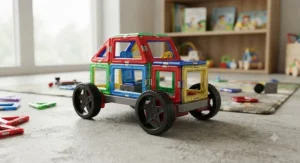
If your household already has a pile of magnetic tiles and the kid building with them is asking “but can it move,” the PicassoTiles PTU05 Motorized Car Base is the direct answer. It’s a battery-operated rolling platform that self-turns and rotates omnidirectionally, with a built-in light, and it’s designed to have magnetic tiles and building bricks stacked directly on top of it to create a moving vehicle, robot, or rolling structure of the kid’s own design.
Key spec, translated into real play: the “omnidirectional self-turning” motor means the base doesn’t just roll forward — it spins and redirects on its own, so whatever structure gets built on top ends up moving unpredictably around the floor, which reads to most kids as far more entertaining than a car that only goes in a straight line. Based on the spec comparison against pull-back car add-ons sold by other tile brands, this is one of the few motorized options that’s genuinely powered rather than spring-loaded, which is the meaningful difference behind the “building toy with motor” search so many parents run before buying.
Reviewer feedback consistently frames this as an add-on rather than a standalone toy — nobody buys just the motor base — with common praise for how it revives interest in an existing tile collection, and the recurring caveat that battery life and weight capacity limit how large a structure can sit on top before the motor struggles.
Pros:
- ✅ True battery-powered motion, not spring-loaded
- ✅ Omnidirectional turning creates unpredictable, fun movement
- ✅ Compatible with full-size PicassoTiles and other tile brands
Cons:
- ❌ Only a motor base, not a full building set
- ❌ Heavier structures can bog down the motor
At under $25, this is the cheapest way to add genuine motorized play to tiles you already own, and the value verdict is straightforward: buy it as an upgrade, not a first purchase.
7. PicassoTiles PTQ11 Construction Adventure Set — best construction-vehicle theme for boys
The PicassoTiles PTQ11 Construction Adventure Set leans directly into the construction-site fantasy that draws a lot of boys to this category in the first place. The set pairs printed and clear tiles with eight small construction-vehicle figures — crane, excavator, bulldozer, roller, mixer, tractor, dump truck, and forklift — designed to ride along the tile surface as kids build roads, job sites, and multi-level structures around them.
What sets this apart from a generic tile set is the printed detail work: several tiles carry construction-themed graphics (caution stripes, brick patterns, signage) that turn a flat build into a recognizable worksite rather than an abstract shape, which is exactly the kind of practical, story-driven detail Amazon listings rarely explain well. Based on the spec comparison, the vehicle figures themselves aren’t magnetic-tile pieces in the structural sense — they’re compatible ride-along accessories — so this set is best understood as a themed accessory pack layered onto a core tile collection rather than a primary structural set on its own.
Aggregated review sentiment is strongly positive on the theme execution specifically, with parents of construction-obsessed kids reporting this set gets more sustained daily use than plain-color tiles, while a recurring note in reviews is that the vehicle pieces are small enough to need supervision with toddlers in the house.
Pros:
- ✅ Eight themed construction vehicles included
- ✅ Printed detail tiles add storytelling to builds
- ✅ Compatible with full-size PicassoTiles tile collections
Cons:
- ❌ Vehicle pieces are small parts, not for toddlers
- ❌ Works best paired with a larger core tile set
In the $30-$50 range, this is the pick for a specifically construction-obsessed kid, and it pairs especially well as a themed add-on to the Playmags or Magna-Tiles core sets covered above.
Top 7 Full Comparison Table
| Product | Magnet Strength | Special Feature | Price Range | Best For |
|---|---|---|---|---|
| PicassoTiles PT42 | Moderate | Transparent panels | Under $30 | First-time buyers |
| Playmags 100-Piece | Very strong | ABC add-on tiles | $60-$80 range | Tall, stable builds |
| Magna-Tiles Classic | Moderate-strong | Riveted magnets | $70-$90 range | Long-term durability |
| Connetix Pastel Set | Very strong | Beveled edges | $90-$120 range | Premium builders |
| PicassoTiles PTW101 | Moderate | Gear mechanics | $40-$60 range | Mechanical/3D play |
| PicassoTiles PTU05 | N/A (motorized) | Self-turning motor | Under $25 | Adding motion |
| PicassoTiles PTQ11 | Moderate | Construction vehicles | $30-$50 range | Themed play |
Read across this table and a pattern emerges: magnet strength and price move together almost linearly, with Connetix and Playmags trading the top spot depending on which independent lab test you trust. The specialty sets — PTW101, PTU05, and PTQ11 — aren’t competing on raw magnet force at all; they’re solving a different problem, which is keeping an existing collection interesting once basic stacking stops holding attention.
🚧 Want the full lineup in one place? Check current availability and bundle options before building your set.
Practical Usage Guide: Getting the Most From Your Magnetic Tiles
Getting a new set out of the box is the easy part; keeping it in good shape for years takes a few habits most parents never think to set up on day one. Start by sorting shapes into a shallow bin instead of a deep toy chest — kids build faster and lose fewer pieces when they can see everything at a glance rather than digging. In the first 30 days, the most common mistake is letting tiles sit directly on carpet fibers or under furniture, where a stray triangle can vanish for months.
For maintenance, wipe tiles down with a barely damp cloth every few weeks rather than a full submerge-and-scrub; the magnets are sealed but repeated soaking accelerates seam wear on lower-cost sets. If you’re mixing brands — which works fine across Magna-Tiles, Connetix, and Playmags since their magnet polarity is standardized — do a quick “polarity check” the first time you combine sets, since a small percentage of off-brand tiles ship with reversed magnets that repel instead of attract.
One optimization trick that rarely makes it onto packaging: building on top of a large flat tray, rather than directly on the floor, lets kids relocate an in-progress structure without collapsing it, which meaningfully extends how long any single build survives snack time and dinner.
Real-World Scenarios: Which Set Fits Your Boy?
The first-time builder (age 3-4): A cautious kid who’s never had magnetic tiles does best starting small. The PicassoTiles PT42 clear starter set is sized right for this — low piece count, low cost, low pressure if interest fizzles after a week.
The daily builder chasing bigger structures (age 6-8): This is the kid who rebuilds the same tower taller every single day. Connetix or Playmags in the 100-piece range rewards that persistence with magnets strong enough to hold ambitious, top-heavy designs without constant collapse — and that persistence tracks with what researchers see in classroom block-play studies on spatial language development, where kids who build taller, more complex structures consistently use more sophisticated spatial vocabulary while doing it.
The mechanically curious kid who asks “how does it work”: Skip more tiles and add the PTW101 gear set or the PTU05 motorized base to an existing collection. This profile of kid gets bored of static shapes fast and lights up the moment something spins or rolls under its own power.
Problem → Solution: Common Magnetic Tile Headaches
Problem: Structures collapse before they’re finished. Solution: check magnet strength before adding pieces — sets like Connetix and Playmags hold taller builds better than budget-tier tiles, and building on a flat tray reduces accidental knocks.
Problem: Pieces go missing constantly. Solution: a dedicated shallow bin plus a “counting the pieces back in” habit at cleanup time catches losses before they compound across weeks.
Problem: Sibling squabbles over limited pieces. Solution: buying a second smaller set, like the PT42 or PTQ11, gives a younger sibling their own supply without needing to double the full 100-piece investment.
Problem: Interest fades after the novelty wears off. Solution: this is exactly what the PTW101 gears and PTU05 motorized base solve — they reintroduce novelty into an existing collection instead of requiring a whole new purchase.
Problem: Mixing brands doesn’t connect properly. Solution: confirm polarity compatibility before combining sets; most major brands (Magna-Tiles, Connetix, Playmags, PicassoTiles) are cross-compatible, but always test two tiles together before assuming a full mixed build will hold.
How to Choose Magnetic Construction Tiles for Boys
- Start with piece count, not price. A 100-piece set almost always delivers more sustained play value than a cheaper 30-piece set, because volume is what lets a kid build something they’re actually proud of.
- Check magnet strength claims against independent comparisons, not just marketing copy — this is where Connetix and Playmags consistently outperform budget alternatives.
- Match the set to your kid’s actual interest, not just their age — a mechanically curious 5-year-old may get more out of the gear-based PTW101 than a standard square-and-triangle set.
- Confirm cross-brand compatibility if you already own tiles, so a new purchase expands the collection instead of sitting in its own separate pile.
- Factor in supervision needs for small parts, especially with themed vehicle add-ons like PTQ11, which aren’t appropriate for toddlers in the house.
- Budget for growth, not just the first set — motorized bases and gear kits are inexpensive ways to extend the life of a core set well past the point where plain tiles stop holding attention.
- Read aggregated review patterns, not just star averages — a 4.6-star product with a recurring complaint about weak magnets tells you more than the number alone.
Common Mistakes When Buying Magnetic Tiles for Boys
The single most common mistake is buying a small piece-count set as if it were a full building system, then feeling disappointed when structures stay small and simple. A 30-40 piece set is a starter or a gift add-on, not a primary purchase for a kid who already loves building.
A second frequent misstep is chasing the cheapest possible price without checking magnet strength, which is the spec most likely to determine whether a set gets used daily or abandoned in a bin after towers keep collapsing. Reviewers across nearly every brand flag weak magnets as the top reason a set gets returned or replaced.
The third mistake is assuming all “magnetic tiles” are interchangeable when specialty sets — gears, motors, themed vehicles — solve an entirely different problem than standard building tiles. Buying a motorized base as a first and only purchase, for instance, leaves a kid with motion but nothing to actually build with it.
Magnetic Construction Tiles vs Traditional Building Blocks
| Factor | Magnetic Construction Tiles | Traditional Blocks (Duplo/LEGO-style) |
|---|---|---|
| Fine motor demand | Low — snaps together instantly | Higher — requires precision pressing |
| Structural flexibility | High — connects at any angle | Moderate — fixed stud/socket connections |
| Frustration threshold | Low, forgiving of mistakes | Higher, especially for younger builders |
| Best For | Open-ended, fast-paced building | Detail-oriented, instruction-based building |
The core trade-off here is precision versus accessibility. Traditional blocks reward following instructions and pressing pieces into exact positions, which builds a different kind of patience and fine-motor skill than magnetic tiles do. Magnetic construction tiles, by contrast, connect at any angle with almost no resistance, which is why they tend to hold younger or less patient builders’ attention longer — there’s no wrong way to attach two tiles, so failure never looks like failure.
Neither format replaces the other; many households running both find that magnetic tiles get pulled out for fast, imaginative, low-frustration sessions, while brick sets come out when a kid wants a specific, instruction-driven project to complete.
Magnetic Tiles Age 5-8: What Changes
Kids at the younger edge of this range (5-6) are usually still building for the sensory satisfaction of snapping pieces together and watching a shape rise — piece count and color variety matter more to them than mechanical complexity. By 7-8, many kids start asking functional questions: why does the tower lean, why does the gear spin faster when it’s smaller, why does the car keep turning in circles.
That shift is exactly why the gear-based PTW101 and motorized PTU05 tend to land better with the older half of this age range, while a straightforward 100-piece set like Magna-Tiles or Connetix remains the stronger core purchase across the entire 5-8 window. If a set feels “too easy” for an 8-year-old within a few weeks, the fix usually isn’t more tiles of the same kind — it’s adding a mechanical or motorized layer that introduces a genuinely new problem to solve.
Transparent Magnetic Tiles: Why Clear Tiles Matter for 3D Building
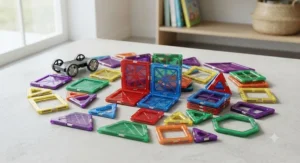
Transparent magnetic tiles aren’t just a color choice — they change how a 3D structure reads visually. A tower built entirely from solid-color tiles reads as an opaque block from any angle, while a structure mixing in clear or translucent panels lets light travel through the build, revealing its internal geometry and casting colored shadows nearby. That’s part of why sets like the PT42 starter and Connetix‘s pastel translucent line get singled out specifically for window-adjacent or light-table play.
For genuine 3D building — domes, multi-room structures, anything meant to be viewed from inside as well as outside — transparent panels also solve a practical problem: they let a builder see through a wall to check alignment on the far side without dismantling anything, which speeds up complex multi-tile constructions considerably.
Building Toy With Motor: Adding Movement to Magnetic Play
A building toy with motor changes the fundamental question a kid asks while building. Static tiles answer “can I make this stand up,” while a motorized base like the PTU05 answers “can I make this move without pushing it.” That shift from static to kinetic building is a meaningfully different cognitive task — balancing weight for stability is one skill, but balancing weight so a structure survives its own self-generated motion is another layer entirely.
Practically, motorized bases work best under lighter, wider structures rather than tall narrow towers, since a high center of gravity combined with self-turning motion is a fast recipe for tip-overs. Pairing a motor base with a themed vehicle set like PTQ11 is a natural combination — the printed road tiles give the moving structure somewhere purposeful to “drive.”
Long-Term Cost & Maintenance
Sticker price tells only part of the story here. A $25 starter set that gets abandoned after two weeks costs more per hour of play than a $90 set still in daily use three years later. Riveted construction, like Magna-Tiles uses, and reinforced beveled edges, like Connetix uses, both exist specifically to reduce the replacement-part costs that come with glued-magnet tiles cracking open over time.
Maintenance costs are minimal across all seven products here — no batteries required except for the PTU05 motorized base, which uses standard replaceable batteries rather than a proprietary rechargeable pack. The main ongoing cost most households actually face isn’t repair, it’s expansion: buying additional piece packs or themed accessories as a kid’s ambitions outgrow the original set size, which is a genuine sign the toy is earning its keep rather than sitting unused.
Features That Actually Matter (And Those That Don’t)
Magnet strength and rivet or bevel construction matter enormously — they’re the difference between a set that survives years of daily building and one that cracks apart within months. Piece variety in basic shapes (square, triangle, rectangle) matters more than exotic shape counts, since the vast majority of real structures rely on those three forms regardless of how many novelty shapes a set advertises.
What matters less than marketing suggests: exact piece count above roughly 100-120, since most kids plateau in how much they build in a single structure well before running out of pieces; and glow-in-the-dark or light-up tile gimmicks, which reviewers consistently describe as a novelty that wears off within the first week. This lines up with broader research on how spatial and mechanical reasoning develops through hands-on construction play — the developmental value comes from open-ended manipulation and problem-solving, not from any single flashy feature.
Safety, Regulations & Compliance Guide
All seven products covered here are full-size magnetic tiles or motorized bases intended for ages 3 and up, not the loose, swallowable “desk toy” magnet balls that prompted the federal safety standard the CPSC finalized in 2022 after years of ingestion injuries tied to small, high-powered magnet sets. That standard specifically targets loose magnets small enough to swallow — full-size building tiles with magnets sealed inside a plastic panel are a fundamentally different risk category, since the magnet itself isn’t accessible during normal play.
That said, accessory pieces matter here: the small construction-vehicle figures in PTQ11 are not sealed magnetic panels and should be supervised around toddlers, and any tile that develops a crack or exposed seam on any brand should be retired immediately rather than kept in circulation. A quick periodic inspection — checking for cracked corners or loose seams — is the single most effective habit for keeping any magnetic tile set safe for the long haul.
🔧 Building a safe, long-lasting collection starts with picking the right first set — see current pricing on today’s top picks.
Frequently Asked Questions
❓ Are magnetic construction tiles good for boys specifically, or just kids in general?
❓ What age should a kid start with magnetic tiles for boys?
❓ Do magnetic construction tiles work with tablets, phones, or other electronics nearby?
❓ Can different brands of magnetic tiles connect to each other?
❓ How many pieces should a first magnetic tile set have?
Conclusion
There’s no single “best” magnetic construction tile for every boy — there’s a best fit for the kid standing in front of you right now. A cautious first-timer does better starting small and cheap with something like the PicassoTiles PT42. A kid already obsessed with building taller and taller towers deserves the stronger magnets in Connetix or Playmags. And a kid who’s bored of static shapes and wants to know how things move is exactly who the PTW101 gears and PTU05 motorized base were built for.
What all seven of these sets share is the thing that actually matters most: open-ended, screen-free building that rewards curiosity over instructions. Whichever set you land on, the real win isn’t the toy itself — it’s the hour of focused, independent building it buys you, and the version of your kid who walks away from it a little more confident than when he sat down.
✨ Ready to pick the right set for your builder? Compare today’s prices and grab the one that fits your household before the best bundles sell out.
Recommended for You
- 7 Best Multi Level Car Garage Toy Picks Kids Actually Love (2026)
- 7 Best Stunt Car Toys for Boys in 2026: Epic Gravity-Defying Picks
- 7 Best Diecast Cars for Kids in 2026: Tiny Wheels, Big Fun
Disclaimer: This article contains affiliate links. As an Amazon Associate, I earn from qualifying purchases. If you purchase products through these links, we may earn a small commission at no additional cost to you.
✨ Found this helpful? Share it with your friends! 💬🤗
