
In This Article
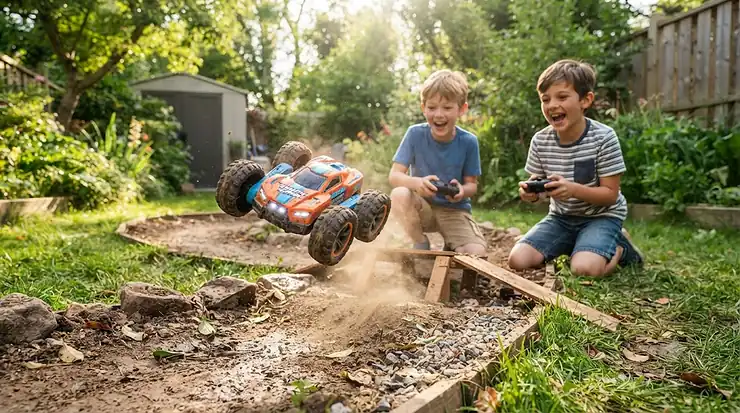
Somewhere in your living room right now, there’s a couch cushion fort with a ramp built out of a hardcover book, and a kid crouched behind it making engine noises with his mouth. That’s the whole appeal of stunt car toys for boys in one image — gravity, speed, and a little bit of chaos, all shrunk down to fit on a rug. Stunt car toys for boys are vehicles and track systems built specifically for high-energy play: loops that flip cars upside down, launchers that fire them across the room, and cars tough enough to survive a face-first crash into the baseboard. Unlike a basic push-along toy, these products are engineered around impact, speed, and repeatable “wow” moments.
We spent our research time digging through real Amazon listings, verified specs, and aggregated review sentiment (never invented quotes — see our honesty note further down) to figure out which stunt car toys actually earn their price tag versus which ones fall apart after the third loop-de-loop. It helps to remember that the whole category traces back to a single 1968 idea — the original Hot Wheels die-cast design was built around a low-friction axle specifically so cars could survive loops and jumps, and that same engineering logic still separates the stunt toys that hold up from the ones that don’t. What follows is a genuine buyer’s breakdown: seven real products across every budget tier, a comparison table you can scan in ten seconds, and enough practical detail that you’ll walk away knowing exactly which one belongs under your kid’s tree, in his Easter basket, or just… on the counter on a random Tuesday, because sometimes that’s reason enough.
Quick Comparison Table: Stunt Car Toys for Boys at a Glance
| Product | Type | Best For | Price Range |
|---|---|---|---|
| Hot Wheels Loop Stunt Champion | Dual-loop launcher track | Head-to-head sibling racing | $20-$25 |
| Hot Wheels City T-Rex Loop Stunt Playset | Giant single loop + boss battle | Dramatic, story-driven play | $20-$30 |
| Hot Wheels Criss-Cross Crash Track | Motorized 4-way crash intersection | Kids obsessed with collisions | $30-$40 |
| Hot Wheels Track Builder Unlimited Fuel Can Stunt Box | Modular DIY stunt kit | Builders who like customizing layouts | $20-$30 |
| GILI Gesture Sensing RC Stunt Car | 4WD hand-controlled flip car | Tech-curious kids ages 6-12 | $30-$45 |
| ZOHANINDL Friction Power Pull Back Racers (3-Pack) | Friction/pull-back cars | Toddlers and travel play | Under $15 |
| Hot Wheels Monster Trucks Stunt Tire Playset | Tire-case transforming track | Budget-minded all-in-one buyers | $25-$35 |
The spread here matters more than it looks like at first glance. If you’ve got two kids trading turns, the dual-launcher Loop Stunt Champion solves arguments before they start, while a single toddler who just wants something that goes fast right now is better served by a $15 friction-powered three-pack that needs zero setup. Notice, too, that price doesn’t map neatly to play value — the Criss-Cross Crash Track costs more than the T-Rex Loop Playset but delivers a completely different kind of chaos (four-way pileups versus one dramatic upside-down moment), so “best” really depends on what kind of noise you want coming from the play room.
💬 Just one click — help others make better buying decisions too!😊
Top 7 Stunt Car Toys for Boys: Expert Analysis
1. Hot Wheels Loop Stunt Champion — dual launcher for instant head-to-head racing
The standout here is the double-car launcher, which turns a solo stunt track into a two-player showdown without needing a second set. Both lanes feed into a single massive loop, and the spring-loaded launchers can be loaded two different ways — nose-first the traditional way, or sideways for a wobblier, less predictable launch that adds a layer of “will it even make the loop” tension. That variability is the whole trick, honestly; a fixed launch angle gets boring after a dozen runs, but this one doesn’t.
Practically speaking, the set includes one 1:64 scale die-cast car, and the landing zone is adjustable, so you can move the target closer or farther to change the difficulty without buying anything new. Based on the spec comparison against single-lane loop sets, the dual-launcher design is what justifies the modest price bump — it’s built for competitive play, not solo cruising, so it’s the pick for households with more than one kid or for a lone racer who likes beating his own best time.
Reviewers consistently report that assembly is quick (most say under fifteen minutes without tools) and that the loop holds up well to repeated use, though a common complaint in user reviews is that the plastic connectors can pop loose on hard carpet if the track isn’t anchored down. That’s a fixable annoyance, not a dealbreaker, but worth knowing before your first play session.
Pros:
- ✅ Dual launcher enables real two-player racing
- ✅ Adjustable landing zone extends replay value
- ✅ Fast, tool-free assembly reported by most buyers
Cons:
- ❌ Track connectors can loosen on carpeted floors
- ❌ Only includes one die-cast car in the box
Sitting in the $20-$25 range, this is a strong mid-tier value pick — the dual-launcher mechanic alone would normally cost more if sold separately, so buyers get above-average play complexity for a below-average price.
2. Hot Wheels City T-Rex Loop Stunt and Race Playset — the tallest gravity-bending loop with a dinosaur boss fight
What makes this one stand out is scale — the loop itself towers over most track sets, and it’s built around a narrative hook (racing through the loop to “defeat” a giant T-Rex) rather than just being a bare stunt ramp. That story element sounds like a small thing until you watch a six-year-old narrate an entire dramatic arc around it for forty-five minutes straight.
The included 1:64 scale car is compatible with the wider Hot Wheels City ecosystem, meaning the loop connects to other City sets if your kid already has a collection going. The T-Rex figure has a mouth mechanism that reacts to a car driving through it, which reviewers say is the single most-repeated play action in the whole set — kids run it dozens of times just to watch the jaw snap. What most buyers overlook about this model is that the loop height, while dramatic, means cars need real launch speed to clear it, so it plays better on hard flooring than thick carpet where friction eats momentum.
Aggregated review sentiment leans positive on durability of the loop structure itself, though several reviewers mention the T-Rex figure’s paint can chip if it takes repeated direct hits from an errant car, which happens more than you’d think with an overzealous six-year-old at the wheel.
Pros:
- ✅ Tall loop delivers genuinely dramatic stunt visuals
- ✅ Story-driven T-Rex mechanism extends engagement
- ✅ Compatible with the broader Hot Wheels City line
Cons:
- ❌ Needs hard flooring for reliable loop completion
- ❌ T-Rex figure paint can chip under repeated impacts
At around $20-$30, this is one of the better value-per-drama ratios on this list — few sets this size manage to combine a physical stunt with an actual mini-narrative for kids to act out.
3. Hot Wheels Criss-Cross Crash Track — a four-way motorized intersection built for collisions
The standout feature is right in the name: four separate lanes converge at a single intersection point, powered by a motorized booster that launches cars into each other on purpose. This is, functionally, a toy engineered around the thing most parents try to prevent — cars smashing into each other — and it does that one job extremely well.
The motorized booster requires batteries (not included, based on our research, so budget for that separately) and pushes cars at a consistent enough speed that the collisions actually look and sound satisfying rather than like two toys gently bumping. Here’s what to weigh: because the layout is fixed around the four-way crash point, it’s less flexible for freeform track-building than a modular set, but that’s also exactly why it’s easier for younger kids to set up correctly on the first try — there’s really only one way to assemble it.
Reviewers consistently note that the crash mechanism is the main draw and that battery life on the motorized booster is decent for typical play sessions, though a handful of reviews mention the plastic housing around the motor feels less rugged than the track pieces themselves.
Pros:
- ✅ Motorized booster ensures consistent crash speed
- ✅ Four-lane design multiplies collision combinations
- ✅ Simple, nearly foolproof assembly for younger kids
Cons:
- ❌ Requires batteries not included in the box
- ❌ Fixed layout offers less customization than modular sets
Priced in the $30-$40 range, it sits at the higher end of this list, but for a kid whose favorite word is “crash,” the dedicated collision mechanic is hard to replicate with a cheaper, more generic loop track.
4. Hot Wheels Track Builder Unlimited Fuel Can Stunt Box — a modular stunt kit for kids who like building their own chaos
This one’s standout feature is flexibility: fourteen component parts pack into a fuel-can-shaped storage box, and instead of one fixed stunt, kids design their own ramps, jumps, and loop combinations. Based on the spec comparison with fixed-layout sets, this is the pick for a kid who enjoys engineering the problem as much as solving it — building the ramp is half the fun, not just a chore before the “real” play starts.
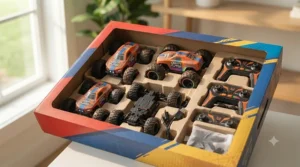
The storage box itself is a smart piece of design — after play, all fourteen pieces fold back into the can shape, which solves the classic problem of loose track pieces disappearing under the couch. Because the pieces are modular and compatible with other Hot Wheels Track Builder sets, this option scales well if your kid’s collection grows; you’re not locked into one fixed configuration forever, which is the deeper value here that a spec sheet won’t fully capture.
Aggregated customer sentiment highlights the portability and reconfigurability as the top-praised features, while a recurring theme in reviews is that younger kids (under 5) often need adult help engineering more ambitious stunt layouts, since the connectors require a bit of trial and error to get a stable jump angle.
Pros:
- ✅ Fourteen modular pieces enable custom stunt design
- ✅ Fuel-can storage keeps pieces organized after play
- ✅ Compatible with the wider Track Builder ecosystem
Cons:
- ❌ Younger kids may need help with more complex builds
- ❌ Fewer guaranteed “instant wow” moments than fixed sets
At roughly $20-$30, it’s a smart pick for the kid who’s aging out of pre-built playsets and starting to want creative control over how the stunt actually works.
5. GILI Gesture Sensing RC Stunt Car — a hand-controlled flip machine with genuine tech novelty
The standout feature is the control method itself — instead of a traditional joystick remote, this 4WD car reads hand gestures, letting a kid steer, spin, and flip it just by moving their hand through the air. On paper this means a lower barrier to “cool factor” than a standard RC car, and in practice it’s the reason this model shows up repeatedly across gesture-RC bestseller lists.
Specs worth flagging: it’s built around a double-sided body, so when it flips over mid-stunt (which happens constantly and is, again, the point), it just keeps driving on the other side without a pause. That detail matters more than it sounds — with a traditional RC car, a flip usually ends the fun until someone flips it back by hand; here, the flip becomes part of the performance instead of an interruption. Reviewers consistently note that the gesture sensing works best within a few feet of the controller’s hand and can be finicky in bright outdoor light, so it performs more reliably as an indoor toy than an all-terrain outdoor racer, despite marketing that leans into “indoor/outdoor” versatility.
A common complaint in user reviews involves battery run time — expect well under half an hour of continuous play per charge, which is fairly typical for this RC toy category but worth setting expectations around before gift-wrapping day.
Pros:
- ✅ Double-sided body means flips don’t stop the fun
- ✅ Gesture control is a genuine novelty vs. joystick RCs
- ✅ 4WD handles a variety of indoor surfaces
Cons:
- ❌ Gesture sensor is less reliable in bright sunlight
- ❌ Battery run time is short relative to purchase price
In the $30-$45 range, this is the premium pick on the list — you’re paying for the tech novelty and durability of the flip-friendly design, not just raw speed.
6. ZOHANINDL Friction Power Pull Back Racers (3-Pack) — zero-battery speed for the smallest stunt fans
The standout advantage is simplicity: no batteries, no charging, no remote to lose under the couch cushions — just pull the car backward and release it for an immediate burst of speed. That immediacy is exactly what makes friction-powered and pull-back race cars the right entry point for younger siblings who aren’t ready for a loop track but still want in on the fun.
Each of the three roughly seven-inch cars uses a wind-up friction mechanism that reviewers describe as genuinely satisfying for the price — the wheels grip well enough that a firm pull sends the car across a decent stretch of hardwood floor. Here’s what to weigh: this isn’t a stunt track product in the loop-and-launch sense, but pull back race cars like these are what most stunt-track owners actually reach for during casual, low-setup play, since there’s no assembly step between “want to play” and “playing.”
Aggregated reviews mention the metal-bottomed, ABS-plastic build as sturdy enough for toddler-level abuse, though a recurring note is that the friction mechanism can weaken slightly after heavy repeated use over many months — a fair trade-off at this price point.
Pros:
- ✅ Zero batteries or setup required for instant play
- ✅ Three-pack means less fighting over a single car
- ✅ Sturdy build tolerates toddler-level rough play
Cons:
- ❌ No stunt track or loop included in this set
- ❌ Friction mechanism can fade slightly with heavy long-term use
At under $15, this is the easiest “yes” on the entire list — a low-risk way to test whether your kid is actually into cars before investing in a bigger stunt system.
7. Hot Wheels Monster Trucks Stunt Tire Playset — a tire-shaped case that unfolds into a full race course
The standout trick is the storage-to-play transformation: the whole set packs into a giant tire-shaped case, which then opens up and becomes the stunt course itself, including three monster trucks and four cars in 1:64 scale. What most buyers overlook is that this dual-purpose design solves two problems most stunt car toys create separately — where do you store seven vehicles, and where do you race them — with one object.
Because the set blends monster truck scale with 1:64 die-cast cars, it plays a little more like a themed stunt arena than a pure loop track, and reviewers say kids tend to use it for freeform demolition-derby-style play rather than following a fixed launch-to-landing path. Based on the spec comparison against dedicated loop sets, this one trades stunt precision for variety and value — you’re getting seven vehicles and a transforming play surface for a price close to what some single-car RC stunt cars cost alone.
Reviewer sentiment is generally strong on the value-per-vehicle math, with a common complaint being that the tire-case hinge can feel a little loose after repeated open-close cycles, though it rarely affects actual gameplay once the case is unfolded.
Pros:
- ✅ Seven vehicles included across two scale types
- ✅ Storage case doubles as the playing surface
- ✅ Strong value-per-vehicle compared to single-car sets
Cons:
- ❌ Less precise stunt mechanics than dedicated loop tracks
- ❌ Case hinge can loosen with heavy repeated use
Sitting around $25-$35, it’s the best “one box, everything included” option here — ideal for a parent who wants maximum vehicle variety without buying multiple separate products.
Setting Up Your Stunt Car Track: A Practical Guide
Getting a stunt track from box to functioning loop is where a lot of frustration happens, and it’s rarely the toy’s fault. First-use tip: assemble on hard flooring whenever the instructions allow it — carpet fibers rob cars of the momentum they need to clear loops, and that’s the single biggest reason a “broken” loop set is really just a friction problem. Anchor connector joints with a strip of painter’s tape on slick floors if pieces keep sliding apart during high-speed runs; it’s not in any manual, but it works.
For maintenance, wipe down plastic track sections every few months with a barely-damp cloth — dust buildup on ramps and loops slows cars down more than people expect, and it’s an easy fix parents skip. On the optimization side, cars with slightly worn wheels often perform worse on loops than fresh ones, so if a car that used to clear the loop suddenly stops making it, check the wheels before assuming the track itself is at fault. A common first-30-days mistake is over-tightening plastic snap connectors, which can crack under stress; they’re designed to snap firmly but not forcefully — if you’re wrestling with it, something’s misaligned.
✨ Don’t Miss These Exclusive Deals!
🔍 Take your stunt car toys for boys collection to the next level with these carefully selected products. Click on any highlighted item to check current pricing and availability. These tools will help you create authentic race-day excitement your family will love!
Real-World Scenarios: Matching the Right Stunt Car Toy to Your Kid
Picture a college-dorm-adjacent scenario in miniature: a seven-year-old who shares a bedroom with a younger sibling and has maybe two square feet of floor space to work with. For him, the Hot Wheels Track Builder Unlimited Fuel Can Stunt Box makes the most sense — it packs down small, stores cleanly, and doesn’t demand a permanent dedicated play zone the way a giant T-Rex Loop Playset does.
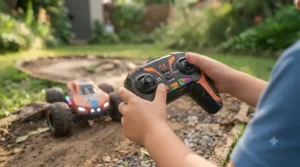
Now picture a nine-year-old with a wide-open basement rec room and a genuine obsession with anything that flips. The GILI Gesture Sensing RC Stunt Car fits that environment well — it needs open floor space to really perform, and the flip mechanic rewards exactly the kind of repetitive, high-energy play that a basement (rather than a cramped bedroom) can absorb without breaking a lamp.
And then there’s the toddler scenario: a three-year-old at a family gathering with a short attention span and zero patience for assembly instructions. The ZOHANINDL friction-powered three-pack solves that instantly — no setup, no waiting, no supervision required to charge a battery, just immediate pull-back speed that keeps a toddler occupied while the adults finish dinner.
Problem → Solution: Fixing the Most Common Stunt Car Toy Complaints
Problem 1: Cars won’t clear the loop. This is almost always a speed issue, not a defect. Solution: switch to hard flooring, clean the wheels, and confirm the launcher is fully engaged before release.
Problem 2: Track pieces keep disconnecting mid-play. Solution: anchor the base pieces with painter’s tape on smooth or slippery flooring, and avoid setting the track up on uneven carpet padding.
Problem 3: RC stunt car won’t respond to gestures reliably. Solution: dim overly bright lighting near the play area and keep the controlling hand within the sensor’s optimal range, typically a few feet.
Problem 4: Younger siblings feel left out of a complex build. Solution: pair a modular stunt kit with a simple friction-powered pull back race car for the younger kid, so both are engaged without one waiting on the other.
Problem 5: Motorized launchers drain batteries fast. Solution: use rechargeable batteries from the start; the ongoing cost evens out quickly compared to replacing alkalines every few weeks of heavy play.
How to Choose Stunt Car Toys for Boys
What is a stunt car toy? A stunt car toy is a vehicle or track system designed for dramatic play actions — loops, jumps, crashes, or flips — rather than simple straight-line rolling, built to survive repeated high-impact use.
Choosing the right one comes down to matching the product’s mechanics to your kid’s actual play style, not just picking whatever looks flashiest in photos. Here’s how to work through it:
- Consider your child’s age first. Younger kids (under 5) generally do better with simple friction-powered or pull-back cars; loop tracks and RC stunt cars suit ages 6 and up better, per most manufacturer guidance.
- Check the flooring where it’ll actually be used. Loop and launcher tracks need hard, flat surfaces to perform correctly — carpet-heavy homes should lean toward RC or friction-powered options instead.
- Decide between fixed and modular layouts. Fixed-layout sets (like the Criss-Cross Crash Track) are easier for younger kids; modular sets reward older kids who enjoy building.
- Factor in battery dependency. RC and motorized sets need an ongoing battery plan; friction-powered toys need none, which matters for spontaneous, low-supervision play.
- Think about multiplayer potential. Dual-launcher tracks solve sibling turn-taking arguments better than single-lane sets.
- Match storage to your space. Transforming, self-storing sets (like the tire-case playset) suit smaller homes better than sprawling multi-piece tracks.
- Read aggregated review themes, not star ratings alone. A 4.5-star average can still hide a recurring durability complaint that matters for your specific use case.
Double Loop Stunt Track Toy vs. Single-Loop Track: What’s the Real Difference?
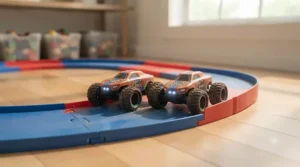
A double loop stunt track toy, like the Loop Stunt Champion, isn’t just “two loops for extra drama” — the real functional difference is the dual-lane launcher system that enables simultaneous racing. A single-loop track, like the T-Rex Loop Playset, is built around one dramatic moment per run rather than a head-to-head contest.
For a solo kid who loves narrative play, a single big loop paired with a story element (defeating a dinosaur, say) often holds attention longer than a race format, since there’s no opponent required to keep it interesting. For siblings or friend groups, though, a double loop stunt track toy earns its complexity — the built-in competition removes the “whose turn is it” friction that ruins solo-track sharing. Neither format is objectively better; it’s a household-composition question more than a product-quality one, and knowing which one applies to your situation will save you from buying the wrong style twice.
Common Mistakes When Buying Car Launcher Toy Boys Playsets
The most frequent mistake is buying a car launcher toy for boys based purely on box art drama without checking whether the launch mechanism needs batteries, since motorized boosters (like the one on the Criss-Cross Crash Track) add an ongoing cost that spring-loaded launchers avoid entirely. A second common misstep: assuming all die-cast cars are interchangeable across brands and track systems — while most 1:64 scale Hot Wheels-compatible cars work across sets, third-party or off-brand vehicles sometimes have wheel or weight differences that throw off launch consistency.
Parents also frequently underestimate flooring requirements, buying an elaborate loop set for a thick-carpet playroom and then being disappointed when cars stall halfway up. Finally, a subtler mistake: buying the single most expensive option assuming it guarantees more play value, when in practice a $15 friction-powered three-pack often gets more actual daily use than a $40 motorized track that requires setup time the kid doesn’t always want to commit to.
Gravity Defying Race Track: What to Expect in Real-World Performance
Marketing copy loves the phrase “gravity defying,” but here’s what that translates to in an actual living room: a car needs enough entry speed at the base of a loop to generate the centripetal force required to stay on the track through the inverted top section. In practice, that means launch power matters more than loop height for whether a stunt actually lands clean — a taller loop with a weak launcher will fail more often than a moderate loop paired with a strong spring-loaded launch.
What reviewers consistently note across gravity-defying loop products is that success rate improves noticeably with lighter, well-maintained die-cast cars versus heavier RC vehicles retrofitted onto standard tracks. If you want the visually dramatic “whoa” moment reliably, prioritize launcher strength and track surface friction over sheer loop height when comparing specs — it’s the detail that separates a toy that performs like its commercial versus one that frustrates a kid within the first ten minutes.
Pull Back Race Cars and Friction Powered Toy Cars for Younger Beginners
For kids just entering car-toy play, pull back race cars and friction powered toy cars are the natural starting point precisely because they remove every barrier between wanting to play and actually playing. There’s no battery to install, no remote to sync, and no track to assemble — the entire mechanism is contained in the car itself, engaged by a simple backward pull that even a two- or three-year-old can manage with a little practice.
The developmental case for these toys goes beyond convenience, too. Manipulating a small car, pulling it back with the right amount of force, and tracking its path across the floor all engage the same fine motor and spatial-reasoning skills that the American Academy of Pediatrics links to early problem-solving and physical development in young children. That’s not a marketing claim — it’s a genuine, incidental benefit of a toy that’s fun regardless. For beginner-level buyers, we’d recommend starting with a multi-pack (so there’s no single point of failure if one mechanism wears out) before graduating to more complex loop or launcher systems around age five or six.
Long-Term Cost & Maintenance of Stunt Car Launcher Sets
Sticker price only tells part of the ownership story. A friction-powered car set has essentially zero ongoing cost — no batteries, no replacement parts beyond the toy itself. A motorized stunt car launcher set, by contrast, carries a real recurring expense: alkaline batteries for a frequently-used motorized booster can add up over a play-heavy year, which is where switching to rechargeables pays for itself within a few months for households with daily play sessions.
RC stunt cars sit in the middle — battery cost is contained to the vehicle’s internal pack (often rechargeable via USB in newer models), but the tradeoff is a shorter usable lifespan if the internal battery degrades, since replacing it isn’t always straightforward for a consumer to do at home. Track-based sets, meanwhile, have the best cost-per-play-hour math over multi-year ownership, assuming plastic connectors survive normal wear, since a single purchase can deliver years of reconfigurable play without ever needing a battery aisle trip.
Features That Actually Matter (And Those That Don’t)
Loop height sounds impressive on a box but matters far less than launcher consistency and track surface friction — a shorter loop with a reliable launch mechanism will outperform a taller one with a weak spring nearly every time. Similarly, the number of included vehicles is a weaker signal of value than most parents assume; seven mediocre cars matter less than two cars that reliably clear every stunt they’re launched into.
What genuinely does matter: modular compatibility with other sets in the same line (protects your investment as the collection grows), storage design (reduces lost pieces, which is the number-one reason a great toy ends up abandoned in a closet), and battery independence for younger kids who need instant-gratification play. Flashy extras like built-in sound effects or lights tend to rank low on genuine long-term engagement based on aggregated review themes — kids habituate to sound and light gimmicks fast, while the core mechanical satisfaction of a clean loop clear or a solid crash holds up over years of play.
Safety, Regulations, and Compliance Guide
All toys sold for children in the U.S. intended for kids under 3 must comply with federal small-parts regulations, and toys with small components for slightly older kids require choking-hazard warning labels under the same framework, as detailed by the Consumer Product Safety Commission’s small parts guidance. Practically, that means always checking the age grading printed on a stunt car toy’s packaging before assuming it’s safe for a younger sibling who might wander over and put a small die-cast car in their mouth.
For RC stunt cars specifically, check battery compartment screws for a secure fit before handing the toy to a young child, and supervise charging — most gesture-sensing and remote-control stunt cars use small lithium or AAA battery packs that should never be left charging unattended overnight. For motorized launcher tracks, keep an eye on pinch points around the launch mechanism itself, since spring-loaded launchers can pinch small fingers if a kid reaches in mid-load. None of this should scare you off — these are mainstream, widely-sold toys — but a five-second age-label check before gifting solves the vast majority of real-world safety issues parents actually run into.
Frequently Asked Questions
❓ What age is appropriate for stunt car toys for boys?
❓ Do stunt car tracks work on carpet?
❓ Are Hot Wheels stunt tracks compatible with other brands of die-cast cars?
❓ How long do RC stunt car batteries last per charge?
❓ What's the difference between a friction powered toy car and a pull back race car?
Conclusion
There’s no single “best” stunt car toy for boys — there’s only the best match for the kid, the floor plan, and the noise level your household can tolerate on a given afternoon. If sibling rivalry is the driving force in your house, the dual-launcher Loop Stunt Champion earns its keep by turning competition into the feature instead of the problem. If your kid is younger or you just want a zero-hassle option for the car ride to grandma’s, the friction-powered three-pack is genuinely hard to beat for the price.
What ties every pick on this list together is that none of them require you to sacrifice real engineering for flash — every product here does the mechanical job it promises, whether that’s a clean loop clear, a satisfying four-way crash, or a flip that doesn’t end the fun. Stunt car toys have stuck around for decades because the underlying appeal (speed, impact, a little bit of controlled danger) never really goes out of style, and honestly, watching a kid’s face the first time a car clears a loop is reason enough to keep buying them.
✨ Don’t Miss These Exclusive Deals!
🔍 Ready to pick the perfect stunt car toy for your young racer? Check current pricing on any of the products above and grab the one that fits your kid’s play style best — the loop clear moment is worth it.
Recommended for You
- 7 Best Diecast Cars for Kids in 2026: Tiny Wheels, Big Fun
- 7 Best Monster Jam Toy Trucks in 2026 (Real Amazon Picks)
- Electric Slot Car Racing Set for Kids: 7 Best Picks (2026)
Disclaimer: This article contains affiliate links. As an Amazon Associate, I earn from qualifying purchases. If you purchase products through these links, we may earn a small commission at no additional cost to you.
✨ Found this helpful? Share it with your friends! 💬🤗
