
In This Article
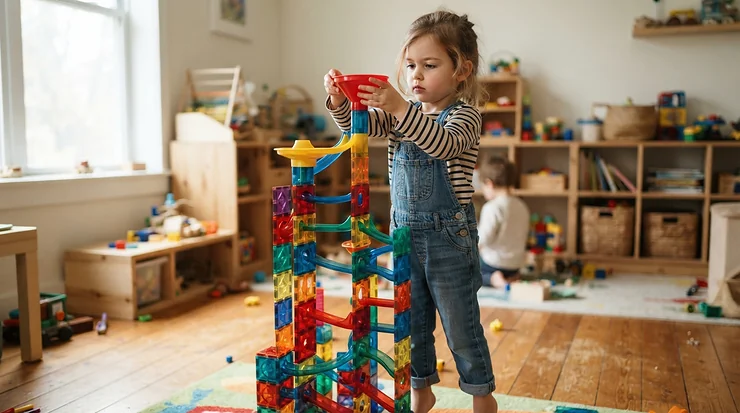
Marble run sets for kids ages 6 and up are construction toys built from interlocking tracks, funnels, spinners, and ramps that children assemble into gravity-powered courses for rolling marbles. At this age, kids can follow multi-step plans, troubleshoot slopes, and build taller, more ambitious layouts than preschool sets allow, learning basic physics through trial and error.

Here’s the funny thing about this category. The toy-aisle label usually says 3+ or 4+, because the marbles are the only thing regulators really worry about. But a 6-year-old has a very different appetite than a 4-year-old. A preschooler is thrilled when the marble comes out the bottom. A first-grader wants the marble to do something interesting on the way down. Adults have felt the same pull for generations, which is why the marble run has a grown-up cousin in the art world, the rolling ball sculpture, a form of kinetic art.
So this guide sorts the market by what an older kid needs: a higher ceiling, more parts, smarter mechanics, and stability that survives a bumped table. You’ll get seven real sets across plastic, magnetic, and wooden builds. You’ll also get deeper dives on marble run track layouts, magnet strength and safety, and a few side detours for the younger sibling in your house: a wooden train set for 3 year olds, magnetic tiles vs building blocks for 3 year olds, and brand-agnostic train track compatibility.
One note on method. This article is built from spec sheets, regulator documents, and aggregated review sentiment, not hands-on testing. Prices appear as ranges because they change constantly, so check current price before you buy.
Quick Comparison Table: Marble Run Sets for Kids Ages 6 and Up at a Glance
| Product | Pieces | Style | Label Age | Price Range | Best For |
|---|---|---|---|---|---|
| Marble Genius Super Set | 150 (85 track + 65 glass marbles) | Translucent snap-together | 4+ | Mid-range; check current price | First big run, solo building |
| Ravensburger GraviTrax Starter Set | 122 | Gravity + magnetic system | 8+ | Around $55-$80 | Puzzle-minded kids who love challenges |
| Thames & Kosmos Marble Run Essential 70-Piece | 70 (60 track + 10 glass marbles) | Interlocking track | 6+ | Around $40-$50 | Ages 6-8 on a budget |
| JOYIN 236-Piece Glowing Marble Run | 236 (176 track) | Snap-together + motorized elevator | Listed 3+ | From around $40 | Endless-loop spectacles |
| National Geographic Glow-in-the-Dark Marble Run | 80 | Clear track + glow marbles | 8+ | Budget-to-mid; check current price | Lights-out play, easy storage |
| MAGBLOCK 176-Piece Magnetic Marble Run | 176 | Magnetic tile-style | 8+ | Mid-to-upper; check current price | Tall, sturdy builds |
| Hape Quadrilla Race to the Finish | 58 | Wooden stacking | 4+ | Around $60-$75 | Wood lovers, two-marble races |
Looking at the table above, the Thames & Kosmos Marble Run Essential 70-Piece is the only set whose label starts at exactly age 6, which matters if you want a toy pitched at your child’s level. The JOYIN 236-Piece Glowing Marble Run offers the most pieces for the money, while the Ravensburger GraviTrax Starter Set asks the most brainpower. Pick based on whether your child wants to build big, solve puzzles, or play for years.
💬 Just one click — help others make better buying decisions too!😊
Top 7 Marble Run Sets for Kids Ages 6 and Up: Expert Analysis
Every pick below pairs real specs with what those specs mean in practice. Review sentiment is aggregated from public listings and review roundups, so verify live ratings before buying.
1. Marble Genius Super Set — best all-rounder for a first big run
The standout is the see-through track. Translucent pieces let a child watch a marble vanish into a tunnel and spot exactly where it stalls. The set packs 150 pieces, which breaks down to 85 track components plus 65 glass marbles, in 19 piece styles with several solid bases. The pieces are chunky, so 85 track parts build a taller, more dramatic tower than 85 small blocks would.
Based on the spec comparison, this suits a 6-to-8-year-old who wants to build solo after one afternoon of adult help. The label starts at age 4, so a 6-year-old will outgrow the starter layouts fast. The stunt pieces then become the reason to keep inventing. The instruction sheet is visual-only, which is great for kids who learn by looking and a limit for those who prefer written steps.
Reviewers consistently praise the snug connectors that still pull apart for small hands. A common complaint is that pieces can pop apart during energetic play, that the base pieces break first, and that the companion app is unreliable.
Pros:
- ✅ Translucent track shows exactly where runs jam
- ✅ Huge variety of stunt and transition pieces
- ✅ Snap fit holds firm but stays kid-removable
Cons:
- ❌ Base pieces are the weakest structural point
- ❌ Too few pieces for true side-by-side racing
Mid-range price tier, so check current price. The value verdict is strong per piece, as long as you accept a stability tax on very tall builds.

2. Ravensburger GraviTrax Starter Set — best for building real physics intuition
GraviTrax isn’t just a run. It’s a puzzle. The 122-piece starter set blends gravity-driven track with magnetic elements, plus a construction booklet and a free app with challenges. In practice, a marble can be launched, redirected, and accelerated rather than merely dropped. That turns “build a slide” into “solve for a goal,” and it’s the biggest jump in thinking this roundup offers.
The label says 8+. One reviewer with boys aged 6, 8, and 10 reported that all three stayed interested, so a sharp 6-year-old can manage with some help, though a 9-year-old will get the most out of it. The real advantage is system compatibility: retailer notes say the starter set works with other GraviTrax sets. The flip side is that the ecosystem invites add-on spending, so budget for total cost, not just the box.
Reviewers describe the set as well designed, easy to use, and surprisingly versatile. Aggregated summaries mention a couple of small issues but mostly positive feedback, and retailer listings note a 2018 Parents’ Choice Gold Award.
Pros:
- ✅ Magnetic and gravity elements go beyond simple ramps
- ✅ Expandable with other GraviTrax sets
- ✅ Booklet and app give structured challenges
Cons:
- ❌ Age 8+ label means help for younger 6-year-olds
- ❌ Expansions can multiply the total spend
Price range is roughly $55-$80 depending on seller. The verdict is worth it if your child will stick with puzzle-style building.
3. Thames & Kosmos Marble Run Essential 70-Piece — the only set labeled exactly 6+
This one is aimed squarely at this guide’s audience. The 70-piece kit includes 60 colorful track pieces designed to interlock securely, ten glass marbles, a manual with step-by-step builds and physics experiments, and a storage bag. Ten marbles is modest, which in practice nudges kids toward timing runs and comparing stunts instead of flooding the track.
Here’s what to weigh. The smaller footprint suits a bedroom corner, a classroom bin, or a travel-friendly gift. The ceiling is lower than the 150-piece-plus sets, so a very ambitious builder will want an expansion within a year. The set is a 2026 release listed to ship in June 2026, so the review pool is thin. Aggregated sentiment can’t be verified yet, and the “interlocks securely” claim deserves a check against fresh reviews as they accumulate.
Pros:
- ✅ Age 6+ label matches this audience
- ✅ Manual includes physics experiments
- ✅ Storage bag makes cleanup quick
Cons:
- ❌ Only ten marbles limits multi-marble races
- ❌ New release with limited review history
Price range is around $40-$50 depending on seller. The verdict is fair for a focused starter, especially for ages 6 to 8.
4. JOYIN 236-Piece Glowing Marble Run — most pieces plus a motorized elevator
The hook is the elevator: marbles climb back to the top on their own, so a child can build a closed loop and watch it cycle without carrying marbles upstairs. The listing counts 176 track pieces and about 60 marbles in total, split among plastic, glow-in-the-dark, and glass. The glow effect depends on charging under light, so it shines best at dusk.
On paper, 236 pieces means long builds and room for two kids. The label says 3+, which tells you the set is aimed wide, but the size makes it a better fit for a patient 6-to-9-year-old. Expect a long first build: one roundup estimates about 25 minutes, and one parent reported roughly an hour for a 6-year-old working with a parent. Motorized parts also add a failure point that gravity-only sets don’t have.
Reviewers describe kids returning to it daily and call the elevator the favorite feature. Reviews of glow-style plastic runs in general mention that bases and track pieces can snap under rough handling.
Pros:
- ✅ Motorized elevator creates endless loops
- ✅ Large piece count supports big builds
- ✅ Glow marbles add after-dark appeal
Cons:
- ❌ Motor adds a possible point of failure
- ❌ Long first build needs patience or help
Price range starts around $40 depending on seller. The verdict is excellent value per piece if the elevator holds up.
5. National Geographic Glow-in-the-Dark Marble Run — best for calm, lights-out play
This compact kit has 80 pieces: 45 clear track pieces, 15 action pieces, 5 bases, and 15 glow-in-the-dark glass marbles in six colors. The box is about 14 by 4 by 10 inches and weighs around 2.8 pounds. In practice, that means quick setup, easy storage in the included bag, and a calmer, bedtime-friendly style of play. Roundups note a charging light pen for the glow marbles and a learning guide covering motion.
The honest trade-off is height. Five bases cap how tall a tower can safely go, so this set rewards clever layout over raw scale. Per the label, it’s aimed at ages 8 and up. A confident 6-year-old can manage the pieces, but the parent will probably do the first build.
Reviewers like the glow effect and the tidy storage. A recurring complaint across reviews is that pieces can pop apart or snap when bumped, and that base pieces break first.
Pros:
- ✅ Compact kit with a storage bag
- ✅ Glow marbles suit dim-room play
- ✅ Quick to assemble and put away
Cons:
- ❌ Limited bases cap tower height
- ❌ Base pieces are a common breakage point
Budget-to-mid price tier; check current price. The verdict is a smart second set or a tidy first one.
6. MAGBLOCK 176-Piece Magnetic Marble Run — sturdiest tall builds
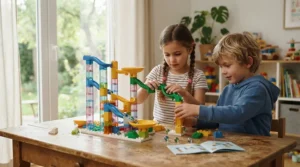
Magnetic construction changes the physics of building. Instead of snapping pegs into holes, kids stick tile-style pieces together with magnets, so a structure can go taller and wider without a base underneath. The 176-piece set offers three play modes plus a turntable and windmill, ships with 12 glass marbles, and is described as compatible with major magnetic tile sets. Roundups also describe corner-positioned magnets and ultrasonically welded construction, which is meant to keep magnets sealed inside.
Here’s what most buyers overlook. Magnetic runs reward kids who already think in tiles and shapes. If your child already owns magnetic tiles, this is a natural extension. If not, the learning curve is steeper than with snap-together plastic. Reviews of magnetic marble runs in general mention that pieces can slide or detach mid-run and that the course can feel short once every piece is used.
Pros:
- ✅ Magnets support tall, wide, freeform builds
- ✅ Turntable and windmill add moving stunts
- ✅ Works with existing magnetic tile collections
Cons:
- ❌ Magnets demand careful supervision around younger siblings
- ❌ Pieces can shift during fast runs
Mid-to-upper price tier; check current price. The verdict is best for builders who want height, with a safety routine in place.
7. Hape Quadrilla Race to the Finish — best wooden option for two-marble races
Wood changes the feel of play. The 58-piece set is billed as a beginner’s Quadrilla build, made from FSC-certified wood with non-toxic finishes and designed so you drop two marbles in and watch them race down different paths. It includes distributor blocks, curve rails, a spiral twist, height adjusters, stabilizer rings, and accelerators, and it’s compatible with other Quadrilla sets. The label starts at age 4, so a 6-year-old will absorb it quickly and move on.
Based on the spec comparison, this is the set for families who prefer less plastic, want a toy that looks good on a shelf, and don’t mind paying for it. Marble catchers are sold separately, and one parent review notes that marbles scatter everywhere without them.
Reviewers praise the sturdy build and quality feel, and the common complaint is price. Some also report that taller builds can fall apart easily and that bigger Quadrilla sets cost a lot.
Pros:
- ✅ Sturdy wooden build with a premium feel
- ✅ Two-marble race design adds friendly competition
- ✅ Expandable with other Quadrilla sets
Cons:
- ❌ Marble catchers sold separately
- ❌ Premium price for a 58-piece set
Price range is around $60-$75. The verdict is worth it if wood and longevity matter more than piece count.
Top 7 Compared: Specs, Price Ranges and Best For
| Product | Material | Pieces | Label Age | Price Range | Review Signal | Best For |
|---|---|---|---|---|---|---|
| Marble Genius Super Set | Plastic | 150 (85 track) | 4+ | Mid-range | Strong; base stability complaints | Best overall |
| Ravensburger GraviTrax Starter Set | Plastic + magnets | 122 | 8+ | Around $55-$80 | Strong; award-listed | Puzzle lovers |
| Thames & Kosmos Marble Run Essential 70-Piece | Plastic | 70 (60 track) | 6+ | Around $40-$50 | New; limited reviews | Ages 6-8 starter |
| JOYIN 236-Piece Glowing Marble Run | Plastic + motor | 236 (176 track) | 3+ | From around $40 | Positive; durability varies | Big, long loops |
| National Geographic Glow-in-the-Dark Marble Run | Plastic | 80 | 8+ | Budget-to-mid | Strong; pop-apart complaints | Bedtime play |
| MAGBLOCK 176-Piece Magnetic Marble Run | ABS + magnets | 176 | 8+ | Mid-to-upper | Strong in roundups | Tall builds |
| Hape Quadrilla Race to the Finish | Wood | 58 | 4+ | Around $60-$75 | Praised quality; pricey | Wood lovers |
Reading across the rows, the cheapest per piece is the JOYIN 236-Piece Glowing Marble Run, while the Hape Quadrilla Race to the Finish costs the most per piece but is the most likely to survive years of play. The Ravensburger GraviTrax Starter Set is the best long-term investment if your child enjoys puzzle logic, since expansions extend its life. Treat the review-signal column as a starting point, not a verdict, because ratings shift.
✨ Ready to Build Something Big?
🔍 Take your marble run sets for kids ages 6 and up shortlist to the next level. Click any highlighted product name above to check current pricing and availability. These picks will help you create hours of authentic, screen-free building your family will love! 🧩
Practical Usage Guide: Your First 30 Days With a Marble Run
The first month decides whether a set becomes a favorite or a closet resident. Here’s a simple plan.
Day 1: set the stage. Sort pieces by type into a shallow tray or muffin tin. Build on a hard, flat surface, because carpet makes bases rock. Put a rimmed baking sheet or low cardboard box at the finish line so marbles stop rolling across the room.
Week 1: follow the booklet. Build two or three of the included layouts exactly as shown. Kids learn what “working” looks like before they improvise.
Week 2: change one variable. Swap a single ramp, lengthen one drop, or add one spinner. This is the heart of the toy: a too-flat ramp stalls the marble, a too-steep one flings it off, and your child is running a physics experiment without noticing.
Week 3: race and time. Use a phone stopwatch to compare two runs. Turn the results into a simple chart.
Week 4: set a design challenge. Use every stunt piece once, or make the marble take at least 15 seconds.
Maintenance and common mistakes:
- Count marbles after each session, and keep them away from under-3s.
- Wipe glass marbles with a damp cloth.
- Check bases for hairline cracks before building tall.
- Avoid the classic mistake of building too tall too soon on carpet.
- Charge glow marbles in light before lights-out play.
Real-World Scenarios: Which Marble Run Fits Your Kid?
Here are three profiles, each matched to a pick with the reasoning behind it.
Scenario 1: the 6-year-old with a younger sibling. Budget under $50, hardwood floors, 30 minutes of play most afternoons. The Thames & Kosmos Marble Run Essential 70-Piece fits the age label, and its compact size means fewer stray pieces. Keep marbles in a lidded bin, since the box carries age warnings and the three-year-old will want in.
Scenario 2: the 9-year-old puzzle lover. Weekend builder, patient, enjoys instructions. The Ravensburger GraviTrax Starter Set gives structure through the booklet and app, and expansions keep it fresh. Budget for the starter plus one expansion in year one.
Scenario 3: the cousin crowd. Three or four kids, a big family room, rainy-day energy. The JOYIN 236-Piece Glowing Marble Run gives everyone a job, and the elevator keeps the show going. The Marble Genius Super Set is the alternative if you prefer no motor to fail.
Bonus scenario: the wood-first household. Minimal plastic, shelf-worthy toys, a long view. The Hape Quadrilla Race to the Finish earns its premium by working with the wider Quadrilla range.
How to Choose Marble Run Sets for Kids Ages 6 and Up
Here’s a quick, snippet-friendly checklist.
- Match the label to the challenge, not just the age. A 4+ label can still work for a 6-year-old if the stunt pieces are rich. An 8+ label signals heavier puzzle demands.
- Count track pieces, not total pieces. Marbles often inflate the headline number. The Marble Genius set’s 150 includes 65 marbles, so the real track count is 85.
- Check base and stability design. Base pieces are the most commonly reported breakage point in plastic sets, so look for sets with several solid bases.
- Decide on the power source. Gravity-only sets never break down. Motorized elevators add loops but add a failure point.
- Choose your material. Plastic offers variety, wood offers longevity, and magnetic offers height. Each has trade-offs covered below.
- Think expansion. GraviTrax, Quadrilla, and magnetic sets can grow, which changes total cost.
- Read the safety label. Marbles are small parts, and magnetic sets need the extra checks in the next sections.
Marble Run Track Layouts: Six Designs Worth Building
Marble run track layouts decide whether a set feels endless or exhausted. Here are six reliable patterns, with the sets that suit them.
The staircase cascade. A zigzag descent that always works. It’s the best first layout because it teaches slope and the physics of friction.
The helix tower. A vertical spiral that wraps around a central column. The Quadrilla spiral twist and the Marble Genius tower pieces suit it.
The split race. Two tracks start together and finish at different times. The Hape Quadrilla Race to the Finish is designed around two marbles, and Quercetti’s Skyrail Race line also targets double-track racing.
The elevator loop. A closed circuit where marbles are lifted back to the start. The JOYIN 236-Piece Glowing Marble Run is the straightforward example.
The suspended coaster. Elevated tracks hung between towers. Quercetti’s Skyrail starter is labeled ages 6-12 and builds suspended tracks several yards long.
The wall run. A vertical layout on a fridge or whiteboard. National Geographic’s magnetic marble run targets this style, though it’s labeled 10+.
A practical tip: build from the bottom up. A stable finish line gives you something to measure against, and it prevents the frustration of a gorgeous top section feeding into a collapsing base.
Magnet Strength and Safety: What Parents of Older Kids Should Know
Magnet strength and safety is the section most buyers skip, and it’s the one worth reading. Stronger magnets hold taller builds. Weaker magnets are easier for small hands to separate. But the real hazard isn’t strength at all. It’s loose magnets.
The U.S. toy standard, ASTM F963, handles this through a measure called flux index. The standard treats a magnet as hazardous if it’s small enough to fit within the small-parts cylinder and has a flux index of 50 or more. Regulators explained that ASTM chose 50 as the cutoff because magnets involved in incidents measured above 70. The CPSC accepted ASTM F963 as a mandatory toy standard in 2012, effective June 12, 2012.
A related magnet-set rule was vacated by a federal court and removed from the regulations. A later rule covers non-toy magnets and exempts toys that are already subject to ASTM F963. In practice, that means toy-labeled magnetic marble runs fall under the toy standard.
Here’s what to do:
- Buy sets marketed as toys that state ASTM compliance.
- Inspect pieces regularly for cracks where a magnet could come loose.
- Keep magnetic sets away from children under 3.
- Check recalls before buying and after gifting.
No listing reviewed publishes a measured flux index for individual products, so rely on standards compliance and routine inspection. Roundups describe the MAGBLOCK 176-Piece Magnetic Marble Run as using welded magnets and a ASTM-tested approach for tile-style rivals, but verify on the listing.
Magnetic Tiles vs Building Blocks for 3 Year Olds
Families shopping for a 6-year-old often have a preschooler underfoot, so here’s a quick look at magnetic tiles vs building blocks for 3 year olds.
Magnetic tiles snap together with a satisfying click and give instant success. One parent blog reports a toddler connecting magnetic tiles at around age 1, while consistently snapping Duplo-style bricks together came closer to age 2. That’s one family’s anecdote, not a rule. Both Magna-Tiles and PicassoTiles are advertised for ages 3+, and they’re reported to work with each other. Magna-Tiles are described as having riveted seams, while PicassoTiles use glued seams, which matters if your child chews.
Building blocks build grip strength and teach stability. Duplo-style bricks are commonly recommended for ages 2-4. Mega Bloks work for ages 2-3 as a Duplo alternative, though one roundup says they don’t interlock as reliably.
Which is better for a 3-year-old? Based on the comparison, magnetic tiles suit kids who get frustrated easily, and blocks suit kids who need to develop finger strength. Many families wisely own both.
On safety, magnets are the extra consideration. The American Academy of Pediatrics’ HealthyChildren site warns that swallowing more than one high-powered magnet can be life-threatening and advises checking toys often for cracks and recalls. Price ranges run roughly $45-$60 for a 100-piece PicassoTiles set and $40-$50 for a 32-piece Magna-Tiles starter. Check current price on both.
Wooden Train Set for 3 Year Olds: A Companion Pick for Younger Siblings
A wooden train set for 3 year olds is the classic “systems” toy for the same household that owns a marble run. Wooden track is durable, quiet, and endlessly reconfigurable.
For a first set, start small. A 20-to-40-piece starter gives a 3-year-old a finished loop quickly. Melissa & Doug’s figure-8 starter is around 22 pieces, while a deluxe 52-piece set with magnetic trains and nine layouts is listed for ages 3+. If you want growth room, Melissa & Doug also offers a 130-piece railway set with freight and passenger trains and four layout configurations.
What matters most for a wooden train set for 3 year olds:
- Magnetic couplings. Easier for small hands than hooks. Check that magnets are sealed in.
- Smooth edges and non-toxic finishes. Listings highlight rounded edges and ASTM F963 compliance.
- Room to expand. Reviewers of one deluxe set flag occasional derailments from track asymmetry, so buy a bit more straight and curved track than you think you need.
Money-saving trick: mix brands. You can buy premium accessories from one maker and bulk straight track from another, which brings us to compatibility.
Brand-Agnostic Train Track Compatibility: What Fits What
Brand-agnostic train track compatibility sounds like a promise, but it’s more like a habit. Most wooden track uses the same knob-and-pocket connections, and manufacturers have followed it for years. Sources report that Brio, Thomas wooden track (sometimes with adapter connectors), Hape, Melissa & Doug, Chuggington, KidKraft, Imaginarium, Bigjigs, and many generic brands connect with one another. Manhattan Toy states its system works with all major brands.
Brand-agnostic train track compatibility has caveats:
- IKEA’s pegs are reportedly longer. The connection works but may fit tightly.
- Thomas plastic isn’t Thomas wood. One source states TrackMaster, wooden Thomas, and Take-n-Play aren’t compatible with each other.
- “Compatible” is marketing. None of the sources reviewed point to a formal certification.
- Trains vary. Some derailments come from uneven track rather than brand mismatch.
The wiggle test is simple: connect two pieces, and if you have to force the knob, expect a tight fit that may loosen with use. The takeaway for shoppers: buy the best locomotive and bridges you can afford, then fill out the loop with budget track from any compatible brand.
Marble Run Sets vs Traditional Building Toys for Kids Ages 6 and Up
| Toy Type | What It Builds | Where It Shines | Where It Falls Short | Best For |
|---|---|---|---|---|
| Marble run | Gravity courses | Instant cause-and-effect feedback | Marbles need supervision and cleanup | Marble Genius Super Set |
| Magnetic tiles | Shapes and structures | Fast, forgiving building | Magnet safety care needed | MAGBLOCK 176-Piece Magnetic Marble Run |
| Wooden blocks | Stacking and balance | Durable, quiet, open-ended | Less built-in “action” | Hape Quadrilla Race to the Finish |
| Puzzle systems | Logic challenges | Structured goals | Higher cost with expansions | Ravensburger GraviTrax Starter Set |
The table shows that marble runs win on built-in feedback: the toy tells your child whether the design worked. Blocks and tiles win on open-ended freedom, and puzzle systems win on structured goals. If your child gets bored once a build is done, a marble run adds the “now test it” step that blocks lack.
Long-Term Cost and Maintenance
A set in the $50 range used a few times a week for a year works out to pennies per session. That’s the real math of marble runs: cost per play drops fast if the toy survives.
Durability. Wood tends to last longest, plastic varies by brand, and magnets add toughness but need inspection. The most common breakage across plastic sets is the base pieces.
Expansion costs. GraviTrax and Quadrilla encourage add-ons. A good rule is to buy one expansion only after your child has exhausted the starter layouts.
Lost pieces. Marbles disappear. Buy a bag of replacement marbles, and keep a count.
Recalls and safety. Check CPSC’s magnets safety center, which warns that high-powered magnets are a safety risk to children from toddlers through teens.
Resale and hand-me-downs. Sets with intact marbles and bases hold value well among parents.
FAQ
❓ Are glass marbles or plastic marbles better in a marble run?
❓ Can I mix marble run sets from different brands?
❓ Are magnetic marble run sets safe for kids ages 6 and up?
❓ Is a motorized marble run worth the extra cost?
❓ How much space does a marble run need?
Conclusion
The best marble run sets for kids ages 6 and up aren’t the biggest boxes. They’re the ones that match your child’s patience, your floor space, and your tolerance for upkeep. The Marble Genius Super Set is the safest all-rounder, the Thames & Kosmos Marble Run Essential 70-Piece is the only one labeled exactly for this age, and the JOYIN 236-Piece Glowing Marble Run gives the biggest show per dollar. The Ravensburger GraviTrax Starter Set rewards puzzle-minded kids, the National Geographic Glow-in-the-Dark Marble Run makes a calm evening toy, the MAGBLOCK 176-Piece Magnetic Marble Run builds tall, and the Hape Quadrilla Race to the Finish is the heirloom pick.
Remember the side notes too. Magnet strength and safety is about sealed magnets and regular inspection, not just pull force. A wooden train set for 3 year olds can share space with your marble run, and brand-agnostic train track compatibility lets you mix budget track with premium trains. Whichever you choose, start with the layouts that teach slope, then let your child break the rules.
Recommended for You
- LEGO Compatible Brick Sets For 8 Year Olds: 7 Best Picks 2026
- Large Building Blocks For Toddlers: 7 Best Safe Picks In 2026
- 37 Key Keyboard Vs Full Size Keyboard For Kids: 7 Best Picks 2026
Disclaimer: This article contains affiliate links. As an Amazon Associate, I earn from qualifying purchases. If you purchase products through these links, we may earn a small commission at no additional cost to you.
✨ Found this helpful? Share it with your friends! 💬🤗
