
In This Article
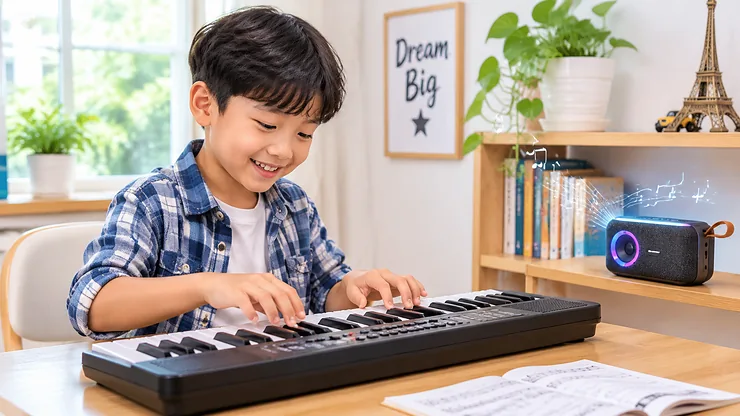
The 37 key keyboard vs full size keyboard for kids debate comes down to hand size, age, and goals. A 37-key model uses narrow mini keys and spans about three octaves, ideal for toddlers and preschoolers. A full size keyboard uses standard-width keys, usually 61 to 88 of them, and prepares kids for real piano lessons.
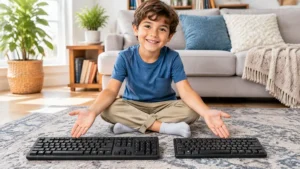
Here’s what the toy-aisle shelf never tells you: both answers are right, just at different ages. The 37 key keyboard vs full size keyboard for kids question isn’t a quality contest. It’s a timing contest. Squeeze a seven-year-old onto mini keys and she’ll outgrow them within a season. Hand a three-year-old a 61-key board and she’ll treat it like a very expensive xylophone, which, honestly, is fine too.
This guide sorts it out with real specs and aggregated review themes, not claims of hands-on testing. The seven picks span 37-key, 61-key, and 88-key keyboards. They also include three companions that tend to land in the same cart: a tongue drum, a karaoke mic, and a speaker. Along the way we’ll unpack weighted vs unweighted keys, a difference Yamaha explains well in its guide to weighted keys. We’ll also ask whether learning-mode lights on keyboards are a great teacher or a clever crutch.
Quick Comparison Table: Seven Picks at a Glance
| Product | Type | Standout Spec | Price Range | Best For |
|---|---|---|---|---|
| aPerfectLife 37-Key Kids Keyboard | 37 mini keys | 8 tones, 8 rhythms, USB or battery | Under $25 | Ages 2-5, first exploration |
| Casio LK-S250 | 61 full-size keys | Key Lighting System, 400 tones | Around $150-$200 | Visual learners, ages 6+ |
| Yamaha PSR-E383 | 61 touch-sensitive keys | Built-in lesson functions | Around $200 | Kids starting lessons |
| Casio CDP-S160 | 88 weighted keys | Scaled Hammer Action II | $400-$550 range | Committed long-term students |
| HOPWELL 13-Inch 15-Note Steel Tongue Drum | Tuned percussion | D Major, mallets and carry bag | $90-$130 range | Ages 5+, no-sheet-music play |
| BONAOK Q78 Karaoke Microphone | Mic with speaker | Bluetooth, 27 LED lights, echo | Budget tier, often under $40 | Young singers |
| JBL JR POP | Bluetooth speaker | IPX7 waterproof, about 5 hours | Around $40-$50 | Playlists, bath and backyard |
Look at the pattern above: the price climbs with key size and key feel, not with fun. The aPerfectLife costs roughly a tenth of the Casio CDP-S160, yet it may deliver more giggles per dollar for a four-year-old. For a child already in lessons, the Yamaha PSR-E383 is the safer middle road. The companions (HOPWELL, BONAOK Q78, JBL JR POP) sit in their own lane and never replace the keyboard decision.
💬 Just one click — help others make better buying decisions too!😊
Top 7 Picks: Expert Analysis for the 37 Key Keyboard vs Full Size Keyboard for Kids Decision
1. aPerfectLife 37-Key Kids Keyboard — lightest on-ramp for preschoolers
Weight is this keyboard’s secret weapon. It’s built to be carried, dropped, and sat on by someone who hasn’t yet learned the word careful.
You get 37 mini keys, roughly three octaves, plus 8 tones and 8 rhythms, powered by USB or batteries. Those numbers look skimpy, but for a preschooler they’re a feature. Fewer buttons means fewer rabbit holes, and three octaves is plenty for hunting out a nursery tune with one finger. Mini keys are narrower than standard keys, which suits tiny hands now and becomes a limitation later.
Based on the spec comparison, this is a discovery tool, not a teaching tool. Keyboards at this price tier generally skip touch-sensitive keys, so every note plays at the same volume. That’s fine for play but won’t teach dynamics, so confirm on the listing. Choose it for ages two to five, or as a low-risk experiment before spending real money.
Aggregated sentiment is thin. One roundup lists it around 4.1 stars, but I couldn’t verify a deep pool of detailed reviews. Treat durability and sound claims as unconfirmed and read recent buyer feedback first.
Pros:
- ✅ Mini keys fit toddler hands comfortably
- ✅ Light enough for kids to carry themselves
- ✅ Runs on USB or batteries for flexible placement
Cons:
- ❌ Only 8 tones and 8 rhythms
- ❌ Mini keys transfer poorly to full-size keys
Price range: under $25, so check current price. Verdict: a cheap, low-regret trial run.
2. Casio LK-S250 — lighted keys for visual learners
Those glowing keys are the whole pitch. LEDs show a child exactly which note comes next, turning sheet-music hieroglyphics into a follow-the-light game.
The spec sheet lists 61 full-size keys with three levels of touch response, 400 tones, 77 rhythms, USB-MIDI, a carry handle, and battery operation. In practice that means about 7.5 pounds of keyboard, light enough to move between rooms, with keys that won’t need replacing as hands grow. MusicRadar’s hands-on review praised how light and portable it is. It also found many of the 400 tones uninspiring, and its review unit arrived without a power supply, so check what’s in your box.
This is arguably the cleanest answer to the size dilemma for ages six to ten: full-size keys, guided practice, no digital-piano price tag. The catch is that roundups report only four notes lighting at once, so busier passages outrun the system.
Reviewers consistently praise the lighting and portability. Recurring complaints are no stand or bench in the box and no onboard recording.
Pros:
- ✅ Full-size keys that grow with your child
- ✅ Light-up keys make note-finding intuitive
- ✅ Battery operation plus a built-in carry handle
Cons:
- ❌ Only four keys can light at once
- ❌ No onboard recording function
Price range: around $150-$200. Verdict: strong value for lesson-age kids.
3. Yamaha PSR-E383 — touch-sensitive keys that teach dynamics
This is the keyboard you buy when a piano teacher says, “Make sure it’s touch-sensitive.”
It offers 61 touch-sensitive full-size keys, a large library of voices and rhythms, USB-MIDI, and Yamaha’s lesson functions that break songs into hand-by-hand steps. Touch sensitivity means a gentle press plays soft and a firm press plays loud. That is how kids learn expression. Without it, every note shouts at the same volume.
What most buyers overlook is that the keys are still unweighted, so fingers will feel the jump to an acoustic piano later. Even so, it’s the best bridge between toy and instrument in this price class, especially for kids around seven and up who can follow lesson steps without a parent hovering.
Roundups consistently rank it a top beginner pick. The recurring critiques are no stand or bench included, a chassis that feels plasticky when lifted, and a 6.35 mm headphone jack that needs an adapter for standard kids’ headphones.
Pros:
- ✅ Touch-sensitive full-size keys teach dynamics
- ✅ Built-in lesson functions guide practice
- ✅ USB-MIDI connects to learning apps
Cons:
- ❌ Keys remain unweighted
- ❌ Stand and bench not included
Price range: around $200. Verdict: the best all-round pick for lesson-takers.
4. Casio CDP-S160 — weighted keys without the bulk
Most weighted pianos look like furniture. This one looks like a slab of black glass, which is why it fits where others won’t.
The specs: 88 weighted keys with Casio’s Scaled Hammer Action II, 10 tones including grand piano, a duet mode, USB-MIDI, and an app for lessons. At roughly 23 pounds it is portable for a piano, though no toddler will carry it. Graded weighting means the lower keys feel heavier than the upper ones, as on an acoustic piano. That builds finger strength and control that transfer directly to a real instrument. Duet mode typically splits the keys into two matching ranges, so a teacher and student can play side by side.
If your child is staying with piano past year one, this pick skips a transition. A weighted 88-key board also ends the 37 key keyboard vs full size keyboard for kids question permanently.
Reviewers describe it as compact but heavier than expected, and praise the key feel. One roundup calls it less premium than Yamaha’s rivals, with a smaller speaker.
Pros:
- ✅ Weighted hammer-action keys build real technique
- ✅ Slim profile fits small rooms
- ✅ Duet mode suits lessons
Cons:
- ❌ Heavy at around 23 pounds
- ❌ Built-in speakers modest versus pricier pianos
Price range: roughly $400-$550. Verdict: best long-term investment on the list.
5. HOPWELL 13-Inch 15-Note Steel Tongue Drum — hard to hit a wrong note
Hand a child a snare drum and you’ll hear chaos. Hand them this and you’ll hear a meditation app.
It’s a 13-inch alloy-steel drum with 15 notes tuned to D Major, sold with mallets, a music book, and a padded carry bag. According to Wikipedia’s overview of the steel tongue drum, these instruments are often tuned to pentatonic scales, though diatonic tunings exist too. Because the notes share one scale, nearby tongues tend to blend rather than clash. Listings put the weight somewhere between five and eight pounds, so a child can play it on a lap, but a younger one needs help.
For ages five and up, this suits kids who bristle at sheet music. It teaches pitch, rhythm, and listening without a single lesson.
Buyers describe it as heavy, well made, and pleasant sounding. One reviewer found the lowest note slightly metallic. A 90-day warranty appears on listings.
Pros:
- ✅ Single-scale tuning keeps melodies pleasant
- ✅ Mallets, book, and carry bag included
- ✅ Soothing tone suits shared walls
Cons:
- ❌ Lowest notes can sound metallic
- ❌ Steel body can dent if dropped
Price range: $90-$130. Verdict: a strong creative companion to any keyboard.
6. BONAOK Q78 Karaoke Microphone — mic and speaker in one handheld
Some toys demand a setup manual. This one demands a phone and a stage name.
It’s a 4-in-1 wireless mic (mic, speaker, karaoke player, recorder) with Bluetooth, an echo effect, 27 LED disco lights, and a built-in stereo speaker. The built-in speaker is the whole point: no cables, no second device, just pair a phone and sing. One source puts battery life near four hours.
Think bedroom and playroom, not birthday-party blowout. The echo flatters wobbly pitch, which builds confidence, but it won’t train pitch accuracy. Pair it with the keyboard for a kid who wants to sing the notes she’s learning.
Roundups repeatedly name it a strong value and a top kids’ pick. The common criticism is that the speaker lacks power and clarity for large rooms.
Pros:
- ✅ All-in-one, with no separate speaker needed
- ✅ Echo and LED lights keep kids engaged
- ✅ Bluetooth pairing for backing tracks
Cons:
- ❌ Speaker lacks punch for big rooms
- ❌ Battery reported around four hours
Price range: budget tier, often under $40. Verdict: great value for young singers.
7. JBL JR POP — waterproof speaker sized for small hands
It’s a speaker that survives bath time, which, for a child’s gear, is basically a durability certification.
The specs: 3 watts, Bluetooth 4.2, an IPX7 waterproof rating, roughly five hours of play from a 600 mAh battery, a light show, a strap, and a weight of about a quarter pound. IPX7 means it tolerates submersion, so pool-side and bathtub use are fine. Five hours covers an afternoon but not a road trip.
Volume deserves a flag. One source credits JBL’s kids’ line with an 85 dB limit, but another reviewer found the JR POP can get louder than ideal for kids. Since the sources conflict, check the speaker yourself and keep the phone’s volume modest.
Reviewers praise the crisp audio, waterproofing, and LED lights, and criticize the battery.
Pros:
- ✅ Fully waterproof for bath and pool
- ✅ Tiny with a backpack strap
- ✅ Built-in LED light show
Cons:
- ❌ Battery lasts only about five hours
- ❌ Volume can exceed comfortable kid levels
Price range: around $40-$50. Verdict: a solid Bluetooth speaker for kids with fair caveats.
Practical Guide: Your Child’s First 30 Days on the Keys
Amazon listings won’t tell you how to start. Here’s a four-week plan that works for either keyboard size.
- Week 1: Set the stage. Place the keyboard so forearms sit level with the keys. Teach finger numbers 1 to 5 and find the groups of two and three black keys. Put a sticker on Middle C. Keep sessions to ten minutes.
- Week 2: Five-finger position. Play hands separately, slowly. On mini keys, stay within a comfortable range of the three octaves. On a 61-key board, move between registers.
- Week 3: Add rhythm. Switch on a slow metronome or a gentle rhythm track. If your board has lights, alternate lights-on and lights-off passes.
- Week 4: First full song. Record a phone video and play it back. Kids adore watching themselves.
Common mistakes in the first 30 days: pushing sessions past 15 minutes, leaving guide lights on forever, parking the keyboard too low, and using a wobbly stand. Adjust volume or use headphones before frustration sets in. Short, daily, easy wins beat long, dreaded sessions every time. 🎹
Real-World Scenarios: Three Families, Three Setups
Scenario 1: The apartment toddler. A four-year-old, a small living room, and a budget under $75. The aPerfectLife gives hands-on exploration, and a JBL JR POP handles lullaby playlists. Daily use will be short bursts, so skip anything heavy.
Scenario 2: The eight-year-old starting lessons. The teacher wants touch response. The budget is around $200, and practice is five days a week. The Yamaha PSR-E383 matches the teacher’s request, while the Casio LK-S250 suits a child who needs visual cues. Add headphones for shared-space sanity.
Scenario 3: The committed ten-year-old. Two years in, the teacher recommends weighted keys, the family has dedicated floor space, and the budget is $400-$550. The Casio CDP-S160 fits, and a HOPWELL tongue drum becomes the creative outlet when scales get dull.
The decision isn’t mini or full in the abstract. It’s age, space, budget, and how seriously your child pursues the piano. Match those four, and the shelf thins out fast.
✨ Ready to Pick Your Child’s First Instrument?
🔍 Take your music corner to the next level with these carefully selected products. Click any highlighted product name to check current pricing and availability. These picks help you build musical habits your family will keep!
How to Choose Between a 37 Key Keyboard vs Full Size Keyboard for Kids
- Check age and hand span. Under five, mini keys fit better. Around six or seven, most children handle standard keys.
- Ask about lesson goals. If a teacher is involved, ask what’s required before buying anything.
- Match key type to goals. Mini keys suit play, full-size keys suit learning.
- Insist on touch sensitivity for kids in lessons, since volume control is half of musicality.
- Decide on weighting. Unweighted is fine for year one, weighted for serious study.
- Plan for space and power. Battery operation and a carry handle matter if the keyboard moves rooms.
- Think about the upgrade path. Buying a mini keyboard now and a full-size one later costs more than one smart purchase.
37 Key vs Full Size: Age-by-Age Fit
| Option | Typical Age | Key Type | Best For | Watch Out |
|---|---|---|---|---|
| 37 mini keys (aPerfectLife) | 2-5 | Mini, unweighted | Exploring sounds | Outgrown quickly |
| 61 full-size keys (Casio LK-S250, Yamaha PSR-E383) | 6-10 | Standard, unweighted | Early lessons | Feel differs from a piano |
| 88 weighted keys (Casio CDP-S160) | 8+ | Standard, weighted | Serious study | Heavy and pricier |
A 37-key keyboard wins on size and price but loses on longevity. A 61-key board costs more but covers the middle years. Weighted 88 keys cost the most, yet they’re the only choice that mirrors an acoustic piano.
Real-world performance follows the same ladder. Mini keys teach hunting and pecking, while full-size keys build hand spacing that carries to every future keyboard. That’s why many families skip the 37-key stage once kids pass preschool.
Weighted vs Unweighted Keys: What Your Child’s Fingers Will Notice
Weighted vs unweighted keys is a question about resistance. Unweighted keys, standard on entry-level boards, are springy and light. Semi-weighted keys add some resistance. Weighted hammer-action keys replicate an acoustic piano, often heavier in the bass and lighter in the treble.
For a preschooler, weight is irrelevant. For a seven-year-old starting lessons, unweighted keys are fine for the first year. By year two or three, a teacher will notice technique gaps, such as flat fingers and weak pressing, that weighted keys expose and correct.
The Yamaha PSR-E383 and Casio LK-S250 are unweighted. The Casio CDP-S160 is weighted. Hand-size also matters: smaller hands tire faster on heavy keys, so graded weighted keys don’t suit every five-year-old. The sensible path is unweighted first, weighted when commitment is proven.
Learning-Mode Lights on Keyboards: Training Wheels or Real Teacher?
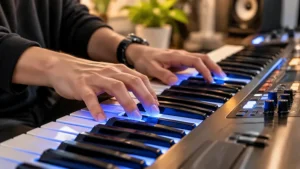
Learning-mode lights on keyboards do something clever: they translate notation into color and position. Kids see the next note glow, press it, and get an instant win. For kids who find sheet music intimidating, that’s a gift.
The risk is dependence. A roundup of lighted boards warns that learners can start watching the lights instead of reading music. The Casio LK-S250 limits lit notes to four at once, which nudges kids toward real reading as pieces get harder.
My take: use the lights for the first few weeks of each new song, then switch them off and try again. Lights are a ramp, not a road. Pair lighted practice with a teacher or an app that adds notation, and you get speed without the crutch.
Karaoke Microphone With Speaker for Kids: What to Look For
A karaoke microphone with speaker for kids sounds like a toy, but it’s the quickest route to a confident voice. When looking for one, check for these features:
- Built-in speaker, because kids prefer one device over a tangle of parts.
- Bluetooth pairing for backing tracks from a phone.
- A lightweight, grip-friendly body.
- Volume control you can set once and forget.
- Battery life of at least a few hours.
Skip anything with a fixed loud output. The BONAOK Q78 hits most marks, though reviewers note the speaker is better suited to bedrooms than big rooms. A karaoke microphone with speaker for kids works best as a short-session toy: fifteen minutes of singing, then a break. If your child prefers learning songs on the keyboard first, keep both near each other and let them swap.
Steel Tongue Drum for Beginners: The No-Wrong-Notes Instrument
A steel tongue drum for beginners works because the scale does the hard work. Nearly every beginner drum is tuned to a major or pentatonic scale, so even random taps sound musical.
What to look for: a 10- to 13-inch body, 11 to 15 notes, and mallets included. More notes give more tunes. The HOPWELL 13-inch, 15-note model covers that range and ships with a book of simple songs.
A steel tongue drum for beginners also teaches listening. Kids learn to let a note ring, which no keyboard demands. It’s quieter than most percussion, making it a rare instrument parents tolerate at 7 p.m. Keep in mind the drum can dent if dropped, so store it in its bag. Weight limits younger children, so supervise those under five. For older kids, it makes a calming break from keyboard drills.
Bluetooth Speaker for Kids: Volume, Water, and Battery Reality
A Bluetooth speaker for kids should survive spills, fit small hands, and keep volume in check. The first two are easy; the third is the one parents miss.
The National Institute on Deafness and Other Communication Disorders explains that sounds at or above 85 dBA can damage hearing over time, and that lower levels are safer for long exposure. In practical terms, if you must raise your voice to be heard near the speaker, it’s too loud.
The JBL JR POP offers IPX7 waterproofing and an adorable size, though battery life is modest and one reviewer found it louder than ideal. Look for a Bluetooth speaker for kids with a clear volume strategy: set the phone volume low, keep sessions short, and revisit settings when your child outgrows toddler volume habits. A rubberized body helps. Drop-proof construction matters more than headline battery numbers.
Long-Term Cost & Value: What Each Setup Really Costs
| Setup | Upfront Range | Outgrown By | Value Verdict |
|---|---|---|---|
| aPerfectLife | Under $25 | Around age 5-6 | Great trial, short life |
| Casio LK-S250 | Around $150-$200 | Years later, if lessons continue | Strong middle value |
| Yamaha PSR-E383 | Around $200 | Rarely for beginners | Best all-rounder |
| Casio CDP-S160 | $400-$550 range | Rarely | Lowest cost per year long-term |
| HOPWELL + BONAOK Q78 + JBL JR POP | Roughly $150-$200 combined | Not outgrown | Fun add-ons, not substitutes |
Total cost of ownership is where the 37 key keyboard vs full size keyboard for kids decision turns. Buying a mini board now and a full-size one later adds up to more than choosing once. But a lower-priced trial still makes sense if you’re unsure your child will stick with it.
Treat the add-ons as optional. A tongue drum, mic, or speaker pairs nicely with a keyboard, but none replaces it.
FAQ
❓ What age is a 37 key keyboard best for?
❓ Is a 61-key keyboard enough for kids taking lessons?
❓ Do weighted vs unweighted keys matter for a beginner child?
❓ Is a steel tongue drum for beginners okay for young kids?
❓ Is a Bluetooth speaker for kids safe for hearing?
Conclusion
So, which wins the 37 key keyboard vs full size keyboard for kids contest? Neither, until you know the child. A 37-key board is a joyful, inexpensive launchpad for preschoolers. A full-size keyboard is the smarter buy for kids who are six or older and moving toward lessons. Between them, the Yamaha PSR-E383 is the safest all-rounder, the Casio LK-S250 suits visual learners, and the Casio CDP-S160 rewards long-term commitment.
The extras are a bonus. A HOPWELL drum adds calm creativity, the BONAOK Q78 gives young singers a stage, and the JBL JR POP keeps the playlist going, as long as you manage the volume.
Match the instrument to your child’s age, space, and stamina, and you’ll buy once and buy well.
Recommended for You
- Ukulele For Kids Who Are Beginners: 7 Smart Picks To Buy In 2026
- Xylophone For Toddlers: 7 Best Picks That Stay In Tune (2026)
- 500 Piece Jigsaw Puzzles For Family Puzzle Night: 7 Best Picks 2026
Disclaimer: This article contains affiliate links. As an Amazon Associate, I earn from qualifying purchases. If you purchase products through these links, we may earn a small commission at no additional cost to you.
✨ Found this helpful? Share it with your friends! 💬🤗
