
In This Article
The driveway goes quiet around 4pm. Then a door slams, a stick clatters against concrete, and suddenly there’s a kid narrating his own breakaway like he’s calling a Game 7 overtime. If you’re shopping for a street hockey set for boys, you already know the scene — you just want to know which box under the tree (or in the garage) actually survives past March. That’s the tricky part. Plenty of sets look identical in a thumbnail photo, but the difference between a goal that lasts three seasons and one that cracks its first cold snap comes down to details most listings gloss over.
This guide digs into that gap. We researched real, currently available products — not hypothetical “best of” fluff — and broke down what the tubing gauge, net weight, and stick length actually mean once a kid is out there hammering slap shots at 6pm on a Tuesday. A street hockey set for boys typically means a portable goal, one or more sticks sized for a youth grip, and a low-bounce ball or puck built for pavement instead of ice — the modern version of what’s more formally called street hockey, a sport that grew directly out of kids improvising ice hockey rules on paved driveways and parking lots. Whether you’re outfitting a driveway rookie or a kid who’s already asking for a second net so he can practice one-timers, there’s a build below that fits.
Quick Comparison Table
| Product | Best For | Price Range | Age Range |
|---|---|---|---|
| Franklin Sports NHL Youth Street Hockey Goalie/Player Stick Set | Budget stick-and-ball starter | Under $30 | 6–12 |
| Mylec Junior Hockey Set | Classic driveway goal setup | $40–$60 | 5–10 |
| Mylec 48″ Deluxe Street Hockey Goal Set | Growing kids who need a bigger net | $60–$90 | 8–14 |
| Franklin Sports NHL Mini Hockey Goal Insta-Set | Two-goal indoor/outdoor practice | $50–$75 | 5–11 |
| GoSports 40 Inch Table Top Air Hockey Game for Kids | Rainy-day tabletop hockey game | $70–$100 | 6+ |
| GoSports Ice Pucky Wooden Table Top Hockey Game | Portable knee-level tabletop hockey | $30–$45 | 5+ |
| GoSports 32 Inch Tabletop Foosball Game Set | Cross-training hand-eye coordination | $50–$70 | 6+ |
A quick read of that table tells the real story: this isn’t really a single-product decision, it’s a budget-versus-space-versus-durability triangle. The Franklin Sports NHL Youth Street Hockey Goalie/Player Stick Set wins on price but skips the goal entirely, so pair it with an existing net or a garage door target if that’s your plan. Families short on square footage lean toward the tabletop options — the GoSports Ice Pucky Wooden Table Top Hockey Game and the GoSports 40 Inch Table Top Air Hockey Game for Kids — since neither demands driveway access or decent weather. Meanwhile, the Mylec 48″ Deluxe Street Hockey Goal Set is the pick for a kid who’s outgrowing junior gear and wants something closer to regulation size.
💬 Found a pick you like already? Bookmark this page so you can compare specs again before you check out.
Top 7 Street Hockey Sets: Expert Analysis
1. Franklin Sports NHL Youth Street Hockey Goalie/Player Stick Set — cheapest way to get two kids playing today
The whole appeal here is speed to gameplay: no assembly, no goal to fold out, just grab the sticks and a ball and you’re playing within a minute of opening the box. The set pairs a 34-inch player stick with a matching 34-inch junior goalie stick, plus an official-size street hockey ball engineered specifically for low bounces so it stays in play on pavement instead of skittering into the neighbor’s yard. Based on the spec comparison against pricier bundles, the 34-inch length is sized for kids roughly 6 to 10 — tall enough to control puck handling without forcing a hunched-over grip, but not built for a teenager’s reach.
What most buyers overlook about this set is that it’s really a “practice pair,” not a full pickup-game kit — you’ll want an actual goal (see picks #2 through #4) if more than two kids show up. Reviewers consistently report the plastic blades hold their shape well through a full summer of driveway use, though the goalie stick’s wider paddle scuffs faster on rough asphalt than smooth concrete. It’s a strong pick for siblings who just want to shoot around, less so for a kid ready for organized 3-on-3.
Pros:
- ✅ Two full sticks (player + goalie) for under $30
- ✅ Ball engineered for low-bounce pavement play
- ✅ Zero assembly required out of the box
Cons:
- ❌ No goal included — needs a separate net
- ❌ Goalie stick paddle wears faster on rough surfaces
At around $20-$30, the Franklin Sports NHL Youth Street Hockey Goalie/Player Stick Set delivers solid value as an add-on stick pair rather than a standalone starter kit.
2. Mylec Junior Hockey Set — the classic all-in-one driveway starter
Mylec practically invented this category, and it shows in how dialed-in this junior bundle is. The set ships with a 40-inch by 36-inch junior PVC folding goal built from 1⅞-inch high-impact tubing, two 32-inch hockey sticks, and one soft, no-bounce ball, and the whole thing assembles with zero tools. In practice, that folding goal is the sleeper feature — most competing junior nets need a wrench or at least a screwdriver, while this one collapses flat enough to slide behind a garage shelf for winter storage.
Mylec has been building street hockey gear for more than 40 years, having essentially created the modern sport back in 1971 when its founder combined two decades of toy-manufacturing experience with a love of hockey played without ice. That pedigree matters here: the netting sleeve is heavier-gauge than most junior sets in this price band, and it’s designed to survive both weather exposure and the kind of aggressive slap-shot play a competitive 8-year-old brings to a Saturday afternoon. What the spec sheet won’t tell you, but reviewer patterns suggest, is that the 32-inch stick length runs slightly short for kids over 4’6″ — plan to upgrade sticks separately once your player hits that growth spurt while the goal itself keeps working fine.
Pros:
- ✅ Complete kit — goal, two sticks, and ball in one box
- ✅ No-tools folding assembly for quick storage
- ✅ Heavy-duty PVC tubing rated for aggressive outdoor play
Cons:
- ❌ 32″ sticks outgrown faster than the goal itself
- ❌ Single ball means no backup if it rolls into traffic
In the $40–$60 range, the Mylec Junior Hockey Set is the benchmark budget-to-mid starter kit most driveway hockey families end up recommending to each other.
3. Mylec 48″ Deluxe Street Hockey Goal Set — the upgrade pick for kids who’ve outgrown junior gear
Once a player is regularly beating the junior goalie stick’s reach, this is where families typically land. The Deluxe Goal Set is built from rugged 1⅝-inch PVC tubing and includes two 43-inch street hockey stick-and-blade combos plus one ball, with a goal that still folds flat for storage. That extra half-inch of tubing diameter over the junior set isn’t cosmetic — it’s the difference between a net that wobbles after a hard shot and one that stays square through an entire game.
Here’s what to weigh: the 43-inch stick length puts this set squarely in the 8-to-14 range, which is exactly where a lot of families get caught buying junior gear twice. One buyer summed up the intended use case well, calling it “perfect for my 6 year old son for an introduction to street hockey” thanks to the simple two-stick setup that lets a sibling or friend jump in immediately. Reviewers also note the sturdier construction holds up well even when kids strap on inline skates and use it indoors on a basement floor — a use case Mylec clearly built the netting sleeve to survive.
Pros:
- ✅ Heavier 1⅝” tubing resists warping under hard shots
- ✅ 43″ sticks fit growing kids through early teens
- ✅ Doubles as an indoor goal for basement or garage play
Cons:
- ❌ Larger footprint needs more storage space when folded
- ❌ Only one ball included despite the bigger goal
Priced in the $60–$90 range, the Mylec 48″ Deluxe Street Hockey Goal Set earns its premium over the junior version through real durability gains, not just size for size’s sake.
4. Franklin Sports NHL Mini Hockey Goal Insta-Set — two goals for real pickup games
Most starter sets assume one kid shoots and one parent stands in as an unwilling goalie. This bundle solves that by including two fully collapsible goals with weatherproof netting, four player sticks, two goalie sticks, and four foam hockey balls, which means two actual nets on opposite ends of a driveway — the closest a backyard setup gets to a real rink layout. Based on the spec comparison, the foam balls (versus the harder no-bounce balls in the Mylec sets) are the deliberate trade-off here: softer impact for indoor-adjacent play, at the cost of a little roll distance outdoors.
The set folds down for easy transport and comes with its own carrying bag, making it a natural fit for sleepovers, hotel stays, or hauling to a friend’s driveway — a detail that separates this from goal sets built to live permanently in one spot. What most buyers overlook is that four sticks means this kit genuinely supports a small 2v2 game rather than one shooter and one bored goalie, which is worth the modest price bump if your kid regularly has friends over.
Pros:
- ✅ Two goals enable real two-way pickup games
- ✅ Carrying bag makes it genuinely portable
- ✅ Foam balls are gentler for mixed indoor/outdoor use
Cons:
- ❌ Foam balls roll less true on rough pavement
- ❌ Smaller goal mouth than dedicated street hockey nets
At $50–$75, the Franklin Sports NHL Mini Hockey Goal Insta-Set is the strongest pick for households where “just one kid shooting” almost never actually happens.
5. GoSports 40 Inch Table Top Air Hockey Game for Kids — the go-to rainy-day tabletop hockey game boys actually stick with
When the driveway’s iced over or it’s pouring for the third day straight, this is the pivot. The table is built with legs so kids can play it on the floor, plus rubber feet to protect surfaces and reduce sliding around during fast play, and the design ditches the flimsy plastic look of typical toy tables for a glossy black veneer frame with UV-printed ice-rink graphics on the playing surface. On paper this means it plays closer to an arcade cabinet than a cheap tabletop toy, and in practice that sturdier build is exactly why it holds up to repeated slap-shot-style hits from enthusiastic 8-year-olds.
The full kit accommodates two players and includes two pushers, three pucks, and an AC adapter with a 10-foot cord, with the table itself measuring 40 inches long by 20 inches wide by 7.6 inches high. What the spec sheet won’t tell you is how much that AC-powered fan matters versus battery models — reviewers who’ve owned both note the corded motor produces noticeably smoother, more consistent airflow, which keeps pucks gliding instead of dragging on humid days. Setup is genuinely simple, since it arrives mostly preassembled and only needs the goals and legs attached.
Pros:
- ✅ AC-powered fan gives consistent, arcade-like glide
- ✅ Legs let kids play on the floor, no table required
- ✅ Preassembled — legs and goals are the only setup
Cons:
- ❌ Requires an outlet, unlike battery-powered mini versions
- ❌ 40″ length still needs meaningful floor or table space
Sitting in the $70–$100 range, the GoSports 40 Inch Table Top Air Hockey Game for Kids is the pick when you want tabletop hockey that feels like a real arcade table, not a toy version of one.
6. GoSports Ice Pucky Wooden Table Top Hockey Game — the compact classic for tight spaces
This is the low-footprint answer to indoor hockey game kids can pull out on a kitchen table in thirty seconds. The set is a two-player face-off game that includes a wooden gameboard, two Pucky sticks in red and blue, three game pucks, and built-in score trackers, all on solid wooden construction designed to hold up to competitive play. Here’s what to weigh against the air hockey pick above: no motor, no power cord, no moving parts to eventually wear out — just a slap-shot mechanism that’s closer to the “knee hockey” games a lot of parents remember from their own childhood.
Reviewers consistently point to the built-in score trackers as the standout detail, since it removes the usual sibling argument over “who’s actually winning” mid-game. The trade-off is scale: this plays more like a strategic slap-shot duel than a full hockey simulation, so kids who want the fan-powered puck-gliding feel of true air hockey will gravitate toward the GoSports 40-inch table instead. As a travel-friendly, no-batteries option for road trips or grandparents’ houses, though, it’s hard to beat.
Pros:
- ✅ Solid wood build with zero electronic parts to break
- ✅ Built-in score trackers end “who’s winning” debates
- ✅ Compact enough for car trips and small apartments
Cons:
- ❌ Slower-paced than motorized air hockey tables
- ❌ Limited to two players at a time
In the $30–$45 range, the GoSports Ice Pucky Wooden Table Top Hockey Game is the budget-friendly, low-maintenance choice for families who want indoor hockey without the fan noise or the cord.
7. GoSports 32 Inch Tabletop Foosball Game Set — the cross-training pick that sharpens hockey reflexes
Not a hockey set in the traditional sense, but a legitimate foosball table for kids belongs on this list because the wrist-flick footwork and rapid-reaction skills transfer directly to stickhandling. The table measures 32 by 20 by 8.25 inches, accommodates 2 to 4 players, and includes two mini soccer foosballs, with players pre-installed on the rods for essentially zero-hassle assembly. Based on the spec comparison with bulkier furniture-style foosball tables, the tabletop format here is the deliberate trade-off — you lose regulation size but gain the ability to store it in a closet between game nights.
The design features a modern black finish with upgraded ergonomic handles for comfort and accuracy, a step up from the cheap-feeling rods on entry-level toy tables. What most buyers overlook is that this doubles as rainy-day cross-training: the same fast hand-eye coordination and anticipation skills that win a foosball match are the exact reflexes a young goalie or forward needs on the driveway. It’s a smart complement to a street hockey set for boys, not a replacement for one.
Pros:
- ✅ Zero-assembly setup with pre-installed players
- ✅ Ergonomic handles improve control for smaller hands
- ✅ Builds hand-eye coordination that carries over to hockey
Cons:
- ❌ Rods still feel small for players with larger hands
- ❌ Not a hockey-specific skill-builder on its own
At $50–$70, the GoSports 32 Inch Tabletop Foosball Game Set rounds out this list as the smart screen-free add-on rather than a core hockey purchase.
Setting Up Your Street Hockey Set: Practical Usage Guide
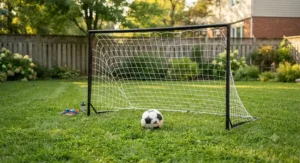
Getting a new goal out of the box on day one is the easy part — keeping it playable through a full season is where most families slip up. Start with surface prep: sweep the driveway or set-up area before the first game, since loose gravel is the number one cause of premature blade chipping on both plastic sticks and goal tubing. When assembling a folding goal like the Mylec Junior Hockey Set or the Mylec 48″ Deluxe Street Hockey Goal Set, stretch the netting sleeve evenly over the frame before locking the final joint — pulling it taut after assembly stresses the seams unnecessarily.
For the first 30 days, the most common mistake is leaving PVC-framed goals out in direct sun for extended stretches; UV exposure is the main reason plastic tubing goes brittle faster than the netting itself. A simple fix: fold the goal down and store it in a garage or shed between sessions rather than leaving it staked out permanently, even though the “insta-set” convenience tempts most families to skip that step. On the maintenance side, wipe down sticks after wet-weather play to prevent wood-composite blades on premium models from swelling, and periodically check goal-tube joints for cracks before a hard shot finds the weak point for you. Tabletop picks like the GoSports Ice Pucky Wooden Table Top Hockey Game need almost no upkeep beyond keeping the board dry, which is part of why they’re the low-effort option for less hands-on families.
One optimization trick worth knowing: rotate which side of the goal faces the sun-exposed part of the driveway every few weeks. It sounds minor, but even netting fades unevenly if it’s always angled the same direction, and rotating it roughly doubles the visible lifespan of the fabric.
Real-World Scenarios: Which Set Fits Your Kid?
The apartment-dwelling 7-year-old with no driveway. Space is the constraint here, not budget. The GoSports Ice Pucky Wooden Table Top Hockey Game solves this cleanly — it lives on a kitchen table, needs no outlet, and packs away in a closet between uses. If there’s a little more room, the GoSports 32 Inch Tabletop Foosball Game Set adds variety without demanding a dedicated play area.
The competitive 10-year-old who plays travel roller hockey and wants driveway reps. This kid needs gear that matches league intensity, not toy-store durability. The Mylec 48″ Deluxe Street Hockey Goal Set, paired with a pair of junior inline hockey skates built for recreational-level roller hockey, gets closest to simulating real roller hockey conditions in a home setting. Entry-level junior skates in that category typically use an injected composite boot construction that gives first-time competitive players real ankle and heel support — worth the step up from casual skates once a kid is training seriously for a roller hockey starter set that includes proper footwear.
The family with two or three kids of different ages who all want in. Budget and inclusivity both matter. The Franklin Sports NHL Mini Hockey Goal Insta-Set‘s two-goal, four-stick layout is built exactly for this — everyone gets a stick, and there’s an actual game structure instead of one kid dominating a single net. Add the Franklin Sports NHL Youth Street Hockey Goalie/Player Stick Set as a spare pair so nobody’s standing around waiting for a turn.
How to Choose a Street Hockey Set for Boys
- Match stick length to height, not age. A stick that’s a few inches too long forces a hunched grip that slows shot accuracy; as a rough guide, the stick should reach roughly chin height when stood on its blade.
- Check the goal tubing gauge before the goal dimensions. A wider net is meaningless if the frame flexes on impact — 1⅝-inch PVC or thicker holds up noticeably better than thinner junior tubing under repeated shots.
- Decide indoor versus outdoor before you shop. Foam-ball indoor sets and hard no-bounce outdoor balls aren’t interchangeable; buying the wrong ball type is a common return reason.
- Count how many kids will actually play at once. A single-goal, two-stick starter set is fine for siblings shooting around, but anything resembling a real pickup game needs two goals and enough sticks for everyone.
- Budget for a ball or puck upgrade separately. Most sets ship with just one ball, and it’s the first thing that gets lost in tall grass or a storm drain — a spare pack pays for itself fast.
- Weigh portability if you’re not staying in one house. Folding goals with carry bags, like the Franklin Insta-Set, matter far more for families who travel to grandparents’ or move often.
- Look at netting material, not just goal color. Heavier-gauge, weatherproof netting sleeves resist tearing far longer than the thin mesh found on the cheapest big-box sets.
Common Mistakes When Buying Street Hockey Gear
The biggest one is buying purely by price without checking stick length against the player’s actual height — a stick that’s the wrong size gets outgrown or abandoned faster than one sized correctly, no matter how cheap it was. Reviewers across nearly every brand flag the same second mistake: assuming a “complete set” includes enough balls for multiple sessions, when most ship with just one. A third pitfall is choosing an outdoor-rated hard ball for indoor play, which can scuff floors or crack drywall on a mis-hit — the foam balls bundled with sets like the Franklin Insta-Set exist specifically to avoid that. Finally, families sometimes skip checking whether a goal is genuinely portable before assuming it’ll move between the garage and driveway easily; not every “folding” goal folds down small enough to store indoors comfortably.
Street Hockey vs. Ice Hockey: What Actually Transfers
Street hockey — also known as ball hockey, dek hockey, road hockey, or shinny — is played on foot on flat, dry surfaces using a ball or puck designed specifically for that surface, with the same core objective of outscoring the opposing team as its on-ice counterpart. The skill overlap with ice hockey is real but not total. Stickhandling, shot mechanics, and reading a play develop almost identically in both settings, which is part of why players commonly wear optional shin pads, gloves, and even a helmet in casual street games, echoing ice hockey’s protective-gear habits without the mandatory skates. What doesn’t transfer as directly is edge work and skating stride — a kid who only plays street hockey will need real ice time or roller hockey skates to build that separately.
Ball hockey specifically developed as an off-ice variant of ice hockey, patterned closely after it but adapted for both indoor and outdoor surfaces, which explains why the equipment in this guide splits cleanly between true outdoor street sets and indoor tabletop alternatives. For families using street hockey as a low-cost way to build hockey IQ before committing to expensive ice time, the honest takeaway is that it’s an excellent stickhandling and game-sense supplement, not a full substitute for skating-specific training.
What to Expect: Real-World Performance
On pavement, expect the no-bounce balls bundled with Mylec sets to behave noticeably differently from a tennis ball — they’re engineered to stay low and track true rather than pop unpredictably off cracks in the asphalt. Goal netting under regular slap-shot use will show visible wear patterns within the first month wherever the ball repeatedly hits the same spot; that’s normal and not a sign of a defective product unless the mesh actually tears. Indoor tabletop options behave more predictably since there’s no weather or surface variability, but the trade-off is that kids often “max out” the challenge of a compact air hockey table faster than an outdoor goal, since the smaller playing field limits how much strategy comes into play.
Temperature matters more than most parents expect. PVC tubing goals stiffen noticeably in cold weather, which is actually a plus for goal stability in winter months but means assembly (and disassembly) takes a bit more patience once temperatures drop below freezing.
Street Hockey Gear for Different Skill Levels
Beginners — roughly ages 5 to 7 — do best with foam balls, shorter 28-to-32-inch sticks, and a smaller goal mouth that makes scoring feel achievable early, since early wins are what keep young kids engaged with a new sport. Intermediate players around 8 to 11 are ready for the step up to 40-plus-inch tubing goals and 43-inch sticks, and this is typically when a second goal for real two-way play starts paying off more than gear upgrades. Advanced youth players — 12 and up, especially those in organized roller or ball hockey leagues — benefit most from pairing a durable street set with actual training gear like inline skates and shooting-accuracy targets, since at that level the driveway setup functions as supplemental practice rather than the primary activity.
Long-Term Cost & Maintenance
A budget stick-and-ball set costs less upfront but tends to need stick replacements every season or two as kids grow, while a mid-range goal set like the Mylec Deluxe holds its functional value for three-plus years if stored properly between uses. Factoring in a spare ball pack — balls are the most commonly lost component — and occasional netting replacement, the realistic total cost of ownership over three years lands closer together across budget and mid-tier options than the sticker price alone suggests, since the deluxe goal’s higher upfront cost is largely offset by not needing a full replacement as quickly. Tabletop options carry the lowest long-term cost since there’s no netting to replace or tubing to crack, though electronic air hockey tables do eventually need fan or motor replacement after years of heavy use.
Features That Actually Matter (And Those That Don’t)
Tubing gauge and netting weight matter enormously — they’re the actual determinants of how long a goal survives real play. NHL team branding, by contrast, is pure marketing; it doesn’t affect performance and mostly matters if your kid has a strong favorite team preference. A carrying bag matters if you travel or store gear indoors, but is irrelevant if the set lives permanently in one spot. Stick material — wood-composite blades versus solid plastic — genuinely affects shot feel and durability, while cosmetic color options are purely a personal preference with zero functional impact.
Safety Considerations for Street and Roller Hockey Play
For any wheeled component of street or roller hockey, proper protective gear that fits correctly — a helmet, wrist guards, elbow pads, and knee pads — meaningfully reduces injury risk, and this matters even for kids who only use inline skates casually alongside a driveway goal setup. Pediatric safety guidance specifically flags checking for a CPSC certification sticker on any helmet, since that confirms it meets the federal impact-safety standard, and recommends never reusing a helmet that’s already absorbed a crash, since a damaged shell won’t protect the head the same way twice. For pure stick-and-ball street hockey without skates, the injury risk profile is much lower, but shin pads and gloves are still worth having on hand once games get competitive enough that slap shots start flying at close range.
✨ Ready to gear up? Check current pricing on the sets above before the next driveway game night!
Why Screen-Free Backyard Games Still Matter
Public health guidance consistently points the same direction: kids benefit from at least 60 minutes of daily physical activity, and time spent on screens is time that could otherwise go toward that movement. A driveway hockey session or even a five-minute tabletop foosball match checks that box in a way that’s genuinely fun rather than a chore, which is a big part of why these sets remain popular gifts year after year — parents are looking for exactly this kind of screen-free alternative, and kids don’t feel like they’re being punished by getting one.
Frequently Asked Questions
❓ What age is appropriate for a street hockey set?
❓ Do street hockey sets work on grass or only pavement?
❓ How many sticks come in a typical starter set?
❓ Can a street hockey goal be used indoors?
❓ What's the difference between street hockey and roller hockey gear?
Conclusion
There’s no single “best” street hockey set for boys — there’s the right one for your driveway, your budget, and how many kids actually show up to play. Budget-focused families do well starting with the Franklin Sports NHL Youth Street Hockey Goalie/Player Stick Set and adding a goal later, while anyone who wants a complete, no-compromise starter kit should look hard at the Mylec Junior Hockey Set or step up to the Mylec 48″ Deluxe Street Hockey Goal Set as kids grow. Apartment dwellers and rainy-day households get real value from the tabletop picks — the GoSports 40 Inch Table Top Air Hockey Game for Kids, the GoSports Ice Pucky Wooden Table Top Hockey Game, and the GoSports 32 Inch Tabletop Foosball Game Set — none of which need a driveway at all.
Whatever you land on, the underlying goal is the same one every parent shopping this category already has: get the kid outside (or at least off a screen), stick in hand, chasing a ball toward a net that’ll survive the season. That’s a win regardless of which brand ends up in the garage.
✨ Don’t Miss These Exclusive Deals!
🔍 Take your street hockey setup to the next level with the picks above. Click on any highlighted item to check current pricing and availability, and get the driveway game going before the weekend!
Recommended for You
- Kids Boxing Gloves and Punching Bag Set: 7 Top Picks for 2026
- Foam Bow and Arrow Set Boys: 7 Safest Picks for 2026
- 7 Best Backyard Sports Toys for Boys in 2026
Disclaimer: This article contains affiliate links. As an Amazon Associate, I earn from qualifying purchases. If you purchase products through these links, we may earn a small commission at no additional cost to you.
✨ Found this helpful? Share it with your friends! 💬🤗
