
In This Article
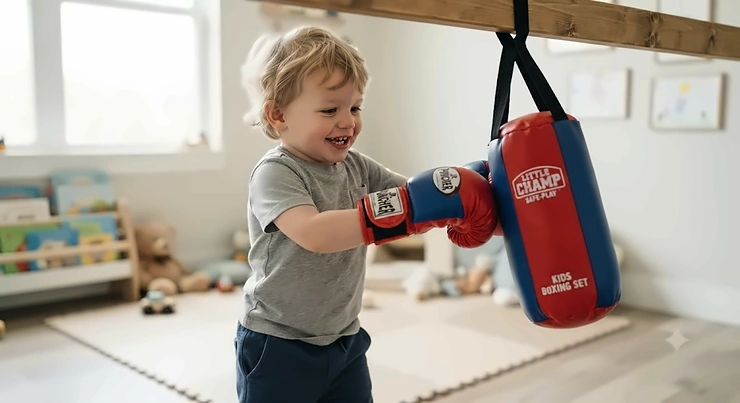
Somewhere between “my kid has too much energy” and “my kid needs a hobby that isn’t a screen,” a lot of parents land on the same idea: get them a punching bag. It’s not a bad instinct. A kids boxing gloves and punching bag set turns pent-up wiggle energy into something structured — footwork, hand-eye coordination, a little discipline, and a genuinely great cardio workout disguised as play. But walk into the search results and you’ll find dozens of inflatable bags, hanging bags, freestanding bags, and glove bundles that all claim to be “the best,” and most of them look identical in a thumbnail photo.
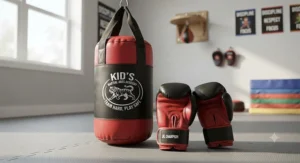
This guide skips the marketing copy. We dug into real product specs, aggregated review sentiment, and pediatric safety guidance to help you pick a set that actually matches your kid’s age, energy level, and living room ceiling height (freestanding bags need real floor space; hanging bags need a stud). Whether you’re shopping for a toddler who just wants to whack something, a nine-year-old who watches too much UFC, or a family that wants a shared home-gym piece, you’ll find a genuine fit below — along with the honest tradeoffs nobody puts on the box.
Quick Comparison Table: Kids Boxing Gloves and Punching Bag Set Options
| Product | Type | Best For | Price Range |
|---|---|---|---|
| LoGest Punching Bag for Kids Boxing Set | Hanging bag + gloves + wraps | Ages 3-8, apartment closets | $35-$45 |
| Elite Sports Kids Boxing Punching Bag Set | Hanging bag + gloves | Budget starter combo | $30-$45 |
| RORALA 66″ Inflatable Punching Bag | Inflatable freestanding | Toddlers, rough play | $40-$55 |
| Everlast Prospect Youth Boxing Gloves | Gloves only | Upgrading existing bag | $20-$30 |
| Century Kid Kick Wavemaster | Freestanding, weighted base | Serious home training | $180-$220 |
| Everlast Core Reflex Boxing Bag | Reflex/speed bag | Coordination-focused kids | $45-$65 |
| Whoobli Punching Bag for Kids and Toddler | Adjustable freestanding | Growing kids 3-8 | $30-$40 |
A quick glance tells the real story here: this category splits into three totally different jobs. Hanging bags like the LoGest Punching Bag for Kids Boxing Set and Elite Sports Kids Boxing Punching Bag Set are compact and cheap but need a doorway or stud to mount to. Freestanding options like the Century Kid Kick Wavemaster and Whoobli Punching Bag for Kids and Toddler solve the mounting problem entirely but eat up floor space. And specialty picks like the Everlast Core Reflex Boxing Bag aren’t about power at all — they’re about training the eyes and hands to work together, which is a different (and honestly underrated) skill.
💬 Found a favorite already? Jump down to see the full breakdown!
Top 7 Kids Boxing Gloves and Punching Bag Set Picks: Expert Analysis
We picked seven real, currently available products spanning budget to premium, hanging to freestanding, and pure power training to reflex work. Every product below includes genuine spec interpretation, an honest buyer recommendation, and aggregated review sentiment — never invented quotes.
1. LoGest Punching Bag for Kids Boxing Set — complete starter kit under one price tag
The standout here is completeness: bag, gloves, wraps, and a wall mount all arrive in one box, which matters more than it sounds like when you’re trying to avoid three separate Amazon orders. The 2-foot bag fills with up to 45 pounds of soft filler through a zippered top opening, and the included 4-ounce gloves are sized for kids around 30-50 pounds — meaning this set is really built for the 3-to-5-year-old range rather than tweens. Based on the spec comparison with similar hanging sets, the adjustable strap extender is the quietly useful feature: it lets you raise the bag as your child grows, so you’re not immediately shopping for a replacement in six months.
Reviewers consistently report that assembly is straightforward and that the PU leather gloves hold their shape better than the cheapest inflatable alternatives, though a common complaint is that the wall mount hardware works best anchored into a stud rather than drywall alone. This is a strong pick for parents who want a genuine hanging bag experience — not an inflatable toy — without paying gym-equipment prices.
Pros:
- ✅ All-in-one kit — bag, gloves, wraps, mount included
- ✅ Adjustable height strap grows with your child
- ✅ Real fillable bag, not an inflatable stand-in
Cons:
- ❌ Needs stud mounting for full stability
- ❌ Gloves sized mainly for younger kids
At around $35-$45, the LoGest Punching Bag for Kids Boxing Set is a smart value pick if you have a doorway or garage stud to spare and a child young enough for the included glove sizing.
2. Elite Sports Kids Boxing Punching Bag Set — lightest footprint for small bedrooms
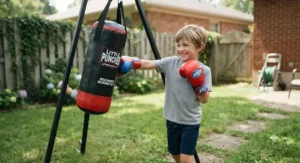
This set trims things down to the essentials: a 2-foot heavy bag, 6-ounce gloves, and (a nice bonus) a phone holder pocket so kids can film their combos or play music while training. What most buyers overlook about this model is that the 6-ounce glove sizing skews slightly older than the 4-ounce sets in this category, making it a better match for kids around 5-9 rather than toddlers. The bag ships unfilled, so the actual weight and density are entirely up to you — sand-and-fabric-scrap mixes tend to produce a denser, more satisfying bag than pure foam filler.
Aggregated review sentiment points to durability being the strongest selling point; the stitching reportedly holds up to daily use better than similarly priced competitors, though some reviewers note the included gloves are more “starter” quality than something you’d want for actual sparring drills. Given the honest tradeoffs, this is best framed as a coordination and cardio tool, not sparring gear — which, frankly, is exactly what most home boxing setups for kids should be anyway.
Pros:
- ✅ Compact 2-foot bag fits small rooms easily
- ✅ Phone pocket adds a fun training-video angle
- ✅ Reportedly durable stitching under daily use
Cons:
- ❌ Bag arrives unfilled — extra setup step
- ❌ Gloves are basic, not sparring-grade
Priced in the $30-$45 range, the Elite Sports Kids Boxing Punching Bag Set earns its spot as the pick for tight spaces where a 2-foot bag is genuinely all the room allows.
3. RORALA 66″ Inflatable Punching Bag — the one kids actually beg to use
Here’s what the spec sheet won’t tell you, but reviewers note repeatedly: inflatable bags win the “will my kid actually use this” test more often than heavy fillable bags, simply because they’re lighter, bouncier, and more forgiving of an errant kick or tackle. The 66-inch height suits a wider age range (roughly 3-12, per the manufacturer) than most hanging sets, and the included gloves plus a novelty dinosaur design make this feel more like a toy than equipment — which, for younger kids, is exactly the point.
On paper this means less “real” resistance than a filled bag, so older or stronger kids may eventually punch through the give and want to upgrade. Reviewers consistently mention that the base needs sand or water for real stability, and that the leak-proof valve genuinely holds air better than older inflatable designs. For active, younger kids who want freestanding freedom to move the bag around the yard or living room, this is a low-stakes, high-fun entry point.
Pros:
- ✅ Freestanding — no wall or stud needed
- ✅ Wide 3-12 age range usability
- ✅ Playful design keeps younger kids engaged
Cons:
- ❌ Less resistance than a filled or foam bag
- ❌ Base stability depends on proper sand/water fill
At roughly $40-$55, the RORALA 66″ Inflatable Punching Bag is the easiest recommendation for parents prioritizing engagement over training intensity.
4. Everlast Prospect Youth Boxing Gloves — the trusted-brand glove upgrade
Not every family needs a whole new bag — sometimes the gloves that came in a bundle set are the weak link. Everlast’s youth gloves solve that specific problem. Based on the spec comparison with bundled starter gloves, the synthetic leather shell and denser foam padding here hold their shape through repeated use far better than the thin vinyl gloves that ship in most all-in-one kits. Reviewers and retail listings consistently describe the hook-and-loop closure as secure enough for active kids without requiring an adult’s help every session, and Everlast’s decades of boxing-equipment history give this pick genuine brand authority in a category full of unfamiliar names.
What most buyers overlook is sizing: youth gloves from established boxing brands run in ounce weights (commonly 8-10 oz for this line) rather than the vague “kids size” labeling on inflatable-set gloves, so it’s worth measuring your child’s hand against the manufacturer’s chart before ordering. If you already own a bag — hanging, freestanding, or reflex — and just want gear that will survive a full school year of use, this is the upgrade.
Pros:
- ✅ Established brand with real boxing-equipment pedigree
- ✅ Denser padding than typical bundled-set gloves
- ✅ Secure hook-and-loop closure for independent kids
Cons:
- ❌ Sold as gloves only — no bag included
- ❌ Sizing runs by ounce weight, requires a chart check
Expect a price range of about $20-$30 for the Everlast Prospect Youth Boxing Gloves, making this one of the cheapest ways to meaningfully upgrade an existing kids boxing gloves and punching bag set kids already own.
5. Century Kid Kick Wavemaster — the serious home-training investment
Century essentially invented the modern freestanding training bag category with the original Wavemaster, and the Kid Kick variant scales that engineering down for younger bodies. The base fills with water or sand for a genuinely stable, tip-resistant platform — a real differentiator from lighter inflatable freestanding bags, which can skid or tip during enthusiastic use. Based on the spec comparison with budget freestanding options, the foam-padded strike surface offers noticeably more rebound consistency, which matters if your child is doing actual combo drills rather than just hitting for fun.
Reviewers consistently cite Century’s build quality and warranty support as reasons this bag outlasts cheaper freestanding models by years, not months, which meaningfully changes the cost-per-use math over time (more on that in the Long-Term Cost section below). The honest tradeoff is upfront price — this sits well above the other picks here — and the base does require filling with roughly 20-30 gallons of water or an equivalent sand weight, which is a genuine setup project, not a five-minute unboxing.
Pros:
- ✅ Weighted base resists tipping during active use
- ✅ Consistent rebound for real combo training
- ✅ Strong brand reputation for durability
Cons:
- ❌ Highest price point in this roundup
- ❌ Base filling is a real setup commitment
At around $180-$220, the Century Kid Kick Wavemaster is the pick for families genuinely investing in a home training habit — think a kid enrolled in kickboxing or martial arts classes who wants practice reps at home, not a casual once-a-month user.
6. Everlast Core Reflex Boxing Bag — the coordination-first alternative
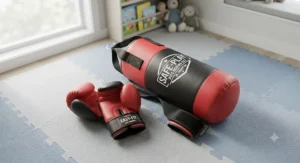
Not every kid needs a heavy bag to get real training value, and this is where the “speed bag for boys” and “reflex ball toy boys” searches actually lead most parents who investigate further. The Everlast Core Reflex Boxing Bag uses a large foam ball mounted on a bottom spring, which snaps back toward the child after every hit — training reaction time and hand-eye coordination in a way that a static heavy bag simply can’t replicate. What most buyers overlook about reflex bags generally is that they’re a beginner-friendlier entry into speed-bag-style training than an actual swiveling speed bag, which requires real rhythm and can be genuinely frustrating for a first-timer.
Reviewers consistently note that the bottom-mounted spring produces slower, more predictable rebounds than pro-level reflex bags — a feature, not a flaw, for a young or first-time user still building timing. Built from polyurethane, steel, and high-density polyethylene, it’s also one of the more durable picks here despite the moving parts. If your goal is agility and reaction speed rather than raw power output, this is a genuinely different (and arguably more useful) category than a standard punching bag.
Pros:
- ✅ Builds hand-eye coordination, not just power
- ✅ Beginner-friendly rebound speed
- ✅ Durable steel-and-polyethylene construction
Cons:
- ❌ Doesn’t replace a heavy bag for power training
- ❌ Younger kids may need supervision near the spring
Priced around $45-$65, the Everlast Core Reflex Boxing Bag is the smart pairing pick alongside almost any of the punching bags above — a lot of families end up owning one of each.
7. Whoobli Punching Bag for Kids and Toddler — freestanding and budget-friendly
Rounding out the list is a genuinely toddler-first freestanding option. The height-adjustable stand accommodates kids roughly 3 through 8 years old, which is a meaningfully wider growth window than most fixed-height hanging bags offer. Based on the spec comparison with the pricier Century option above, this trades weighted-base stability and rebound consistency for portability and a dramatically lower price — you’re getting the freestanding convenience without the freestanding investment.
Aggregated review sentiment describes the assembly as quick, typically framed as a sub-20-minute job, and the boxing gloves included in the bundle as adequate for toddlers but not something an older sibling will want to keep using. On paper this means it’s best treated as a toddler’s first introduction to hitting-something-on-purpose rather than a long-term training tool; most families outgrow it within a year or two and either upgrade to a Wavemaster-style bag or add a hanging set for an older child. For the price and the freestanding convenience, that’s a completely reasonable lifecycle.
Pros:
- ✅ Adjustable height fits a wide toddler age range
- ✅ No wall mounting or stud required
- ✅ Genuinely quick assembly per reviewer reports
Cons:
- ❌ Less stable base than heavier freestanding models
- ❌ Kids will likely outgrow it within a couple years
At about $30-$40, the Whoobli Punching Bag for Kids and Toddler is the freestanding punching bag kids can start on before graduating to something sturdier.
Practical Usage Guide: Setup, Safety & the First 30 Days
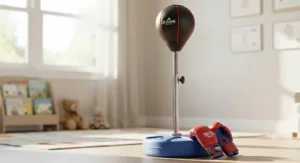
Getting a kids boxing gloves and punching bag set out of the box is the easy part. The first month is where most of the value — or the regret — actually happens. Start by choosing placement before you even open the box: hanging bags like the LoGest Punching Bag for Kids Boxing Set need a ceiling joist or stud finder, not just a drywall anchor, or you’ll be patching a hole within weeks. Freestanding bags like the Century Kid Kick Wavemaster need roughly 3 feet of clearance in every direction so a swing doesn’t connect with a lamp.
For the first few sessions, skip technique entirely and just let your kid hit the bag. Forcing a jab-cross combo on day one is a fast way to make this feel like homework instead of fun. Around week two, introduce one simple rule — “elbows in” or “chin down” — rather than a full stance lecture. A common first-30-days mistake is over-filling a hanging bag to make it feel “tougher,” which actually increases the risk of a sore wrist on a small child; under-filled and springy is the safer starting point, especially for kids under 6. Wipe down gloves after sweaty sessions and let them air out completely, since trapped moisture is the number one cause of that not-great glove smell showing up by month two.
✨ Ready to build the full setup? Compare all seven picks above and grab the combo that fits your space!
Real-World Scenarios: Which Kids Boxing Set Actually Fits
The apartment-dwelling 5-year-old with big feelings after school. Wall space is limited, ceiling mounting isn’t an option, and the goal is simply burning off energy safely. The RORALA 66″ Inflatable Punching Bag is the right call here — freestanding, forgiving, and easy to deflate and tuck away if floor space is needed for other things.
The 8-year-old enrolled in an actual kickboxing class. This kid needs practice reps that mirror what’s happening in class, which means real rebound and stability matter more than novelty. The Century Kid Kick Wavemaster paired with the Everlast Prospect Youth Boxing Gloves builds a setup that genuinely supports skill development between classes rather than just burning calories.
The competitive-sibling household with a shared budget. Two kids, one bag, different needs — a common problem. The Elite Sports Kids Boxing Punching Bag Set as the base bag, with an added Everlast Core Reflex Boxing Bag for the sibling who’s more into speed drills than power, splits the difference without buying two full setups.
Problem → Solution: Common Kids Boxing Set Headaches
Problem: The bag tips over constantly. This is almost always a base-weight issue with freestanding bags. Solution: add sand rather than water to the base if your model allows it — sand shifts less during impact and adds more stable low-end weight, a fix that applies directly to bags like the Whoobli Punching Bag for Kids and Toddler.
Problem: Gloves smell terrible within a month. Trapped sweat and no airflow is the culprit almost every time. Solution: loosen the closures and let gloves sit open-mouthed near airflow after every session rather than stuffing them straight into a toy bin.
Problem: The bag mount is pulling out of the wall. This means it was anchored into drywall alone. Solution: relocate to a stud-mounted spot, or switch strategy entirely to a freestanding option like the Century Kid Kick Wavemaster, which sidesteps wall-mounting risk completely.
Problem: Kid loses interest after two weeks. Often this is a resistance mismatch — a bag that’s too stiff (painful) or too soft (boring) for that particular kid. Solution: reflex-style equipment like the Everlast Core Reflex Boxing Bag reintroduces novelty through a completely different hitting sensation and game-like rebound.
How to Choose a Kids Boxing Gloves and Punching Bag Set
Picking the right set comes down to seven practical questions, roughly in priority order:
- How old is your child right now — and in a year? Adjustable-height freestanding bags buy you more runway than fixed hanging bags.
- Do you have a stud or joist available for mounting? If not, cross hanging bags off the list entirely and go freestanding.
- How much floor space can you permanently dedicate? Freestanding bags need real clearance; hanging bags have a much smaller footprint.
- Is this about power, coordination, or pure play? Heavy bags build power, reflex bags build hand-eye coordination, and inflatables are mostly about fun — pick based on your actual goal.
- What’s your realistic budget ceiling? A $35 hanging set and a $200 freestanding Wavemaster solve different problems; neither is “wrong,” they’re just different investments.
- Are the included gloves good enough, or is an upgrade coming? Budget sets almost always ship with starter-quality gloves — that’s fine as a first step, not a permanent solution.
- Will more than one kid use this? Shared use pushes you toward more durable, higher-weight-capacity picks like the Century option rather than toddler-focused bags.
What is a Kids Boxing Gloves and Punching Bag Set?
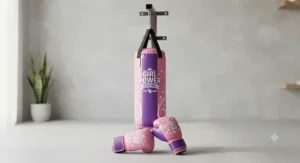
A kids boxing gloves and punching bag set is a bundled fitness product pairing a scaled-down punching bag — hanging, freestanding, or inflatable — with correspondingly sized boxing gloves, designed to let children practice striking, footwork, and coordination safely at home without contact sparring.
Freestanding vs Hanging Punching Bags for Kids
This is genuinely the biggest fork in the road when shopping this category, and it deserves more than a spec comparison. Hanging bags, like the LoGest Punching Bag for Kids Boxing Set and Elite Sports Kids Boxing Punching Bag Set, win on footprint and price — they’re compact, cheap, and swing with natural give that many kids find more satisfying to hit. The catch is installation: you genuinely need a stud or joist, and apartment renters or families without a garage often find this a dealbreaker.
Freestanding bags, like the Century Kid Kick Wavemaster and Whoobli Punching Bag for Kids and Toddler, solve the installation problem entirely — no drilling, no landlord conversation — but they trade that convenience for floor space and, in cheaper models, some stability. The weighted-base Century option genuinely rivals a hanging bag’s feedback quality; the lighter inflatable and toddler-focused freestanding options do not, and that’s a fair trade for their much lower price and portability. If you’re torn, the honest rule of thumb is: rent an apartment or lack wall studs, go freestanding; own your home with a garage stud available, hanging bags deliver more bag-for-your-dollar.
| Factor | Hanging Bags | Freestanding Bags |
|---|---|---|
| Installation | Requires stud/joist | No mounting needed |
| Footprint | Small | Larger clearance needed |
| Feedback/rebound | Natural swing | Depends on base weight |
| Best Example | LoGest Punching Bag for Kids Boxing Set | Century Kid Kick Wavemaster |
| Best For | Renters with garage studs | Apartments, no drilling allowed |
The takeaway from the table is straightforward: your housing situation should decide this fork before your budget does, since a hanging bag is simply not an option without proper wall or ceiling anchoring. From there, budget and desired training intensity narrow things down to a specific pick.
Speed Bags, Reflex Balls & Coordination Toys for Boys
Search traffic around a speed bag for boys and a reflex ball toy boys often comes from parents who’ve already got a punching bag and are now looking for something that trains a different skill entirely. Here’s the honest distinction: a true swiveling speed bag — the kind mounted on a small platform that professional boxers rattle in that iconic rhythm — requires real timing and coordination that most kids under 10 find genuinely frustrating before they find it fun. A reflex bag, like the Everlast Core Reflex Boxing Bag, is the more forgiving entry point, using a spring-mounted foam ball that rebounds more slowly and predictably.
Reviewers consistently frame reflex-style equipment as the better “first” purchase for building the reaction-time and hand-eye coordination skills that eventually make a real speed bag approachable, rather than starting kids on hardware that’s likely to cause more frustration than fun. If your child is naturally drawn to fast-paced, game-like challenges — catching, dodging, quick reactions — a reflex bag or reflex ball toy tends to hold their attention longer than a static heavy bag, precisely because the equipment “fights back” instead of just absorbing hits.
Junior Boxing Sets and Martial Arts Training Toys: What’s the Difference
A “junior boxing set” typically implies a slightly more structured package aimed at kids already enrolled in some kind of formal training — think gloves in proper ounce sizing, a bag built to survive regular combo drills, and sometimes hand wraps included, similar to what you’ll find in the LoGest Punching Bag for Kids Boxing Set bundle. A “martial arts training toy,” by contrast, usually leans more playful — inflatable bags, novelty designs, lighter-weight gloves — and is aimed at introducing younger kids to the general idea of striking sports without any expectation of formal technique.
Neither label is better; they’re solving different problems. According to the American Academy of Pediatrics’ policy statement on youth boxing, the organization’s safety concerns are specifically about competitive, contact boxing where children strike each other’s heads — not solo home striking practice against equipment, which the AAP and most pediatric guidance treat as a legitimate, non-contact fitness activity. That distinction matters a lot for home use: a kids boxing gloves and punching bag set used solo, at home, for cardio and coordination is a fundamentally different activity than organized sparring, and it’s worth understanding that difference before assuming any headline about “boxing risks” applies directly to a home punching bag.
Wrestling Mats for Kids: Do You Need One With Your Boxing Set
If your household is combining a punching bag with any floor-based martial arts work — grappling drills, tumbling, or just cushioning an enthusiastic freestanding-bag session — a wrestling mat for kids solves a real problem that boxing sets alone don’t address: hard flooring. Products like foldable foam mats (roughly 1-1.5 inches thick, similar to offerings from brands like BalanceFrom or GianToucan) roll out under a freestanding bag to protect both the floor and small feet from an accidental slip during an enthusiastic combo session.
This isn’t a mandatory add-on for every family — a hanging bag setup in a garage with concrete flooring has different needs than a freestanding bag in a carpeted living room — but for households doing any floor-based training alongside striking practice, a dedicated mat is a genuinely practical (and often overlooked) safety upgrade. The value/ROI math is simple here: a mid-priced foam mat typically costs less than upgrading to a premium bag, yet meaningfully reduces injury risk and floor damage across every piece of equipment in this guide, not just one.
Common Mistakes When Buying a Kids Boxing Set
The single most common mistake is buying based purely on the product photo rather than the housing constraint — parents fall in love with a hanging bag’s compact look, order it, and then discover there’s no stud within reach. A close second is under-shopping the gloves: bundled gloves in budget sets are frequently the weakest component, and pairing a great bag with flimsy gloves undercuts the whole setup, which is exactly why the standalone Everlast Prospect Youth Boxing Gloves exists as an upgrade path.
A third mistake is buying for the child’s current age rather than a growth window — a fixed-height bag purchased for a 4-year-old is often outgrown within a year, whereas an adjustable option like the Whoobli Punching Bag for Kids and Toddler or the strap-extendable LoGest Punching Bag for Kids Boxing Set stretches that usable window considerably. Finally, plenty of parents skip filling instructions entirely, either underfilling a freestanding base (tipping risk) or overfilling a hanging bag (injury risk for small wrists) — both errors the manufacturer’s fill guidelines are specifically written to prevent.
Long-Term Cost & Maintenance
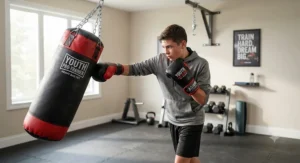
Sticker price only tells part of the story. A $35 hanging bag set that gets replaced every 8-10 months because the seams give out or a child outgrows the glove sizing can easily cost more over three years than a single $200 Century Kid Kick Wavemaster purchased once and used through elementary school. That’s the cost-per-use logic worth running before defaulting to the cheapest option: divide the price by realistic months of use, not just the sticker number.
Maintenance itself is minimal across this category — wipe bags down monthly, check mounting hardware or base fill levels quarterly, and replace gloves when the foam padding visibly compresses or the closure straps lose grip, typically somewhere in the 12-18 month range for daily users. Reflex and speed-style equipment, like the Everlast Core Reflex Boxing Bag, has one additional maintenance point worth flagging: check the spring mechanism periodically for wear, since that’s the one moving part in an otherwise low-maintenance category.
Safety, Regulations & Pediatric Guidance
Regular movement matters for kids, and the numbers back that up: the CDC recommends at least 60 minutes of moderate-to-vigorous physical activity daily for children and adolescents ages 6 to 17, covering aerobic, muscle-strengthening, and bone-strengthening activity — a category a punching bag session genuinely fits into. That said, safety specifics matter here. For toys and kits intended for kids under 3, CPSC regulations require products to be free of small parts that could liberate during use, which is worth checking on any bundled accessory pieces — phone holders, small hardware, valve caps — before handing a set to a very young child unsupervised.
As covered earlier, it’s worth reiterating the AAP’s specific concern is with competitive, contact boxing, not solo equipment-based practice, but sensible supervision still applies: keep freestanding bags away from stairs and hard corners, check hanging bag mounting hardware periodically for wear, and size gloves properly so wrist strain doesn’t become an issue. None of this is an argument against these products — it’s simply the difference between casual use and careless use.
Features That Actually Matter (And Those That Don’t)
Base weight and mounting security matter enormously — they’re the difference between a bag that stays put during real use and one that becomes a hazard. Glove closure quality matters too, since a loose glove that slips mid-swing is both annoying and a genuine small-hand-safety issue. LED lights, music modes, and game-mode electronics, on the other hand, are largely novelty — fun for the first week, rarely the reason a kid keeps using the equipment six months later, according to the pattern in aggregated review sentiment across this category. Fill material composition (sand versus water versus foam) matters more than most shoppers realize, since it directly determines rebound feel and tip resistance, while cosmetic details like color or novelty branding matter basically not at all to long-term satisfaction.
What to Expect: Real-World Performance
On paper, spec sheets talk about ounces, inches, and pounds. In the living room, what that actually translates to is this: a lighter, less-filled hanging bag like the base LoGest Punching Bag for Kids Boxing Set swings noticeably with each hit, giving younger kids satisfying visual feedback without much resistance. A weighted freestanding bag like the Century Kid Kick Wavemaster barely moves, which initially disappoints kids expecting a big swing but ultimately builds better technique, since they’re striking against real resistance rather than chasing a swinging target. Reflex equipment like the Everlast Core Reflex Boxing Bag feels closer to a game than a workout in the first few sessions — kids often laugh more than they “train,” which, again, is the entire point for building engagement early.
FAQ
❓ What age is appropriate for a kids boxing gloves and punching bag set?
❓ Do kids punching bags need to be filled with sand or water?
❓ Are inflatable punching bags as good as filled ones for kids?
❓ Can a punching bag replace boxing gloves that came with a cheap set?
❓ Is a freestanding or hanging punching bag better for kids?
Recommended for You
- Foam Bow and Arrow Set Boys: 7 Safest Picks for 2026
- 7 Best Backyard Sports Toys for Boys in 2026
- 7 Best Toy Military Helicopters for Boys in 2026
Conclusion
✨ Found this helpful? Share it with your friends! 💬🤗
