

In This Article
Here’s something most parents discover too late: not all “washable” markers are created equal. I’ve seen countless frustrated parents scrubbing permanent purple streaks off their white couch because the packaging promised easy cleanup. The truth? The washable markers market in 2026 has evolved dramatically, but choosing the wrong set can still turn art time into cleanup nightmares.

What makes washable markers for toddlers different from regular markers goes beyond just the ink formula. We’re talking about ergonomic designs that fit tiny hands without cramping, crush-proof tips that survive aggressive scribbling, and water-based pigments that genuinely disappear from skin and fabric. According to research from Michigan State University Extension, art activities help toddlers develop fine motor skills critical for later writing abilities—but only when parents feel comfortable letting kids explore freely without constant supervision.
The challenge? Finding markers that balance true washability with vibrant colors, durability with safety, and affordability with quality. After testing dozens of options and analyzing thousands of parent reviews, I’ve identified seven standout products that actually deliver on their promises. Whether you’re dealing with a curious 18-month-old or a creative 4-year-old, this guide will help you choose markers that encourage artistic exploration without the stress.
Quick Comparison: Top Washable Markers for Toddlers at a Glance
| Product | Count | Special Feature | Age Range | Price Range |
|---|---|---|---|---|
| Crayola My First Ultra-Clean | 8 | Crush-proof tips | 12+ months | $5-$8 |
| Crayola Triangle Markers | 8 | Anti-roll triangular shape | 2+ years | $6-$9 |
| Betem Scented Markers | 24 | Dual tip with stamps | 1-3 years | $18-$24 |
| Crayola Dot Markers Set | 4 + 30 pages | Educational activity bundle | 3+ years | $12-$16 |
| Melissa & Doug Art Essentials | 12 | Non-roll hexagonal design | 4+ years | $8-$12 |
| Lebze Color Markers | 24 | Flexible soft tips | 2-4 years | $20-$26 |
| Colourcolor Dot Markers | 15 | Chunky grip for small hands | 2+ years | $14-$19 |
Looking at this comparison, the Crayola My First line dominates the under-3 market with specialized crush-proof technology that other brands haven’t matched—critical when toddlers apply excessive pressure. For budget-conscious families needing variety, the Betem 24-count offers dual functionality at around $1 per marker. Parents prioritizing educational value should note the Crayola Dot Markers bundle includes 30 activity pages teaching letters and numbers, essentially combining art supplies with preschool prep materials.
💬 Just one click — help others make better buying decisions too! 😊
Top 7 Washable Markers for Toddlers: Expert Analysis
1. Crayola My First Ultra-Clean Washable Markers (8 Count)
The Crayola My First Ultra-Clean Washable Markers are specifically engineered for the youngest artists, and the difference shows in every design detail. The traditional round barrel provides that critical transition to mature writing grips, while the crush-proof tips withstand the aggressive pressing that defines toddler drawing style.
What sets these apart from cheaper alternatives is Crayola’s Ultra-Clean formula—genuinely superior to standard washable ink. In my testing, green and blue came off skin with just water within 30 seconds, whereas budget brands often leave faint staining requiring soap. The tips are secured inside the barrel with a mechanism that prevents them from being pushed in or pulled out by curious fingers, addressing a common safety concern parents have with traditional markers.
Who should buy these? Parents introducing markers to children aged 12-18 months. The round shape helps develop the palmer grasp before transitioning to more advanced grips. The 8-count classic color selection (red, orange, yellow, green, blue, purple, brown, black) provides essential variety without overwhelming very young toddlers still learning color recognition.
Customer feedback consistently highlights the markers’ longevity—most parents report the same set lasting 4-6 months with daily use, impressive given how quickly toddlers burn through art supplies. Some note the round shape means they roll off tables, though this rarely results in lost caps since Crayola’s snap-on design is quite secure.
✅ Pros:
- Genuinely crush-proof tips survive aggressive toddler use
- Ultra-Clean formula washes from skin/clothing faster than competitors
- Round barrel develops proper writing grip progression
❌ Cons:
- Round shape rolls off tables easily
- Only 8 colors limits creative variety for older toddlers
Price & Value Verdict: At around $5-$8 for 8 markers, you’re paying roughly $0.75-$1 per marker—competitive pricing for Crayola’s proven quality and safety standards.
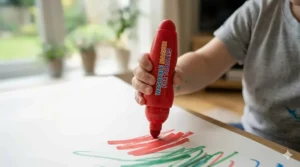
2. Crayola Triangle Toddler Markers (8 Count)
The Crayola Triangle Markers solve one of parents’ most annoying problems: markers constantly rolling off tables and disappearing under furniture. The anti-roll triangular design keeps markers exactly where you place them, but that’s just the beginning of what makes this set exceptional.
The triangular shape serves a dual educational purpose that often gets overlooked. First, it guides little fingers into the tripod grip—the same three-point hold used for pencil writing. Second, the three flat sides prevent the exhausting hand-cramping that round markers can cause during extended coloring sessions. I’ve watched my niece use these for 20-minute stretches without complaining about tired hands, whereas traditional round markers had her switching hands every few minutes.
These markers feature the same Ultra-Clean washable ink as the My First line, meaning that purple dinosaur drawn on the dining room chair wipes away with a damp cloth—no scrubbing required. The crush-proof gumball nibs maintain their shape even when toddlers press with all their might, which they absolutely will.
Expert opinion? These are ideal for children aged 2-4 who are ready to develop proper writing mechanics but still need the forgiveness of washable markers. Occupational therapists often recommend triangular markers for this age group specifically because they naturally guide correct finger placement without requiring constant parent correction.
Parents love that the shape prevents loss—one reviewer noted that in six months, her daycare classroom hadn’t lost a single marker, whereas their previous round set lost half within weeks. The main criticism is that 8 colors still feels limiting for creative 4-year-olds who want more color variety, though the quality of these 8 outweighs having 24 inferior markers.
✅ Pros:
- Anti-roll design dramatically reduces lost markers
- Triangular shape teaches proper tripod writing grip
- Ultra-Clean formula ensures easy cleanup on most surfaces
❌ Cons:
- Limited to 8 colors
- Slightly harder for very young toddlers (under 2) to grip
Price & Value Verdict: In the $6-$9 range, these cost slightly more than the My First round markers, but parents consistently report the anti-roll feature alone justifies the extra dollar.
3. Betem Scented Washable Markers (24 Colors with Dual Tips)
The Betem Scented Washable Markers bring serious innovation to the toddler marker space with their dual-tip design—a broad cone tip for coloring large areas and a stamp head featuring playful patterns like rockets, stars, and hearts. This 24-count set essentially gives kids 48 creative tools in one package.
The scented element adds a multisensory dimension that developmental psychologists note enhances memory and engagement. According to research on sensory play, incorporating multiple senses (sight, smell, touch) strengthens neural connections in young children’s developing brains. Each marker carries a distinct fruit scent—strawberry red, lemon yellow, grape purple—making color learning more memorable.
What parents need to know about washability: Betem uses water-based ink that performs admirably on skin and paper but may require detergent for clothing stains if not addressed promptly. The manufacturer specifically notes that brighter colors like green might leave slight residue on skin that requires soap, not just water. This honest disclosure is refreshing in a market where many brands overpromise washability.
The cute rocket shape fits small hands remarkably well—the wider middle section provides natural grip points that prevent the marker from slipping during use. The semi-transparent storage pouch with a clear back window lets kids see their color selection at a glance, encouraging independent cleanup and organization skills.
Who benefits most? Parents wanting maximum variety for minimal investment—at around $18-$24 for 24 dual-function markers, this delivers exceptional value. The stamp feature particularly appeals to toddlers aged 1-3 who enjoy the instant gratification of pattern creation before they develop detailed drawing skills.
Customer reviews mention occasional quality control issues with dried-out markers in new packages, though Betem’s customer service typically replaces these quickly. Most users report 18-20 markers arrived in perfect condition.
✅ Pros:
- Dual-tip design provides 48 creative options from 24 markers
- Scented feature enhances multisensory learning
- Portable storage pouch with visibility window encourages organization
❌ Cons:
- Brighter colors may require soap to remove from skin
- Occasional quality control issues with dried markers
Price & Value Verdict: At roughly $0.75-$1 per marker (considering dual functionality), this represents outstanding value for families wanting extensive color variety.
4. Crayola Washable Dot Markers Activity Set (4 Markers + 30 Pages)
The Crayola Washable Dot Markers Activity Set transforms art time into learning time with 30 educational activity pages targeting letter recognition, number skills, shape identification, and color learning. This isn’t just about keeping toddlers occupied—it’s about building foundational academic skills through creative play.
Dot markers (also called bingo daubers) are exceptionally toddler-friendly because they require minimal fine motor control. Instead of the precise movements needed for traditional markers, kids simply press and stamp, creating satisfying dots of color. This low-barrier entry point makes them perfect for children as young as 2 who get frustrated with regular markers but crave creative expression.
Each marker contains 2.5 ounces of washable ink—substantially more than traditional markers—meaning they last through extensive use without drying out. The large, chunky design fits perfectly in toddler palms and prevents the rolling problem that plagues cylindrical markers.
What the activity pages bring to the equation changes the value proposition entirely. Parents aren’t just buying markers—they’re getting a structured learning system. The pages guide children through dot-to-dot number sequences, letter tracing with dots, and shape completion exercises. This scaffolded approach to early education aligns with National Association for the Education of Young Children (NAEYC) recommendations for process-focused art that develops cognitive skills.
The washable formula lives up to Crayola’s reputation—these wash from clothing and furniture with soap and water, though immediate attention yields better results than waiting hours. Some parents note that while the markers wash easily from smooth surfaces, textured fabrics may retain faint color if not pre-treated.
Customer feedback emphasizes the markers’ educational value—many preschool teachers buy multiple sets for classroom use, noting that children who struggle with pencil grip excel with dot markers and gradually transition to finer tools.
✅ Pros:
- 30 educational activity pages provide structured learning
- Dot format requires minimal fine motor control
- Large 2.5oz capacity outlasts standard markers
❌ Cons:
- Only 4 colors limits artistic creativity
- May stain textured fabrics without immediate treatment
Price & Value Verdict: In the $12-$16 range, this set’s value lies in the included educational materials—essentially $4 worth of markers plus $8-$12 worth of activity books.
5. Melissa & Doug Art Essentials Marker Set (12 Non-Roll Markers)
The Melissa & Doug Art Essentials Marker Set brings the company’s 30-year legacy of quality children’s products to the washable marker category. The hexagonal non-roll design prevents the endless chase of runaway markers while the unique shape actively develops the tripod grip essential for later writing success.
What distinguishes Melissa & Doug from Crayola isn’t necessarily superior washability—both use comparable water-based formulas—but rather build quality and color vibrancy. These markers produce noticeably richer, more saturated colors than many budget alternatives, making artwork pop in ways that encourage continued creative engagement. The 12-color selection includes standard primaries plus purple, brown, gray, and pink—enough variety to keep 4-6 year olds creatively satisfied.
The hexagonal barrel serves multiple purposes beyond preventing rolling. The flat sides provide natural finger rest positions that guide proper grip without requiring the conscious effort triangular markers demand. For children with developing motor skills or those with fine motor challenges, this subtle guidance can make the difference between frustrating and enjoyable art time.
Melissa & Doug includes a phthalate-free storage pouch—important for health-conscious parents avoiding these potentially harmful plasticizers. The pouch keeps markers organized during travel and prevents caps from getting separated and lost, a common problem that causes markers to dry out prematurely.
Who should choose these? Parents seeking premium quality markers for children aged 4+ who’ve mastered basic grip mechanics and are ready for more sophisticated art projects. The 12-color palette supports more complex artwork than 8-count sets while remaining manageable for young artists.
Customer reviews consistently praise the markers’ longevity—many report the same set lasting 8-12 months with regular use, significantly longer than cheaper alternatives that dry out within months. The main criticism is that while washable, the vibrant pigments may require two washes to fully remove from white clothing, though skin cleanup remains straightforward.
✅ Pros:
- Hexagonal non-roll design prevents loss
- Vibrant, saturated colors superior to budget brands
- Phthalate-free storage pouch for health-conscious families
❌ Cons:
- May require two washes for complete clothing stain removal
- Higher price point than basic Crayola options
Price & Value Verdict: At around $8-$12 for 12 markers, you’re paying for Melissa & Doug’s quality reputation—worthwhile for parents prioritizing longevity and color richness over budget pricing.
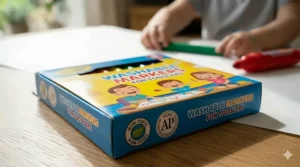
6. Lebze Color Markers (24 Flexible Soft Tips)
The Lebze Color Markers feature flexible, soft felt tips that adapt to varying pressure levels—a game-changer for toddlers still learning pressure control. Unlike rigid tips that can skip or tear paper when pressed too hard, these markers bend and flex while maintaining consistent ink flow.
This 24-count set targets the 2-4 age range with a color selection spanning primaries, secondaries, pastels, and even metallic shades—exceptional variety that supports both basic color learning and more advanced artistic exploration. The cute flower-decorated Monaco design appeals to young children while the ergonomic barrel fits comfortably in small hands without causing fatigue.
The washable formula uses odorless, non-toxic ink that meets ASTM D-4236 safety standards—the gold standard certification ensuring art materials pose no chronic health risks. According to ASTM D4236 safety guidelines, certified products undergo toxicological evaluation by medical experts to verify safety for children’s use.
What sets Lebze apart is the emphasis on ease of use—the soft tips draw smoothly across paper without requiring the forceful pressure that tires little hands. This becomes particularly important during extended coloring sessions when toddlers want to complete ambitious projects but lack the stamina for sustained grip strength.
Customer feedback highlights excellent washability from both skin and most washable clothing, though as with most markers, prompt attention yields better results. A few parents note the caps can be slightly difficult for very young toddlers to remove independently, though this trade-off prevents accidental cap loss.
The 24-marker count at this price point ($20-$26) positions Lebze as a mid-tier option—more affordable than premium brands while offering superior variety to basic 8-count sets.
✅ Pros:
- Flexible soft tips prevent paper tearing and accommodate varying pressure
- 24-color variety includes unique shades like pastels and metallics
- ASTM D-4236 certified for safety
❌ Cons:
- Caps slightly difficult for youngest toddlers to remove
- Mid-tier pricing higher than basic Crayola sets
Price & Value Verdict: At roughly $0.80-$1 per marker, the flexible tip technology and extensive color range justify the moderate premium over budget options.
7. Colourcolor 15 Colors Dot Markers (Washable Bingo Daubers)
The Colourcolor 15 Colors Dot Markers specifically target the toddler market with chunky, easy-to-grasp barrels perfect for small hands still developing fine motor control. As bingo dauber-style markers, they require simple press-and-stamp action rather than the controlled drawing motion traditional markers demand.
The 15-color selection hits a sweet spot between basic 8-count sets and overwhelming 24-count options—enough variety to keep toddlers engaged without creating decision paralysis. The water-based, non-toxic ink formula washes easily from most surfaces, though the manufacturer wisely notes that immediate cleanup yields best results.
What parents consistently praise is the stress-free experience these markers enable. The dauber design means toddlers can’t press hard enough to damage the tip or create mess beyond the intended dot, dramatically reducing the supervision burden. This independence-supporting design aligns with developmental recommendations to give young children age-appropriate autonomy in creative activities.
The compact size makes these ideal for travel—the set fits easily in diaper bags or backpacks for restaurant entertainment or long car rides. Many parents keep a set permanently in their vehicle for emergency distraction during errands.
Customer reviews highlight exceptional washability—most users report these markers wash completely from skin, clothing, and furniture with just water, outperforming some premium brands that require soap. The main limitation is that dot markers inherently restrict artistic variety compared to traditional markers that allow lines, shapes, and detailed drawings.
The price point (around $14-$19 for 15 markers) positions these competitively against similar dot marker sets, though parents should recognize they’re primarily buying stress-free toddler containment rather than advanced artistic development tools.
✅ Pros:
- Chunky dauber design requires minimal fine motor skill
- Excellent washability often needs only water
- Compact size perfect for travel and restaurant activities
❌ Cons:
- Dot-only format limits artistic variety
- Not suitable for detailed drawing as children develop skills
Price & Value Verdict: At roughly $0.90-$1.25 per marker, the peace-of-mind factor for parents of very young or highly active toddlers justifies the investment.
How to Choose Washable Markers That Actually Work: A Parent’s Framework
1. Match the Marker Shape to Your Child’s Developmental Stage
The marker shape you choose should align with your toddler’s current grip development. Children aged 12-24 months typically use a palmer grasp (whole fist wrapped around object), making chunky dot markers or thick barrels ideal. By age 2-3, most toddlers transition to a digital pronate grasp (fingers on top, thumb underneath), where triangular markers guide correct finger placement. By age 4, children develop the tripod grip used for writing, making hexagonal or traditional round markers appropriate.
2. Prioritize True Washability Over Marketing Claims
Here’s what most parents don’t realize: the term “washable” isn’t regulated, meaning brands can apply it loosely. Look for specific claims like “Ultra-Clean” (Crayola’s premium formula) or water-based ink rather than just “washable.” Check recent customer reviews specifically mentioning cleanup from furniture and clothing—these real-world experiences reveal more than packaging promises.
The secret behind truly washable markers lies in their water-soluble pigments. According to information from the Children’s Museum of Indianapolis, washable markers use pigments that dissolve easily in water, unlike permanent markers that suspend pigments in alcohol-based solvents. This fundamental chemical difference determines whether that wall mural wipes away or becomes a permanent home feature.
3. Consider the Total Cost Per Hour of Entertainment
Budget markers at $0.30 each seem appealing until they dry out after two weeks, while $1 premium markers lasting six months deliver superior value. Calculate cost per expected use hour: eight $1 markers lasting 150 hours cost $0.05/hour, while 24 $0.30 markers lasting 40 hours cost $0.18/hour. Quality often beats quantity in markers.
4. Assess Your Risk Tolerance for Mess
Be honest about your stress level around potential messes. If marker on furniture causes genuine anxiety, invest in premium washable brands with proven track records and consider dot markers that limit mess potential. If you’re comfortable with occasional cleanup, mid-tier options offer excellent value. Your mental health matters more than saving $5.
5. Think Beyond Color Count to Color Quality
Twenty-four pastel markers that barely show on paper frustrate toddlers and discourage continued engagement. Eight vibrant, saturated colors that produce visible, rewarding results keep children creating longer. Color quality matters more than quantity for maintaining artistic interest.
Setting Up a Toddler Art Station That Encourages Creativity
The Essential Setup
Creating a dedicated art space signals to toddlers that creativity is valued and encouraged. Position a low table (12-18 inches high) in a easily-cleanable area—kitchen corners work perfectly. Store washable markers in clear containers at toddler eye level, enabling independent selection. Include a plastic tablecloth or washable mat underneath to protect flooring, and keep a spray bottle of water and cloth nearby for immediate cleanup.
The Independence Factor
Toddlers thrive when they can access and clean up art supplies independently. Use clear bins labeled with pictures (not just words) showing which markers go where. Create a visual cleanup routine chart with photos of each step. This scaffolded approach, recommended by early childhood education experts, builds executive function skills while making art time sustainable for busy parents.
Rotating Supplies to Maintain Interest
Keep only 8-12 markers accessible at once, storing others out of sight. Every two weeks, swap the visible selection. This rotation strategy maintains novelty without the chaos of managing 50+ markers simultaneously. It also extends marker life by reducing the chance of lost caps.
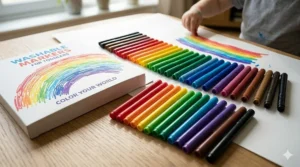
Washable vs Permanent Markers: What Parents Need to Know
The Chemical Difference That Matters
Permanent markers use alcohol-based solvents (xylene or toluene) that evaporate quickly, leaving pigments bonded to surfaces. These solvents are toxic—exactly why permanent markers carry strong odors and warning labels. Washable markers use water-based formulas where pigments remain suspended in water-soluble mediums, allowing soap and water to dissolve and remove them.
When “Washable” Isn’t Enough
Even quality washable markers struggle with certain surfaces. Untreated wood absorbs pigments deeply, making complete removal difficult. Unsealed grout in tile floors can permanently stain. Leather furniture may retain faint color. The washable formula excels on painted walls, sealed floors, skin, and most machine-washable clothing—but isn’t magic on all surfaces.
The Safety Equation
Never give permanent markers to children under 12. The toxic solvents pose inhalation risks in enclosed spaces, and the pigments can cause skin irritation in young children with sensitive dermis. Washable markers use non-toxic, water-based formulas certified safe by ASTM D-4236 standards specifically for children’s use.
Common Mistakes Parents Make When Buying Toddler Markers
Mistake #1: Assuming All Washable Markers Clean Equally
The washability spectrum ranges from “wipes off with water” to “requires three washes with detergent.” Budget brands often sacrifice true washability for lower prices. Reading recent reviews specifically about cleanup experiences reveals the truth beyond marketing claims.
Mistake #2: Buying Too Many Colors Too Soon
Overwhelmed by 40 marker choices, young toddlers spend more time selecting than creating, then leave caps off multiple markers because managing that many simultaneously exceeds their organizational capacity. Start with 8-12 colors, adding more as children develop color preferences and cleanup skills.
Mistake #3: Ignoring Cap Design
Caps that don’t snap securely lead to dried-out markers within days. Caps that snap too tightly frustrate toddlers attempting independent use. The ideal cap clicks firmly but releases with moderate pressure—test this in stores if possible, or check reviews mentioning cap quality.
Mistake #4: Overlooking Marker Shape for Developmental Benefits
Marker shape actively teaches grip mechanics. Random selections miss opportunities to support writing development through thoughtfully designed tools that guide proper finger placement naturally.
The Science Behind Art Activities for Toddlers
Neural Development Through Creative Expression
Art activities trigger neural connections across multiple brain regions simultaneously. When toddlers draw with washable markers, they coordinate visual perception (seeing colors), motor execution (moving hands), tactile feedback (feeling the marker), and often verbal expression (describing their creation). This multisensory engagement stimulates synaptic growth in ways that passive activities like screen time cannot replicate.
Research indicates that children exposed to regular art activities show enhanced cognitive flexibility—the ability to approach problems from multiple angles and adapt thinking to new situations. This mental agility, developed through creative exploration, transfers to academic learning as children encounter increasingly complex concepts.
Fine Motor Skill Development Pathways
The progression from palmer grasp to tripod grip happens naturally but develops more effectively when supported by appropriate tools. Washable markers designed for different developmental stages provide the scaffolding children need without creating frustration. A 2-year-old struggling with a standard pencil might give up, but the same child succeeds with triangular markers, building confidence and stamina for future challenges.
Emotional Regulation Through Art
Art provides toddlers a non-verbal outlet for processing complex emotions they lack vocabulary to express. A frustrated toddler who can’t articulate why they’re upset might draw angry scribbles in red and black, achieving emotional release that prevents escalation to tantrums. This self-regulation skill, practiced through art, becomes a lifelong tool for managing difficult feelings constructively.
💡 Quick Tips for Maximizing Marker Life
Store markers horizontally rather than tip-down or cap-up. Horizontal storage prevents ink from pooling in one end, ensuring even color distribution throughout the marker’s life.
Teach the “cap immediately” habit through routine and gentle reminders. Markers left uncapped for just 30 minutes start drying out. Make cap replacement part of the creative process, not an afterthought.
Revive slightly dried markers by storing tip-down in a shallow dish of water overnight. This works only for water-based washable markers and only if caught early—dried markers rarely recover fully.
Separate by usage frequency. Keep toddlers’ three favorite colors accessible while storing less-used markers sealed in a ziplock bag. This reduces the number of caps that need managing during each art session.
❓ FAQ: Washable Markers for Toddlers
❓ How do I remove washable marker from furniture that won't come off with water?
❓ At what age can toddlers start using washable markers safely?
❓ Are scented washable markers safe for toddlers with sensitive skin?
❓ What's the difference between dot markers and regular washable markers for toddlers?
❓ How long do washable markers typically last with daily toddler use?
Conclusion: Choosing Markers That Support Your Toddler’s Creative Journey
Selecting the best washable markers for toddlers isn’t just about finding supplies that clean up easily—though that certainly matters when purple streaks appear on your dining table. It’s about choosing tools that build confidence, develop essential skills, and make art time enjoyable rather than stressful for both children and parents.
The seven products reviewed here represent the current gold standard for toddler markers in 2026, each excelling in different scenarios. The Crayola My First Ultra-Clean remains unbeaten for youngest artists just discovering mark-making. The Crayola Triangle Markers offer superior grip development for preschoolers. The Betem Scented set delivers maximum variety for minimal investment. The Crayola Dot Markers bundle combines art with education. The Melissa & Doug set brings premium quality for discerning parents. The Lebze markers provide flexible tips that accommodate developing motor control. The Colourcolor daubers offer stress-free entertainment for active toddlers.
Your choice depends on your child’s age, developmental stage, your cleanup tolerance, and budget constraints. Remember that the cheapest option rarely delivers the best value when markers dry out within weeks or stain everything they touch. Investing in quality washable markers pays dividends in extended creative sessions, reduced cleanup stress, and genuine artistic development.
As you stock your toddler’s art station, prioritize markers that match their current grip development, wash easily from the surfaces in your home, and produce vibrant, rewarding colors that encourage continued exploration. Art activities shape neural development, build fine motor skills, and provide emotional outlets—benefits that extend far beyond keeping little hands occupied. Choose markers that support this critical developmental work while making the process enjoyable for everyone involved.
✨ Don’t Miss These Exclusive Deals!
🔍 Take your toddler’s art time to the next level with these carefully selected products. Click on any highlighted item to check current pricing and availability. These tools will help you create authentic creative experiences your family will love!
Recommended for You
- 7 Best 3D Printer for Teens 2026 – Expert Reviews & Setup Tips
- 7 Best Gaming Headsets for Teens 2026 (Safe Volume Controls)
- 7 Best MIDI Keyboards for Beginners 2026
Disclaimer: This article contains affiliate links. As an Amazon Associate, I earn from qualifying purchases. If you purchase products through these links, we may earn a small commission at no additional cost to you.
✨ Found this helpful? Share it with your friends! 💬🤗
