
In This Article
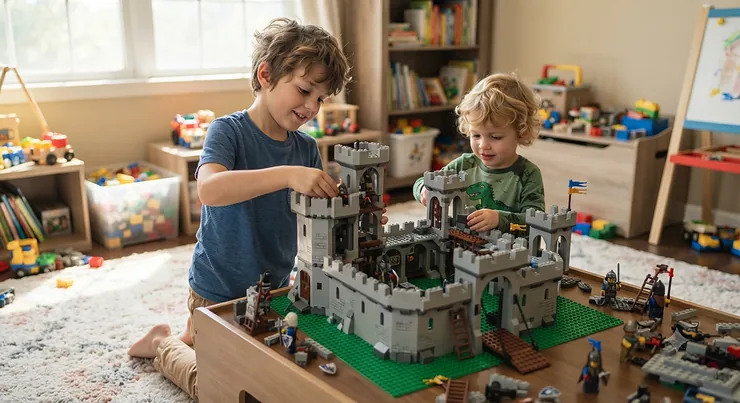
A castle building set for boys is any construction toy — bricks, panels, or rod-and-connector systems — designed to let kids assemble a medieval-style fortress, tower, or knight’s stronghold, then knock it down and start over. That’s the whole appeal in one sentence, and it’s also why the category refuses to go away. Sofas have been repurposed as parapets since roughly the invention of the sofa.
Here’s the thing nobody tells you before you start scrolling through a hundred nearly-identical product photos: “castle set” is doing a lot of heavy lifting as a category name. It covers a $35 rod-and-ball kit that turns into a blanket fort tonight and a pirate ship tomorrow, and it covers a 1,400-piece LEGO build that’ll eat an entire rainy Saturday and half a bag of minifigures. Somewhere between those two extremes sits the set that’s actually right for your kid — not the one with the shiniest box art.
We dug into seven real, currently available options — from LEGO’s Creator 3-in-1 lineup to Playmobil’s snap-together fortresses to the rod-and-ball forts that don’t even pretend to be historically accurate — and broke down what the spec sheets mean once the box is actually open on the living room floor. Expect honest trade-offs, not marketing copy. If you’re also weighing broader options, the history and design of real medieval fortifications is a surprisingly good primer on why these toys look the way they do — moats, drawbridges, and all.
Quick Comparison Table
Before the deep dive, here’s the 30-second version. If you already know your budget and your kid’s age, this table alone might settle it.
| Set | Price Range | Piece Count | Best For |
|---|---|---|---|
| LEGO Creator 3-in-1 Medieval Castle | $100–$135 | 1,426 | First “big kid” castle build, ages 9+ |
| LEGO Creator 3-in-1 Medieval Horse Knight Castle | $125–$150 | 1,371 | Kids who want army-building minifigs |
| Playmobil Wolf Knights’ Castle | $95–$140 | Panel-based | Younger builders who want instant play |
| Fisher-Price Imaginext Eagle Talon Castle | $55–$90 | Panel-based | Preschoolers, ages 3–6 |
| Crazy Forts 69-Piece Playset | $30–$45 | 69 pieces | Budget buyers, open-ended play |
| LEGO City Dump Truck & Front End Loader | $110–$135 | 1,132 | Kids who prefer modern builds to medieval ones |
| MEGA Halo Heroes Series 18 Bundle | $25–$38 | 5 figures | Tweens who want buildable action figures |
Looking at the spread, there’s a clean split between “construction toy” and “playset” here — the two LEGO castles and the LEGO City set reward kids who like the building process itself, while the Playmobil Wolf Knights’ Castle and Fisher-Price Imaginext Eagle Talon Castle hand over a pre-built stage so play can start almost immediately. The Crazy Forts kit is the outlier in the best way: it’s the only set here that refuses to be just one thing, which matters if your household gets bored of “the castle” by Thursday.
💬 Already got a favorite? Bookmark it and keep reading — the “Best For” column only tells half the story.
💬 Just one click — help others make better buying decisions too!😊
Top 7 Castle Building Sets for Boys: Expert Analysis
We picked these seven to cover every realistic budget and skill level: two premium LEGO castle builds, a snap-together Playmobil fortress, a preschool-friendly Imaginext set, a budget rod-and-ball fort, a modern LEGO City alternative, and a buildable action-figure line for kids who’ve outgrown “castle” but not “building.”
1. LEGO Creator 3-in-1 Medieval Castle — three builds in one box
The headline feature here is genuinely the 3-in-1 mechanic — you’re not just building a castle, you’re building three different structures from the same 1,426 pieces, and that alone roughly triples the shelf life of the set. The base build is a two-story castle with a moat, a working drawbridge, and a king’s room, and it comes with a fire-breathing dragon figure that turns “let’s play knights” into “let’s play knights versus dragons” without anyone having to explain why. Once your kid gets bored of version one, the same bricks rebuild into a jousting tower with a working catapult, or a bustling medieval marketplace with a water mill and a prison cell.
Based on the piece count and recommended age of 9+, this is squarely aimed at kids who’ve already built a few hundred-piece sets and are ready for something that takes an afternoon, not twenty minutes. What most buyers overlook is that the “3-in-1” label isn’t a gimmick tacked onto the box — it’s baked into the instruction booklet, which walks through three separate build guides, so nobody has to freelance an alternate model from memory.
Retailer review sections for this set consistently mention two things: the realistic look of the finished castle, and instructions that are unusually easy for a solo 9- or 10-year-old to follow without adult help. A recurring theme in less-favorable reviews is that the included minifigure count feels thin compared to older, retired LEGO castle sets — you get a blacksmith and two guards, not a small army.
Pros:
- ✅ Three distinct builds from one set dramatically extend playtime
- ✅ Working catapult and drawbridge add genuine interactive play
- ✅ Instructions are clear enough for solo building at age 9+
Cons:
- ❌ Only three minifigures included, thin for army-style play
- ❌ Fold-open back hinge feels less sturdy than the main structure
Currently priced in the low-to-mid $100s at the time of research, this set earns its spot as the best all-rounder for a first serious castle build — check current price before buying, since LEGO retail pricing shifts with demand.
2. LEGO Creator 3-in-1 Medieval Horse Knight Castle — six minifigures for army-builders
The standout feature on this one is the minifigure roster: six characters, including a horse knight king, a champion, an archer, a spearman, a blacksmith, and a serpent knight, plus two poseable brick-built horses. That’s double the cast of the base Medieval Castle set, and for kids whose entire play style is “more knights, more battles,” that number matters more than any single feature of the build itself.
At 1,371 pieces, the primary build includes a movable drawbridge, a great hall, a stable, a smithy, a secret treasure chest, and two tower terraces — real depth for a set built around imaginative play rather than just display. Here’s what the spec sheet won’t tell you: the two alternate builds (a jousting arena with a smaller castle, and a medieval town with a windmill) mean this set can effectively become three different toys over a year of play, which is a genuinely good return on a single purchase.
Based on the spec comparison with its sibling set, this is the pick for a kid who cares more about characters and factions than about the castle’s architectural detail — the two opposing knight factions (Horse Knights vs. Serpent Knights) practically write the battle scenarios for you. Reviewers on major retail sites frequently praise the build quality and the number of “army-building” pieces available separately through LEGO’s Pick-a-Brick bundles, while some note the price sits noticeably above the base Medieval Castle for a similar piece count.
Pros:
- ✅ Six minifigures plus two horses fuel faction-based battle play
- ✅ Three alternate builds (castle, jousting arena, medieval town) in one box
- ✅ Pick-a-Brick bundles let families expand the knight armies affordably
Cons:
- ❌ Higher price than the base Medieval Castle for a similar piece count
- ❌ Serpent Knight faction has fewer parts than the Horse Knight side
At around $130–$150 depending on retailer, this is the better value if your son already role-plays factions and rivalries rather than just “the castle.”
3. Playmobil Wolf Knights’ Castle Playset Building Kit — instant setup, no instructions needed
The standout advantage of the Playmobil Wolf Knights’ Castle is speed: large panels snap together without a fifty-page instruction manual, so a determined 5-year-old can have towers standing and knights posted within about fifteen minutes. That single fact changes the entire play dynamic compared to a brick set — there’s no “building phase” that has to end before “playing” begins; the two happen almost simultaneously.
The set includes a castle structure, three armored figures, an armored horse, a breakaway wall, a crossbow with fire arrows, a coat of arms, castle flags, and a dungeon, all built around Playmobil’s classic figure system with bendable joints and turnable heads. What most buyers overlook is that the breakaway wall isn’t decorative — it’s a real play mechanic, letting kids stage a siege where the wall physically gives way, which is the kind of dramatic payoff bricks alone rarely deliver.
Based on the age range (4–10) printed on the box, this sits in a useful middle ground: sturdy enough that a 10-year-old won’t feel babied, simple enough that a 4-year-old can operate every feature without help. Aggregated feedback across retail listings tends to praise how compatible this set is with other Playmobil Knights-line sets, letting a single castle grow into a small kingdom over several birthdays; a common complaint is that the figures, while durable, are small enough to be a genuine “step on a Lego at 2am” hazard for households with younger siblings.
Pros:
- ✅ Snap-together panels mean setup takes minutes, not hours
- ✅ Breakaway wall creates real siege-style dramatic play
- ✅ Compatible with the wider Playmobil Knights product line
Cons:
- ❌ Small figures and accessories pose a stepped-on-in-the-dark risk
- ❌ Less of a “building challenge” than brick-based alternatives
Typically priced in the $95–$140 range, this is the pick for families who want dramatic play now and building-as-a-hobby later.
4. Fisher-Price Imaginext Eagle Talon Castle — the preschool workhorse
The Eagle Talon Castle’s standout trick is that it unfolds to over three feet tall from a compact folded state, which is a genuinely impressive scale-to-storage ratio for a preschool toy. Add ACTION TECH technology — the castle’s cannon and accessories trigger recorded sounds and speech when connected — and you get sensory feedback that a 3- or 4-year-old finds far more compelling than a silent plastic wall.
Key features include a breakaway wall for storming the castle, a working drawbridge, a secret treasure hideaway, two catapults with eight foam disks, and an eagle-head mechanism that fires projectiles when the castle is in “defense mode.” What this means in practice: a preschooler gets six or seven distinct interactive points spread across one toy, which is roughly what keeps attention spans that short actually engaged for more than five minutes.
Reviewers commonly note that this set holds up well to rough, repeated preschool play — Imaginext as a line is built for that kind of durability — while a recurring theme in feedback is frustration with the battery requirements (2 AA plus 3 button cells) needed for the full sound experience, since dead batteries quietly turn ACTION TECH features back into silent plastic.
Pros:
- ✅ Unfolds to over 3 feet, an unusually large footprint for the age range
- ✅ Sound-responsive ACTION TECH adds sensory feedback preschoolers love
- ✅ Durable design built for repeated rough preschool play
Cons:
- ❌ Requires multiple battery types for full sound functionality
- ❌ Additional castle accessories are often sold separately
At roughly $60–$90, this is the strongest pick for the 3-to-6 age bracket specifically — older kids will likely find it too simple.
5. Crazy Forts 69-Piece Buildable Fort Playset — the budget shape-shifter
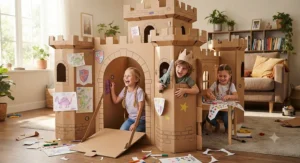
The single biggest advantage of Crazy Forts is that it isn’t actually a castle set at all — it’s a fort-building system of 25 geometric balls and 44 rods that becomes a castle, a cave, an igloo, or a pirate ship depending entirely on what bedsheet gets thrown over it that day. For households where “the castle” gets replaced by “the pirate fort” every other week anyway, this honestly solves that problem better than a dedicated castle toy would.
There’s no motor, no battery, and no brand license here — just structural geometry, which means the learning curve is entirely about spatial reasoning and load-bearing angles rather than following printed steps. Based on the spec comparison with rod-and-connector competitors, Crazy Forts sits in the middle of that specific niche: not the cheapest option on the market, but consistently cited as more durable than several lower-cost imitators using thinner plastic.
Aggregated reviewer sentiment across major retailers is notably positive on longevity — parents frequently mention kids using the same kit from preschool age well into the 8–10 range, just building more ambitious shapes as they grow. A common critique is that, without the included bedsheet-draping step, the bare rod-and-ball frame alone doesn’t look much like a castle to a child expecting brick walls and towers.
Pros:
- ✅ Reconfigures endlessly — castle today, pirate ship tomorrow
- ✅ No batteries, screens, or licensed characters required
- ✅ Reviewers report multi-year use across a wide age range
Cons:
- ❌ Requires a bedsheet or blanket to actually look “castle-like”
- ❌ Less visually detailed than brick or panel-based alternatives
At around $30–$45, this is the easiest recommendation for a first fort-building set boys will actually keep using past age 8.
✨ Don’t Miss These Exclusive Deals!
🔍 Take castle-building playtime to the next level with these carefully selected sets. Check current pricing and availability before you buy — stock and prices shift fast around birthdays and holidays!
6. LEGO City Dump Truck & Front End Loader — the modern-day alternative
This set’s standout feature is scope: at 1,132 pieces, it’s essentially a full construction-site starter kit, pairing two heavy-duty vehicles with a billboard and a portable office, plus three minifigures to run the whole operation. It’s not a castle in any sense, but for boys whose “building set” interest points toward cranes and diggers rather than moats and turrets, it belongs in this comparison as the honest alternative.
The dump truck and front-end loader are both fully poseable with moving parts — tipping beds, scooping buckets — which means the play value isn’t just in the one-time build but in ongoing physical interaction afterward. Based on the spec sheet, this set is aimed at kids who enjoy realistic modern machinery detail over medieval fantasy elements, and the piece count puts the build time roughly in line with the two LEGO castle sets above.
Early reviewer chatter on this newer release focuses heavily on how well the vehicles’ scale matches other recent LEGO City construction sets, meaning it slots into an existing collection rather than standing alone; some buyers note the “starter pack” framing implies more expandability than a single set alone actually delivers.
Pros:
- ✅ Two fully functional, poseable construction vehicles included
- ✅ Compatible in scale with the wider LEGO City construction subtheme
- ✅ High piece count offers a comparable build challenge to castle sets
Cons:
- ❌ No castle, knights, or medieval theming whatsoever
- ❌ “Starter pack” framing may oversell built-in expandability
Priced around $110–$135, this is the pick for the kid who loves LEGO building itself but has zero interest in dragons.
7. MEGA Halo Heroes Series 18 Buildable Action Figure Bundle — for the “outgrew castles” crowd
The standout hook of this bundle is the format: five fully buildable, poseable Halo characters — including Atriox and a Sangheili Honor Guard — assembled from individual brick-built parts rather than pre-molded action-figure bodies. That distinction matters because it keeps the “construction toy” appeal alive for kids who’ve decided medieval castles are for little kids, without abandoning building entirely.
Each figure includes swappable armor pieces and weapon accessories, and the set is designed to display on included stands once built, which shifts the play pattern toward customization and collection rather than open-ended battle scenes. Based on the spec sheet, this is aimed squarely at older kids and early teens (the packaging lists 13+), reflecting both small-parts complexity and the source material’s more mature tone compared to a medieval castle set.
Reviewer sentiment across retail listings tends to highlight the sculpt detail on individual figures as a strong point for the price, while a recurring complaint is that “complete set of 5” bundles from resellers are frequently marked up well above the components’ combined individual price — a pattern worth double-checking before buying.
Pros:
- ✅ Buildable, poseable figures with swappable armor and weapons
- ✅ Keeps “construction toy” appeal alive for kids who’ve outgrown castles
- ✅ Individual figures display well on included stands
Cons:
- ❌ 13+ age recommendation puts it out of reach for younger boys
- ❌ Bundle pricing from third-party sellers often runs above component cost
At roughly $25–$38 for the bundle when purchased directly rather than marked up, this is the natural next step once a boy has aged out of the castle-and-knights phase.
Practical Usage Guide
Getting one of these sets out of the box and into actual, sustained play comes down to a handful of habits that most parents figure out by accident, usually after set number two.
First-30-days setup matters more than it seems. Sort loose pieces by type before the first build — a shoebox lid with a few dividers turns a frustrating half-hour of searching into a smooth build session, especially for the 1,000-plus-piece LEGO sets. For panel-based sets like the Fisher-Price Imaginext Eagle Talon Castle or Playmobil Wolf Knights’ Castle, do the first assembly together even if your kid technically “doesn’t need help” — knowing where the breakaway wall or drawbridge mechanism is supposed to click back into place after it’s been “sieged” saves a lot of later frustration.
Maintenance is minimal but real. Brick sets benefit from a shallow storage bin rather than the original cardboard box, since repeated open-close cycles wear boxes out fast. Battery-powered features — like the ACTION TECH sounds on the Eagle Talon Castle — should get fresh batteries checked seasonally, since kids rarely report a feature as “broken” so much as they just quietly stop using it.
The most common early mistake: buying a set above a child’s actual patience threshold because the box art looks age-appropriate. A 9-year-old rating on the box doesn’t guarantee a 9-year-old will want to sit through 1,400 pieces solo on day one — plan for the first build to be a shared activity regardless of what the age label suggests.
Real-World Scenarios: Matching Boys to the Right Castle Set
Consider a 5-year-old who loves knights but has zero patience for instructions — the Fisher-Price Imaginext Eagle Talon Castle or Playmobil Wolf Knights’ Castle fits this profile far better than any brick set, since play starts in minutes and the interactive features (drawbridge, breakaway wall, sound effects) do the entertaining without requiring reading comprehension.
If you’re a parent of a 9-year-old who already owns a few hundred-piece LEGO sets and is hungry for a bigger challenge, the LEGO Creator 3-in-1 Medieval Castle or the Medieval Horse Knight Castle are the natural next step — both offer a genuine afternoon-long build and enough post-build play value (via the alternate models and minifigure factions) to justify the higher price tag.
For a budget-conscious household with multiple kids and a habit of rotating interests weekly, the Crazy Forts kit solves a real logistics problem: instead of buying a castle set, then a pirate set, then a fort set, one $30–$45 kit covers all three phases. And for the 11-to-13-year-old who’s decided he’s “too old” for castles but still loves building things with his hands, the MEGA Halo Heroes Series 18 Bundle offers a face-saving bridge — still a construction toy, just with a different aesthetic.
Buyer’s Decision Framework
If your child is under 6 and mainly wants immediate, dramatic role-play, choose a panel-based playset like Imaginext or Playmobil, because the setup-to-play time is nearly instant and there’s no risk of a half-finished build souring the mood.
If your child is 8 or older and enjoys the building process as much as the finished toy, choose a LEGO brick set, because the instruction-following itself becomes part of the entertainment, not just a barrier before the “real” play starts.
If budget is the primary constraint or your household’s interests shift often, choose a rod-and-connector system like Crazy Forts, because a single kit covers castle, fort, and pirate-ship phases without three separate purchases.
If your child has aged out of medieval themes specifically but still loves construction toys, choose a buildable action-figure line or a modern LEGO City set, because the underlying “build something with your hands” appeal survives even when dragons stop being cool.
How to Choose a Castle Building Set for Boys
- Match the piece format to attention span, not just age. A rod-and-panel set (Playmobil, Imaginext) suits shorter attention spans regardless of age; brick sets reward kids who already enjoy sequential building.
- Check the actual age range printed on the box, not the marketing photos. Box art often shows older kids playing with preschool sets purely for photogenic reasons.
- Count the interactive mechanisms, not just the piece count. A working drawbridge or catapult adds more lasting play value than fifty extra decorative bricks.
- Decide whether army-building matters. If your child wants factions and rivalries, prioritize minifigure count over structural detail.
- Factor in expandability. Sets compatible with a wider product line (Playmobil Knights, LEGO Creator, LEGO City) let a single purchase grow into a collection over time.
- Weigh battery dependence honestly. Sound- and light-enabled sets add engagement but introduce an ongoing maintenance cost most parents forget to budget for.
- Confirm small-parts safety for your household. Any home with toddlers or pets needs to weigh choking-hazard risk regardless of the primary child’s age — voluntary toy safety standards exist specifically because small interlocking pieces are a genuine risk category.
Common Mistakes When Buying Castle Building Sets for Boys
The single most common mistake is buying for the box art’s implied age rather than the actual printed recommendation — a set that photographs well with a 10-year-old model can still be engineered for a 6-year-old’s attention span, and vice versa.
A second frequent misstep is assuming “more pieces” automatically means “more fun.” A 1,400-piece LEGO castle and a 69-piece Crazy Forts kit can deliver comparable long-term play value for very different kids; piece count measures build complexity, not entertainment ceiling.
Parents also regularly underestimate battery-dependent features. Sound- and motion-triggered accessories are genuinely engaging on day one, but they quietly become “broken” toys the moment batteries die and nobody replaces them — check the battery requirements before assuming a feature-rich set is maintenance-free.
Finally, buying into a single castle faction without checking expandability is a common regret. Sets tied to an ongoing product line (Playmobil Knights, LEGO Creator castles) let you add pieces later; standalone or discontinued sets leave you stuck with exactly what’s in the box.
Castle Building Sets vs Architect Toy Sets for Boys
Castle building sets and architect-style building toys look similar on a store shelf — both involve stacking small interlocking pieces into a finished structure — but they reward almost opposite instincts. A castle set like the LEGO Creator 3-in-1 Medieval Castle is built for play afterward: the finished model gets knights posted on it, catapults fired from it, and drawbridges raised and lowered on repeat. An architect toy set for boys, by contrast — think detailed skyline or landmark model kits — is built primarily to be displayed once completed, with the reward concentrated in the building process itself rather than ongoing hands-on play.
That distinction should drive the purchase decision more than age alone. A meticulous 10-year-old who enjoys precision and finds satisfaction in a finished, static model may genuinely prefer an architect-style kit over another castle. A kid who wants his toys to keep doing things after the build — battles, sieges, rescues — will get more lasting value from castle and knight sets specifically, since the play mechanisms (drawbridges, catapults, breakaway walls) simply don’t exist in most architecture-focused kits. Neither category is “better” in the abstract; they’re built around different definitions of a satisfying afternoon.
What to Expect: Real-World Performance
On paper, spec sheets list piece counts and minifigure numbers, but the everyday experience comes down to a few things the box rarely mentions. Brick-based castle builds genuinely do take as long as advertised — a 1,400-piece set is realistically a two-to-four-hour build for a first-timer, longer with interruptions, which is worth planning around rather than treating as a quick afternoon activity.
Panel-based playsets like Playmobil and Imaginext deliver on the “instant play” promise, but the trade-off shows up in storage: unlike bricks, which pack down flat into a bin, assembled castle panels tend to stay assembled, eating shelf or floor space semi-permanently unless disassembled each time. Rod-and-connector systems like Crazy Forts land in between — quick to build, quick to break down, but requiring an actual bedsheet on hand to complete the “castle” illusion, which is easy to forget the first few times.
Across all formats, the single biggest real-world performance factor isn’t the toy at all — it’s whether a sibling or friend is available to play the other role in a two-person knights-and-castle scenario. Even the most detailed set sits quieter than expected during genuinely solo play sessions.
Long-Term Cost & Maintenance
Total cost of ownership varies more between these categories than the sticker price alone suggests. A LEGO Creator 3-in-1 Medieval Castle at roughly $100–$135 delivers three distinct builds from one purchase, which works out to a lower cost-per-play-session than it first appears, especially since rebuilding the alternate models effectively resets the “new toy” feeling months later at zero extra cost.
Battery-dependent sets like the Fisher-Price Imaginext Eagle Talon Castle carry a small but real ongoing cost: 2 AA and 3 button-cell batteries aren’t free, and a household that replaces them promptly gets meaningfully more play value than one that lets the sound features quietly die.
| Set | Approx. Price | Ongoing Cost | Best Value For |
|---|---|---|---|
| LEGO Creator 3-in-1 Medieval Castle | $100–$135 | None | Multiple build cycles from one purchase |
| Crazy Forts | $30–$45 | None | Lowest entry cost, multi-year use |
| Fisher-Price Imaginext Eagle Talon Castle | $55–$90 | Batteries | Younger kids, shorter ownership window |
| MEGA Halo Heroes Bundle | $25–$38 | None | Collectors adding figures over time |
Reading across this table, the Crazy Forts kit has the strongest long-term cost profile purely because of its multi-year, multi-theme reuse pattern, while the LEGO Creator 3-in-1 Medieval Castle offers the best value-per-dollar for households that will actually rebuild the alternate models rather than leaving the first version permanently assembled on a shelf.
Features That Actually Matter (And Those That Don’t)
Piece count gets far more attention in marketing than it deserves. What actually predicts long-term satisfaction is the number of functional mechanisms — a working drawbridge, a firing catapult, a breakaway wall — since these are what turn a static model into a repeatable play scenario. Research on structured block play has found it measurably improves children’s spatial reasoning compared to less hands-on activities, which is a genuine reason to favor sets that require real assembly over pre-molded, ready-made playsets.
Minifigure or character count matters, but mainly for kids whose play style centers on factions and army-building; a solo-focused builder gets little added value from a sixth knight sitting in a drawer. Sound and light features drive short-term excitement but rarely predict which set gets played with six months later — durability and mechanism variety do that instead.
What genuinely doesn’t matter much: brand prestige alone. A well-reviewed budget rod-and-ball set can deliver more sustained engagement than an expensive brand-name castle that gets built once and displayed. The honest filter is mechanism count and rebuild potential, not the logo on the box.
Safety, Age Ratings & Regulations Guide
Every set in this roundup falls under U.S. toy safety requirements enforced through the Consumer Product Safety Commission, and the printed age ranges aren’t arbitrary marketing — they reflect actual choking-hazard testing for small parts. Sets like the Playmobil Wolf Knights’ Castle, with its small weapons and accessories, are labeled for ages 4 and up specifically because of small-parts risk to younger siblings, not because a 3-year-old couldn’t physically operate the drawbridge.
Battery-powered features on sets like the Fisher-Price Imaginext Eagle Talon Castle use sealed compartments as standard practice, but it’s worth periodically checking that screws remain tight, especially in households with toddlers who might encounter the toy secondhand. Brick-based sets carry their own small-parts warnings on packaging for the same underlying reason — a 9+ age rating on the LEGO Creator 3-in-1 Medieval Castle reflects both build complexity and genuine small-piece choking risk for younger children in the same household.
The practical takeaway: check the printed age range against every child who might access the toy, not just the intended recipient, and store loose small pieces out of reach of toddlers between play sessions regardless of the primary user’s age.

FAQ
❓ What age is a castle building set appropriate for boys?
❓ Are LEGO castle sets worth the higher price over Playmobil?
❓ Can girls play with castle building sets marketed to boys?
❓ How long does a 1,000+ piece castle set take to build?
❓ Do castle building sets help with STEM skills?
Conclusion
There’s no single “best” castle building set for boys — there’s only the best match for a specific kid’s patience level, budget, and whether he wants to build first and play second, or skip straight to the sieging. The LEGO Creator 3-in-1 Medieval Castle and Medieval Horse Knight Castle reward builders who like the process; the Playmobil Wolf Knights’ Castle and Fisher-Price Imaginext Eagle Talon Castle get straight to the drama; Crazy Forts stretches a modest budget across years of shape-shifting play; and the LEGO City and MEGA Halo picks cover the kids whose interests have drifted past dragons and drawbridges entirely.
What ties all seven together is something decades of developmental research keeps confirming: hands-on construction play isn’t just a way to pass a rainy afternoon, it’s genuinely building spatial reasoning skills kids carry well past childhood. Pick the format that matches your son’s patience and budget, and the learning happens whether he notices it or not.
✨ Found the right set for your castle-obsessed builder? Check current pricing before it changes, and start the siege this weekend! 💬🤗
Recommended for You
- 7 Best Jumbo Foam Building Bricks Outdoor Sets in 2026
- 7 Best construction site toy playset for boys Picks (2026 Guide)
- 7 Best Gear Building Toy Set Boys Picks for 2026 (Ranked)
Disclaimer: This article contains affiliate links. As an Amazon Associate, I earn from qualifying purchases. If you purchase products through these links, we may earn a small commission at no additional cost to you.
✨ Found this helpful? Share it with your friends! 💬🤗
