
In This Article
There’s a particular kind of silence that settles over a kid who is completely absorbed in something. No pinging notifications. No background TV noise. Just a child, a set of sprues, and a growing determination to make something real. That silence, in 2026, is increasingly coming from the hobby room — because ship model kits for kids are back, and they’re bigger than ever.
What exactly is a ship model kit for kids? Simply put, it’s a scale-model building set — usually plastic, wooden, or laser-cut metal — that lets young builders assemble a replica of a real or historically inspired vessel, from WWII battleships to pirate frigates. The best kits don’t just produce a shelf decoration; they teach patience, spatial reasoning, and a surprising amount of history while they’re at it. According to a STEM education overview from the Smithsonian Institution, hands-on assembly projects like model building measurably improve fine motor skills and sequential thinking in children aged 8–15.
Not every kit on the market is created equal, though. Some are gems that will hook your kid on a lifelong hobby. Others are frustrating piles of warped plastic that’ll end up in the back of a closet by Tuesday. I’ve dug through ratings, reviews, expert hobbyist forums, and Amazon’s current inventory to find the seven ship model kits for kids that actually deliver on their promise — covering every skill level, price point, and personality type.
Whether your kid is a 9-year-old pirate enthusiast or a 14-year-old with a thing for WWII naval history, there’s something on this list that will light them up.
Quick Comparison: Top 7 Ship Model Kits for Kids at a Glance
| Product | Scale | Pieces/Sheets | Skill Level | Age | Best For |
|---|---|---|---|---|---|
| Revell USS Missouri Battleship (85-0301) | 1:535 | ~65 | Skill 2 (Beginner) | 10+ | First-time builders |
| Lindberg Jolly Roger Pirate Ship | 1:130 | ~100+ | Skill 2 | 12+ | Pirate-obsessed kids |
| Revell PT-109 Patrol Torpedo Boat (05147) | 1:72 | ~85 | Skill 3 | 11–14 | History buffs, step-up builders |
| Academy R.M.S. Titanic 1:1000 | 1:1000 | ~100+ | Skill 2–3 | 14+ | Titanic fans, value seekers |
| Revell USS Arizona Battleship (85-0302) | 1:426 | 133 | Skill 4 | 12–16 | Ambitious teen builders |
| Fascinations ICONX Queen Anne’s Revenge | — | 2 metal sheets | Challenging | 14+ | Teen metal puzzle lovers |
| HAPYLY 1:130 Wooden Sailing Boat Kit | 1:130 | Wood planks | Beginner | 10+ | Patient, wood-craft fans |
The table above maps out the full spectrum — from the forgiving Revell Missouri at one end to the precise metal artistry of the ICONX Queen Anne’s Revenge at the other. For most 10–12-year-olds just starting out, I’d point straight at the Missouri or the Jolly Roger. Teens who’ve already finished a kit or two will find real satisfaction in the Arizona or the PT-109. The HAPYLY wooden kit is its own category: slower, calmer, and deeply rewarding for kids who like to work with their hands.
💬 Just one click — help others make better buying decisions too! 😊
✨ Don’t Miss These Exclusive Deals!
🔍 Take your model ship building hobby to the next level with these carefully selected kits. Click on any highlighted product to check current pricing and availability on Amazon. These kits will help your child create something they’ll be proud to display for years!
Top 7 Ship Model Kits for Kids: Expert Analysis
1.Revell USS Missouri Battleship 1:535 Scale (85-0301)
If I had to recommend one ship model kit for a kid who has never held a sprue before, this is it. The Revell USS Missouri — the “Mighty Mo” that witnessed the Japanese surrender aboard her decks on September 2, 1945 — is arguably the most beginner-friendly plastic battleship kit on the American market.
At 1:535 scale, the Missouri isn’t huge when finished (which is actually a feature, not a bug — a massive kit will intimidate a first-timer). The Skill Level 2 rating means that even a motivated 10-year-old can complete this without an adult doing half the work for them. It comes with roughly 65 plastic pieces molded in light gray, plus a display stand, waterslide decals, a colorful flag sheet, and a historical paper plaque. Those two Navy seaplanes on movable catapults? Kids absolutely love them. Three rotating gun turrets add playability without turning it into a toy.
What most parents overlook about this kit: the one-piece hull. Unlike many battleship models that require you to glue two hull halves together and then spend an afternoon sanding the seam into oblivion, the Missouri’s solid hull means your child skips one of the most frustrating beginner experiences entirely. The trade-off is that historical accuracy takes some hits — the original mold dates back to 1953 and the lower hull design was partially classified when Revell made it — but for a 10-year-old building their first ship? It doesn’t matter one bit.
Customer reviews consistently describe it as a great “entry ticket” to the hobby. Multiple adults recall building this exact model as children and returning to it decades later for the nostalgia factor alone.
✅ Skill Level 2 — genuinely manageable for ages 10+
✅ One-piece hull eliminates most frustrating step
✅ Display stand included — it looks great on a shelf immediately
❌ Older mold — some flash and minor fit gaps to expect
❌ Paint and glue sold separately (Testors paints work well)
Price range: under $25, making it one of the best-value ship model kits for kids on the market.
2. Lindberg Jolly Roger Pirate Ship 1:130 Scale
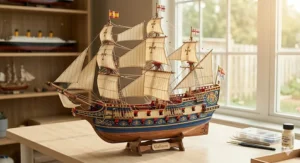
Pirates. Skull flags. Cannons. If your kid has ever watched a swashbuckling adventure movie and announced they wanted to live on a pirate ship, the Lindberg Jolly Roger is the kit you hand them. At 1:130 scale, the finished model stretches a full 16 inches — long enough to be genuinely impressive on a shelf, without being so large that assembly becomes overwhelming.
The kit earns its Skill Level 2 rating honestly. Pieces are molded in brown, tan, black, and white plastic, which is a thoughtful touch — it means even an unpainted version still looks reasonably attractive. Most ship kits come in a single boring gray. The Jolly Roger includes detailed crew figures (!) which are a rare bonus at this price point, plus rigging blocks, pre-molded sails, cannons, and colorful pirate decals. The ratline details are intricately molded right into the plastic, so kids don’t have to tie tiny knots to get that authentic rigging look.
What separates this kit from cheaper pirate ship toys is the educational value hiding inside the box. The Jolly Roger is loosely based on a European sailing frigate from the age of sail — the same type of vessel that dominated the Atlantic trade routes in the 17th and 18th centuries. Building it naturally sparks questions about how these ships worked, how they were crewed, and why pirates were so feared. That’s a history lesson that no worksheet can replicate. For a deeper look at the golden age of piracy and historical ship design, Wikipedia’s overview of the frigate is a surprisingly engaging rabbit hole for curious kids.
Some reviewers note that keel warping can be an issue — a common complaint with older Lindberg molds. A quick fix is to hold the keel piece under warm water for 20–30 seconds and let it cool flat.
✅ Multi-color molded plastic — looks good even unpainted
✅ Crew figures included — rare and fun detail
✅ 16″ finished length — genuinely impressive display piece
❌ Some warping reported in older stock
❌ Glue required; not snap-fit
Price range: $15–$30 depending on seller.
3. Revell PT-109 Patrol Torpedo Boat 1:72 Scale (05147)
Here’s the kit that turns a model-building hobby into something personal. The PT-109 was the patrol torpedo boat commanded by a young Navy lieutenant named John F. Kennedy in the South Pacific during WWII — before he became the 35th President of the United States. Revell’s modern tooling of this kit (model #05147) is a significant upgrade over the vintage version, featuring a clear windshield, new interior bulkhead details, and considerably sharper part definition.
At 1:72 scale, this is noticeably larger and more detailed than the Missouri. The higher part count includes delicate deck railings, machine guns, torpedoes, and crew positions that require more careful handling than a beginner kit. I’d call this the perfect “second build” — appropriate for an 11–14-year-old who finished the Missouri or Jolly Roger and is hungry for a step up. The historical backstory also makes this a genuinely great conversation piece; the story of Kennedy’s survival after his boat was cut in half by a Japanese destroyer is remarkable.
What most buyers overlook about this kit: the 1:72 scale means PT-109 is large enough that painting becomes both necessary and genuinely satisfying. A few sessions with a basic brush and some flat green, brown, and tan paint transforms the finished model dramatically. That painting experience — even crude brushwork — builds skills that transfer to every future kit.
Multiple reviewers praise the updated parts fit as much better than the original vintage kit, though some note the small clear windows require careful handling to avoid fingerprints and fogging.
✅ Famous, story-rich subject — sparks genuine curiosity
✅ Newly tooled parts with significantly better detail and fit
✅ Great step-up kit for intermediate-level kids
❌ Requires paint, glue, and some patience with small parts
❌ Skill Level 3 — not for first-time builders
Price range: $25–$40 range.
4. Academy R.M.S. Titanic 1:1000 Scale
Every kid knows the Titanic. And Academy’s 1:1000 scale version is, in the opinion of most hobbyist reviewers, substantially better than Revell’s competing Titanic offering at a similar price point. Where the Revell Germany Titanic has drawn criticism for ill-fitting parts and a subpar instruction manual, the Academy version consistently earns praise for solid molding quality and a more satisfying building experience — even when the subject matter is equally challenging.
The 1:1000 scale keeps the finished model at a manageable size while still capturing the iconic four-funnel profile. This is primarily a collector’s display model rather than a “play with it” kit — at this scale, the Titanic is a beautiful shelf centerpiece, not something a kid is going to pick up and make engine sounds with. What that means in practice: this kit rewards patience and precision. The builder who takes their time, dry-fits each piece before gluing, and uses a hobby knife to clean up mold lines will end up with something genuinely stunning.
The Academy Titanic represents excellent scale model ships craftsmanship for the price bracket. It’s rated for ages 14 and up — and I’d respect that recommendation, because small parts and thin railings require fine motor control. The real educational value here is historical: the National Ocean Service has excellent resources on the Titanic and maritime disasters that pair naturally with this kit as a companion project.
✅ Better fit and finish than most Titanic competitors in this price range
✅ Iconic, universally recognized subject with genuine emotional weight
✅ Excellent display value when completed
❌ Ages 14+ — not for younger kids, small parts are genuinely tiny
❌ No paint or glue included
Price range: $20–$35 range.
5. Revell USS Arizona Battleship 1:426 Scale (85-0302)
If the Missouri is the “Hello, hobby” kit and the Titanic is the “I’m getting serious” kit, the USS Arizona is the “I am committed to this” kit. At 1:426 scale with 133 individual pieces and a Skill Level 4 rating, this is a genuinely challenging build — the kind that a focused 13–16-year-old will remember completing for the rest of their life.
The Arizona’s backstory carries weight that few model subjects can match. On the morning of December 7, 1941, she was struck by a Japanese armor-piercing bomb that detonated her forward ammunition magazine. Of her crew of 1,512, 1,177 were killed — the most devastating single-ship loss in American naval history. She rests on the bottom of Pearl Harbor to this day, a memorial visited by over one million people every year. Building this model is, in a very real sense, an act of remembrance.
The kit includes 12 elevating 14″ cannons in four rotating turrets, two Vought O2U catapult biplanes, complete deck fittings including searchlights and tripod masts, and a display stand. The Skill Level 4 designation is honest — expect some flash cleanup, some fitment patience with the hull, and a genuine investment of hours. What you get at the end is a display-quality model ship that communicates something real about American history. That’s rare. Most parents, when they look at the finished model sitting on their teenager’s desk, admit they had no idea how much work went into it.
✅ 133-piece, highly detailed build — a true skill builder
✅ One of the most historically significant ships ever modeled
✅ Rotating turrets and elevating cannons add great tactile detail
❌ Skill Level 4 — requires modeling experience and real patience
❌ Flash on older mold sections requires cleanup work
Price range: $20–$35 range.
6. Fascinations Metal Earth ICONX Queen Anne’s Revenge (ICX009)
This one is fundamentally different from every other kit on this list, and that’s exactly the point. The Fascinations Metal Earth ICONX Queen Anne’s Revenge isn’t a plastic ship model kit — it’s a 3D metal puzzle model, laser-cut from two stainless steel sheets, that you assemble by bending and interlocking tiny metal tabs without glue or solder.
Queen Anne’s Revenge was the flagship of Blackbeard, the most feared pirate of the Caribbean, from 1717 until he deliberately ran her aground in 1718. The finished ICONX model measures 6 inches long by 4.2 inches tall and is genuinely jaw-dropping in its detail — a miniature steel galleon packed with tiny masts, rigging impressions, cannon ports, and hull texture, all etched with laser precision from flat metal. This is what architectural model building looks like when it gets applied to maritime history.
The “Challenging” difficulty rating is real and should be taken seriously. This is a 14+ kit, and the small metal tabs require tweezers (sold separately, or grab a bundle that includes them) and patient, methodical work. What you’re teaching a teenager here is completely different from plastic modeling: precision bending, structural spatial reasoning, and the satisfaction of creating something almost impossibly fine-detailed. Kids who love puzzles and have a high tolerance for fiddly work absolutely love these. Those who want instant gratification will find it deeply frustrating.
Customer reviews are polarized in exactly the way you’d expect: passionate five-star ratings from teen builders who spent three focused hours on it, and frustrated two-star reviews from parents who gave it to a 10-year-old. Age guidance matters here.
✅ Stunning metallic finish — one of the most impressive-looking finished models available
✅ No glue or solder required — just tweezers and patience
✅ Genuinely unique gift for puzzle-minded teenagers
❌ Recommended age 14+ — not suitable for younger kids
❌ Small tabs can snap if bent incorrectly; requires careful, methodical approach
Price range: $15–$25 range.
7. HAPYLY 1:130 Scale DIY Wooden Sailing Boat Kit
Everything on this list so far has been plastic or metal. The HAPYLY wooden kit occupies a completely different emotional space. This is model ship building as a meditative craft — slower, quieter, and more tangible than working with injection-molded plastic. The kit includes pre-cut wooden components that you assemble into a traditional sailing vessel, with a mast, basic rigging string, and sails.
What HAPYLY gets right for a first wooden build is the level of pre-cutting. The parts are laser-cut, which means the pieces pop out cleanly without the splintered edges and rough trimming that plagued old-school wooden ship kits. A motivated 10-year-old with a patient adult nearby can genuinely complete this project. A 12–14-year-old with some craft experience can probably tackle it independently.
The distinction I always make between wooden kits and plastic kits for parents: wooden models teach completely different skills. Sanding edges smooth, applying wood glue with precision, letting joints cure before moving on — these are skills that transfer into carpentry, furniture-making, and a general comfort with working materials. A plastic kit teaches you how manufacturing works. A wooden kit teaches you how making works.
The HAPYLY won’t produce a museum-quality result — it’s an entry-level wooden kit, not an expert-level model ship building project. But as a first introduction to wooden crafts, it’s approachable, rewarding, and surprisingly attractive when finished and placed on a bookshelf.
✅ Laser-cut parts for clean, frustration-free assembly
✅ Teaches fundamentally different skills than plastic kits
✅ Calm, focused activity — ideal for anxious or ADHD kids who need a tactile anchor
❌ Not as detailed as premium wooden kits; clearly a beginner offering
❌ Thin wood can crack if handled roughly during assembly
Price range: $20–$40 range.
Comparison: Ship Model Kits vs. Pre-Built Model Ships
| Feature | Ship Model Kits for Kids | Pre-Built Models |
|---|---|---|
| Build time | 3–40+ hours | Zero |
| Skill development | High | None |
| Customization | Paint, modify freely | Usually no |
| Cost | Budget to mid-range | Often higher |
| Educational value | History + STEM + craft | Display only |
| Sense of accomplishment | Extremely high | Low |
| Best for | Kids who want to make something | Collectors & decorators |
Pre-built models look nice on a shelf from day one. But there’s zero comparison in terms of what they give a kid. A child who spends eight hours building the USS Arizona and places it on their desk has done something. They’ve built patience, they’ve learned history, and they’ve created a physical object with their hands. Pre-built models are for people who want the result. Model kits are for people who want the experience — and the result. For most kids, the experience is the whole point.
The data backs this up: according to research on project-based learning published by the Association for Supervision and Curriculum Development, students who complete hands-on construction projects show significantly higher retention of related content knowledge compared to passive learning.
How to Choose the Right Ship Model Kit for Your Kid
Getting this decision right upfront saves a lot of frustration. Here’s a framework:
1. Start with age and attention span, not ambition. A 10-year-old with zero modeling experience and a 10-year-old with two completed aircraft kits under their belt need completely different starting points. Skill level ratings exist for a reason — respect them.
2. Match the subject to their passion. A kid who just watched a pirate movie will be motivated for weeks by the Jolly Roger. A kid obsessed with WWII history will treasure the Arizona. Interest sustains effort through the hard parts of a build.
3. Consider the material. Plastic is fastest and most forgiving. Wood teaches different skills and rewards patience. Metal puzzles (like the ICONX) are for focused, puzzle-minded teens who enjoy precise, methodical work.
4. Budget for supplies. Almost every kit on this list requires glue and paint sold separately. Budget an extra $10–$20 for Testors model cement and a basic paint set. Buying the kit and then discovering you need supplies is a momentum-killer.
5. Think about workspace. Wooden and plastic kits require a flat, stable surface. Nothing is worse than a bumped table at the wrong moment. A dedicated hobby mat ($10–$15) is a worthy investment.
6. Buy one level below your instinct. Parents consistently overestimate what a first-time builder can handle. If you think your kid is ready for Skill Level 3, buy Skill Level 2. The win they get from completing an easier kit will propel them into harder ones.
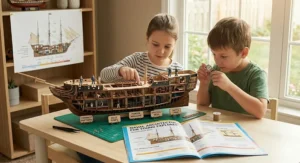
7. Plan the first session together. The single biggest predictor of kit completion is parental involvement in the first 30–60 minutes. You don’t have to build it for them — just sit with them while they open the box, organize the parts, and read the instructions. That launch matters enormously.
Who Should Buy Which Kit: A Real-World Scenario Guide
The 9–11-year-old who has never built a model before: Start with the Revell USS Missouri. It’s forgiving, historically rich, and the one-piece hull eliminates the most common beginner failure point. Low price means low stakes if they lose enthusiasm halfway through.
The pirate-obsessed 10–13-year-old: The Lindberg Jolly Roger is the answer. The multi-color molded plastic means it looks great even if they skip painting, the crew figures are a genuinely fun bonus, and the 16″ finished length makes an impressive display. Motivation is everything at this age, and nothing motivates like pirates.
The 12–14-year-old history nerd who’s ready for a challenge: Point them at the Revell PT-109 or Academy Titanic. Both have compelling backstories that will keep them engaged through difficult assembly steps. The PT-109 is particularly good because the JFK connection opens up a natural history discussion with real depth.
The ambitious 14–16-year-old who wants a serious project: The Revell USS Arizona is the answer. 133 pieces, Skill Level 4, and one of the most historically significant ships ever built. This will take multiple sessions over days or weeks — and the finished model will be something they keep for years.
The puzzle-loving teenager who wants something completely different: Fascinations ICONX Queen Anne’s Revenge. No glue, no paint, just laser-cut steel sheets and tweezers. The finished model looks nothing like any plastic kit — it’s all gleaming metallic detail. Genuinely unique gift territory.
The calm, craft-oriented kid who prefers working with natural materials: The HAPYLY Wooden Sailing Boat gives them wood, string, and the satisfaction of building with their hands. Great for kids who are also into woodworking, model railroad scenery, or generally working with their hands rather than a screen.
Common Mistakes When Buying Ship Model Kits for Kids (And How to Avoid Them)
🚫 Buying a kit that’s too advanced. The most common mistake by a country mile. Skill Level 4 kits will crush a first-time builder’s enthusiasm in about forty-five minutes. Always start one level below where you think they are.
🚫 Skipping the supplies. Most kits come with parts and instructions — not glue, not paint. Handing a kid a kit on a Tuesday evening and discovering on Wednesday morning that you need Testors cement and a round brush is genuinely demoralizing. Buy supplies at the same time as the kit.
🚫 Choosing the wrong scale for the space. A 1:72 scale PT-109 takes up real desk real estate. Make sure there’s somewhere meaningful to display the finished model before you buy. A model that gets shoved in a drawer because there’s nowhere to put it is a sad outcome.
🚫 Expecting completion in one sitting. Kids’ hobby guides sometimes suggest that certain kits take “2–4 hours.” That estimate assumes adult experience and zero learning curve. Plan for multiple sessions, especially for first builds, and frame those sessions as enjoyable rather than goal-driven.
🚫 Not doing a dry fit first. Before gluing any part, test-fit it without glue. This is the single most important technique in plastic modeling, and it’s almost never mentioned in kit instructions. Dry fitting reveals alignment issues before they become permanent mistakes.
🚫 Ignoring the skill level rating because the subject looks cool. The USS Arizona is an extraordinary model of an extraordinary ship. It’s also rated Skill Level 4 and has 133 pieces. A 9-year-old who wants to build it because WWII battleships are cool is going to have a difficult time. Historical model kits are inspiring — and so is matching the right kit to the right builder.
Features That Actually Matter (And Those That Don’t)
In the world of ship model kits for kids, marketing copy can be misleading. Here’s what to actually look for.
Matters a lot:
- Part count relative to skill level — too many parts for a beginner is a recipe for frustration
- Pre-colored plastic — gray-only kits require painting; multi-color kits look decent unpainted (great for impatient builders)
- Quality of instructions — clear, step-by-step diagrams change everything for a young builder
- Inclusion of a display stand — it signals the kit was designed to be completed and displayed, not just started
Matters somewhat:
- Historical accuracy — great for older, detail-oriented builders; irrelevant for younger, enthusiasm-driven ones
- Scale — mostly affects finished size, which affects display space
- Number of decal options — more choices are nice, but kids often skip detailed painting anyway
Doesn’t matter much for kids:
- Photo-etched detail sets — these are aftermarket additions for adult hobbyists
- Ultra-precise scale fidelity — a 10-year-old is building for joy, not for competition judging
- Brand prestige in the expert modeling community — Revell and Academy are trustworthy; that’s what matters at this level
Frequently Asked Questions About Ship Model Kits for Kids
❓ What age is appropriate for ship model kits for kids?
❓ Do ship model kits come with paint and glue?
❓ How long does it take to build a ship model kit?
❓ Are scale model ships good for kids with ADHD?
❓ What is the best ship model kit for a complete beginner child?
Conclusion: The Right Kit Can Start a Lifelong Hobby
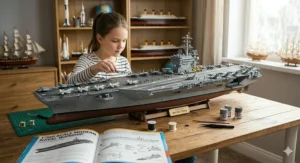
Here’s the thing about ship model kits for kids that doesn’t show up in any product listing: the hobby has a compounding effect. A kid who finishes the Missouri at 10 will want to build the PT-109 at 11. By 13, they’re researching the historical accuracy of the Arizona before they even open the box. By 15, they’re dry-brushing weathering effects and watching scale modeling YouTube tutorials. The first kit isn’t a purchase — it’s an entry point into a world of focused, creative, historically rich engagement that screens simply can’t replicate.
The seven products on this list represent the best of what’s currently available on Amazon: genuine quality, real historical content, and — most importantly — kits that are appropriately matched to the skills of young builders. Start where your kid actually is, not where you wish they were. Match the subject to their passion. Buy the supplies. Sit with them for the first thirty minutes.
The rest takes care of itself.
✨ Ready to Set Sail? Don’t Miss These Picks!
🚢 Click on any highlighted product to check the latest pricing and availability on Amazon. These ship model kits for kids make exceptional gifts for birthdays, holidays, or as a “just because” project for a kid who loves building things!
Recommended for You
- 7 Best Pandemic Board Games in 2026 — Stop the Outbreak!
- Best Bike for 6 Year Old Boy: 7 Top Picks in 2026
- 7 Best LEGO Friends Sets for Girls in 2026 — Ultimate Guide
Disclaimer: This article contains affiliate links. As an Amazon Associate, I earn from qualifying purchases. If you purchase products through these links, we may earn a small commission at no additional cost to you.
✨ Found this helpful? Share it with your friends! 💬🤗
