
In This Article
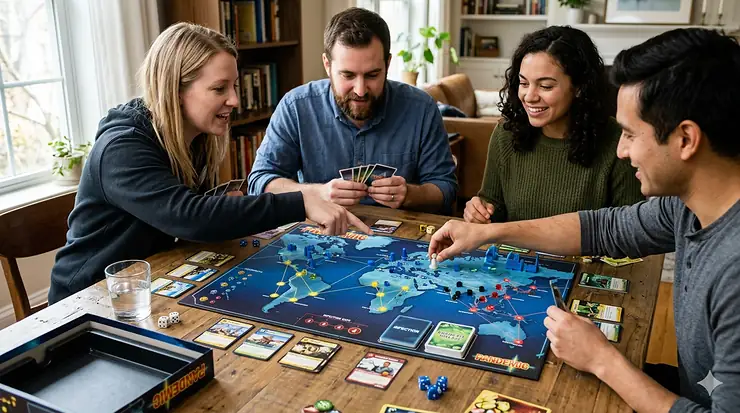
Picture this: it’s 9 PM on a Friday, the coffee table is cleared, and your friends are leaning in, voices low with urgency. Tokyo just erupted in a chain outbreak. Someone whispers, “We need the Medic in Atlanta right now.” Nobody’s looking at their phone. Nobody’s arguing about who went last. You’re all losing together — and it is absolutely magnificent.

That’s the peculiar magic of the pandemic board game.
What is a pandemic board game, exactly? In short, it’s a cooperative strategy game where 2–4 players work as a team of disease-fighting specialists to stop global outbreaks before humanity reaches the point of no return. No one player wins; you all win together — or you all go down in a swarm of cascading infection cubes. The original Pandemic, designed by Matt Leacock and published by Z-Man Games in 2008, essentially invented the modern cooperative board game genre as we know it. Today, the Pandemic universe has expanded into a full lineup of standalone titles, legacy campaigns, and creative spin-offs.
Research backs up what players already feel in their gut: cooperative games generate 15–20 communication exchanges per turn compared to just 5–7 in competitive games. That’s not a trivia stat — that’s the difference between a game night that builds genuine connection and one that ends with someone flipping Monopoly money across the room.
Whether you’re a first-timer curious about cooperative board games, a legacy veteran hunting for your next campaign fix, or a parent searching for family game night ideas that don’t devolve into sibling warfare, this guide covers every corner of the Pandemic universe. We tested, analyzed, and cross-referenced all the major titles available right now on Amazon — so you don’t have to.
Let’s save the world.
Quick Comparison: 7 Best Pandemic Board Games at a Glance
| Game | Players | Avg. Playtime | Difficulty | Best For | Price Range |
|---|---|---|---|---|---|
| Pandemic (Base Game) | 2–4 | 45–60 min | Medium | Beginners & families | $30–$45 |
| Pandemic Legacy Season 1 | 2–4 | 60 min | Medium-Hard | Long-term campaign fans | $45–$65 |
| Pandemic Legacy Season 2 | 2–4 | 60 min | Hard | Story-driven gamers | $45–$65 |
| Pandemic Legacy Season 0 | 2–4 | 60 min | Hard | Thriller/spy enthusiasts | $45–$65 |
| Pandemic Hot Zone: North America | 2–4 | 30 min | Easy-Medium | Quick sessions & travel | $15–$25 |
| Pandemic Rapid Response | 2–4 | 20 min | Medium | Real-time adrenaline seekers | $20–$30 |
| Pandemic Contagion | 2–5 | 30 min | Easy-Medium | Groups wanting a twist | $20–$35 |
Looking at the table above, the base game remains the smartest entry point — it delivers the full cooperative experience at the lowest price with the flattest learning curve. If you’ve already played the base game and want to commit to something deeper, the Legacy titles are in a price tier of their own, but the per-session value is extraordinary: you’re paying roughly $3–$5 per sitting for a narrative experience that rivals a TV drama series. Budget-conscious buyers and families with kids under 12 should start with Hot Zone or Rapid Response — compact, fast, and surprisingly tense.
💬 Just one click — help others make better buying decisions too! 😊
Top 7 Pandemic Board Games: Expert Analysis
1. Pandemic (Base Game) — The One That Started Everything
If the cooperative board game genre had a founding document, Pandemic would be it. The base game puts 2–4 players in the roles of disease-fighting specialists — Medic, Scientist, Researcher, Operations Expert — each with asymmetric abilities that genuinely change how you approach the board. Four color-coded diseases spread across a world map of 48 cities, and you’re racing to cure all four before outbreaks cascade out of control or the card deck runs dry.
Here’s what the box won’t tell you: the moment Pandemic “clicks” for a new player is one of the most satisfying things in tabletop gaming. The Medic’s ability to clear all cubes of a single disease in one action sounds simple on paper, but in practice, it transforms how the whole team plans three turns ahead. That kind of role synergy is what keeps groups coming back.
⏱️ The 45–60 minute playtime hits a sweet spot — long enough to feel like an event, short enough to squeeze in a rematch. It plays cleanly at 2, 3, or 4 players without feeling hollow or chaotic at either extreme. Ages 8+ is accurate; the rules are clean enough for sharp kids and deep enough to challenge adults.
Customer feedback on Amazon is overwhelmingly positive, with thousands of reviews praising it as the best introduction to cooperative board games. The most common critique — and it’s fair — is that the base game can start to feel “solved” after 15–20 plays. That’s when you graduate to expansions or Legacy mode.
✅ Pros:
- Near-perfect gateway cooperative game
- Scales beautifully from 2 to 4 players
- Highly replayable with adjustable difficulty
❌ Cons:
- Experienced players may find it too predictable after many plays
- Box insert is notoriously bad at organizing components
In the $30–$45 range, this is the best value in cooperative board gaming, full stop.

2. Pandemic Legacy Season 1 — The Game That Changed Everything, Permanently
Here’s the premise: you play Pandemic. But every decision you make — every city that falls, every card you burn, every role that gets injured — carries forward. Permanently. You write on the board. You open sealed boxes mid-campaign. Cities gain new names, diseases mutate, rules change. Over 12 months of in-game time (typically 12–24 real-world sessions), you play through a story that evolves in response to your choices.
Pandemic Legacy Season 1 isn’t just a great game. It’s widely considered one of the greatest board games ever made, consistently ranking at or near the top of BoardGameGeek’s all-time rankings. For groups who play together regularly — couples, friend groups, families with older teens — it’s the closest thing to a tabletop TV series.
The spec that matters most here isn’t on any box: replayability is finite but intentional. You’ll play it roughly 12–24 times total before the campaign concludes. That sounds like a limitation, but it creates something competitive games can’t — genuine narrative stakes. When a city you’ve been protecting for months gets destroyed by an outbreak, it hurts. That emotional investment is the entire point.
Most players report it takes 3–6 months to complete, playing once or twice a week. Budget for about a year of game nights.
✅ Pros:
- Narrative depth that rivals video game RPGs
- Permanent consequences create genuine tension
- Designed for exactly 2–4 regular players (ideal for couples or small groups)
❌ Cons:
- Single-use by design — not replayable once complete
- Requires consistent group; hard to pick up mid-campaign with new players
In the $45–$65 range, Season 1 delivers some of the best cost-per-hour entertainment in all of tabletop gaming.
3. Pandemic Legacy Season 2 — A Darker, More Ambitious Story
Season 2 is set 71 years after the events of Season 1, and the world did not come out well. Humanity survives in scattered coastal havens, and instead of curing disease, you’re managing supply lines and scouting an unknown world. The map starts literally blank in many regions — you discover cities as you explore, which gives the game a haunting, post-apocalyptic atmosphere that Season 1 never approached.
The mechanical shift from curing disease to supplying desperate cities is more than cosmetic. It changes your entire risk calculation. You’re not just fighting outbreaks; you’re managing logistics in a world that’s already lost. Supply cubes become as important as player cards, and the tension of “do we push forward or reinforce what we have?” defines every session.
What most buyers overlook: Season 2 is designed so you can play it without having completed Season 1. The story references past events, but mechanically, it stands alone. That said, if you want the full emotional payoff of the world-building, play Season 1 first.
Customer reviews on Amazon consistently highlight the story reveals in later months as genuinely shocking — the kind of put down the components and just talk moments that competitive games can never manufacture.
✅ Pros:
- Stunning world-building and narrative ambition
- Can be played as a standalone (no Season 1 required)
- New supply mechanic adds strategic depth
❌ Cons:
- Higher complexity than Season 1; steeper mid-campaign learning curve
- Some players find the opening months slower to engage
At the $45–$65 price range, it sits alongside Season 1 in terms of cost, and delivers comparable campaign length.
4. Pandemic Legacy Season 0 — Before It All Began
Season 0 is a prequel — and a dramatic genre pivot. You’re not playing disease researchers. You’re playing Cold War-era CIA operatives in 1962, traveling the world under cover identities to prevent the Soviet Union from unleashing a bioweapon. It’s spy thriller meets cooperative board game, and the tonal shift is jarring in the best possible way.
The alias system is the mechanical star here. Each player manages multiple cover identities across different cities. If you’re too suspicious in Moscow, your alias gets blown — and that identity is gone, permanently. It adds a layer of resource management that the other Legacy games never touch. You’re not just managing disease cubes; you’re managing your team’s entire operational capacity.
The spec that makes this stand out: 12 full missions unfold across the campaign, but the branching paths mean two groups playing simultaneously can arrive at dramatically different mid-game states. It’s the most replayable entry in the Legacy trilogy — some groups have gone back and run the campaign a second time with different choices just to see what else the box contained.
Recommended for groups who’ve already played at least one Legacy title and want something more thematically ambitious. This is not the place to start if your group is new to Pandemic. Ages 14+ is the right call here.
✅ Pros:
- Spy thriller atmosphere unlike anything else in the Pandemic line
- Alias system adds entirely new strategic layer
- Surprising branching narrative replayability
❌ Cons:
- Not beginner-friendly — prior Legacy experience strongly recommended
- Thematic departure may not suit everyone expecting traditional Pandemic gameplay
Priced in the $45–$65 range, consistent with the other Legacy titles.
5. Pandemic Hot Zone: North America — Big Thrills in a Small Box
Hot Zone is what happens when you strip Pandemic down to its essential skeleton and ask: what’s the minimum experience needed to still feel like the real thing? The answer is remarkably complete. Three diseases instead of four, a regional map focused on North American cities, 30-minute games, and a box small enough to fit in a backpack.
The design decision that matters most: Hot Zone uses a simplified card structure that makes the game accessible to players who’ve never touched a cooperative board game before. A new player can be fully up to speed in under 10 minutes. That sounds minor until you’re at a cabin with extended family and someone’s never played a strategy game before in their life.
What most buyers don’t realize: Hot Zone is also an excellent gateway back to the full base game. The mechanics are identical in concept, just scaled down. Players who master Hot Zone move to the full Pandemic with a confidence that cold-starters don’t have.
Customer reviews frequently come from parents buying this as their child’s first “real” strategy game — and the reception is almost universally positive for ages 10 and up (despite the 8+ label on the box).
✅ Pros:
- True travel-sized version — fits in any bag
- Fastest learning curve in the entire Pandemic lineup
- Under $25 makes it an easy gift
❌ Cons:
- Experienced Pandemic players may find it too simple
- Three diseases feels noticeably less complex than the full game’s four
In the $15–$25 range, this is the best bang-for-buck entry point in the family.

6. Pandemic Rapid Response — When 20 Minutes of Chaos Is Exactly What You Need
Forget careful deliberation. Pandemic Rapid Response is a real-time dice game — everyone acts simultaneously, frantically rolling and re-rolling dice to allocate resources while the situation on the board deteriorates in actual time. There’s a sand timer running. Cities need water, food, vaccines, and emergency kits right now, and your team of two to four specialists is aboard a cargo plane scrambling to deliver supplies before each city reaches the crisis threshold.
The mechanical soul of this game: dice allocation. Each player’s turn isn’t “pick an action” — it’s “spend your dice pool as efficiently as possible before passing to the next person who desperately needs that die you’re holding.” Coordination under pressure, in real time, with an actual ticking clock. It’s genuinely stressful in a way the other Pandemic titles never are.
This is the right game for groups who find traditional Pandemic “a little slow” or who want a game they can crush in their lunch break. It’s also — unexpectedly — one of the best two-player options in the whole lineup. With two players, the coordination becomes almost telepathic, and the shared pressure creates a distinct kind of bonding.
Customer feedback highlights the tension as the game’s standout feature. Multiple reviews note that it’s loud, chaotic, and produces more involuntary shouting than any other game in the house.
✅ Pros:
- Real-time format delivers genuine adrenaline
- One of the best two-player options in the series
- 20-minute sessions make it deeply replayable in a single evening
❌ Cons:
- Real-time format can frustrate players who prefer deliberate pacing
- Less thematically rich than other Pandemic titles
Priced in the $20–$30 range — a solid mid-tier buy.
7. Pandemic Contagion — Flip the Script, Be the Disease
Every other Pandemic title asks you to save humanity. Pandemic Contagion asks you to destroy it. You and your fellow players each control a different disease — mutating, evolving, and spreading across the globe in competition with each other to infect the most people before humanity either wipes you out or runs out of cities to defend.
This is technically a competitive game within the Pandemic brand, which makes it the most unusual entry on this list. But it earns its place here because it plays in roughly 30 minutes, supports up to 5 players (the largest count in the family), and serves as a brilliant “palate cleanser” between heavier sessions.
The strategic hook: each disease gains mutation abilities over the course of the game. Choose your mutations wisely and your disease becomes antibiotic-resistant, airborne, or capable of explosive urban spread. Choose poorly and humanity’s response teams crush you before you’ve established a foothold. It rewards the same kind of systemic thinking as cooperative Pandemic, just pointed outward at your opponents.
This is the game to reach for when your group wants to try something different without leaving the Pandemic universe entirely. It’s also the most subversive gift for any Pandemic fan who’s never seen it.
✅ Pros:
- Unique competitive angle within a cooperative brand
- Plays up to 5 — the largest group in the lineup
- Fast 30-minute sessions are highly replayable
❌ Cons:
- Some players find competing against friends counterintuitive after cooperative Pandemic
- Lighter strategic depth compared to the base game or Legacy titles
Available in the $20–$35 range — an affordable way to round out a Pandemic collection.
✨ Don’t Miss These Exclusive Deals!
🔍 Take your game night to the next level with these carefully selected pandemic board game titles. Click on any highlighted item above to check current pricing and availability. These games will help you create unforgettable cooperative moments your family and friends will talk about for years!
Which Pandemic Game Is Right for You? A Real-World Scenario Guide
This is the question that every comparison table fails to fully answer, so let’s put some real human beings into the equation.
The New Family (Kids Ages 8–12). You want something everyone at the table can follow without reading a rulebook for 45 minutes. You also want to avoid the “I’m losing and I hate this” meltdown. Start with Pandemic Hot Zone: North America. It’s short enough that even younger kids stay engaged through a full game, and the shared win/loss model means nobody goes home sulking. Once the family has played it three or four times, graduate to the Pandemic Base Game for the full experience.
The Dedicated Friend Group (4 Adults, Weekly Game Night). You meet every Friday, you’ve played the base game to death, and you want something that makes game nights feel like events. Pandemic Legacy Season 1 is specifically designed for you. You’ll be playing it for four to six months, and the shared narrative will become something your group references for years. Season 1 first, then Season 2, then Season 0 if you’re still hungry.
The Couple Looking for a Shared Hobby. Two players. You want challenge, strategy, and something that doesn’t end when one person wins. Pandemic Legacy Season 1 is outstanding at two players and creates the kind of shared history that genuinely strengthens relationships. If you want something quicker for weeknights, Pandemic Rapid Response plays in 20 minutes and is surprisingly brilliant at two.
The Party Host (6+ People, Mixed Experience Levels). You need something anyone can jump into and the box needs to support more than four. Pandemic Contagion handles up to 5 and takes just 30 minutes — fast enough to run two rounds in a typical game night. For groups of 6, rotate who sits out each round while others play; the game moves quickly enough that nobody minds.
The Solo Gamer. The base game offers a challenging solo mode that most players overlook entirely. You play with all four roles simultaneously, which removes the social element but creates a pure puzzle-solving experience that’s deeply satisfying at 11 PM when you can’t wrangle a group.

How to Choose a Pandemic Board Game: 6 Criteria That Actually Matter
The Pandemic lineup is broader than most people realize, and buying the wrong entry point is the single most common mistake. Here’s a framework that cuts through the noise.
1. How experienced is your group? The base game is the correct starting point for anyone who hasn’t played cooperative board games before. The Legacy titles assume mechanical fluency — players who understand card management, action economy, and outbreak cascades intuitively will get far more from Legacy’s narrative payoffs.
2. How much time do you have? This is practical and non-negotiable. Hot Zone and Rapid Response are sub-30-minute games. The base game runs 45–60. The Legacy games commit you to 60+ minutes per session, multiple times a week, for months. If your game nights are spontaneous and irregular, don’t start a campaign.
3. Are you okay with permanent changes? Legacy games involve writing on boards, opening sealed boxes, and tearing up cards. Some players — especially those who’ve spent years carefully preserving their games — find this genuinely uncomfortable. That’s a real preference to honor. The base game, Hot Zone, Rapid Response, and Contagion are all fully replayable forever.
4. What’s your group size? Two players: Rapid Response or Legacy Season 1. Three or four players: anything works. Five players: Contagion is your only option in the Pandemic family.
5. What tone are you after? Tense tactical drama → Base Game. Narrative campaign → Legacy Season 1 or 2. Spy thriller → Legacy Season 0. Frantic chaos → Rapid Response. Competitive twist → Contagion.
6. What’s your budget? Hot Zone and Rapid Response offer genuine Pandemic experiences under $30. The base game delivers tremendous value in the $30–$45 range. Legacy titles cost more upfront but amortize brilliantly — you’re looking at $3–$5 per session for a 12-session campaign.
Cooperative Games vs. Competitive Games: What the Research Actually Says
There’s a misconception that cooperative board games are somehow “easier” or “less strategic” than competitive ones. The research tells a different story — and so does anyone who’s survived a Pandemic Legacy campaign.
Studies on cooperative game mechanics show that cooperative games generate significantly more prosocial behavior in both children and adults. Preschoolers in controlled studies showed higher enthusiasm and enjoyment for cooperative formats over competitive ones. Among adults, the shared victory or defeat creates what psychologists call “collective efficacy” — the belief that a group can accomplish difficult things together.
For families specifically, experts recommend maintaining at least 40% cooperative options in your game rotation. The reasoning isn’t sentimental; it’s structural. When every game night is a zero-sum competition, even friendly groups start unconsciously building adversarial habits. Cooperative games reset that dynamic.
What cooperative games like Pandemic do strategically that competitive games can’t match: they externalize the enemy. Instead of “me versus you,” it’s “us versus the system.” That subtle reframe makes the same complex strategic decisions feel collaborative instead of threatening. Players who would never tolerate losing to their spouse in Catan will enthusiastically spend hours getting crushed together in Pandemic — and call it a great night.
That said, competitive games aren’t without value. They teach strategic independence, healthy rivalry, and the skill of reading other players. The smartest game collections have both. But if your shelf is 100% competitive, you’re missing something.
Pandemic Board Game: Common Mistakes First-Time Buyers Make
After watching dozens of new players discover this game family, a few mistakes come up with startling regularity.
Mistake 1: Skipping the Base Game and Going Straight to Legacy. The Legacy campaigns are designed for players who already understand Pandemic’s core mechanics fluently. Jumping straight in means spending half of each session looking up rules instead of making dramatic decisions. Spend 5–8 base game sessions first. You’ll thank yourself by Month 3 of the Legacy campaign.
Mistake 2: Playing on “Normal” Difficulty First and Assuming It’s Too Easy. Pandemic has an epidemic card system that controls difficulty. The base game comes with 4, 5, and 6 epidemic cards — 4 is genuinely approachable, 6 is brutal. Most new groups play 4 epidemics, win on their third attempt, and decide the game is solved. It isn’t. Ramp up to 5 and then 6 before passing judgment.
Mistake 3: Letting One Person “Quarterback” the Team. This is the pandemic board game’s most cited flaw in online discussions — and it’s a player problem, not a design problem. One experienced player who tells everyone what to do destroys the collaborative magic entirely. The whole joy of cooperative board games is that everyone contributes. House rule: you can only discuss your own hand, not instruct others on their turns.
Mistake 4: Not Reading the Outbreak Rules Carefully Before Starting. The cascade rules — where one city’s outbreak triggers adjacent cities — are the heart of Pandemic’s tension, and they’re also the most commonly misread rules in the game. Misread them and you’ll either make the game trivially easy or impossibly hard. Read them twice before your first game.
Mistake 5: Underestimating Hot Zone and Rapid Response. These smaller titles are sometimes dismissed as “just travel versions.” They’re not. Hot Zone at two players with 6 epidemics is a genuinely demanding experience. Rapid Response’s real-time format has stressed out veteran gamers who breeze through base game Pandemic on Hard. Small box doesn’t mean small challenge.
Long-Term Value: What Does a Pandemic Collection Actually Cost Per Play?
Let’s run the numbers that the box art never bothers to mention.
The base game at around $35 averages, conservatively, 25–40 plays over its lifetime for an engaged group. That’s roughly $0.90–$1.40 per play session. For entertainment cost-per-hour, that rivals streaming a movie.
Legacy Season 1 costs around $55 and delivers 12–24 sessions before the campaign concludes. That’s $2.30–$4.60 per session — but each session runs 60–90 minutes, putting you in the $1.50–$3.00 per hour range. For a narrative-rich experience that a group of four shares simultaneously? There’s nothing else in tabletop gaming that competes.
Hot Zone at around $20 is almost comically good value. Thirty-minute sessions, high replayability, and a price point that makes it a legitimate impulse buy.
Rapid Response at around $25 offers 20-minute sessions with extremely high replayability — the real-time format means even the same players in the same situation will make different decisions and produce a different outcome. It’s one of the higher-value purchases in the family for groups who play frequently.
The one caveat worth flagging: Legacy titles are a finite investment. You’re paying for an experience, not a permanent game. Some players resell completed Legacy campaigns on the secondary market for a fraction of the original cost, which matters for budget-conscious buyers. But the emotional value of a completed campaign — the shared story your group built — doesn’t show up in any resale listing.

FAQ: Pandemic Board Game Questions Answered
❓ What is the best pandemic board game for beginners?
❓ Can you play pandemic board games solo?
❓ Do I need to play Pandemic Legacy Season 1 before Season 2?
❓ What are the best cooperative board games similar to Pandemic?
❓ How long does a Pandemic Legacy campaign take to complete?
Conclusion: The World Won’t Save Itself
Here’s the honest case for adding a pandemic board game to your shelf: in a world of increasingly isolating entertainment, there is something genuinely special about a game that forces four human beings to look each other in the eye, share information, argue constructively, and either save the world or go down trying.
The Pandemic series has done more for cooperative board games than any other franchise in tabletop history. From the elegant simplicity of the base game to the narrative ambition of the Legacy trilogy to the frantic joy of Rapid Response, there’s a version of this experience calibrated for almost every group, every budget, and every Friday night.
If you’re new: start with the base game or Hot Zone. Play it three times. Then decide if the Legacy campaigns are calling your name.
If you’re experienced: Season 1 remains the gold standard for campaign play, and Season 0 deserves far more attention than it typically gets.
If you want something fast, loud, and completely different: Rapid Response will humble you in 20 minutes.
Whatever you choose, the outcome is the same: you’ll be talking about it on Saturday morning.
✨ Don’t Miss These Exclusive Deals!
🔍 Ready to start your cooperative adventure? Click on any highlighted game above to check current pricing and availability on Amazon. Give your family game night the upgrade it deserves — these pandemic board game titles will create memories that outlast any competitive game on your shelf!
Recommended for You
- Best Bike for 6 Year Old Boy: 7 Top Picks in 2026
- 7 Best LEGO Friends Sets for Girls in 2026 — Ultimate Guide
- 7 Best Plasma Car for Toddlers: Ultimate 2026 Guide
Disclaimer: This article contains affiliate links. As an Amazon Associate, I earn from qualifying purchases. If you purchase products through these links, we may earn a small commission at no additional cost to you.
✨ Found this helpful? Share it with your friends! 💬🤗
