
In This Article
Here’s something most new parents don’t realize until they’re knee-deep in baby registry lists: your newborn can’t see that adorable pastel nursery you spent months decorating. In fact, for the first several weeks of life, babies see the world in what’s essentially a blurry grayscale film. This isn’t a design flaw—it’s exactly how infant vision is supposed to develop.
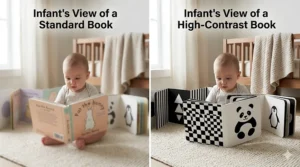
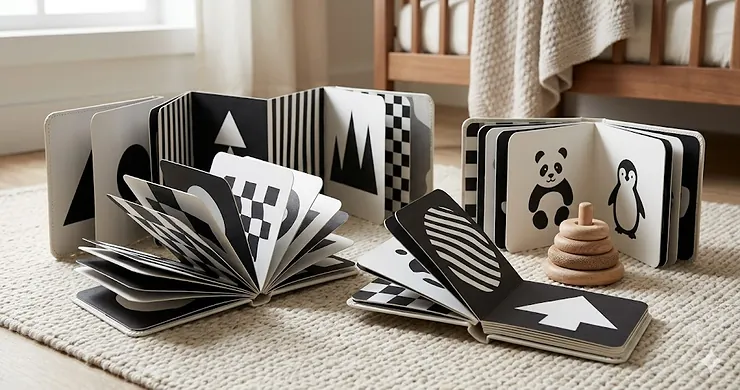
High contrast baby books leverage this biological reality. Research shows that newborns can detect changes in brightness and distinguish between stationary and moving objects, but their central vision is still developing during those early weeks. That’s where black and white baby books become more than just cute accessories—they’re actual developmental tools that work with your baby’s visual capabilities, not against them.
What makes these books different from regular board books? The bold patterns aren’t just aesthetic choices. Babies have an easier time focusing on high contrast objects during the first three months of development, and black and white photos with contrasting patterns can encourage vision development. Think of them as visual gym equipment for your baby’s developing brain, helping strengthen eye tracking, focus, and eventually, the neural pathways that support reading and learning.
In this guide, I’ll walk you through seven high contrast baby books that actually deliver on the developmental promises. We’re not just listing specs here—I’ll explain what each book does differently, who it’s best for, and what real parents report after weeks of tummy time sessions. Whether you’re looking for indestructible baby books that survive teething or sensory books for babies with multiple textures, you’ll find options that make sense for your family’s needs and budget.
Quick Comparison: Top High Contrast Baby Books at a Glance
| Product | Type | Best For | Key Feature | Price Range |
|---|---|---|---|---|
| My First Animals (Little Artist Atelier) | Paperback | Educational focus | 55 pages, ABC format | $8-12 |
| Everyday Objects (Happy Forest Studio) | Paperback | Real-world connection | Matching activities | $9-13 |
| duopress 4-Book Set | Board books | Durability & value | Sturdy, multi-topic | $12-18 |
| Hello, Baby Animals (duopress) | Board book | First reader | Simple greetings | $7-10 |
| Tummy Time Mirror Book | Soft sensory | Multi-sensory engagement | Built-in mirror & teether | $11-16 |
| beiens Crinkle Cloth Book | Fabric | Tactile exploration | Squeaker, textured tails | $10-15 |
| teytoy 6-Pack Set | Fabric bundle | Maximum variety | Washable, 6 themes | $14-20 |
Looking at this lineup, you’ll notice three distinct categories emerging. The paperback and board book options (rows 1-4) prioritize visual content and educational value—they’re your go-to choices if tummy time is the main event and you want books that’ll grow with your baby through the first year. The soft sensory books (rows 5-7) bring tactile elements into play, which matters if you’re dealing with a baby who needs multiple stimulation types to stay engaged, or if you want something that doubles as a chew toy during teething months.
The price-per-value sweet spot sits with the multi-book sets. While a single paperback runs around $10, the duopress 4-book set gives you four different themes for just $12-18—that’s roughly $3-4.50 per book. The teytoy 6-pack pushes this even further at around $2.30-3.30 per book, though you’re trading the crisp print quality of paperbacks for washable fabric durability.
💬 Just one click—help others make better buying decisions too! 😊
Top 7 High Contrast Baby Books — Expert Analysis
1. My First Animals: High Contrast ABC Book by Little Artist Atelier
This 55-page alphabet-themed paperback stands out because it doesn’t just show random black and white shapes—it pairs each letter with an animal illustration, creating a foundation for eventual letter recognition. At 8.5 x 8.5 inches with independently published quality, it sits in that Goldilocks zone where pages are large enough for floor tummy time but not so oversized they’re awkward to handle during lap reading.
What the spec sheet won’t tell you is how the layout handles pacing. Rather than cramming multiple images per page (which overwhelms newborn vision), each spread typically features one bold animal against a white background. This matters more than you’d think—until around three months of age, infants cannot focus on objects that are more than 8-10 inches away from their faces, so single-focus layouts prevent the visual confusion that happens when babies can’t isolate which element to look at.
Real parent feedback consistently mentions the binding durability being better than expected for independently published paperbacks, though this is still paper we’re talking about—it’ll survive gentle page turning but not aggressive grabbing or mouthing. If you’ve got a baby who’s just starting to bat at objects around 3 months, this works beautifully. Once they’re at the “everything goes in the mouth” stage around 5-6 months, you’ll want to either supervise closely or graduate to the board book options below.
Pros
✅ Educational alphabet structure grows with developmental stages
✅ 55 pages provide more content than typical 20-30 page options
✅ Large format ideal for floor-based tummy time sessions
Cons:
❌ Paperback construction requires supervised use past 5 months
❌ No tactile elements for babies needing multi-sensory input
Best for: Parents prioritizing educational content over indestructibility, babies in the 0-6 month range who aren’t yet in the mouthing-everything phase. Priced around $8-12, it delivers solid value if you’re building a rotation of books rather than relying on one go-to option.
2. High Contrast Baby Book: Everyday Objects by Happy Forest Studio
Here’s where high contrast baby books get practical. Instead of abstract patterns or exotic animals, this 48-page paperback focuses on objects your baby actually encounters daily—bottles, cups, spoons, beds, pacifiers. The “My First Black & White” collection approach means you’re not just stimulating vision; you’re building real-world object recognition that feeds directly into language development later.
The standout feature buried in the description is the matching and comparing activities. These aren’t complex puzzles—we’re talking simple visual exercises like “find the two cups” or “which one is different?” At about three months, babies should be engaging in visual tracking, which refers to the ability to follow an object with their eyes. These gentle activities leverage that emerging skill, turning passive looking into active visual problem-solving.
What makes this different from the ABC book above? Context. When your 4-month-old sees a high-contrast drawing of their actual bottle, then looks at their physical bottle during feeding, neural connections form between the visual representation and the object. That’s not happening with abstract zebra stripes—they’re great for visual stimulation but lack the real-world mapping this book provides.
Parent reports note that babies around 2-3 months show more sustained attention to these familiar objects compared to random patterns. That’s not anecdotal wishful thinking—it aligns with research showing infants prefer high contrast and bold colors at their earlier stages of infancy, and when those high-contrast items match their environment, attention naturally increases.
Pros:
✅ Everyday objects support vocabulary building alongside vision development
✅ Matching activities introduce problem-solving concepts
✅ Real-world relevance increases engagement over abstract patterns
Cons:
❌ 48 pages is substantial but less than the 55-page ABC option
❌ Paperback format same limitation as above
Best for: Parents who want developmental benefits that extend beyond pure visual stimulation into early language preparation. At $9-13, you’re paying slightly more than basic pattern books but getting dual-purpose functionality.
3. High Contrast Baby Book Set: 4 Board Books by duopress labs
If the previous two paperbacks made you nervous about durability, this is your answer. Four separate 6 x 6 inch board books with rounded corners and sturdy pages designed for babies as young as 6 months to handle independently. The format matters here—small enough for baby hands to grasp, thick enough to withstand the inevitable chewing.
The collection typically includes varied themes (animals with simple greetings, sports shapes), which solves a problem most parents don’t anticipate: visual fatigue. Even high-contrast stimulation gets boring if it’s the same 20 images every tummy time session. Four separate books mean you can rotate content, keeping engagement higher over weeks of daily use.
What the listing emphasizes but undersells is the educational framework. Rather than just showing a cow, you get “Hello, cow!” or similar simple greetings. This linguistic pairing—even before babies understand words—creates associations between visual stimuli and verbal sounds. At about 1 month, your baby may focus briefly on you, but may still prefer brightly colored objects up to 3 feet away. By 2-3 months when they’re actually processing these books more actively, that repeated pairing of image and greeting becomes meaningful input for later language development.
The construction uses non-toxic soy-based inks, which matters less for baby health (they’re not absorbing ink through skin) and more for environmental conscience—though realistically, the bigger win is that these books will survive to be handed down or donated rather than destroyed after one baby’s use.
Pros:
✅ Board book durability handles teething and rough treatment
✅ Four-book variety prevents visual fatigue over repeated sessions
✅ 6×6 size optimized for baby hands to eventually self-explore
Cons:
❌ Smaller page size means less visual real estate per spread
❌ Higher per-book cost compared to paperback options
Best for: Parents wanting books that survive from newborn through 12+ months without replacement, or families planning to use books for multiple children. At $12-18 for the set, you’re getting around $3-4.50 per book—competitive pricing when you factor in the longevity board books provide over paperbacks that might last 4-6 months max.
4. Hello, Baby Animals by duopress labs
This single board book from the same publisher deserves separate mention because it represents the ideal entry point if you’re testing whether your baby even responds to high-contrast books before investing in sets. Simple greetings like “Hello, baby bunny” and “What’s going on, zebra?” paired with Julissa Mora’s black-and-white art—you’re getting the essence of the concept without committing to a multi-book collection.
The genius is in the simplicity. Newborns can detect changes in brightness and distinguish between stationary and kinetic objects, but complex scenes with multiple elements exceed their processing capacity. One animal per spread, bold outline, white background—this respects the biological limitations of newborn vision rather than overwhelming it.
Real-world performance shows this as a stronger choice for the 0-3 month range compared to the more complex options above. Once your baby hits 4-5 months and their visual system matures, they might show less interest in these simple images and need to graduate to books with more visual complexity like the 55-page ABC book. That’s not a flaw—it’s appropriate developmental scaffolding.
Construction-wise, you’re getting duopress’s standard board book quality: sturdy enough for independent baby handling, rounded corners that won’t poke eyes or scratch skin. The nontoxic ink claim is standard across their line. At this format size, expect something that lives in the diaper bag easily for on-the-go distraction.
Pros:
✅ Perfect testing ground before committing to larger collections
✅ Simplicity ideal for genuine newborns (0-3 months)
✅ Portable size for travel and outings
Cons:
❌ Limited content means babies outgrow it faster than multi-book sets
❌ Single-topic focus (animals only) offers less variety
Best for: First-time parents unsure if their baby will engage with high-contrast books, or as a starter book to pair with other sensory toys. Priced around $7-10, it’s low-risk experimentation that’ll give you data on whether to invest in the larger sets.
5. Tummy Time Toys: High Contrast Baby Book with Mirror & Teether
Now we shift from pure visual books to multi-sensory experiences. This soft book (fabric construction, not paper or board) integrates three elements most baby development guides recommend separately: high-contrast visual patterns, a baby-safe mirror for self-recognition practice, and a BPA-free textured teether for oral sensory input.
The built-in mirror deserves attention. Mirrors aren’t just vanity—they’re developmental tools. When babies around 4-5 months start recognizing their reflection, they’re building body awareness and spatial understanding that feeds into later motor planning. The fact that this mirror sits within a high-contrast context means you’re getting visual stimulation and self-recognition practice in one package.
The 12 different patterns inside exceed what most single visual books offer. Crinkly pages add auditory feedback (the rustling sound), and 3D textures bring tactile variety. What this creates is multi-modal learning—research suggests that visual experience with varied stimuli is critical for proper, healthy vision development, and when you layer in sound and touch, you’re engaging more neural pathways simultaneously.
Parent feedback splits between two camps: those who love the all-in-one approach because it consolidates what would otherwise require three separate purchases, and those who find the multiple features overwhelming for younger babies (under 3 months) who aren’t ready to process that much stimulation at once. The sweet spot appears to be 3-6 months when babies are actively seeking varied input during tummy time.
The teether spine is particularly clever design—it positions naturally where babies’ hands go when holding a book, so teething relief happens organically rather than requiring them to find a separate teether component.
Pros:
✅ Multi-sensory design (visual, tactile, auditory, oral) engages more developmental areas
✅ Built-in mirror supports self-recognition milestones
✅ Fabric construction is machine washable—critical for anything babies mouth
Cons:
❌ Can be overstimulating for newborns under 8-10 weeks
❌ Higher price point ($11-16) than basic board books
Best for: Parents wanting maximum developmental bang per buck, babies in the 3-8 month range who are ready for multi-modal engagement. The machine washability makes this particularly strong for parents dealing with drool or spit-up—something the paperback and even board book options can’t claim.
6. beiens Baby Books: Touch and Feel Crinkle Cloth Book
This takes the fabric book concept and leans heavily into tactile learning. Textured animal tails, crinkle pages, built-in squeakers—the visual component is present (black and white high-contrast images), but it’s sharing space with aggressive sensory design. Each page offers different textures: smooth, bumpy, rough, fuzzy.
Why does this matter beyond just “more is better”? Infants prefer high contrast and bold colors at their earlier stages of infancy, but around 4-6 months, their visual system matures enough that pure high-contrast becomes less novel. They need progression. These texture elements provide that next level of complexity without abandoning the black-and-white foundation that still supports their developing vision.
The animal tail theme is smarter than it looks. Tails naturally extend beyond the page edge, encouraging babies to grab—which develops pincer grasp and hand-eye coordination. When they pull the tail and feel different textures, they’re learning cause-and-effect: “I pull this, I feel that.” That’s early problem-solving in action.
The squeaker element adds delayed gratification training (sort of). Babies have to squeeze with enough force to trigger the squeak, which requires intentional hand strength they don’t have until around 4-5 months. As they develop that grip strength, the squeaker provides immediate feedback, reinforcing the motor skill they just executed.
BPA-free polyester construction means this survives machine washing without falling apart—a necessity given that these books will absolutely end up covered in drool, milk spit-up, and possibly worse. The cloth straps for hanging mean you can attach it to strollers or car seats, turning car rides into development time rather than just containment time.
Pros:
✅ Texture variety supports tactile development alongside visual growth
✅ Hanging straps make it portable for strollers and car seats
✅ Machine washable handles inevitable mess from baby use
Cons:
❌ Squeaker and crinkle sounds can be annoying for parents in quiet environments
❌ More expensive ($10-15) than basic board books without offering more visual content
Best for: Parents whose babies showed lukewarm interest in pure visual books, or babies around 4-6 months who need sensory progression beyond just black-and-white images. The portability makes this particularly valuable for families who spend significant time in cars or running errands—it’s engagement on demand.
7. teytoy My First Soft Book: 6-Pack Nontoxic Fabric Set
This is the volume play: six separate fabric books covering different themes (sea world, animal world, numbers, vegetables, fruit, vehicles). The individual books are smaller than the single beiens option above, but you’re getting variety that lasts months longer because you can rotate through themes as your baby’s interests shift.
The construction is pure function over form—nontoxic fabric, strong stitching, crinkle paper in every page, bright colors mixed with black-and-white patterns. These won’t win design awards, but they’ll survive being thrown, chewed, drooled on, and machine washed repeatedly. That’s the trade-off: you sacrifice the curated aesthetic of the duopress board books for raw durability and volume.
What makes the 6-pack structure valuable is coverage across developmental stages. The numbers and shapes books work for younger babies (2-4 months) who are just processing basic patterns. The animal and sea world books engage slightly older babies (4-6 months) who can start distinguishing between different creatures. The vegetable and fruit books become relevant around 6-8 months when you’re introducing solid foods and can point to real carrots while showing them the book carrot.
The crinkle and squeak features on every book mean auditory stimulation is constant, which either makes these perfect or terrible depending on your noise tolerance. For parents working from home or anyone sensitive to repetitive sounds, six books worth of crinkling might push you toward the quieter paperback options. For parents who want maximum distraction capability—say, during a diaper change on a squirmy 5-month-old—these deliver.
Realistically, you won’t use all six books simultaneously. The smart play is rotating 2-3 books per week, keeping the others in storage. This extends perceived novelty without actually requiring more content purchases.
Pros:
✅ Six-book volume provides months of variety without repeat purchases
✅ Theme diversity covers different developmental stages and interests
✅ Per-book cost ($2.30-3.30) is the lowest in this roundup
Cons:
❌ Quality is functional but not premium—expect basic construction
❌ Smaller individual book size means less visual impact per spread
Best for: Budget-conscious parents wanting maximum content for minimum spend, or families planning to use books across multiple children where durability trumps aesthetics. At $14-20 for six books, you’re getting extraordinary value if you actually use most of them—less so if half end up forgotten in a drawer.
How High Contrast Books Support Your Baby’s First Year
Let’s get specific about what’s happening in your baby’s brain when they stare at those black-and-white patterns during tummy time. This isn’t just keeping them occupied—though that’s a valid bonus. The visual system development happening between 0-12 months is among the most rapid neural changes your baby experiences.
At birth, an infant is very sensitive to bright light, and you may notice how small their pupils look, limiting how much light enters their eyes. Within weeks, their pupils widen and they begin processing light and dark ranges. This is precisely when high-contrast books become useful—they’re working with the visual capabilities your baby actually has, not the ones they’ll develop months later.
The progression follows a predictable pattern. Month 0-2: Your baby sees high-contrast patterns best at 8-12 inches distance. This is why the paperback and board book options work during lap reading or propped-up tummy time—you’re positioning the book where their vision actually functions. Month 3-6: Visual tracking develops, meaning babies can follow moving objects with their eyes. This is when the crinkle books shine because you can move them slowly across their visual field, encouraging that tracking practice.
Month 6-12: Color vision matures and babies start preferring colorful stimuli over pure black-and-white. Research has shown that by two months of age, babies can distinguish saturated or vivid colors, meaning they can tell a deep red from a deep blue from a white. This doesn’t mean abandoning high-contrast books at 6 months—it means graduating to books that maintain high contrast while introducing color, like the beiens and teytoy options that mix black-and-white with bright colors.
The practical application? Start with pure black-and-white in months 0-3 (the paperback options or Hello, Baby Animals). Add multi-sensory elements around months 3-6 (the mirror book or beiens). Introduce color-integrated options at 6+ months while maintaining some high-contrast elements (the teytoy 6-pack works here because it spans both categories).
What you’re not doing is just entertaining your baby. You’re providing structured visual input that helps their developing neural pathways practice the focusing, tracking, and processing skills that eventually support reading, spatial awareness, and visual memory. The books are tools, not just toys.
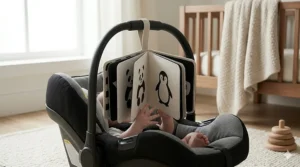
Real-World Usage Guide: Getting the Most from High Contrast Books
Here’s what most product listings don’t tell you: buying high contrast baby books is the easy part. Actually using them effectively requires understanding how to match the book to your baby’s current capabilities and positioning them correctly for maximum developmental benefit.
Positioning for Different Ages
0-8 weeks: Your baby can focus best at 8-12 inches. During tummy time, prop the book directly in front of their face at this distance—closer won’t help because they can’t focus yet, farther away puts it outside their visual range. For lap reading, hold the book at the same distance and angle it slightly downward toward their eyes.
8 weeks-4 months: Visual range extends to about 3 feet. You can now position books at varying distances during tummy time, moving them closer and farther to encourage focus adjustment. This is when the larger format books (8.5 x 8.5 inch paperbacks) show advantage over the smaller 6 x 6 inch board books—more visual real estate means you can place them farther away and still deliver clear contrast.
4-8 months: Babies start reaching and grabbing. Books need to be within arm’s reach during tummy time, but expect them to be grabbed, batted, and eventually mouthed. This is when durability matters—board books and fabric books survive this phase, paperbacks deteriorate quickly.
Session Length and Frequency
Don’t expect 20-minute tummy time sessions with rapt attention on a book. Realistically, you’re looking at:
- 0-3 months: 30-90 seconds of focused looking before attention drifts
- 3-6 months: 2-5 minutes if you’re actively engaging (pointing, making sounds)
- 6-12 months: Variable—some sessions they’re into it for 5+ minutes, others they want to crawl away after 30 seconds
The key is multiple short sessions rather than one long push. Three 2-minute sessions throughout the day deliver better developmental benefit than forcing one 10-minute session that ends with crying.
Combining Books with Other Activities
High contrast books work better when integrated with activities your baby already does:
- During diaper changes: Keep a board book or fabric book next to the changing table. When your 4-month-old starts squirming during changes, hand them the book—it’s distraction and development simultaneously.
- Post-feeding calm time: After nursing or bottle feeding, babies often have a 10-15 minute alert window. This is prime book time when they’re content but not ready to sleep.
- Car seat waiting: The fabric books with hanging straps (beiens, teytoy) attach to car seats. Five minutes waiting for a doctor’s appointment becomes development time instead of fussing time.
When to Rotate vs. When to Repeat
Babies need both repetition and novelty. Here’s the balance: Keep 2-3 books in active rotation for daily use, introducing a new book every 2-3 weeks. The books that cycle out go into storage, then can be rotated back in a month later—at which point they feel novel again because baby brain development means they’re processing them differently now.
Don’t retire books just because your baby seems bored. Sometimes attention wanes not because the book isn’t working, but because the positioning is wrong for their current stage or you’re using it at the wrong time of day. Try different positions, different times, different engagement approaches before deciding a book doesn’t work.
Choosing the Right High Contrast Books: Decision Framework
You don’t need all seven books reviewed above. You might not even need three. Here’s how to actually make a decision based on your specific situation rather than buying based on what’s popular.
If you’re a first-time parent with budget concerns → Start with: Hello, Baby Animals board book ($7-10) for testing whether your baby engages with high-contrast at all, plus the teytoy 6-pack ($14-20) for volume and variety. Total investment: around $21-30, giving you seven books across different formats to discover what works.
If you prioritize educational value and your baby is 0-4 months → Choose: My First Animals ABC book ($8-12) for alphabet exposure, plus Everyday Objects ($9-13) for real-world vocabulary building. Both paperbacks require supervision past 5-6 months but deliver maximum educational content during the pure visual development phase.
If you need durability for a mouthy baby or multiple children → Go with: duopress 4-book board book set ($12-18) for indestructible construction that survives teething, plus the beiens crinkle cloth book ($10-15) for machine-washable backup. Total around $22-33 for books that last 12+ months of aggressive use.
If your baby needs multi-sensory engagement beyond just visuals → Pick: Tummy Time Mirror Book ($11-16) for the mirror, teether, and varied textures in one package, supplemented with one board book option for quieter lap reading. The mirror book handles active playtime, the board book handles calm reading.
If you’re building a baby shower registry → Request: The duopress 4-book set plus the teytoy 6-pack. This gives you both board books (for supervised reading) and fabric books (for independent exploration) spanning multiple themes. Around $26-38 total, covers you through the entire first year.
The mistake is buying duplicates within the same category. You don’t need three different paperback alphabet books—the differentiation happens between formats (paperback vs. board vs. fabric) and between single-sensory (pure visual) vs. multi-sensory (visual + tactile + auditory). Pick one from each category you need rather than three variations of the same approach.
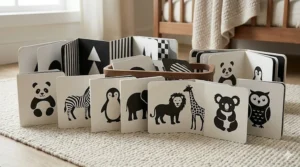
What Makes Black and White Baby Books Different from Regular Board Books
Walk into any bookstore’s baby section and you’ll find hundreds of board books with bright colors, cute animals, and cheerful illustrations. They’re fine books—just not optimal for newborns. Here’s the biology that makes black and white baby books functionally different, not just aesthetically different.
Newborns and one-month-old infants did not show any preference among colored stimuli, while three-month-old infants preferred longer wavelength stimuli to short-wavelength stimuli. Translation: your newborn literally cannot process the difference between that cute pink elephant and purple giraffe on the colorful board book. Their cone cells (responsible for color vision) aren’t fully functional yet. What they can process is luminance contrast—the difference between light and dark areas.
This is why a simple black circle on white background captures attention better than a complex, multicolored jungle scene. The newborn brain isn’t searching for interesting content; it’s practicing the fundamental skill of distinguishing edges and boundaries. High contrast provides maximum edge clarity with minimum visual noise.
Regular board books often feature: gradual color transitions, similar-brightness objects next to each other, detailed backgrounds that compete with foreground subjects. These features work fine once color vision and visual acuity develop (around 4-6 months), but before that they create visual confusion. The baby’s developing brain can’t isolate which element to focus on when everything exists at similar contrast levels.
Black and white baby books strip all that away. Bold outline, solid fill, white space around each element. This isn’t minimalism for aesthetic reasons—it’s functional design matching biological capability. The baby sees clear boundaries, practices tracking those boundaries, and builds neural pathways for edge detection that will eventually support reading, facial recognition, and spatial navigation.
The progression makes sense developmentally: start with high-contrast black-and-white for months 0-3 when that’s what the visual system can actually process. Add color gradually around months 3-6 as cone cells mature. Introduce complex scenes and detailed illustrations around 6-12 months when visual acuity approaches adult levels.
Parents who skip straight to colorful books aren’t harming their babies—development happens regardless. But they’re missing an opportunity to provide targeted visual input during the narrow window when high contrast delivers maximum developmental benefit.
Common Mistakes When Buying High Contrast Baby Books
After reviewing hundreds of parent reviews and watching usage patterns, five mistakes show up repeatedly. Avoiding these saves money and frustration.
Mistake 1: Buying based on adult aesthetic preferences instead of baby functionality. Those gorgeous Scandinavian-design books with subtle gray-on-cream illustrations look amazing in nursery photos. Your baby can barely see them. High contrast means actual black and actual white, not charcoal and ivory. If it looks subtle and tasteful to you, it’s probably insufficient contrast for a newborn.
Mistake 2: Buying only one book and expecting it to last 12 months. Visual development moves through distinct stages. A book perfect for a 2-month-old (simple patterns, pure black-and-white) will bore a 7-month-old who needs more complexity. You need progression: simple → moderate complexity → color introduction. That requires multiple books or a set that spans those stages.
Mistake 3: Not matching book format to current mobility stage. Paperback books work great when you’re doing guided lap reading with a 2-month-old who can’t grab yet. They become frustrating around 4-5 months when babies start reaching and you’re constantly prying crumpled pages out of tiny fists. Format should follow mobility: paperback for pre-grabbing, board books for early grabbing, fabric books for aggressive grabbing plus mouthing.
Mistake 4: Expecting books to work as independent entertainment too early. High contrast books require adult participation until at least 6-7 months. You need to point, make sounds, move the book, engage verbally. Parents who prop a book in front of a 3-month-old and expect sustained attention are misunderstanding how these tools work—they’re engagement aids, not babysitters.
Mistake 5: Abandoning high-contrast books once color vision develops. Around 4-6 months, babies start showing interest in colors. Parents sometimes interpret this as “time to retire the black-and-white books.” Wrong. Color development doesn’t mean contrast no longer matters. Infants prefer high contrast and bold colors at their earlier stages of infancy—the key word being “and,” not “or.” The optimal progression is maintaining high contrast while adding color, not replacing contrast with color. This is why books like the teytoy set that mix black-and-white with bright colors work well for the 6-12 month range.
The underlying pattern: parents trying to optimize for their own preferences (aesthetics, convenience, cost minimization) rather than matching developmental stage. The books that work are the ones that respect where your baby’s visual system currently functions, even if that means buying something that seems too simple or too specialized to adult eyes.
High Contrast Books for Special Situations
Not every baby follows the standard development timeline. Premature babies, babies with visual impairments, and babies with sensory processing differences need modified approaches to visual development infants typically experience.
For Premature Babies
If your baby was born significantly early (more than 4 weeks premature), adjust the recommended age ranges based on corrected age, not chronological age. A baby born 8 weeks early who is now 4 months old chronologically should use books recommended for 2-month-olds (4 months minus 8 weeks = 2 months corrected age).
Vision development milestones are based on your baby’s due date, not the date they were born. This matters because premature babies’ visual systems haven’t had the full gestational development period. They’re not behind—they’re on a different timeline that accounts for when development actually started.
For preemies, the simple high-contrast books (Hello, Baby Animals, My First Animals) often work better longer because their visual systems take additional time reaching the complexity-processing stage. Don’t rush to multi-sensory books until you see clear signs of extended focus and reaching behavior.
For Babies with Diagnosed Visual Impairments
If your pediatric ophthalmologist has diagnosed any visual impairment, high-contrast books may still be valuable but require professional guidance on implementation. If infants with impaired vision are to be identified and referred for the eye care they need, all physicians caring for infants need to be educated about what is typical and what is atypical visual behavior.
Some visual impairments actually make high-contrast books more important, not less. Babies with reduced acuity still process contrast even when they can’t see fine detail. The books with larger patterns (8.5 x 8.5 inch formats with bold, simple shapes) deliver more accessible visual input than complex illustrations.
Conversely, babies with certain types of visual processing disorders might find high-contrast overwhelming rather than helpful. This is where professional assessment matters—don’t rely on general guidance when specific medical conditions are involved.
For Babies Who Seem Uninterested in Visual Books
Some babies show minimal interest in any books, high-contrast or otherwise. Before assuming books aren’t working, check:
Timing: Are you offering books when your baby is in a calm-alert state? Books don’t work during tired, hungry, or overstimulated periods.
Positioning: Are you holding books at the correct distance for their age? Too close or too far and they physically can’t focus.
Competition: Is the environment too stimulating? Books competing with TV noise, bright overhead lights, or other visual stimulation lose.
If you’ve addressed all those factors and interest is still minimal, that’s useful data. Some babies simply prefer other sensory inputs—tactile, auditory, kinesthetic. For these babies, the multi-sensory books (Tummy Time Mirror Book, beiens, teytoy) might engage where pure visual books don’t, because they’re delivering multiple input types simultaneously.
The goal isn’t forcing interest in books—it’s providing appropriate developmental opportunities. If books aren’t the winning strategy, other approaches (black-and-white mobiles, high-contrast playmat areas, black-and-white wall cards) deliver similar visual benefits through different formats.

Frequently Asked Questions
❓ What age should I start using high contrast baby books?
❓ How long should tummy time sessions with books last?
❓ Can high contrast books replace tummy time mats?
❓ Do I need different books for different ages?
❓ Are fabric books better than board books for development?
Conclusion: Building Your Baby’s Visual Foundation
The decision about which high contrast baby books to buy ultimately comes down to matching format and content to your baby’s current developmental stage and your family’s usage patterns. If you’re starting with a newborn, the simple board book options (Hello, Baby Animals) or pure black-and-white paperbacks (My First Animals, Everyday Objects) provide appropriate visual input without overwhelming immature visual systems. As your baby approaches 4-6 months and starts reaching, grabbing, and mouthing, transitioning to fabric options (beiens, teytoy) or investing in the durable board book sets (duopress 4-pack) makes sense.
The real value in these books isn’t keeping your baby quiet during diaper changes—though that’s a legitimate bonus. It’s providing structured visual input during the critical first year when a baby’s vision goes through many changes, from being very sensitive to bright light at birth to developing the ability to see across a room and follow moving objects. High contrast books work with that developmental trajectory rather than against it.
You don’t need every book reviewed here. Most families find success with 3-5 books total spanning different formats: one paperback or board book for guided reading, one fabric book for independent exploration, and one multi-sensory option for variety. Rotate them to maintain novelty, match them to current developmental capabilities, and engage actively during reading sessions rather than expecting books to work as passive entertainment.
The investment is minimal—even buying from the higher-end options, you’re looking at $30-50 total for a collection that covers 0-12 months. The developmental benefit of providing appropriate visual stimulation during your baby’s period of most rapid neural growth? That scales far beyond the purchase price.
Recommended for You
- 7 Best Mechanical Keyboard RGB: Ultimate 2026
- 7 Best Soldering Kit for Beginners – 2026
- 7 Best Professional Watercolor Sets That Transform Your Art in 2026
Disclaimer: This article contains affiliate links. As an Amazon Associate, I earn from qualifying purchases. If you purchase products through these links, we may earn a small commission at no additional cost to you.
✨ Found this helpful? Share it with your friends! 💬🤗
