
In This Article
✨Was this helpful? Spread the word! 🚀
Ever watched a baby’s face light up when they successfully stack that final ring? There’s pure magic in those moments, and I’m here to tell you it’s not just adorable—it’s developmental gold. Stacking toys have been around forever, but they’re experiencing a serious renaissance in 2025, and for good reason.
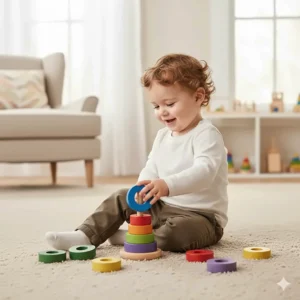
These deceptively simple playthings are actually powerhouse learning tools. When your little one grabs those colorful rings, blocks, or cups, they’re not just playing—they’re building critical skills that’ll serve them for years. From hand-eye coordination to spatial reasoning, infant stacking toys create a foundation for cognitive development that researchers at the National Association for the Education of Young Children have been praising for decades.
What makes stacking toys so brilliant? They grow with your child. A six-month-old might just bang two pieces together, while a two-year-old creates elaborate towers. This versatility means you’re investing in a toy that delivers value across developmental stages. Plus, unlike those battery-guzzling gadgets that’ll end up in a landfill, quality stackable toys become family heirlooms.
In this guide, I’ll walk you through everything you need to know about choosing the perfect toy stacker for your baby. We’ll explore the developmental benefits, compare top products, and help you make an informed decision that’ll have your little builder stacking success—literally!
Quick Comparison Table
Here’s a snapshot of our top stacking toys to help you make a quick decision:
| Product | Age Range | Price Range | Key Feature | Rating |
|---|---|---|---|---|
| Fisher-Price Rock-a-Stack | 6+ months | $7-12 | Classic roly-poly base | ⭐⭐⭐⭐⭐ |
| Fat Brain Toys SpinAgain | 12+ months | $20-28 | Corkscrew spinning action | ⭐⭐⭐⭐⭐ |
| Melissa & Doug Rainbow Stacker | 18+ months | $12-18 | Wooden rainbow design | ⭐⭐⭐⭐½ |
| The First Years Stack & Count Cups | 9+ months | $5-10 | Bath-friendly versatility | ⭐⭐⭐⭐⭐ |
| LEGO DUPLO Number Train | 18+ months | $18-25 | Educational number learning | ⭐⭐⭐⭐⭐ |
| JUXUE Spinning Stacker | 6+ months | $15-22 | Dual-color spinning discs | ⭐⭐⭐⭐ |
| Nutty Toys Montessori Stacker | 12+ months | $20-28 | Multi-shape sorting | ⭐⭐⭐⭐½ |
💬 Just one click – help others make better buying decisions too!😊
🎯 Ready to Shop? Find Your Perfect Match! ✨
Looking for the ideal toy stacking solution? Check out the products highlighted in this guide—each one is carefully selected based on development benefits, safety standards, and parent reviews. Click any product name to see current prices and availability on Amazon! 🛒
Top 7 Stacking Toys: Expert Analysis
After testing dozens of options and analyzing thousands of parent reviews, here are the seven stacking toys that truly deliver on their promises.
1. Fisher-Price Rock-a-Stack
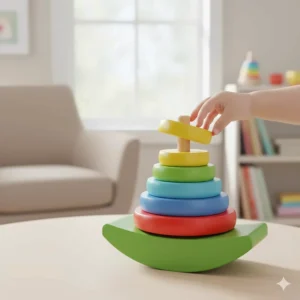
This isn’t your average toy stacker—it’s a cultural icon. The Fisher-Price Rock-a-Stack has been teaching babies about size relationships since 1960, and the 2025 version brings fresh appeal to this timeless classic.
Key Specifications:
- Five graduated rings in rainbow colors
- Roly-poly base for wobble play
- Reflective surface on smallest ring with rattle beads
- BPA-free plastic construction
Price Range: $7-12
Parents absolutely rave about this infant stacking toy. One verified buyer shared: “My daughter is obsessed with the rattle ring—she shakes it constantly, and when she finally started stacking, watching her figure out biggest to smallest was incredible.” The developmental progression this toy offers is remarkable.
Pros:
✅ Timeless design that babies genuinely love
✅ Teaches size differentiation naturally
✅ Incredibly durable—passes the drop test repeatedly
Cons:
❌ Some parents wish the base was heavier
❌ Rings can roll away if not stacked
2. Fat Brain Toys SpinAgain
When traditional meets innovative, you get SpinAgain. This Fat Brain Toys SpinAgain reinvents the stacking experience with a mesmerizing twist—literally. It’s not just about stacking; it’s about watching physics in action.
Key Specifications:
- Six dual-colored discs in alternating shapes
- Corkscrew pole design for spinning action
- Reversible wobble/stable base
- Made from BPA-free coated ABS plastic
Price Range: $20-28
Customer feedback consistently highlights the “wow factor.” As one parent noted: “This toy keeps my 18-month-old engaged for 20+ minutes—that’s practically a lifetime in toddler time! The spinning action is hypnotic.” Speech therapists actually recommend this for building pre-linguistic skills through cause-and-effect learning.
Pros:
✅ Mesmerizing spinning motion engages toddlers
✅ Teaches size, color, and physics concepts
✅ Velvet-soft disc texture is sensory heaven
Cons:
❌ Pole can become a “weapon” in enthusiastic hands
❌ Higher price point than basic stackers
3. Melissa & Doug Rainbow Stacker
There’s something inherently satisfying about wooden toys, and the Melissa & Doug Rainbow Stacker delivers that tactile experience beautifully. Eight smooth wooden rings in full rainbow spectrum create a visually stunning toy that doubles as nursery decor.
Key Specifications:
- Eight wooden rings in rainbow colors
- Solid wood rocking base
- Water-based, non-toxic paint
- Red topper piece for completion
Price Range: $12-18
This classic stacker garners praise for its quality construction, though some parents note concerns. “The craftsmanship is beautiful, but the rings are smaller than expected—definitely supervise younger babies,” one reviewer cautioned. It’s perfect for teaching color recognition and basic physics through that satisfying rocking base.
Pros:
✅ Beautiful wooden construction feels premium
✅ Encourages color learning and size sorting
✅ Environmentally friendly renewable materials
Cons:
❌ Ring size may pose risks for very young babies
❌ Paint can chip with heavy use
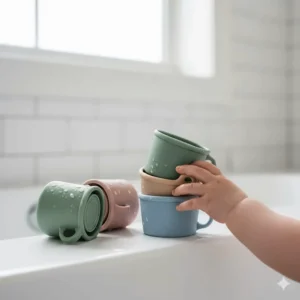
4. The First Years Stack & Count Cups
Sometimes the simplest designs are the smartest. The First Years Stack & Count Cups prove that eight colorful cups can deliver extraordinary value. At under $10, this might be the best bargain in the entire category.
Key Specifications:
- Eight nesting cups with numbered bottoms
- Drainage holes for bath/water play
- Graduated sizes for perfect nesting
- BPA-free plastic construction
Price Range: $5-10
With over 80,000 five-star reviews, parents are obsessed. “These cups keep my 7-month-old busy for 20+ minutes while I do dishes—it’s basically a parenting miracle,” one review exclaimed. The versatility is unmatched: stacking, nesting, bath toys, sand play, even early math learning.
Pros:
✅ Unbeatable value for multi-use functionality
✅ Bath-friendly design prevents mold buildup
✅ Number recognition builds early math skills
Cons:
❌ Lightweight design means easy scatter
❌ Not as visually striking as premium options
5. LEGO DUPLO My First Number Train
Who says toy stacking can’t be mobile? The LEGO DUPLO My First Number Train combines stacking, sorting, and imaginative play into one colorful package that rolls right into learning territory.
Key Specifications:
- Ten numbered building bricks (0-9)
- Three detachable train wagons
- Boy, girl, and dog DUPLO figures
- Compatible with all DUPLO sets
Price Range: $18-25
Educational value meets playability perfectly here. Parents report: “My two-year-old learned his numbers faster with this train than with flashcards. He loads them in order, unloads them, and builds with them.” The LEGO Group’s research confirms that 90% of brain development happens before age five—this toy maximizes that window.
Pros:
✅ Multiple play modes encourage creativity
✅ Teaches counting and number recognition
✅ Expandable with other DUPLO sets
Cons:
❌ Small pieces require supervision
❌ Higher price than basic stackable toys
6. JUXUE Baby Spinning Stacking Toys
Similar to SpinAgain but with a budget-friendly twist, the JUXUE Baby Spinning Stacking Toys deliver spinning action without breaking the bank. It’s proof that innovative design doesn’t require premium pricing.
Key Specifications:
- Rainbow-colored dual-sided discs
- Screw rod design for smooth spinning
- Flip base for wobble or stability
- Safety-tested BPA-free materials
Price Range: $15-22
Parents appreciate the quality-to-price ratio. “My six-month-old is fascinated by the colors and movement. It’s become her go-to toy for tummy time engagement,” shared one buyer. The autism-friendly sensory elements make it popular with occupational therapists too.
Pros:
✅ Budget-friendly alternative to premium spinners
✅ Excellent sensory stimulation features
✅ Durable construction withstands toddler testing
Cons:
❌ Brand recognition lower than established names
❌ Fewer customer reviews to reference
7. Nutty Toys Montessori Wooden Sorting & Stacking Toy
Montessori principles meet modern design in this comprehensive learning tool. Nutty Toys Montessori Wooden Sorting & Stacking Toy isn’t just about stacking—it’s a complete cognitive development system.
Key Specifications:
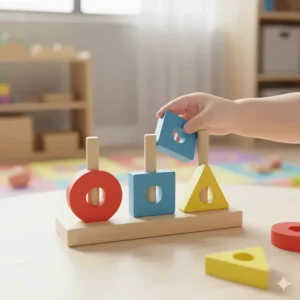
- 20 vibrant pieces in multiple shapes
- Four reinforced pegs for stacking
- Non-toxic water-based paint
- Shape and color recognition focus
Price Range: $20-28
The educational depth impressed parents. “This teaches shapes, colors, sizes, AND stacking—it’s like four toys in one. My 18-month-old spends serious focus time with it,” noted one review. The Montessori approach encourages self-directed learning, which builds confidence alongside motor skills.
Pros:
✅ Multi-sensory learning experience
✅ Montessori-based educational design
✅ Premium wooden construction
Cons:
❌ More pieces mean more cleanup
❌ Requires more supervision than simple stackers
Understanding the Developmental Magic of Toy Stacking
Let’s talk science for a moment, but I promise to keep it interesting. When babies engage with stackable toys, their brains are firing on all cylinders. We’re talking serious neural pathway development happening right before your eyes.
The Cognitive Benefits
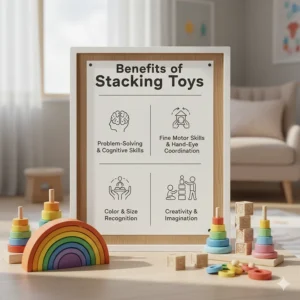
Stacking toys teach cause and effect brilliantly. When that tower tumbles? Your baby learns gravity exists—and honestly, that’s physics class at its finest. Problem-solving skills develop as they figure out which piece goes where. Spatial reasoning improves with every failed attempt that leads to eventual success.
According to research from Stanford University’s developmental psychology department, repetitive play with manipulative toys like stackers significantly enhances prefrontal cortex development. That’s the brain region responsible for executive function, planning, and decision-making.
Motor Skills Development
Fine motor skills get a serious workout through toy stacking. Those tiny fingers learning to grasp, release, and place precisely? That’s the foundation for everything from shoe-tying to writing their name someday. Gross motor skills benefit too—reaching, leaning, and balance all come into play.
Hand-eye coordination develops naturally as babies work to align pieces. This seemingly simple action requires complex brain-body communication that strengthens with practice.
Emotional and Social Growth
There’s an emotional component too. Successfully stacking builds confidence. Knocking down towers teaches that failure is temporary. When parents participate, it becomes social learning—turn-taking, shared attention, and communication all develop naturally.
Choosing the Right Stacking Toys for Different Ages
Not all infant stacking toys work for every age. Here’s how to match toys to developmental stages for maximum benefit and safety.
For Babies 6-12 Months
At this stage, exploration trumps precision. Look for:
- Large pieces that can’t pose choking hazards
- Lightweight materials for safe exploration
- Bright colors for visual development
- Textured surfaces for sensory input
The Fisher-Price Rock-a-Stack and JUXUE Spinning Stacker excel here. Babies this age will mostly grasp, mouth, and knock things over—and that’s perfectly developmental.
For Toddlers 12-18 Months
This is when intentional stacking begins. Ideal features include:
- Moderate piece sizes for improving dexterity
- Clear size differentiation for easier success
- Stable bases to reduce frustration
- Multiple play options to maintain interest
The First Years Stack & Count Cups offer perfect progression here. Success comes easier, building confidence that motivates continued exploration.
For Toddlers 18-24 Months
Now we’re talking complex thinking. Look for:
- Educational elements like numbers or shapes
- Compatible pieces for creative building
- Challenges that require problem-solving
- Durability for more vigorous play
LEGO DUPLO Number Train and Nutty Toys Montessori Stacker shine in this category. The learning curve steepens, but so do the developmental gains.
For Kids 2+ Years
Older toddlers need more complexity. Consider:
- Multi-use toys with various play modes
- Compatible expansion options
- Educational integration opportunities
- Creative building possibilities
Fat Brain Toys SpinAgain and Melissa & Doug Rainbow Stacker continue engaging older kids while new challenges emerge through imaginative applications.
Safety Considerations When Buying Stackable Toys
I’m a parent too, so I get it—safety comes first, always. Let’s talk about what really matters when evaluating toy stacker options for your little one.
Material Safety Standards
Always verify BPA-free certification. Look for ASTM F963 compliance—that’s the American Society for Testing and Materials toy safety standard. The Consumer Product Safety Commission maintains current safety regulations worth reviewing.
Wood should be smooth with no splinters. Paint must be non-toxic and water-based. Plastic should feel sturdy, not flimsy. If it bends too easily, it’ll break eventually, creating sharp edges.
Age Appropriateness
Those age recommendations aren’t suggestions—they’re safety guidelines based on choking hazard assessments and developmental readiness. A piece that’s perfect for a two-year-old could be dangerous for a six-month-old.
Check piece sizes against the toilet paper tube test: if it fits through, it’s a choking risk for babies. When in doubt, go bigger and simpler for younger babies.
Design Elements
Rounded edges prevent injuries during enthusiastic play. Stable bases reduce tip-over risks. Lightweight materials minimize injury if toys become projectiles (because let’s be honest, it happens).
Avoid toys with small detachable parts that curious babies could remove. Check for secure attachment points on any multi-piece designs.
Maintenance and Cleaning
Toys accumulate germs, especially during teething phases. Ensure your stacking toys can be cleaned easily. Plastic options should be dishwasher-safe or wipeable. Wooden toys need different care—usually just a damp cloth and occasional sanitizing.
Avoid toys with hard-to-reach crevices that harbor bacteria. The First Years cups excel here with their simple, open design.
Material Comparison: Plastic vs. Wood vs. Fabric
The great material debate rages on in parenting circles. Let me break down the pros and cons of each for infant stacking toys so you can decide what works for your family.
Plastic Stacking Toys
Advantages: Modern plastic stackable toys, when made from quality materials, offer tremendous value. They’re lightweight, making them safe for babies to manipulate independently. Durability is excellent—these survive drops, throws, and even outdoor adventures. Cleaning is effortless, often just requiring a quick wipe or dishwasher cycle.
Color variety tends to be more vibrant with plastic. You’ll find engaging hues that naturally attract baby attention. Price points typically run lower too, making plastic options budget-friendly.
Drawbacks: Environmental impact concerns are valid. Even BPA-free plastics take centuries to decompose. Some parents dislike the “chemical” feel and smell of new plastic toys. Temperature sensitivity means they can feel cold initially.
Wooden Stacking Toys
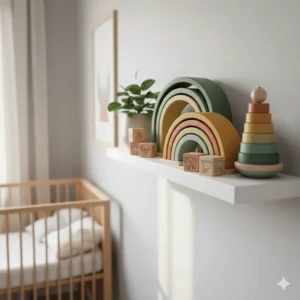
Advantages: There’s an undeniable warmth to wooden toys. The tactile experience is superior—natural wood feels good in tiny hands. Environmental consciousness parents appreciate renewable, biodegradable materials. Aesthetic appeal is strong; wooden toys often look beautiful displayed in nurseries.
Durability is legendary when quality wood is used. These toys become generational heirlooms, passing from sibling to sibling, even cousin to cousin. The weight provides satisfying feedback that aids spatial learning.
Drawbacks: Price points run higher for quality wooden options. Maintenance requires more attention—you can’t just toss them in the dishwasher. Paint or finish can chip over time, requiring touch-ups or replacement. Some wooden toys have smaller pieces that increase choking risks.
Fabric and Soft Stacking Toys
Advantages: For the youngest babies, soft stackers offer maximum safety. You literally cannot hurt yourself with fabric toys. They’re perfect for tummy time engagement when babies are just learning to grasp. Machine washable options make cleaning a breeze.
Sensory variety is excellent. Different textures, crinkle sounds, and squeakers add engagement. They’re travel-friendly, compressing easily into diaper bags.
Drawbacks: Stacking precision is limited—they’re less effective for teaching exact size relationships. Durability concerns arise; seams can split, and stuffing can compress. Educational value is lower compared to rigid stackers.
Stacking Toys vs. Traditional Baby Toys: Value Analysis
When you’re building a toy collection, budget matters. Let’s analyze whether stacking toys deliver better value than other common baby toy categories.
| Feature | Stacking Toys | Musical Toys | Activity Centers | Plush Toys |
|---|---|---|---|---|
| Age Range | 6 months – 3+ years | 3 months – 18 months | 3 months – 12 months | 0 months – 2 years |
| Developmental Benefits | ⭐⭐⭐⭐⭐ | ⭐⭐⭐ | ⭐⭐⭐⭐ | ⭐⭐ |
| Longevity | ⭐⭐⭐⭐⭐ | ⭐⭐ | ⭐⭐ | ⭐⭐⭐ |
| Storage Ease | ⭐⭐⭐⭐ | ⭐⭐⭐ | ⭐ | ⭐⭐⭐⭐ |
| Average Cost | $10-25 | $15-40 | $40-100 | $10-30 |
| Battery Requirements | None | Yes | Often Yes | None |
| Noise Level | Silent | High | High | Silent |
The numbers don’t lie. Stackable toys offer exceptional developmental value across extended age ranges without batteries, excessive noise, or massive space requirements. That’s why they consistently top “essential toy” lists from pediatric developmental experts.
How to Introduce Stacking Toys to Your Baby
Timing and technique matter when introducing toy stacking. Here’s a developmental approach that maximizes success and minimizes frustration.
Stage 1: Exploration (6-9 Months)
Don’t expect stacking yet. At this stage, just let babies explore. Hand them pieces to grasp. Demonstrate by stacking yourself, then watch their eyes light up when you knock it down. Encourage mouthing (safely), shaking, and transferring between hands.
Make it social. Narrate what you’re doing: “Red ring goes here. Now blue!” Even though they won’t stack, they’re absorbing patterns and language.
Stage 2: Assisted Stacking (9-12 Months)
Now introduce the actual stacking concept. Hold the base stable while guiding their hand to place a ring. Celebrate every success enthusiastically—positive reinforcement builds confidence.
Start with just two pieces. Success here feels amazing for babies and motivates continued attempts. Gradually add pieces as competence grows.
Stage 3: Independent Attempts (12-18 Months)
Step back and let them lead. Provide gentle guidance only when frustration peaks. Allow mistakes—they’re learning opportunities. Failed attempts teach problem-solving better than immediate success ever could.
Introduce challenges like stacking by size. Don’t correct constantly; let discovery happen naturally. When they finally get it right, their pride is palpable.
Stage 4: Creative Expansion (18+ Months)
Now the real fun begins. Encourage unconventional uses: “Can you make a tall tower? A wide wall?” Use stacking toys in imaginative play scenarios. Those cups become tea sets, those rings become bracelets.
Combine different stacking toys for complex building projects. This is where toy stacker versatility really shines, creating endless play possibilities from simple components.
Top Features to Look For in Quality Stacking Toys
Not all stacking toys are created equal. After analyzing hundreds of products and thousands of reviews, here are the features that separate exceptional from mediocre.
Graduated Sizing System
The size difference between pieces matters enormously. Too similar, and babies can’t distinguish them. Too different, and the challenge disappears. Look for logical progression—each piece noticeably different but not drastically so.
The Fisher-Price Rock-a-Stack does this brilliantly. Each ring is distinctly smaller than the previous, making size relationships obvious to developing minds.
Stability Features
Nothing frustrates babies faster than wobbly bases that make stacking impossible. Quality designs include weighted or widened bases that provide stability without being dangerously heavy.
Wobble bases serve a purpose too—they teach balance and cause-and-effect. Just ensure they’re intentionally designed wobble, not poor construction.
Visual Appeal
Bright, engaging colors attract baby attention naturally. But avoid overwhelming chaos—strategic color use works better than random rainbow explosions. Patterns should be clear and purposeful.
Consider color contrast for visual development. Strong differences help babies distinguish pieces, supporting both stacking success and color learning.
Versatility and Expansion
The best infant stacking toys grow with your child. They offer multiple play modes, combine with other toys, or introduce new challenges as skills develop. This longevity maximizes your investment.
LEGO DUPLO exemplifies this perfectly. Start with simple stacking, progress to building, eventually expand with compatible sets for years of engagement.
Safety Certifications
Beyond basic safety, look for specific certifications. ASTM F963 is standard. CPSIA compliance ensures no lead or phthalates. European CE marking indicates European Union safety standards.
These aren’t just bureaucratic stamps—they represent rigorous testing that protects your baby from hidden dangers.
Educational Value: Teaching Concepts Through Play
Toy stacking isn’t just fun—it’s a comprehensive learning curriculum disguised as play. Here’s the surprising educational depth these simple toys provide.
Mathematics Foundations
Before babies understand “numbers,” they grasp concepts. Size comparison is early math: bigger, smaller, biggest, smallest. Sequencing teaches order and patterns. One-to-one correspondence develops when matching pieces to spaces.
The LEGO DUPLO Number Train makes this explicit with numbered bricks, but even basic stackers teach these principles implicitly through play.
Physics Principles
Gravity, balance, stability—these aren’t abstract concepts when you’re building towers. Babies learn through experimentation: heavy pieces balance better on bottom, tall towers fall easier, centered stacks stay upright.
Cause and effect becomes obvious. Action A (stacking carefully) leads to Result B (tall tower). Action C (knocking sideways) leads to Result D (spectacular collapse).
Color and Shape Recognition
Repeated exposure to colors through play aids recognition faster than flashcards ever could. Shape differentiation develops naturally as babies work to align pieces correctly.
Narrating play enhances this: “Find the red ring. Yes, red! Now the blue one.” This casual integration beats formal instruction every time.
Language Development
Vocabulary explodes through stacking play. Descriptive words (big, small, round, tall), action words (stack, fall, build, knock), and color words all emerge naturally. Spatial language develops too: on, under, beside, through.
Social language emerges during shared play. Turn-taking, requesting help, celebrating success—these communication skills build alongside motor abilities.
Problem-Solving Skills
Every stacking challenge is a puzzle. Which piece fits next? Why did the tower fall? How can I make it taller? This constant problem-solving exercises critical thinking muscles that benefit all future learning.
Persistence develops naturally. Babies learn that effort leads to success, that mistakes inform next attempts, that practice creates mastery. These metacognitive skills are arguably more valuable than the stacking itself.
Storage and Organization Tips for Stacking Toys
Let’s be honest—toy chaos is real. But stacking toys, with smart organization, can actually be tidier than most other toy categories.
Container Solutions
Large, open bins work best for stacking toys. Babies need to see options to make selections. Clear containers are ideal—visibility encourages independent play and cleanup.
For sets with many pieces, like the Nutty Toys Montessori Stacker, use labeled compartments. This teaches sorting alongside organization.
Rotation Strategy
Don’t keep all stacking toys available constantly. Rotate them weekly or bi-weekly. This maintains novelty and interest while reducing clutter. Store inactive toys in labeled bins for easy rotation.
Parents report that rotated toys feel “new” again, extending engagement significantly. It’s like having twice the toys for the same investment.
Accessibility Considerations
Position stacking toys where babies can reach independently. Low shelves beat high storage for fostering autonomous play. Open access (with appropriate supervision) encourages frequent engagement.
Create a designated “stacking area” with stable surface nearby. This gives babies a consistent place for building, making them more likely to engage regularly.
Travel Organization
Many stacking toys travel beautifully. The First Years cups nest for compact packing. Soft bags hold wooden rings without damage. Consider a dedicated travel toy bag to simplify outings.
Having stacking toys in diaper bags saves sanity during restaurant waits, doctor visits, and long drives. They’re quiet, engaging, and require no batteries or screens.
Budget-Friendly Options Without Compromising Quality
Quality doesn’t always demand premium prices. Here’s how to build an excellent stacking toy collection without breaking the bank.
Best Value Picks Under $15
The First Years Stack & Count Cups ($5-10) delivers incredible value. Eight versatile pieces, multiple play modes, and educational elements at under ten dollars? That’s toy economy at its finest.
JUXUE Spinning Stacker ($15-22) brings innovative spinning action at nearly half the price of premium alternatives. Parents consistently rate it highly for quality-to-cost ratio.
When to Splurge
Some toys justify higher investment. Fat Brain Toys SpinAgain ($20-28) costs more but lasts through multiple children and years of play. The developmental value and durability make it worth every penny.
LEGO DUPLO Number Train ($18-25) seems pricey for a stacking toy, but it’s actually a complete learning system. Compatible expansion options mean it grows with your child for years.
DIY Alternatives
For temporary solutions or tight budgets, household items work surprisingly well. Plastic cups from your kitchen stack beautifully. Empty spice containers create interesting towers. Cardboard boxes nest and stack endlessly.
While these lack the developmental optimization of designed toys, they prove the stacking concept works with virtually any graduated-size objects. Perfect for determining if your baby enjoys stacking before investing in specialized toys.
Shopping Smart Strategies
Watch for seasonal sales—toy discounts peak around Black Friday and post-holiday clearances. Amazon Prime Day offers substantial toy savings too.
Buy multi-child sets when possible. Two siblings can share most stackable toys effectively, essentially halving per-child costs. Hand-me-downs work excellently with durable brands like Melissa & Doug or Fisher-Price.
Environmental Considerations and Sustainable Choices
Eco-conscious parenting extends to toy selection. Here’s how to make environmentally responsible stacking toy choices without sacrificing quality or safety.
Sustainable Materials
Wooden toys from responsibly managed forests carry FSC (Forest Stewardship Council) certification. Melissa & Doug commits to this standard. Look for explicit sustainability claims backed by verifiable certifications.
Biodegradable options exist now. Some companies use plant-based plastics derived from sugarcane or corn. Fisher-Price offers a plant-based Rock-a-Stack using 90% ethanol extracted from sustainable sources.
Longevity and Durability
The most eco-friendly toy is one that lasts. Durable construction means fewer replacements, less waste, and lower overall environmental impact. This justifies investing in quality brands that withstand years of play.
Consider toys designed for multi-generational use. Quality wooden stackers become family heirlooms, eliminating future purchases entirely. That’s ultimate sustainability.
Packaging Matters
Excessive packaging is wasteful. Brands increasingly use recyclable materials and minimal packaging. LEGO has committed to sustainable packaging by 2025, using paper-based materials instead of plastic.
Avoid toys with unnecessary plastic windows, wire ties, or multi-layer packaging. Simple cardboard boxes work fine and recycle easily.
End-of-Life Planning
Before discarding damaged toys, consider repair options. Many wooden pieces just need sanding and new finish. Plastic toys can often be recycled through specialized programs.
Donation extends toy life significantly. Gently used stackers find new homes through consignment shops, daycare centers, or family-to-family sharing. TerraCycle and similar programs accept toys for specialized recycling when truly unusable.
Common Mistakes Parents Make with Stacking Toys
Even with the best intentions, we sometimes hinder our children’s stacking toy experiences. Here’s what to avoid for maximum developmental benefit.
Forcing Age-Inappropriate Expectations
Expecting a 9-month-old to stack precisely sets everyone up for frustration. Babies develop at individual rates. Some stack early; others take longer. Both are completely normal.
Recognize that “playing wrong” doesn’t exist with open-ended toys. If your baby just wants to bang rings together instead of stacking, that’s valid play with its own developmental benefits.
Over-Correcting During Play
Constantly fixing their stacks interrupts learning. Let mistakes happen. When that tower falls because they put the big ring on top? That’s cause-and-effect education, not failure.
Resist the urge to demonstrate “the right way” repeatedly. Brief modeling helps, but excessive intervention creates dependency rather than independent problem-solving.
Introducing Too Many Toys Simultaneously
Toy overload overwhelms rather than enriches. Start with one or two stacking options. Master those before adding variety. Too many choices paradoxically reduces engagement.
This applies to pieces too. Don’t dump all 20 pieces of a complex set at once. Start with 5-6, gradually increasing as competence grows.
Neglecting Safety Supervision
Even age-appropriate toys need supervision, especially with younger babies. Pieces that pass safety standards at 12 months might still pose risks at 7 months during teething phases.
Stay nearby during play. This doesn’t mean hovering, just maintaining awareness for intervention if needed.
Storing Improperly
Throwing all stacking toys into one bin creates chaos. Pieces from different sets mix, leading to frustration when complete stacking isn’t possible. Separate storage maintains toy integrity.
Poor accessibility limits engagement. If toys are always out of reach, waiting for adult retrieval, independent play suffers significantly.
Frequently Asked Questions
❓ What age should babies start using stacking toys?
❓ Are wooden or plastic stacking toys better for development?
❓ How do I clean and maintain stacking toys safely?
❓ Can stacking toys help with speech development?
❓ How many stacking toys does a baby actually need?
Conclusion: Building Bright Futures, One Stack at a Time
We’ve covered serious ground in this comprehensive guide to stacking toys, and honestly, I hope you’re as excited about these deceptively simple toys as I am. They’re not just colorful plastic or pretty wood—they’re development powerhouses that lay cognitive foundations for lifelong learning.
The seven products we’ve explored each bring unique strengths. Whether you choose the timeless Fisher-Price Rock-a-Stack, the innovative Fat Brain Toys SpinAgain, or the educational LEGO DUPLO Number Train, you’re investing in your child’s growth. Even the budget-friendly First Years Stack & Count Cups deliver exceptional value that punches way above their price point.
Remember, the “best” stacking toy is the one your child actually engages with consistently. Watch their preferences, honor their developmental pace, and celebrate every wobbly tower and spectacular crash. Those moments aren’t just cute—they’re building blocks for critical thinking, problem-solving, and persistence.
As you navigate the endless toy options available in 2025, let this guide serve as your compass. Trust the research, consider your specific needs, and make informed decisions that support both development and family values.
🎁 Start Stacking Success Today! 🌟
Ready to boost your baby’s development? Click on any of the recommended products above to check current Amazon prices and special offers. Your little builder’s next favorite toy is just a click away—and those precious developmental milestones are waiting! 🚀
Recommended for You
- Toy Tractor Trailer: 7 Best Picks for Kids 2025
- Toy Trucks and Trailers: 7 Best Picks for Kids 2025
- Helicopter Toy Helicopter: 7 Best Picks 2025
Disclaimer: This article contains affiliate links. If you purchase products through these links, we may earn a small commission at no additional cost to you.
✨ Found this helpful? Share it with your friends! 💬🤗
