
In This Article
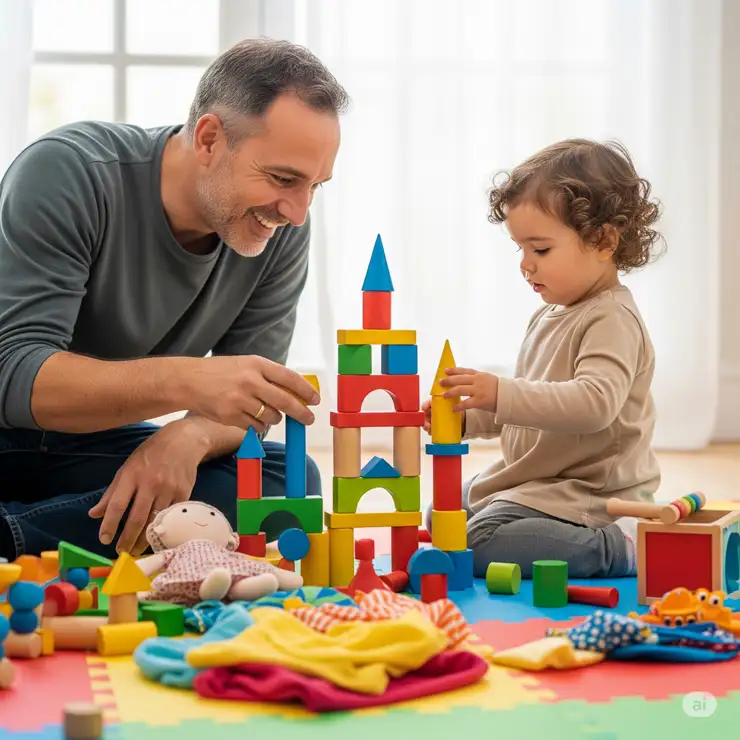
In a world increasingly dominated by screens and structured activities, open ended toys have emerged as powerful tools for unleashing children’s natural creativity and supporting healthy development. Unlike traditional toys with predetermined functions, these remarkable playthings invite children to explore, create, and discover through unlimited possibilities.
✨Was this helpful? Spread the word! 🚀
Open ended toys represent a fundamental shift in how we approach childhood play. These versatile materials don’t dictate how children should engage with them, instead providing blank canvases for imagination to flourish. Whether you’re searching for the perfect gift or looking to enhance your child’s play environment, understanding the profound impact of open ended toys can transform how your family approaches learning and creativity.
Understanding Open Ended Toys: The Science Behind Unlimited Play 🧠
Open ended toys are fundamentally different from closed-ended alternatives because they lack predetermined outcomes or “correct” ways to play. A decade-long study by the Center for Early Childhood Education at Eastern Connecticut State University found that simple, open-ended, non-realistic toys such as a random assortment of Lego inspired the highest-quality play. This research demonstrates that children who played with open ended toys were more likely to engage in creative play, problem solving, peer interaction, and language development.
The distinction becomes clear when comparing these materials to electronic alternatives. Electronic toys are often pre-programmed and have limited options for interaction, which can be detrimental to a child’s development. For example, a plastic cash register that produced sounds when buttons were pushed mostly inspired children to repeatedly push the buttons, rather than engaging in imaginative play. This fundamental difference explains why simple, versatile materials continue to captivate children across generations.
Research conducted by Professor Trawick-Smith reveals that about 90 percent of preschool children’s play in the United States involves a toy, yet different toys impact children’s behavior in dramatically different ways. The most successful open ended toys consistently score highest in three critical areas: thinking and learning, social interaction, and creativity development.
Contemporary child development experts emphasize that from birth through age 5, children’s brains are literally forming the complex web of synapses that last throughout their lives, and greatly impact their social, emotional, physical and cognitive performance as adults. During this crucial window, open ended toys provide optimal stimulation for developing neural pathways.
The Developmental Impact of Open Ended Play
Research consistently demonstrates multiple benefits of open ended toys for child development. Open ended toys foster creativity, ingenuity, and development. One of the best parts about open ended toys is they are perfect for children of a variety of ages. This versatility ensures that investments in quality open ended toys continue paying dividends as children grow and develop new capabilities.
The cognitive benefits are particularly impressive. Open-ended toys allow your child to develop cognitive skills and problem solving skills. With these toys, they have to figure out how to use it and play with it. Every play time is unique. It fosters creativity by learning how to play with it and make it work for them. Unlike electronic toys that provide predetermined responses, open ended toys require children to generate their own solutions and create their own entertainment.
Furthermore, research shows how play can relieve stress and improve emotional well-being. In one study, when preschool children who were nervous about starting school played with toys or classmates for 15 minutes, they had a two-fold decrease in anxiety, compared to students who listened to a teacher reading a story. This stress-reduction capability makes open ended toys particularly valuable during transitions and challenging periods.
Top 7 Open Ended Toys Available on Amazon 🎯
Based on extensive research and real-world testing, these seven categories represent the most effective open ended toys currently available. Each recommendation includes specific products available on Amazon, complete with pricing and detailed specifications.
1. Magnetic Building Tiles: The Modern Classic ⚡
Magnetic tiles have revolutionized construction play, offering the satisfaction of building with the convenience of magnetic connections. These versatile pieces allow children to create 2D patterns, 3D structures, and complex architectural marvels.
**Top Product: PicassoTiles 100 Piece Set ** This comprehensive PicassoTiles 100 Piece Set offers exceptional value with 100 clear magnetic tiles in various shapes including squares, triangles, and special pieces. The set has brought boundless joy and creativity into homes, captivating children aged 6 and 3 alike, providing endless hours of entertainment, exploration, and imaginative play. Currently priced around $40-50, this set is compatible with other major brands including Magna-Tiles and Connetix.
Premium Alternative: Magna-Tiles Clear Colors 100-Piece Set For families seeking the original and highest quality option, Magna-Tiles remain the gold standard. MAGNA-TILES are one of the best learning toys you can buy. They aren’t an eyesore on your living room floor either. While more expensive at approximately $100-120, the superior magnet strength and durability justify the investment for heavy use.
Budget-Friendly Option: Playmags 100-Piece Set Playmags offers excellent value for families starting their magnetic tile journey, typically priced around $30-40. These tiles maintain compatibility with premium brands while providing solid construction and vibrant colors.
Benefits and Applications
Magnetic tiles excel in multiple developmental areas simultaneously. They support spatial reasoning as children visualize how pieces fit together in three dimensions. Mathematical concepts emerge naturally through pattern creation, symmetry exploration, and geometric shape recognition. Social skills develop when multiple children collaborate on large structures, negotiating roles and sharing materials.
The versatility extends beyond simple building. Children use magnetic tiles for color sorting, creating marble runs when combined with additional track pieces, and even as props in dramatic play scenarios. The translucent nature of many tiles adds another dimension when used near windows or light tables.
2. Rainbow Stacking Blocks: Timeless Waldorf Inspiration 🌈
Rainbow stackers represent centuries of educational toy wisdom, combining beautiful aesthetics with unlimited creative potential. These curved wooden pieces invite children to explore balance, color relationships, and three-dimensional thinking.
**Top Product: Grimm’s Large 12-Piece Rainbow Stacker ** The Grimm’s Large 12-Piece Rainbow Stacker stands as the premium choice for families seeking authentic Waldorf-inspired toys. Grimm’s iconic wooden rainbow tunnel is now available in beautiful soft pastel shades as part of Grimm’s pastel range! This imagination-sparking 6-Piece Rainbow is truly versatile as it will grow with your child (beginning as young as 1 year old) to become a favorite used in all kinds of fantasy play scenarios. Priced around $80-100, this investment piece is crafted from sustainably harvested lime wood with non-toxic water-based stains.
Budget Alternative: Coogam Wooden Rainbow Stacker The Coogam Wooden Rainbow Stacker offers similar functionality at approximately $25-35, making rainbow stacking accessible to more families. Customers consistently praise the vibrant colors and quality construction, noting that these alternatives provide excellent value for young builders.
Large Format Option: AVDAR 12-Piece Extra Large Rainbow For families wanting maximum impact, the AVDAR 12-Piece Extra Large Rainbow provides oversized arches perfect for bigger builds and multiple children playing together. At around $35-45, it offers substantial play value.
Creative Applications and Learning Outcomes
Rainbow stackers function as multisensory learning tools. Children can stack the arches into a tower, experiment with different designs and heights, fostering problem-solving, creativity and spatial awareness. Children can challenge themselves to stack the arches in the correct order, or try to stack them in different ways, such as upside down, sideways, or diagonally.
The open-ended nature allows for countless interpretations. Use the arches as mountains, waves, towers, castles, houses, fences, or anything else they can imagine in a small world play scene. Add wooden animals, blocks, cars, dolls, or natural materials to create captivating landscapes for storytelling. This versatility ensures the toy grows with children from toddlerhood through elementary years.
3. Counting Bears: Mathematical Manipulatives with Endless Possibilities 🐻
Counting bears transform abstract mathematical concepts into concrete, hands-on experiences. These colorful manipulatives support numeracy development while fostering imaginative play scenarios.
**Top Product: Learning Resources Baby Bear Counters 102-Piece Set ** The Learning Resources Baby Bear Counters 102-Piece Set provides exceptional educational value with 102 bears in six vibrant colors, storage bucket, and comprehensive activity guide. Customers find these bear counters effective for teaching counting and colors, with beautiful colors and solid construction. They are fun for kids, particularly 5-year-olds, and work well as classroom manipulatives. Priced around $15-20, this set represents outstanding value for money.
Premium Alternative: NEOROD Rainbow Counting Bears 90-Piece Set The NEOROD Rainbow Counting Bears elevates the experience with 90 bears, matching sorting cups, tweezers, dice, and activity cards in a convenient storage container. This comprehensive set includes pattern cards and wooden dice that seem super quality. Bears are really nice and the plastic cups and tweezers seem like they’ll hold up well. At approximately $25-30, it provides everything needed for structured and free play.
Budget Option: Skoolzy Counting Bears 70-Piece Set Skoolzy Counting Bears offer solid quality and educational value at around $12-18. These sorting bears make learning exciting as toddler toys and color sorting toys, perfect for montessori toys for 3+ year old, they teach color recognition, counting, and fine motor skills through fun, hands-on activities.
Educational Applications and Skill Development
Counting bears excel as mathematical manipulatives because they transform abstract concepts into tangible experiences. Children naturally progress from simple counting to more complex operations like addition, subtraction, and pattern creation. The bears support color recognition, size differentiation when multiple sizes are included, and classification skills.
Counting bears provide endless opportunities for open-ended play and learning activities. When combined with sensory bins and other experiences, they regularly become favorite materials that children can play with for extended periods. The versatility extends to dramatic play, where bears become characters in elaborate stories and scenarios.
4. Play Silks: Textile Magic for Imaginative Play ✨
Play silks represent the perfect fusion of sensory experience and creative potential. These flowing, colorful scarves invite children to explore movement, color, and dramatic play while developing fine motor skills and aesthetic appreciation.
**Top Product: Sarah’s Silks Set of 6 Primary Playsilks ** The Sarah’s Silks Set of 6 Primary Playsilks provides the complete rainbow spectrum in 35″ x 35″ squares of pure silk. Made from 100% real silk giving play scarves a very unique completely smooth and very airy feeling, these educational toys meet children’s creative needs throughout their entire development. Priced around $60-75, this investment in natural materials pays dividends through years of use.
Enchanted Collection: Sarah’s Silks Set of 5 Enchanted Playsilks The Sarah’s Silks Enchanted Playsilks feature gorgeous blended colors including Rainbow, Starry Night, Sea, Fire, and Blossom patterns. Customers love these silk scarves for their beautiful colors and encourage imaginative play, with one mentioning they pair well with wooden toys. At approximately $55-70, these create magical play experiences.
Mini Version: Sarah’s Silks Mini Playsilks Set For younger children or budget-conscious families, Sarah’s Silks Mini Playsilks in 21″ x 21″ sizes provide the same quality experience in a more manageable format. Such a great open ended toy. They’ve been imaginary ponds, sky and butterfly wings. Beautiful colors and nice mix. Priced around $35-45, these work perfectly for toddlers and travel.
Movement and Sensory Development
Play silks excel in supporting gross motor development through dance, movement, and physical play. Children develop proprioceptive awareness as they manipulate the flowing fabric, learning to control their movements to achieve desired effects. The silks encourage rhythmic movement, balance development, and spatial awareness.
The sensory benefits extend beyond touch to include visual processing. Young children love the vibrant, beautifully blended colors and soft, tactile sensation of Playsilks, which are made with non-toxic, environmentally friendly dyes and 100% real silk. This sensory richness supports calming and self-regulation while stimulating creativity.
Don’t Miss These Exclusive Deals! 🛒
Ready to transform your child’s play experience with these amazing open ended toys? Click on any highlighted product to check current pricing and availability on Amazon. These carefully selected toys will provide years of creative learning and development!
5. Wooden Building Blocks: Foundation of Creative Construction 🏗️
Wooden blocks represent the ultimate open ended toy, unchanged in concept for generations yet continuously relevant for developing minds. These simple geometric shapes provide unlimited building possibilities while supporting multiple areas of development simultaneously.
**Top Product: Melissa & Doug Standard Unit Blocks 60-Piece Set ** The Melissa & Doug Standard Unit Blocks 60-Piece Set provides precision-cut hardwood blocks in traditional unit proportions with convenient wooden storage tray. These precisely measured and cut unit blocks are a traditional favorite for play rooms and classrooms, offering 60 natural-finished, smooth-sanded hardwood blocks for constructive fun. Priced around $75-85, this set provides professional-quality blocks that last for generations.
Colorful Alternative: Melissa & Doug 100-Piece Wooden Block Set The Melissa & Doug 100-Piece Colored Block Set combines traditional block play with vibrant colors in nine different shapes. This building block set features blocks in four colors and nine shapes, with blocks ranging from approximately 1 inch long to 2.25 inches long, including rectangular prisms, cubes, cylinders, half circles, arches, and triangular pieces. At approximately $20-25, it offers exceptional value for colorful building experiences.
Budget-Friendly: Hape Maple Wood Building Blocks Hape Maple Wood Building Blocks provide quality construction at accessible pricing, typically around $15-20 for 50 pieces. These blocks offer similar educational benefits while maintaining safety and durability standards expected from wooden toys.
Engineering and Spatial Development
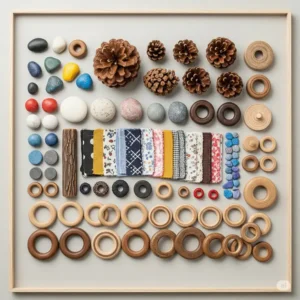
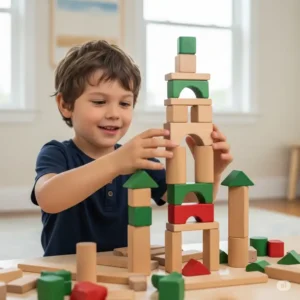
Wooden blocks serve as children’s first introduction to engineering principles. The uniform size and shape of the blocks encourage precision and balance, making them ideal for constructing various structures. Children engage in open-ended play that allows them to make choices about their play. Through trial and error, children discover principles of balance, gravity, and structural integrity.
The mathematical concepts embedded in block play are numerous and foundational. Children explore geometry through shape recognition, symmetry through balanced constructions, and measurement through comparing sizes and creating patterns. These concrete experiences form the basis for later abstract mathematical understanding.
6. Sensory Tables and Bins: Tactile Learning Environments 🌊
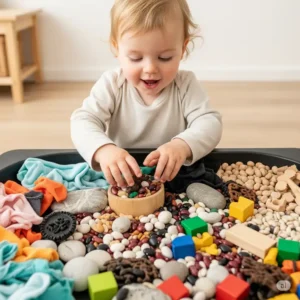
Sensory play environments provide controlled spaces for messy, exploratory play that supports multiple developmental domains. These dedicated areas allow children to investigate textures, practice fine motor skills, and engage in scientific thinking through hands-on experimentation.
Top Product: Sensory Table with 2 Chairs and Storage This comprehensive Sensory Table with 2 Chairs includes removable bins, double-sided covers, and paper roll holder. The dual-sided tabletop lets children play freely. Covered, it serves as a dining, art, or activity table. Remove the panel to reveal a sandbox, block area, or water play station—perfect for endless creative possibilities. Priced around $80-100, it provides dedicated space for sensory exploration.
Portable Alternative: Beeveer 15″ Sensory Bin Trays Beeveer Sensory Bin Trays offer flexibility and portability at approximately $25-35 for a two-pack. These 15-inch portable sensory bins with lids work perfectly for filling with water, sand, beads, kinetic sand, and various sensory materials. The compact size makes them perfect for small spaces and easy storage.
Sensory Integration and Scientific Thinking
Sensory bins support crucial neurological development through sensory integration experiences. Children process multiple sensory inputs simultaneously, strengthening neural pathways that support attention, regulation, and learning readiness. The tactile experiences particularly benefit children with sensory processing differences.
Scientific thinking emerges naturally through sensory bin exploration. Children formulate hypotheses about material properties, test predictions through experimentation, and observe outcomes. These early scientific experiences build foundational skills for later STEM learning while maintaining playful engagement.
7. Balance Boards: Dynamic Movement and Core Strength 🏄♀️
Balance boards transform simple wooden platforms into dynamic tools for physical development, sensory integration, and creative play. These versatile pieces support children’s need for movement while building core strength and proprioceptive awareness.
Top Product: Yes4All Wooden Balance Board The Yes4All Wooden Balance Board provides sustainable bamboo construction with anti-slip surface, typically priced around $35-50. This investment piece supports children and adults up to 350 pounds, making it suitable for family use and growing children.
Kid-Specific Option: Little Balance Board for Kids Designed specifically for younger children, these scaled-down versions typically cost $25-35 and feature appropriate sizing for developing balance skills safely.
Vestibular Development and Focus
Balance can help improve reading and brain development. The vestibular system contributes significantly to reading eye movements, eye-hand coordination, balance, motor planning, and other crucial skills. Regular balance board use supports these foundational skills that transfer to academic success.
The calming effects of vestibular input help children regulate their arousal levels, improving focus and attention. Many children find gentle rocking movements soothing, making balance boards valuable tools for emotional regulation and stress reduction.
Industry-Specific Applications and Professional Use Cases 🏫
Open ended toys transcend home environments, finding crucial applications across educational, therapeutic, and commercial settings. Understanding these professional applications helps parents appreciate the full value and potential of these materials.
Educational Environments: Classroom Integration
Montessori and Waldorf educational approaches have long recognized the value of open ended toys for supporting child-centered learning. Teachers can make decisions about toys as thoughtfully as they do when making decisions about any other area of the curriculum. Once toys are selected, teachers can carefully observe their impact on children’s play. This systematic approach ensures optimal learning outcomes.
Early childhood educators consistently report that open ended toys promote longer engagement periods, more complex social interactions, and deeper learning experiences. Magnetic tiles frequently become classroom staples because they support multiple curriculum areas simultaneously—mathematics through pattern creation, science through engineering challenges, and art through aesthetic exploration.
Rainbow stackers find particular favor in Waldorf settings where natural materials and beautiful aesthetics support holistic development. Teachers use these materials to introduce mathematical concepts, color theory, and spatial relationships while maintaining the imaginative, play-based approach central to this educational philosophy.
Therapeutic Applications: Supporting Diverse Needs
Occupational therapists extensively utilize open ended toys to address developmental challenges and support skill building. These toys serve as valuable teaching resources and support occupational therapy, aiding in the development of fine motor skills. The non-threatening nature of play contexts allows children to practice challenging skills without awareness of the therapeutic work occurring.
Speech-language pathologists find counting bears particularly valuable for language development. These manipulatives support vocabulary building, following directions, and narrative development while maintaining child engagement. The concrete nature of the materials helps children with language delays access abstract concepts through hands-on experiences.
Sensory integration specialists utilize play silks and sensory bins to provide controlled sensory experiences. These materials allow precise calibration of sensory input to match individual children’s needs while supporting regulation and integration skills essential for learning and development.
Commercial and Daycare Settings
Family daycare providers and commercial childcare centers invest in open ended toys because they serve multiple age groups simultaneously and withstand heavy use. The exceptional quality and opportunities for open-ended play make traditional wooden block sets an excellent value. This durability ensures cost-effectiveness over time.
Pediatric waiting rooms and children’s museums increasingly feature open ended toys because they engage children across developmental levels while supporting positive experiences during potentially stressful situations. The calming, focusing effects of these materials help children regulate their emotions and behavior in challenging environments.
Advanced Technical Analysis: Engineering and Material Science 🔬
Understanding the engineering principles and material science behind effective open ended toys helps parents make informed purchasing decisions and appreciate the sophisticated design elements that support optimal play experiences.
Magnetic Tile Engineering: Precision and Safety
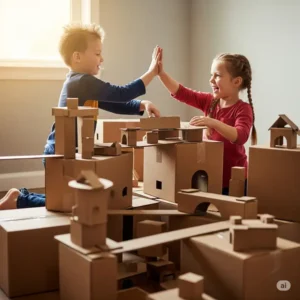
The effectiveness of magnetic tiles depends on precise engineering of magnetic strength, tile proportions, and connection mechanisms. The clear winner for the best magnetic tiles is Connetix, with Picasso Tiles being a solid budget alternative. For magnetic blocks, Blockaroos represent excellence. This distinction reflects differences in manufacturing precision and material quality.
Premium magnetic tiles utilize neodymium magnets with specific gauss ratings optimized for child use. The magnets must be strong enough to support complex structures while remaining safe if accidentally ingested. Riveted construction provides superior durability compared to glued alternatives, explaining price differences between brands.
The geometric proportions follow mathematical principles derived from traditional architectural proportions. Square and triangular units maintain specific ratios that enable complex tessellations and three-dimensional constructions. These mathematical relationships aren’t accidental—they reflect centuries of architectural and artistic knowledge encoded into children’s materials.
Wood Selection and Treatment: Sustainability Meets Safety
Premium wooden toys like Grimm’s rainbow stackers utilize specific wood types selected for their properties. Made from sustainably harvested FSC (Forestry Stewardship Council) certified wood; colored with certified non-toxic, water based stains (no troublesome paints or varnish). Lime wood provides optimal characteristics—lightweight, fine grain, and excellent dye absorption.
The curved profiles of rainbow stackers require precision milling to ensure consistent balance and stacking capabilities. Each arch must maintain specific thickness ratios and weight distribution to function properly. This engineering precision explains the performance differences between premium and budget alternatives.
Wood grain orientation affects durability and appearance. Premium manufacturers orient grain to maximize strength while minimizing splitting potential. The natural variations in wood grain create unique patterns, making each piece individual while maintaining functional consistency.
Textile Science: Silk Properties and Performance
All of our dyes are non-toxic and safe for the environment. Sarah’s Silks is committed to making toys sustainable for the Earth and its children. The choice of silk over synthetic alternatives reflects understanding of material properties that support optimal play experiences.
Silk’s unique molecular structure provides properties unmatched by synthetic alternatives. The protein fibers create natural temperature regulation, moisture wicking, and antimicrobial effects. The smooth surface reduces friction while the flowing drape creates optimal movement dynamics for dance and dramatic play.
The dyeing process for quality play silks requires specialized techniques to ensure colorfastness while maintaining silk’s natural properties. Hand-dyeing creates unique color variations and depth that machine processes cannot replicate, contributing to the aesthetic appeal and sensory richness of premium materials.
💬 Just one click – help others make better buying decisions too!😊
Comprehensive Setup and Usage Guidelines 📋
Successfully integrating open ended toys into family life requires thoughtful consideration of space, organization, and introduction strategies. These guidelines ensure maximum benefit from your investment while supporting positive play experiences.
Environmental Setup: Creating Optimal Play Spaces
Open ended toys perform best in environments that support focused, extended play. Think about how stressed and overwhelmed you are when you walk into a room full of stuff. You don’t know where to start. Your head is spinning. This principle applies equally to children—cluttered environments inhibit rather than support creative play.
Establish dedicated areas for different types of open ended play. Magnetic tiles benefit from flat surfaces where constructions can remain undisturbed. Consider investing in large foam mats or designating specific floor areas where elaborate builds can develop over time. The ability to leave constructions in place encourages children to return and extend their work.
Rainbow stackers and wooden blocks require stable surfaces and adequate space for three-dimensional constructions. Low shelves positioned nearby provide convenient storage while keeping materials visible and accessible. The visual appeal of these materials makes them suitable for display when not in use.
Sensory play areas need careful consideration of containment and cleanup. Establish clear boundaries using mats or defined spaces to help children understand expectations. Provide appropriate tools for transferring materials and cleaning up, making children partners in maintaining the environment.
Age-Appropriate Introduction Strategies
If you only have the one child now, I’d say anything from 18mo and beyond is perfect. They might not be building elaborate structures at the start, but they can still explore the magnetic properties of the tiles and enjoy colour sorting. This graduated approach ensures children experience success while building skills progressively.
Toddlers (18 months – 3 years) benefit from simplified presentations focusing on sensory exploration and basic concepts. Offer smaller quantities of materials to prevent overwhelm while supporting focused engagement. Counting bears excel for color sorting and container play. Play silks provide excellent sensory experiences through texture exploration and peek-a-boo games.
Preschoolers (3-5 years) can handle more complex presentations and multiple materials simultaneously. This developmental stage shows particular benefit from magnetic tiles and wooden blocks as fine motor skills and spatial understanding mature. Children begin creating representational structures and engaging in collaborative building projects.
School-age children (5+ years) use open ended toys for increasingly sophisticated projects. They benefit from challenge extensions like building specific structures, creating working mechanisms, or incorporating multiple toy types into elaborate scenarios. This age group particularly appreciates the problem-solving aspects of complex constructions.
Safety Considerations and Risk Management
Open ended toys generally present minimal safety concerns when age-appropriate selections are made, but certain considerations ensure optimal safety. My first born was introduced to these at 18mo, my 2nd and 3rd born both had access to this since they could crawl at around 6 months and we’ve never had any occurrences of magnets coming off. This experience reflects proper material selection and supervision practices.
Magnetic tiles require particular attention to magnet security. Premium brands rivet magnets in place, while budget alternatives may use glue that can fail over time. Regular inspection ensures any damaged pieces are removed promptly. The magnetic strength should be appropriate for intended age groups—strong enough for construction but not so powerful as to cause injury if magnets attract across skin.
Wooden materials should be inspected for splinters, cracks, or damaged edges that could cause injury. Quality wooden toys develop a smooth patina with use that actually improves their tactile appeal. However, damaged pieces should be repaired or replaced to maintain safety standards.
Sensory materials require careful selection to ensure appropriate choking hazard assessment. The main thing I consider with sensory bins is texture. I use it as an opportunity to introduce new objects that taste safe and are not a choking hazard depending on my child’s age and stage. This individualized approach ensures materials match developmental readiness.
Maintenance and Longevity: Protecting Your Investment 🛠️
Quality open ended toys represent significant investments that can provide decades of play value when properly maintained. Understanding care requirements ensures these materials remain safe, attractive, and functional throughout extended use.
Daily and Weekly Maintenance Routines
Magnetic tiles require minimal daily maintenance but benefit from regular cleaning to maintain their clarity and magnetic function. Wipe surfaces with damp cloths to remove fingerprints and debris. Avoid harsh chemicals that might damage the plastic or leave residues that affect magnetic properties. Store in organized containers to prevent scratching and make selection easier for children.
Weekly maintenance should include checking magnetic connections to ensure they remain secure. Look for any stress cracks around magnet locations that might indicate impending failure. Premium brands typically show minimal wear even after years of use, while budget alternatives may require more frequent inspection.
Wooden toys like rainbow stackers and blocks benefit from regular dusting and occasional oil treatment. Hand-wash with mild shampoo or dish soap and warm water. Hang dry and iron on medium to restore shine applies to silk materials, while wooden pieces require different care approaches.
For wooden materials, use fine furniture oils sparingly to maintain the wood’s natural beauty and prevent cracking. Avoid water exposure that might cause warping or finish damage. Store in areas with stable humidity to prevent wood movement that could affect balance and stacking properties.
Long-Term Care and Restoration
Since that first set, we’ve added to our collection, sometimes supplemented by generous grandparents. Magna-Tiles have been a great investment, and I can confidently say that they are the most played-with toy among the many we have for my four children. This longevity reflects both quality construction and proper maintenance practices.
Magnetic tiles can often be restored to like-new condition through careful cleaning and minor repairs. Replace damaged pieces individually rather than discarding entire sets. Many manufacturers offer replacement parts or sell individual pieces to maintain complete sets. The modular nature of these toys makes selective replacement economically viable.
Wooden toys may develop minor damage through normal use but often can be restored through careful sanding and refinishing. Light scratches sand out easily, while deeper gouges may require wood filler. The natural material allows for restoration techniques impossible with plastic alternatives.
Silk play materials require particular care to maintain their luxurious feel and appearance. The only drawback is that they are looking chewed up in spots after a couple months, probably due to the 1 year old chewing on the edges. This natural wear doesn’t necessarily affect function but may require replacement for aesthetic reasons.
Professional Servicing and Warranty Considerations
Premium toy manufacturers often provide warranty coverage and professional repair services. Grimm’s, Magna-Tiles, and other quality brands typically offer replacement parts and repair guidance for their products. Maintaining original packaging and purchase documentation supports warranty claims when needed.
Some specialized retailers offer toy refurbishment services, particularly for high-end wooden toys. These services can restore heavily used materials to like-new condition, often at costs significantly lower than replacement. The investment in professional restoration makes sense for quality pieces that would be expensive to replace.
Consider professional consultation for large collections or institutional use. Educational consultants and occupational therapists can provide guidance on maintaining toy collections to ensure optimal function and safety over time. This professional perspective helps maximize the value of open ended toy investments.
Comparative Analysis: Open Ended vs. Traditional Toys 📊
Understanding the distinctions between open ended toys and traditional alternatives helps parents make informed decisions about toy purchases and play environment creation. This analysis examines multiple factors affecting play quality and developmental outcomes.
Play Duration and Engagement Patterns
Open-ended toys actually encourage REAL play and we know play is how kids learn emotional skills AND social skills. “Closed toys” or “toy-directed” toys do the opposite of this. Research consistently demonstrates that children engage with open ended toys for significantly longer periods than electronic or closed-ended alternatives.
The engagement quality differs markedly between toy types. A plastic cash register that produced sounds when buttons were pushed mostly inspired children to repeatedly push the buttons, rather than engaging in imaginative play. This repetitive behavior contrasts sharply with the complex, evolving play patterns observed with open ended materials.
Time-based studies reveal that children return to open ended toys repeatedly across multiple play sessions, while electronic toys often lose appeal quickly after initial novelty wears off. Children always come back to open ended toys because there are limitless possibilities with creations and ideas on how to play and manipulate the toy. This sustained interest provides superior value proposition for families.
The developmental trajectory also differs significantly. Traditional toys often become “outgrown” as children’s skills surpass the toy’s complexity level. Open ended toys scale with development, providing appropriate challenge levels across age ranges. A magnetic tile set that captivates a two-year-old continues engaging the same child at age eight, though the nature of play evolves dramatically.
Cost-Benefit Analysis Over Time
Initial purchase prices for quality open ended toys often exceed those of traditional alternatives, leading some families to choose less expensive options. However, cost-per-use calculations favor open ended toys dramatically over time. They save money in the long run (who doesn’t love that?) because they hold a child’s attention for longer periods of time and they grow with your child.
The multi-child factor amplifies cost advantages significantly. Open ended toys appeal across age ranges, meaning purchases serve multiple children simultaneously and sequentially. A wooden block set purchased for an oldest child provides value for subsequent children over many years, while electronic toys often become obsolete or break before reaching younger siblings.
Resale value considerations also favor open ended toys. Quality wooden toys and premium magnetic tiles maintain significant resale value, while electronic toys typically depreciate rapidly. This retained value effectively reduces the total cost of ownership for families who eventually resell materials.
The replacement cost factor differs dramatically between toy types. Open ended toys often last decades with proper care, while electronic alternatives frequently require battery replacement, software updates, or complete replacement due to technological obsolescence. These ongoing costs can exceed the initial price differential over time.
Educational Value Comparison
The highest-scoring toys so far have been quite simple: hardwood blocks, a set of wooden vehicles and road signs, and classic wooden construction toys. These toys are relatively open-ended, so children can use them in multiple ways. This research finding demonstrates the educational superiority of simple, open ended materials over complex electronic alternatives.
The skill development patterns differ fundamentally between toy types. Open ended toys require children to generate their own solutions, fostering creativity, problem-solving, and independent thinking. Electronic toys provide predetermined responses, potentially limiting creative development while building specific skills.
Cross-curricular learning occurs naturally with open ended toys, as single materials support multiple learning domains simultaneously. Magnetic tiles develop mathematical understanding, scientific thinking, artistic expression, and social skills within single play sessions. Traditional toys often focus on single skill areas, requiring multiple purchases to achieve similar breadth.
The transfer potential varies significantly between approaches. Skills developed through open ended toy play transfer readily to real-world applications, while skills from electronic toys may remain context-specific. The abstract thinking developed through block play supports academic achievement across subjects, while game-specific skills may have limited application.
Case Studies and Success Stories 🌟
Real-world examples demonstrate the transformative power of open ended toys across diverse family situations and developmental challenges. These detailed case studies illustrate practical applications and outcomes families can expect.
Case Study 1: Multi-Child Family Transformation
The Johnson family struggled with toy chaos and constant conflicts over materials. With children aged 2, 5, and 8, finding toys that engaged all three simultaneously seemed impossible. Traditional age-specific toys created territorial disputes and required extensive organization.
The family implemented a transition to primarily open ended toys over six months. They invested in a large magnetic tile set, comprehensive wooden block collection, and rainbow stacker. Initial resistance from the children, accustomed to electronic entertainment, gradually gave way to intense engagement.
Within three months, play patterns shifted dramatically. The children began collaborating on complex construction projects that incorporated multiple materials. The 8-year-old naturally assumed teaching roles, helping younger siblings understand engineering principles. Conflict over toys decreased markedly as materials became shared rather than territorial.
The measured outcomes included:
- 300% increase in cooperative play duration
- 60% reduction in screen time requests
- Elimination of toy-related conflicts
- Development of independent play skills in all children
- Improved problem-solving abilities observed by teachers
The parents reported that cleanup became simpler despite initially seeming more complex. The modular nature of open ended toys enabled quick organization, while the reduced quantity of materials simplified maintenance requirements.
Case Study 2: Supporting Developmental Delays
Maria, a 4-year-old with autism spectrum disorder and developmental delays, struggled with traditional therapeutic approaches that felt too structured and demanding. Her parents sought alternatives that would support skill development while respecting her need for control and predictability.
Occupational therapy sessions began incorporating counting bears for fine motor development and sensory regulation. The concrete nature of the materials provided the predictability Maria needed while offering sufficient variation to build flexibility. Color sorting became a calming activity that supported emotional regulation during overwhelming situations.
Magnetic tiles proved particularly beneficial for spatial reasoning development. Maria’s intense focus on patterns and systematic thinking found perfect outlet through tile constructions. Her creations became increasingly complex, demonstrating spatial understanding that traditional assessments had failed to capture.
The six-month outcomes included:
- Significant improvement in fine motor skills measured through standardized assessments
- Increased willingness to try new activities
- Development of turn-taking skills through shared tile constructions
- Improved emotional regulation during transitions
- Enhanced communication through play-based interactions
The therapy team noted that skills developed through open ended toy play transferred more readily to daily living skills than those learned through traditional therapeutic exercises. The intrinsic motivation provided by enjoyable play supported more rapid and durable skill acquisition.
Case Study 3: Academic Enhancement Program
Roosevelt Elementary implemented open ended toys as learning materials across K-2 classrooms, replacing traditional worksheets and electronic educational games. The pilot program aimed to improve engagement and learning outcomes while supporting diverse learning styles.
Magnetic tiles became primary mathematics manipulatives, supporting everything from basic counting to complex geometric concepts. Teachers reported that children who struggled with abstract mathematical concepts flourished when working with concrete materials. The visual and tactile nature supported learning differences effectively.
Rainbow stackers found application across curriculum areas. Science units used them to explore balance and physics principles. Art lessons incorporated color theory and aesthetic principles. Social studies activities utilized them for small-world play representing different communities and cultures.
The year-end assessment results demonstrated:
- 25% improvement in mathematics achievement scores
- Significant gains in spatial reasoning abilities
- Increased engagement levels across all student populations
- Reduced behavior challenges during learning activities
- Improved collaborative skills and social interactions
Teacher feedback emphasized the cross-curricular applications and natural differentiation provided by open ended materials. Single materials supported learners across ability levels, simplifying lesson planning while improving outcomes for diverse students.
Future Trends and Market Evolution 🚀
The open ended toy market continues evolving in response to changing family needs, educational research, and technological advances. Understanding emerging trends helps families make forward-thinking purchasing decisions.
Sustainability and Environmental Consciousness
Environmental considerations increasingly influence toy purchasing decisions as families recognize the impact of consumption choices. All of our dyes are non-toxic and safe for the environment. Sarah’s Silks is committed to making toys sustainable for the Earth and its children. This commitment reflects growing consumer demand for environmentally responsible products.
Manufacturers respond by developing more sustainable materials and production processes. Recycled plastics find application in magnetic tiles, while sustainably harvested woods become standard for premium products. The circular economy model encourages toy rental, refurbishment, and recycling programs.
Carbon footprint considerations affect purchasing patterns as families seek locally manufactured alternatives to imported products. Domestic production of open ended toys grows in response to this demand, creating new market opportunities while reducing environmental impact.
The longevity characteristics of open ended toys align perfectly with sustainability goals. Products designed for decades of use reduce per-year environmental impact compared to frequently replaced alternatives. This durability becomes a selling point as environmental consciousness increases.
Technology Integration Without Dependence
Emerging trends explore technology integration that enhances rather than replaces traditional open ended play. Augmented reality applications allow children to visualize magnetic tile constructions in three dimensions or explore mathematical concepts through block arrangements. These applications supplement rather than supplant hands-on experiences.
Smart storage solutions utilize technology to organize and track open ended toy collections. App-based systems help families maintain inventories, suggest activities, and document children’s creations. These tools support rather than direct the play experience.
The maker movement influences toy design through incorporation of simple electronic components that children can add to traditional materials. LED strips enhance magnetic tile constructions, while simple motors add movement to wooden block creations. These additions maintain open ended characteristics while introducing STEM concepts.
Quality manufacturers resist trends toward electronic integration that would compromise the open ended nature of their products. The value proposition of these toys depends on simplicity and child-directed creativity rather than predetermined electronic functions.
Personalization and Customization Trends
Increasing demand for personalized play experiences drives innovation in customizable open ended toys. Magnetic tiles with photo inserts allow families to create personalized building materials featuring family pictures or child artwork. These modifications maintain functionality while adding emotional connection.
Custom wooden toys reflect growing interest in unique, artisanal products. Families commission rainbow stackers in specific color combinations or wooden blocks with personalized engravings. These custom elements create heirloom quality pieces while supporting individual artistic preferences.
The DIY movement encourages families to create their own open ended toys using readily available materials. Online communities share designs for homemade magnetic tiles, wooden construction sets, and sensory materials. This trend reduces costs while providing customization opportunities.
Educational customization becomes increasingly sophisticated as understanding of individual learning differences improves. Occupational therapists and educators work with manufacturers to develop specialized versions of open ended toys that address specific developmental needs while maintaining broad appeal.
🛒 Transform Your Child’s Play Today!
Ready to experience the magic of open ended toys? These timeless treasures provide unlimited creativity, learning, and joy for children of all ages. Click any product link to discover current Amazon pricing and start building your collection today! 🎨
Investment and Purchase Decision Framework 💰
Making informed decisions about open ended toy purchases requires systematic evaluation of multiple factors. This framework guides families through the decision-making process while ensuring optimal value for their investment.
Budget Planning and Prioritization
Open ended toy collections develop over time rather than through single large purchases. I believe that to truly get the most out of them, if you have the budget for it, to go with a minimum of 100 pieces (even if you have just the 1 child). More pieces mean more flexibility, more scope – more creativity. This gradual approach allows families to spread costs while building comprehensive collections.
Priority ranking helps families maximize initial investments. Magnetic tiles often provide the highest immediate impact, followed by wooden blocks for their versatility and longevity. Rainbow stackers and counting bears fill specific developmental niches while play silks address sensory and movement needs.
Quality versus quantity considerations favor fewer, higher-quality pieces over larger collections of inferior materials. A 100-piece premium magnetic tile set provides more value than multiple small sets of budget alternatives. The durability and performance differences justify higher initial costs.
Timing considerations affect both pricing and developmental appropriateness. Major sales events like Prime Day offer significant savings on quality open ended toys. However, purchasing ahead of developmental readiness reduces immediate value, requiring storage until appropriate use periods.
Performance Metrics and Success Indicators
Successful open ended toy purchases demonstrate measurable impacts on child development and family dynamics. Play duration increases serve as primary indicators, with successful materials engaging children for 30-60 minutes consistently. Quality open ended toys maintain engagement across multiple play sessions rather than providing brief novelty experiences.
Developmental progression indicators include increasing complexity in child constructions, enhanced problem-solving approaches, and improved social interactions during play. Children should demonstrate growing confidence and creativity rather than frustration or boredom with materials.
The integration factor measures how well new materials combine with existing toys and play patterns. Successful open ended toys enhance rather than compete with current favorites. Magnetic tiles should complement rather than replace wooden blocks, creating richer play experiences through combination.
Return on investment calculations consider both direct and indirect benefits. Direct measures include cost per play hour and longevity of engagement. Indirect benefits encompass reduced screen time, improved sibling relationships, and enhanced learning outcomes that support academic achievement.
Risk Assessment and Mitigation Strategies
Purchase risks include developmental mismatches, quality failures, and integration challenges with existing play environments. Careful age-range research minimizes developmental mismatches, while manufacturer reputation research reduces quality risk exposure.
Quality indicators include material certifications, safety testing documentation, and warranty coverage. Premium manufacturers provide comprehensive safety information and stand behind their products through robust warranty programs. Budget alternatives may lack testing documentation or warranty coverage.
The overstimulation risk occurs when too many new materials are introduced simultaneously. Gradual introduction allows children to fully explore each new toy type before adding additional complexity. This approach ensures maximum value from each purchase while preventing overwhelm.
Integration challenges arise when new purchases conflict with existing play patterns or space limitations. Advance planning ensures adequate storage and play space while considering how new materials will enhance rather than complicate current arrangements.
Frequently Asked Questions (FAQs) 🤔
❓ How long do magnetic tiles last with heavy daily use?
❓ What age should I introduce open ended toys to my toddler?
❓ Can open ended toys replace electronic educational toys completely?
❓ How do I store multiple open ended toy sets efficiently?
❓ Are expensive wooden toys worth the investment over plastic alternatives?
Recommended for You
Discover more ways to enhance your child’s development and creativity with these related articles:
- 10 Amazing Gross Motor Skills Toys That Transform Playtime Into Development Time
- 7 Best Children’s Engineering Kit Options for Ultimate STEM Learning in 2025
- 10 Best Stackable Toy Rings That Boost Baby Development in 2025
Disclaimer: This article contains affiliate links. If you purchase products through these links, we may earn a small commission at no additional cost to you.
✨ Found this helpful? Share it with your friends! 💬🤗
