
In This Article
✨Was this helpful? Spread the word! 🚀
Why Montessori Climbing Toys Matter for Your Child’s Development
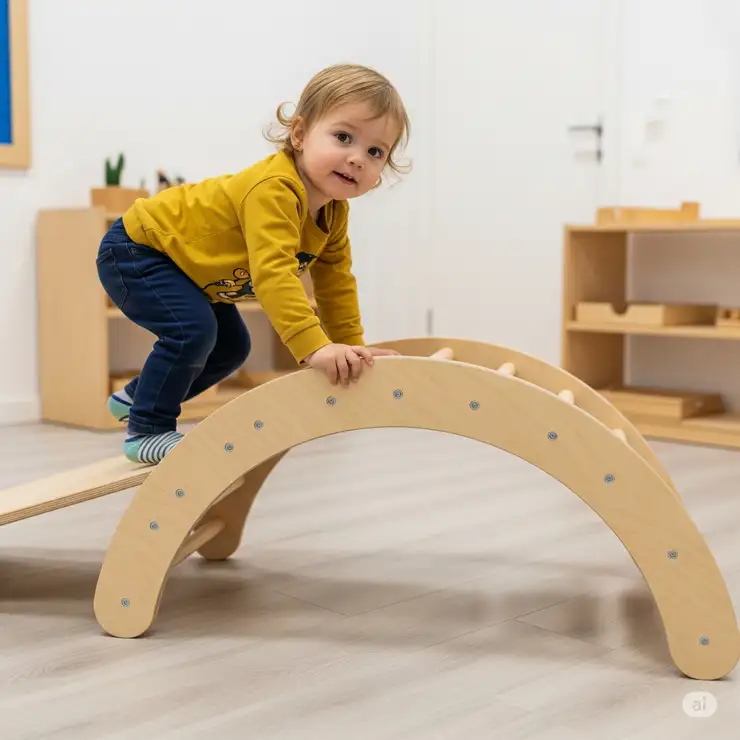
Have you ever watched your little one try to scale the couch, climb up the stairs, or attempt to conquer the coffee table? That natural urge to climb isn’t just adorable – it’s actually a crucial part of their development! As a parent who’s navigated the toddler climbing phase (and survived to tell the tale), I can tell you that montessori climbing toys aren’t just fun additions to your playroom – they’re developmental powerhouses.
Montessori climbing toys are specially designed play equipment that follows the Montessori philosophy of child-led learning through exploration and movement. These toys provide a safe outlet for your child’s innate climbing instincts while supporting physical, cognitive, and emotional development in ways that might surprise you.
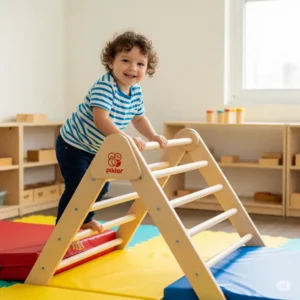
In this comprehensive guide, we’ll explore everything you need to know about montessori climbing toys – from understanding why they’re so beneficial to selecting the perfect climbing equipment for your space and your child’s developmental stage. I’ve spent countless hours researching, testing, and observing these toys in action, and I’m excited to share what I’ve learned with fellow parents navigating this exciting (if sometimes nerve-wracking) phase of childhood.
Whether you’ve got a budding mountaineer on your hands or you’re simply looking for ways to support your child’s gross motor skills, this guide to montessori climbing toys will help you make informed choices that both you and your little climber will love. Let’s get started on this adventure together!
Understanding the Montessori Approach to Physical Development
The Montessori method, developed by Dr. Maria Montessori in the early 20th century, revolves around the concept that children learn best through independent exploration in a prepared environment. When it comes to physical development, Montessori emphasizes freedom of movement and opportunities for children to challenge themselves physically at their own pace.
The Philosophy Behind Montessori Climbing Toys
Montessori climbing toys epitomize this philosophy perfectly. Unlike traditional playground equipment that often dictates how children should play, montessori climbing toys are open-ended structures that invite creativity and self-directed play. They embody several key Montessori principles:
✅ Respect for the child’s natural development: Montessori observed that children have an innate drive to move and develop their bodies. Climbing toys respect this natural urge rather than restricting it.
✅ Freedom within limits: While children have freedom to explore the climbing equipment as they choose, the toys are designed with appropriate boundaries for safety.
✅ Intrinsic motivation: Children climb because it feels good and satisfies their developmental needs, not for external rewards.
✅ Self-correction: When using climbing toys, children learn through natural consequences – if they’re not ready for a certain height or challenge, they’ll choose something within their capabilities.
According to research published in the Journal of Physical Education, Recreation & Dance, physical activity through climbing contributes significantly to developing fundamental movement skills in early childhood, which are crucial building blocks for lifelong physical literacy.
Why Climbing is Essential for Development
Climbing isn’t just about burning energy – it’s a multifaceted developmental activity that benefits children in numerous ways:
- Physical development: Climbing strengthens core muscles, improves balance, enhances coordination, and develops both fine and gross motor skills.
- Cognitive development: As children navigate climbing structures, they’re problem-solving, planning movements, estimating distances, and making spatial judgments.
- Emotional development: Successfully conquering climbing challenges builds confidence, improves resilience, and provides appropriate risk-taking opportunities.
- Social development: When children climb together, they practice taking turns, helping each other, and communicating about their experiences.
Dr. Angela Hanscom, pediatric occupational therapist and founder of TimberNook, explains in her book “Balanced and Barefoot” that children need opportunities for movement that challenges their vestibular (balance) system to develop properly. Montessori climbing toys provide exactly this type of vestibular stimulation.
Benefits of Montessori Climbing Toys for Different Age Groups
Montessori climbing toys offer different benefits depending on your child’s age and developmental stage. Let’s explore how these toys support children from infancy through early childhood.
For Babies (6-12 months)
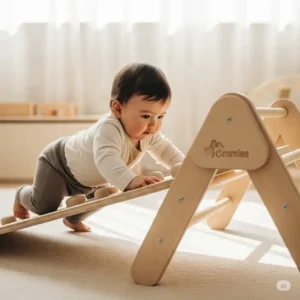
At this stage, babies are just beginning to master sitting, crawling, pulling up to stand, and perhaps taking those exciting first steps. Simple climbing toys for this age group might include:
- Low climbing arches
- Small soft climbing blocks
- Montessori climbing pillows
Benefits for babies include:
✅ Gross motor development: Encourages crawling, pulling up, and early standing skills
✅ Sensory exploration: Different textures and shapes stimulate tactile senses
✅ Spatial awareness: Helps babies understand their body in relation to objects
✅ Confidence building: Mastering small physical challenges builds early self-confidence
According to the American Academy of Pediatrics, providing opportunities for babies to move freely and explore their environment is critical for healthy development.
For Toddlers (1-3 years)
Toddlers are movement masters in training! Their physical abilities are developing rapidly, and their confidence often outpaces their skills. Appropriate montessori climbing toys for toddlers include:
- Climbing triangles and arches
- Small climbing frames with slides
- Stepping stones and balance beams
- Convertible rocking/climbing toys
Benefits for toddlers include:
✅ Balance and coordination: Regular climbing helps toddlers refine these crucial skills
✅ Strength development: Supports development of core, arm, and leg muscles
✅ Risk assessment: Toddlers learn to gauge their abilities and make decisions about what’s safe
✅ Energy release: Provides healthy outlets for boundless toddler energy
✅ Independence: Allows for self-directed physical challenge
A study published in the International Journal of Environmental Research and Public Health found that children who engage in climbing activities develop better proprioception – the awareness of body position – which contributes to better physical confidence and reduced injury risk.
For Preschoolers (3-6 years)
Preschoolers are more sophisticated climbers with improved strength and coordination. They benefit from more complex climbing challenges:
- Larger climbing frames and combinations
- Climbing walls with varied handholds
- Rope ladders and climbing nets
- Indoor rock climbing holds
- Expandable climbing systems
Benefits for preschoolers include:
✅ Advanced motor planning: Planning multi-step movements across varied climbing surfaces
✅ Upper body strength: Critical development often lacking in modern childhood
✅ Problem-solving skills: Figuring out how to navigate more complex structures
✅ Emotional regulation: Learning to manage frustration when facing climbing challenges
✅ Cooperative play: Working with peers to create climbing games and challenges
Researchers from the University of Washington’s Institute for Learning & Brain Sciences have demonstrated that physical activities requiring cross-body coordination, like climbing, help develop neural pathways that are also essential for cognitive skills like reading and mathematical thinking.
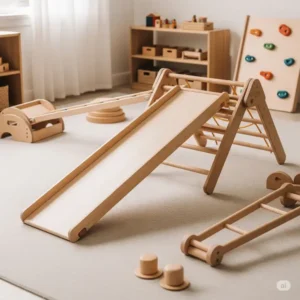
Key Features to Look for in Quality Montessori Climbing Toys
When investing in montessori climbing toys, certain features distinguish high-quality options that will grow with your child and stand up to enthusiastic use.
Safety Considerations
Safety comes first with any children’s equipment, especially climbing toys:
✅ Stability: The structure should be stable and not tip over during normal use
✅ Smooth edges: No sharp corners or splintered surfaces
✅ Appropriate height: Matches your child’s developmental capabilities
✅ Impact absorption: Consider what surface the toy will be used on
✅ Weight capacity: Check manufacturer guidelines for weight limits
✅ Non-toxic materials: Especially important for younger children who may mouth surfaces
The Consumer Product Safety Commission provides guidelines for children’s climbing equipment that reputable manufacturers follow.
Material Quality
The materials used in montessori climbing toys affect both safety and longevity:
✅ Wood quality: Look for solid hardwoods like birch, maple, or beech rather than softwoods or particleboard
✅ Finish type: Non-toxic, child-safe finishes without harmful VOCs
✅ Fabric durability: For soft climbing toys, look for dense foam and tear-resistant covers
✅ Joinery methods: Quality toys use proper joinery rather than just screws or nails
✅ Load-bearing capacity: Materials should support multiple children if designed for group play
Versatility and Adaptability
The best montessori climbing toys grow with your child:
✅ Convertibility: Toys that can be reconfigured into different positions or combined with other pieces
✅ Multiple play options: Equipment that can be used for climbing and other activities (rocking, sliding, hiding)
✅ Modularity: Ability to add components as your child grows
✅ Indoor/outdoor versatility: Can be used in different environments
✅ Storage consideration: Can the toy fold or be easily stored when not in use?
Age-Appropriateness
Ensure the climbing toy matches your child’s current abilities while offering room to grow:
✅ Challenge level: Provides appropriate challenge without overwhelming frustration
✅ Accessibility: Can your child get on and off independently?
✅ Growth potential: Will it continue to interest your child as they develop new skills?
✅ Supervision needs: Consider how much supervision different toys require
Top 10 Montessori Climbing Toys for 2025
Based on extensive research, parent reviews, and child development principles, here are the top montessori climbing toys currently available:
Comparison Table: Best Montessori Climbing Toys
| Product Name | Age Range | Material | Indoor/Outdoor | Special Features | Price Range |
|---|---|---|---|---|---|
| Pikler Triangle Classic Plus | 6 months-5 years | Birch wood | Indoor | Foldable, adjustable height | $$$$ |
| Little Partners Adjustable Climbing Triangle | 1-6 years | Birch plywood | Indoor | Adjustable rungs, rock climbing wall | $$$$ |
| Cassarokids Climbing Arch | 1-6 years | Birch wood | Indoor | Converts to rocker, table | $$$ |
| Wooden Climber by Woodandhearts | 9 months-5 years | Beech wood | Indoor | Transformable design, ramp accessory | $$$$ |
| Sawdust & Rainbows Rainbow Rocker | 10 months-5 years | Birch plywood | Indoor | Rock/climb/slide functions | $$$ |
| Lily & River Little Climber | 6 months-5 years | Baltic birch | Indoor | Reversible ramp, rock wall | $$$$ |
| Costzon Foldable Climbing Triangle | 2-6 years | Pine wood | Indoor | Foldable, includes climbing ladder | $$ |
| ECR4Kids Climbing Play Set | 9 months-3 years | Foam | Indoor | Soft surfaces, modular design | $$ |
| Figment Adventure Center | 2-8 years | Baltic birch | Indoor/Outdoor | Complete playset system | $$$$$ |
| Wooden Jungle Gym by Merriman | 1-8 years | Maple hardwood | Indoor/Outdoor | Expandable, high weight capacity | $$$$$ |
💬 Just one click – help others make better buying decisions too!😊
Detailed Reviews of Top Montessori Climbing Toys
1. Pikler Triangle Classic Plus
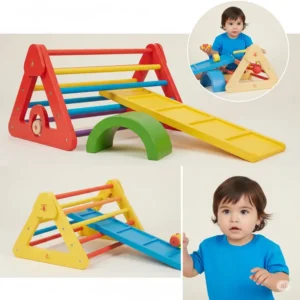
The Pikler Triangle, inspired by pediatrician Dr. Emmi Pikler, remains the gold standard in montessori climbing toys. This updated Classic Plus version features adjustable heights to grow with your child.
Why we love it:
- Thoughtfully designed with child development in mind
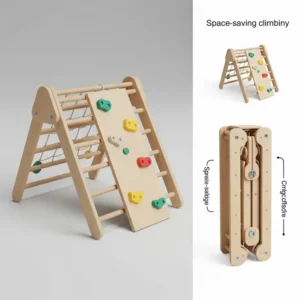
- Folds flat for easy storage
- Suitable from early climbing stages (6+ months) through preschool years
- Smooth, splinter-free construction
- Available with additional attachments like slides and ramps
Amazon verified purchaser says: “This has been the best investment for my 14-month-old. She’s been using it since 10 months and her confidence and climbing skills have improved dramatically. Worth every penny for the quality and developmental benefits.”
2. Little Partners Adjustable Climbing Triangle
This climbing triangle stands out for its innovative adjustable rungs that allow you to customize the challenge level as your child grows.
Why we love it:
- Adjustable difficulty level
- Rock climbing wall on one side
- Stable base prevents tipping
- Supports up to 150 lbs
- Easy assembly with included tools
Amazon verified purchaser says: “The adjustable rungs are genius! My 2-year-old started with them wide apart, and as he’s gotten more confident, we’ve made them more challenging. I see him problem-solving in real-time.”
3. Cassarokids Climbing Arch
This versatile climbing arch converts between multiple functions, making it one of the most adaptable montessori climbing toys available.
Why we love it:
- Transforms from climber to rocker to table
- Beautiful, minimalist design
- Sustainably sourced birch wood
- Non-toxic, water-based finishes
- Pairs perfectly with other climbing elements
Amazon verified purchaser says: “We’ve had this for over a year and it’s still my son’s favorite toy. It’s been a tunnel, a bridge, a fort base, and yes, a climbing arch. The versatility is amazing.”
4. Wooden Climber by Woodandhearts
This European-designed climber brings premium craftsmanship to montessori climbing toys with its transformable design.
Why we love it:
- Convertible between 12+ configurations
- Designed by early childhood experts
- Exceptional build quality with beech wood
- Accessories available (ramps, slides, boards)
- Smooth, rounded edges for safety
Amazon verified purchaser says: “The craftsmanship is exceptional. You can tell this was designed by people who understand children. My twins use it every single day in different ways.”
5. Sawdust & Rainbows Rainbow Rocker
This rainbow-shaped climbing toy offers multiple play possibilities in one beautiful piece.
Why we love it:
- Functions as rocker, climber, and slide
- Gorgeous rainbow design
- Hand-sanded smooth finish
- Compact footprint for smaller spaces
- Creates beautiful play space aesthetic
Amazon verified purchaser says: “This rainbow rocker has been the centerpiece of our playroom for two years. All three of my kids (1, 3, and 5) use it in different ways. It’s held up beautifully despite constant use.”
6. Lily & River Little Climber
The Little Climber combines multiple Montessori elements in one cohesive unit, perfect for homes with limited space.
Why we love it:
- All-in-one climbing solution
- Reversible ramp/slide
- Rock wall with child-friendly holds
- Made in the USA from sustainable materials
- Sturdy construction supports active play
Amazon verified purchaser says: “We have a small apartment and wanted something that offered lots of play value without overwhelming our space. This climber is perfect—compact but offers so many play options.”
7. Costzon Foldable Climbing Triangle
For families on a budget, this foldable triangle offers excellent value while maintaining good quality standards.
Why we love it:
- More affordable price point
- Folds for easy storage
- Includes climbing ladder attachment
- Suitable for multi-child play
- Straightforward assembly
Amazon verified purchaser says: “We were hesitant about spending a fortune on climbing equipment our toddler might quickly outgrow. This has been the perfect middle ground—good quality, safe, and she loves it.”
8. ECR4Kids Climbing Play Set
For the youngest climbers, this soft foam set provides a safe introduction to climbing.
Why we love it:
- Super soft surfaces ideal for babies
- Modular pieces can be reconfigured
- Waterproof and easy to clean
- Lightweight for repositioning
- Perfect for developing crawlers and new walkers
Amazon verified purchaser says: “Got this for my 9-month-old who was desperate to climb everything. It’s been perfect for letting him safely explore climbing without constant heart attacks for me!”
9. Figment Adventure Center
For families with space for a complete play system, this premium climbing center offers years of developmental play.
Why we love it:
- Comprehensive climbing system with multiple elements
- Indoor/outdoor versatility
- Exceptional durability for multi-child households
- Expandable with additional components
- Created by childhood development specialists
Amazon verified purchaser says: “We invested in this as our main Christmas present for our three kids (2, 4, and 6) and it’s been used daily for months. The quality is outstanding and all three children use it differently based on their abilities.”
10. Wooden Jungle Gym by Merriman
This heirloom-quality climbing system is designed to grow with families through multiple children and years of use.
Why we love it:
- Highest weight capacity (200+ lbs)
- Indoor/outdoor capabilities
- Expandable system adds components as children grow
- Premium hardwood construction
- Exceptional customer service
Amazon verified purchaser says: “We’re now using this with our second child, and it looks as good as new. The company even helped us add components as our first child grew. It’s an investment piece that truly lasts.”
🔥 Don’t Miss These Exclusive Montessori Climbing Deals! 🧗♀️
→ Take your child’s physical development to new heights with these carefully selected montessori climbing toys. Click on any highlighted item to check current pricing and availability. These developmental tools will help your little one build confidence, strength, and coordination while having a blast! 🌟
How to Introduce Montessori Climbing Toys Safely
Bringing montessori climbing toys into your home requires thoughtful preparation and supervision strategies.
Creating a Safe Environment
Before introducing climbing equipment:
✅ Pad the area: Place cushions, foam tiles, or a thick rug under climbing toys
✅ Clearance space: Ensure adequate space around the equipment free from hard furniture edges
✅ Secure placement: Position climbing toys away from windows and on level surfaces
✅ Room considerations: Consider ceiling height and lighting in the play area
✅ Supervision zones: Set up the climbing area where you can easily observe while doing other tasks
The National Association for the Education of Young Children recommends creating environments where children can safely take appropriate physical risks, which is exactly what a well-prepared montessori climbing space provides.
Supervision Strategies by Age
Different ages require different supervision approaches:
For babies:
- Direct, hands-on supervision at all times
- Stay within arm’s reach
- Demonstrate how to use equipment
- Guide movement gently without forcing
For toddlers:
- Close supervision with occasional hands-on assistance
- Teach safe climbing techniques (three points of contact)
- Model proper use rather than lifting them onto equipment
- Allow them to choose when they’re ready to climb
For preschoolers:
- Supervision with greater independence
- Establish clear safety rules
- Check equipment regularly for stability
- Encourage self-assessment of abilities
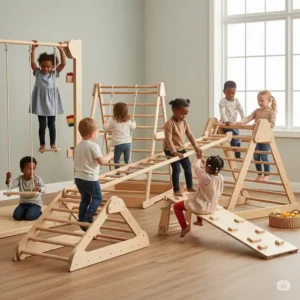
Teaching Climbing Safety Skills
Children develop safer climbing habits when taught specific skills:
- The Three-Point Contact Rule: Teach children to always have three limbs on the climbing structure
- Climbing Down Skills: Many children can climb up but struggle with descent—practice these skills specifically
- Turn-Taking: Establish clear guidelines for multiple children using equipment
- Body Awareness: Help children recognize when they’re tired and need a break
- Respectful Use: Teach children to use climbing equipment only for its intended purpose
According to child development expert Dr. Peter Gray, allowing children to experience risk through activities like climbing actually improves their risk-assessment abilities and makes them safer in the long run, as discussed in his research published in the American Journal of Play.
DIY Montessori Climbing Toys: Budget-Friendly Options
Not ready to invest in premium climbing equipment? Several DIY options can provide similar benefits:
Simple DIY Projects
- Cushion Mountain: Arrange couch cushions, pillows, and foam blocks in climbing configurations
- Modified Step Stool: Add grip tape to a wooden step stool for a simple climbing challenge
- Indoor Balance Beam: A wooden board secured between two low supports creates an effective balance challenge
- Climbing Wall Section: Install a small section of climbing holds on a secured plywood board
- Repurposed Furniture: An old coffee table can become a climbing bridge with some modifications
Safety Considerations for DIY Options
If creating your own climbing toys:
✅ Structural integrity: Ensure all components can truly support your child’s weight
✅ Secured connections: All parts should be firmly attached without risk of collapse
✅ Material safety: Use child-safe materials and finishes
✅ Edge protection: Sand all edges and corners to prevent splinters and injuries
✅ Regular inspection: Check homemade equipment frequently for wear and stability
The National Safety Council provides helpful guidelines for home safety that can be applied to DIY play equipment.
Integrating Montessori Climbing Toys into Your Home
Bringing montessori climbing toys into your living space requires thoughtful planning to maintain both functionality and aesthetics.
Space-Saving Solutions
For homes with limited square footage:
✅ Foldable options: Many quality climbing toys now fold for storage
✅ Multi-purpose designs: Choose items that serve as both climbing toys and functional furniture
✅ Vertical storage: Store climbing components on wall hooks when not in use
✅ Rotation system: If space is very limited, rotate different climbing toys rather than having all out simultaneously
✅ Outdoor alternatives: Consider whether some climbing can happen in outdoor spaces
Aesthetic Integration
Montessori climbing toys don’t have to disrupt your home’s visual harmony:
✅ Choose natural finishes: Unpainted wood blends with most home aesthetics
✅ Consider color coordination: Some manufacturers offer custom color options to match your décor
✅ Dual-purpose designs: Look for climbing toys that double as attractive furniture pieces
✅ Strategic placement: Position climbing toys in play zones rather than main living areas
✅ Design-forward options: Several brands now create climbing toys with modern design sensibilities
Interior design experts featured in Dwell Magazine note that the trend toward beautiful, design-conscious children’s furniture makes it easier than ever to integrate play equipment into sophisticated home environments.
Montessori Climbing Toys for Special Needs
Climbing equipment can be particularly beneficial for children with various developmental needs when appropriately selected and introduced.
Benefits for Different Needs
For sensory processing challenges:
- Climbing provides proprioceptive input that can help with regulation
- The pressure of climbing can have a calming effect
- Physical activity helps release energy in productive ways
For motor planning difficulties:
- Simple, clearly defined climbing structures help develop sequencing skills
- Repeated practice on consistent equipment builds motor memory
- Visual cues on climbing toys can help with movement planning
For children with low muscle tone:
- Climbing naturally builds core strength
- The motivating nature of climbing encourages sustained physical effort
- Different climbing angles target various muscle groups
According to research published in the Journal of Autism and Developmental Disorders, physical activities like climbing can significantly improve body awareness and motor coordination in children with autism spectrum disorders.
Adaptations and Modifications
Safety modifications:
- Extra padding around climbing areas
- Lower height options
- High-contrast visual markers for steps/handholds
- Additional support bars or handles
Sensory considerations:
- Textured handholds for tactile feedback
- Minimal visual distractions on and around equipment
- Consider noise factors (does the toy creak or echo?)
- Weight of movable parts appropriate for the child’s strength
Occupational therapists often recommend climbing activities as part of sensory integration therapy, as noted in research from the American Occupational Therapy Association.
🔍 Expert Insights: Montessori Climbing Toys in Education
→ Wondering how montessori climbing toys support your child’s educational journey? Child development specialists recommend incorporating these physical tools alongside other learning activities to create a balanced approach to whole-child development. These climbing structures aren’t just for fun—they’re building the physical foundation that supports cognitive learning! 🧠💪
Outdoor vs. Indoor Montessori Climbing Options
Both indoor and outdoor climbing options offer unique benefits for children’s development.
Indoor Climbing Advantages
✅ Year-round accessibility: Weather never interrupts play
✅ Controlled environment: Easier to manage safety variables
✅ Cleanliness: Not affected by outdoor elements
✅ Supervision convenience: Easier to monitor while handling other tasks
✅ Protection from elements: No sunburn or weather concerns
Outdoor Climbing Benefits
✅ Natural light exposure: Important for vitamin D and circadian rhythm
✅ More space for larger movements: Often allows for more expansive play
✅ Connection with nature: Adds additional sensory benefits
✅ Fresh air: Better ventilation during active play
✅ Different sensory feedback: Natural elements add complexity to the experience
Transitioning Between Environments
To create continuity between indoor and outdoor climbing:
- Consistent rules: Maintain similar safety expectations in both environments
- Transferable skills: Help children recognize how indoor climbing skills apply outdoors
- Portable options: Some climbing toys can be used in both settings
- Seasonal planning: Develop a rhythm of indoor/outdoor climbing based on weather
- Safety adaptations: Teach children how safety changes in different environments
Research published in the International Journal of Play indicates that children who experience both indoor and outdoor climbing develop more adaptable physical skills and greater environmental awareness.
Maintenance and Longevity of Montessori Climbing Toys
Quality montessori climbing toys represent a significant investment, but proper care ensures they last for years or even generations.
Routine Care Tips
For wooden climbing toys:
✅ Regular inspection: Check for splinters, loose parts, or wear weekly
✅ Cleaning: Wipe with damp cloth and mild soap as needed
✅ Moisture control: Keep wooden toys away from high humidity areas
✅ Tightening hardware: Check and tighten all screws and bolts monthly
✅ Finish maintenance: Apply food-grade mineral oil or beeswax periodically to maintain wood
For fabric/foam climbing toys:
✅ Cover washing: Follow manufacturer guidelines for removing and cleaning covers
✅ Spot cleaning: Address spills immediately with appropriate cleaners
✅ Air drying: Allow to fully dry before use if cleaned
✅ Foam inspection: Check for compression or breakdown of foam support
✅ Seam checking: Examine seams regularly for separation or weakness
Extending Lifespan
To maximize the longevity of your investment:
- Rotation: If possible, rotate climbing toys to distribute wear
- Storage: Store properly when not in use, following manufacturer guidelines
- Environmental factors: Keep wooden toys away from direct heat sources and sunlight
- Weight limits: Strictly observe recommended weight guidelines
- Refinishing: Sand and refinish wooden climbing toys as needed
The Wood Database provides specific care instructions for different wood types commonly used in children’s furniture and toys.
Frequently Asked Questions About Montessori Climbing Toys
❓ At what age can babies start using montessori climbing toys?
❓ Are montessori climbing toys worth the investment compared to regular playground equipment?
❓ How do I know if a climbing toy is too challenging for my child?
❓ Can montessori climbing toys really improve cognitive development?
❓ How long will my child use a montessori climbing toy before outgrowing it?
Conclusion: Investing in Your Child’s Development Through Movement
Montessori climbing toys represent more than just play equipment—they’re tools for developing confident, capable, physically literate children. By providing appropriate physical challenges in a safe, child-led environment, these toys honor your child’s innate drive to move while supporting their development across multiple domains.
Whether you choose a classic Pikler triangle, a convertible climbing arch, or create your own DIY solution, the key is consistency and thoughtful implementation. By understanding the developmental benefits, selecting appropriate equipment, creating safe play spaces, and allowing for child-directed exploration, you’re setting the foundation for not just physical skills but cognitive and emotional growth as well.
Remember that your child’s climbing journey is uniquely their own. Some may leap fearlessly into challenges while others take a more cautious approach—both paths are equally valid and worthy of support. By providing quality montessori climbing toys and attuned supervision, you’re giving your child the gift of bodily confidence and physical literacy that will serve them throughout life.
🚀 Ready to Transform Your Child’s Play Space? 🌈
→ Don’t wait to give your child the developmental benefits of montessori climbing toys! Check out our top recommendations by clicking on any highlighted product name. These carefully selected climbing toys will provide years of growth, learning, and fun for your little one! 🎁💕
Recommended for You:
- 10 Best Montessori 6 Month Old Toys That Boost Development in 2025
- 10 Best Montessori Toys for 3 Year Olds That Boost Development in 2025
- 15 Best Montessori Toys for 2 Year Olds That Boost Development in 2025
Disclaimer: This article contains affiliate links. If you purchase products through these links, we may earn a small commission at no additional cost to you.
✨ Found this helpful? Share it with your friends! 💬🤗
