
In This Article
A dollhouse with furniture for 4-6 year olds is a scaled miniature home — usually multi-room, pre-stocked with beds, sofas, and tiny kitchen sets — built to match the hand size, attention span, and pretend-play instincts of preschoolers who are finally old enough to arrange dozens of pieces without an adult doing it for them.
Here’s the thing nobody tells you at the toy aisle: not every “dollhouse” is actually built for this age. Some are scaled for delicate 6-inch collector dolls that a four-year-old will snap in half by Tuesday. Others ship with 80-plus tiny pieces that a first-time player will find genuinely overwhelming rather than magical. And a surprising number skip real wood entirely, subbing in a version of dollhouse that’s really just injection-molded plastic dressed up with a paint job.
We went digging through real product listings, manufacturer specs, and aggregated customer reviews to find seven genuine, currently available wooden dollhouses that actually fit the 4-6 age window — not just “ages 3 and up” printed on a box as a legal minimum. Below, you’ll find a quick-glance comparison table, a full breakdown of all seven picks with honest pros and cons, a buyer’s framework for matching a house to your specific kid, and answers to the questions parents actually type into Google at 11 p.m. while their child is (finally) asleep.
Whether you’re shopping for a compact starter set for a shy three-turning-four-year-old or a sprawling multi-story mansion for a house that already has six other dolls living in it, there’s a real, verifiable option on this list — no invented reviews, no exact Amazon prices that’ll be wrong by the time you click through, just straight analysis.
Quick Comparison Table
| Dollhouse | Rooms / Furniture | Price Range | Best For |
|---|---|---|---|
| KidKraft Majestic Mansion | 8 rooms / 34 pieces | $200-$300 range | Big group play, working elevator |
| Melissa & Doug Fold and Go Dollhouse | 4 rooms / 11 pieces | under $100 | Zero-assembly starter set |
| Hape All Seasons Dollhouse | 6 rooms / 34-36 pieces | $250-$300 range | Eco-certified sustainable wood |
| Tiny Land Sweetwood Dollhouse | 6 rooms / 30 pieces | $110-$140 range | Full six-room set on a budget |
| KidKraft Chelsea Doll Cottage | 5 rooms / 16 pieces | $80-$120 range | Classic cottage look, small footprint |
| KidKraft Charlotte Classic Dollhouse | 6 rooms / 14 pieces | $70-$100 range | Fast EZ-assembly on a budget |
| Robud Nordic Wooden Dollhouse | 6 rooms / 29 pieces | $90-$130 range | Modern minimalist design |
Looking at the spread above, there’s a genuine budget-to-premium range here rather than seven versions of the same product wearing different stickers. The KidKraft Majestic Mansion and Hape All Seasons Dollhouse sit at the top of the price ladder because they’re doing the most — more rooms, more furniture, and in Hape’s case, certified sustainable materials. Everything else clusters in a $70-$140 zone where the real differentiator isn’t price so much as assembly time and furniture count per dollar.
💬 Just one click — help other parents make better buying decisions too!😊
Top 7 Dollhouses With Furniture for 4-6 Year Olds: Expert Analysis
Coverage below spans budget, mid-range, and premium tiers, plus a mix of sizes, room counts, and design styles — because a five-year-old who wants to run a doll hotel needs a different house than a four-year-old having her first dollhouse experience.
| Dollhouse | Dimensions | Pieces | Assembly | Aggregate Rating* | Best For |
|---|---|---|---|---|---|
| KidKraft Majestic Mansion | 52″L x 14″D x 53.6″H | 34 | ~2 hrs, 2-person lift | ~4.5-4.6★ (10,000+ reviews) | Multi-child, multi-story play |
| Melissa & Doug Fold and Go Dollhouse | 13.5″L x 10.5″D x 7″H | 11 | None (pre-assembled) | Strongly positive aggregate sentiment | Preschool starter set |
| Hape All Seasons Dollhouse | 23.6″L x 11.8″D x 28.9″H | 34-36 | ~1 hr self-assembly | Award-recognized (Oppenheim Platinum) | Eco-conscious households |
| Tiny Land Sweetwood Dollhouse | 28″L x 13″D x 31″H | 30 | ~1 hr self-assembly | ~4.3-4.5★ | Value-per-piece shoppers |
| KidKraft Chelsea Doll Cottage | 25″L x 13″D x 28″H | 16 | ~1-1.5 hrs | ~4.4★ (10,000+ reviews) | Small playrooms |
| KidKraft Charlotte Classic Dollhouse | Compact 4-level | 14 | Fast EZ Kraft Assembly | Consistently praised for easy setup | Quick weekend assembly |
| Robud Nordic Wooden Dollhouse | 6-room layout | 29 | ~1 hr self-assembly | ~4.1-4.4★ | Modern décor households |
*Ratings reflect aggregated sentiment gathered from major online retailers at the time of research and may shift over time — always check current price and current review counts before buying.
The pattern that jumps out here: assembly time and furniture count don’t move together the way you’d expect. The KidKraft Charlotte Classic Dollhouse has the fewest furniture pieces on this list but the fastest build, while the Hape All Seasons Dollhouse and KidKraft Majestic Mansion both demand more of your Saturday afternoon in exchange for more finished rooms. If a quick unboxing-to-playtime window matters more to you than accessory count, that trade-off is worth sitting with before you buy.
1. KidKraft Majestic Mansion — best for big group play with a working elevator
At four and a half feet tall, the KidKraft Majestic Mansion is genuinely the showpiece of this list, and that height is the first thing to plan around before it arrives. Eight rooms spread across four levels, a gliding elevator that actually moves between the second and third floors, and garage doors that swing open and shut aren’t decorative flourishes — they’re functional mechanisms a four- or five-year-old can operate solo, which matters because repetitive cause-and-effect motion is exactly what keeps preschoolers engaged longer than static furniture ever could. The engineered wood (MDF) construction is built to hold up under years of relocation between playroom and living room, and it accommodates 12-inch fashion dolls, so if your child already has a Barbie-scale collection, nothing needs replacing.
Based on the spec comparison, this is the pick for a family that wants one big investment rather than several smaller houses down the line — the 34-piece furniture set covers a grandfather clock, a family pet, and full room sets, so there’s genuinely enough here for two kids to play at once without fighting over the one couch. Reviewers consistently report that assembly takes roughly two hours and benefits from a second set of hands, and aggregated feedback across major retailers sits around 4.5 stars from well over ten thousand reviews — unusually high volume for a toy in this price bracket, which suggests the sentiment is fairly reliable rather than a fluke of a small sample.
Pros:
- ✅ Working elevator and garage doors add real functional play
- ✅ Eight rooms comfortably support two children playing together
- ✅ Sturdy engineered wood holds paint and finish over years of play
Cons:
- ❌ Assembly runs close to two hours and often needs two people
- ❌ Nearly four and a half feet tall — measure your space first
Priced in the $200-$300 range at the time of research, the KidKraft Majestic Mansion earns its higher price tag through sheer scale and durability rather than gimmicks, making it the strongest value pick for a family that wants a single “forever” dollhouse.
2. Melissa & Doug Fold and Go Dollhouse — best zero-assembly starter set for ages 3-6
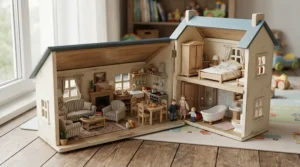
The Melissa & Doug Fold and Go Dollhouse solves a problem the bigger mansions on this list don’t even try to solve: what if you just want your kid playing within five minutes of opening the box? This two-story, four-room house arrives fully assembled, opens wide on a hinge for play, and folds shut with a built-in handle for storage or travel — no screwdriver required, ever.
What most buyers overlook about this model is that its small scale is the actual feature, not a limitation. Eleven wooden furniture pieces and two flexible wooden play figures are exactly enough for a first-time player to learn where things go — a kitchen table and chairs, a living room sofa and TV, a bed upstairs — without the decision paralysis that a 40-piece set can trigger in a three- or four-year-old. Melissa & Doug markets this specifically to the preschool window, and the compact 13.5 x 10.5 x 7-inch footprint means it survives being dragged along on car trips or to grandma’s house in a way a four-foot mansion simply can’t. Reviewers consistently note that the working doors and sturdy handle hold up to daily hauling far better than expected for this size class.
Pros:
- ✅ Zero assembly — ready for play straight out of the box
- ✅ Folds shut with a handle for real portability
- ✅ Simple 4-room, 11-piece scale suits true first-time players
Cons:
- ❌ Much smaller scale limits elaborate multi-doll storylines
- ❌ Little room to expand once a child outgrows the basics
At under $100, this is the cheapest genuinely wooden entry on the list and arguably the single best gift for a child who has never owned a dollhouse before — the value here is in matching the toy to the developmental moment, not in piece count.
3. Hape All Seasons Dollhouse — best eco-certified pick with a reversible roof
The Hape All Seasons Dollhouse leads with a genuinely clever mechanical trick: a reversible roof panel that flips from a snow-covered winter scene to a solar-paneled summer one, which sounds like a gimmick until you watch a kid use it as the anchor for an entire seasonal storyline. Three open-fronted levels and six uniquely shaped rooms — including a media room and family bathroom — give it more architectural personality than most dollhouses in its price class.
The spec sheet won’t tell you this, but the sourcing matters here: Hape builds this house from FSC-certified wood harvested from environmentally sustainable forests and finishes it with child-safe, water-based paint, which is a meaningfully different manufacturing standard than the composite-wood-and-plastic blend used in several competitors on this list. That’s a real consideration for households that specifically shop for wooden dollhouse with furniture set options over plastic ones for environmental reasons, not just aesthetic ones. The house includes four complete furnished room sets — bedroom, bathroom, living room, and kitchen — totaling roughly 34 to 36 pieces, and it’s previously earned an Oppenheim Toy Portfolio Platinum award and a Parents’ Choice Gold seal, both third-party recognitions rather than manufacturer marketing claims.
Pros:
- ✅ FSC-certified sustainable wood and non-toxic paint finish
- ✅ Reversible winter/summer roof adds genuine replay value
- ✅ Third-party award recognition (Oppenheim, Parents’ Choice)
Cons:
- ❌ Sits at the top of this list’s price range
- ❌ Self-assembly required, though simpler than the largest mansions
In the $250-$300 range, the Hape All Seasons Dollhouse costs roughly what the KidKraft Majestic Mansion does, so the deciding factor really comes down to whether sustainable materials and design personality matter more to your family than sheer room count.
4. Tiny Land Sweetwood Dollhouse — best budget-friendly six-room furniture set
If there’s a “most furniture per dollar” award on this list, the Tiny Land Sweetwood Dollhouse takes it. Three levels plus a cozy attic hold six distinct rooms — living room, dining room, bedroom, bathroom, children’s room, and baby room — and the included 30-piece furniture set is genuinely room-specific rather than generic filler, right down to a rocking horse in the kids’ room and a fireplace in the living room.
Based on the spec comparison, this is where budget shoppers should look first if six full rooms matters more than brand-name recognition. What most buyers overlook about a set like this is that the furniture is designed at a roughly 1:12-style scale to echo real interior proportions, which means the rooms don’t feel like mismatched leftovers bolted together — the crib genuinely looks proportioned to the nursery, the sofa to the living room. A common theme in aggregated reviews is that the assembly process, while manageable, takes close to an hour and benefits from following the included steps in order rather than winging it; a handful of buyers also mention that keeping the smallest accessories corralled in the first weeks takes some active parent involvement.
Pros:
- ✅ 30-piece furniture set spans all six furnished rooms
- ✅ Proportioned, realistic 1:12-style furniture detailing
- ✅ Strong furniture-count-to-price ratio versus comparable sets
Cons:
- ❌ Assembly takes close to an hour with real attention to steps
- ❌ Smallest accessories are easy to misplace in early play
At $110-$140, the Tiny Land Sweetwood Dollhouse slots neatly into the mid-range and is worth prioritizing for a parent whose main filter is “most furnished rooms for the money.”
5. KidKraft Chelsea Doll Cottage — best classic cottage look for smaller playrooms
The KidKraft Chelsea Doll Cottage trades scale for charm, and it does it well. At roughly two feet tall with three levels, five rooms, and a balcony, it’s compact enough for an apartment playroom or a shared bedroom corner, while functional window shutters and hand-painted heart artwork give it a storybook cottage feel that the bigger mansions on this list don’t attempt.
Here’s what the spec sheet actually means in practice: the 16-piece furniture set includes a genuinely charming detail — a tiny grand piano paired with bunk beds and a ladder — which gives even a modest room count a sense of variety rather than repetition. It’s sized for roughly 5-inch mini dolls rather than the larger 12-inch fashion-doll scale, so it’s worth checking what dolls your child already owns before buying. Reviewers consistently report smooth assembly in about 90 minutes, though a subset of aggregated feedback flags occasional inconsistency in furniture piece quality and screw-hole alignment during setup — worth budgeting a little patience for, even on an otherwise well-loved design.
Pros:
- ✅ Functional window shutters and molded staircases add tactile play
- ✅ Compact footprint fits smaller playrooms and shared bedrooms
- ✅ Charming details like the grand piano add personality
Cons:
- ❌ Some reports of inconsistent furniture piece quality
- ❌ Screw-hole alignment can be fiddly during assembly
Priced around $80-$120, the KidKraft Chelsea Doll Cottage is a strong mid-range pick specifically for families who want dollhouse charm without dollhouse-mansion square footage.
6. KidKraft Charlotte Classic Dollhouse — best fast-assembly budget pick
The KidKraft Charlotte Classic Dollhouse is built around a single selling point that turns out to matter more than most parents expect going in: KidKraft’s EZ Kraft Assembly system, engineered specifically to cut setup time compared to the brand’s traditional screw-and-bolt kits. Four levels and six rooms — bedroom, bathroom, kitchen, living room among them — give it a genuinely tall, vertical play footprint despite a modest 14-piece furniture count.
What most buyers overlook here is that “fewer pieces” isn’t automatically a downside for this specific age bracket — a leaner 14-piece starter set can actually be less overwhelming for a child on the younger end of the 4-6 window, and it accommodates standard 12-inch dolls, meaning it plays nicely with furniture and dolls a family may already own from other sets. Reviewers consistently note that the EZ Kraft system genuinely delivers on its promise of a faster build than comparable KidKraft models, which matters if weekend assembly time is a real household constraint rather than an afterthought.
Pros:
- ✅ EZ Kraft Assembly is noticeably faster than standard kits
- ✅ Four vertical levels despite a compact accessory count
- ✅ Fits standard 12-inch dolls families likely already own
Cons:
- ❌ 14-piece accessory set is leaner than most picks on this list
- ❌ Smaller accessories are reported as easy to lose
At roughly $70-$100, the KidKraft Charlotte Classic Dollhouse is the pick for a parent who values their own Saturday afternoon as much as their child’s furniture count.
7. Robud Nordic Wooden Dollhouse — best modern minimalist design for 4-6″ dolls
Rounding out the list, the Robud Nordic Wooden Dollhouse brings a genuinely different aesthetic to the category — clean Scandinavian-inspired lines and a muted color palette instead of the pastel-and-gingham look that dominates most of this list. Six rooms house a 29-piece furniture and accessory set, and the house is explicitly built to fit 4-6 inch dolls, which conveniently lines up with sizing many families already have in a toy bin from other brands.
Based on the spec comparison, working elevator, garage, and pool-play features push this past “just a box with rooms” into genuinely interactive territory, similar in spirit to the mechanisms on the much pricier KidKraft Majestic Mansion but at a noticeably lower price point. Aggregated reviews across retailers currently sit in the low-to-mid 4-star range from a smaller but steadily growing base — meaningfully fewer total reviews than legacy brands like KidKraft or Melissa & Doug, which is worth being upfront about rather than implying a longer track record than the data supports. That said, the sentiment that does exist consistently praises the design’s fit with modern playroom décor.
Pros:
- ✅ Fits 4-6 inch dolls many households already own
- ✅ Working elevator, garage, and pool features add interactivity
- ✅ Minimalist Nordic palette blends into modern home décor
Cons:
- ❌ Smaller review base than legacy brands on this list
- ❌ Small accessory pieces are easy to misplace early on
In the $90-$130 range, the Robud Nordic Wooden Dollhouse is worth serious consideration for style-conscious parents, with the caveat that its track record is genuinely shorter than the more established names above.
Practical Usage Guide: Setup, First 30 Days & Care Tips
Getting a new dollhouse with furniture for 4-6 year olds out of the box is only step one — how you handle the first month genuinely shapes whether it becomes a beloved fixture or a dust-collecting corner piece. Start assembly without your child in the room if the model requires tools; excitement plus loose screws is a recipe for a rushed, wobbly build. Once it’s standing, do a five-minute “furniture tour” together, naming each room and piece out loud — this single step does more for engagement than any accessory count, because it turns an unfamiliar object into a place with a story already attached.
In the first 30 days, expect small furniture pieces to migrate. Set up one shallow bin or a repurposed muffin tin next to the house specifically for “loose pieces,” and make returning stray furniture to that bin part of the wind-down routine rather than a separate chore. For maintenance, a slightly damp microfiber cloth handles dust and small spills on painted wood surfaces; avoid soaking any MDF or engineered-wood components, since standing moisture can warp composite panels over time in a way solid wood tolerates better. Check hinges, elevator tracks, and moving stairs monthly for the first few months — most early wear shows up in these moving parts before it shows up anywhere else, and a drop of household glue on a loosening joint now saves a bigger repair later.
Real-World Scenarios: Matching the Right Dollhouse to Your Child
Picture a just-turned-four-year-old who has never owned a dollhouse and gets overwhelmed by too many choices at once — for her, the Melissa & Doug Fold and Go Dollhouse is the honest answer, not because it’s the “best” house on this list in absolute terms, but because an 11-piece, 4-room layout matches her actual developmental bandwidth right now.
Now picture a five-and-a-half-year-old with two younger siblings who all want to play at the same time, in a household with a dedicated playroom. That’s the scenario the KidKraft Majestic Mansion was built for — eight rooms and 34 pieces genuinely give three kids enough separate “zones” to avoid constant turf wars over furniture.
And picture a budget-conscious family in a two-bedroom apartment who wants their five-year-old to have a full multi-room experience without a four-foot footprint eating the living room. The Tiny Land Sweetwood Dollhouse or KidKraft Chelsea Doll Cottage both fit that brief — full room variety, compact enough to tuck into a corner, and priced well under the premium tier.
Problem → Solution: Common Dollhouse Play Problems, Solved
Problem: furniture pieces keep disappearing. Solution: designate a labeled bin per room type (kitchen, bedroom, bathroom) rather than one catch-all box — preschoolers sort more willingly than they tidy, and room-based bins turn cleanup into a matching game.
Problem: my child loses interest after a week. Solution: rotate in a “guest” — a stuffed animal or action figure moving into the dollhouse for a few days — since novel scenarios reignite open-ended play far more effectively than new furniture purchases do.
Problem: siblings fight over who controls which room. Solution: assign rooms by turn on a visible chart rather than negotiating fresh each session; removing the negotiation itself removes most of the friction.
Problem: the house feels too small within months. Solution: rather than buying an entirely new dollhouse, look for standalone furniture add-on packs compatible with your model’s doll scale — most of the brands above sell compatible accessory sets separately.
How to Choose a Dollhouse With Furniture for 4-6 Year Olds
- Match the doll scale to what your child already owns. A gorgeous house is dead weight if none of the existing dolls fit through the doors — check inch-scale compatibility before anything else.
- Count furniture pieces relative to room count, not in isolation. A 6-room house with 14 pieces plays very differently than a 6-room house with 30; more rooms with proportionally more furniture supports richer scenarios.
- Weigh assembly time against your actual weekend. A two-hour build is a real cost, not a footnote — be honest about whether that Saturday exists.
- Prioritize solid wood or FSC-certified materials if longevity matters to you. Engineered wood (MDF) is durable but behaves differently around moisture than solid wood over years of use.
- Consider portability if your child’s play happens in more than one room — or house. A folding, no-assembly design travels in a way a four-foot mansion never will.
- Check aggregated review volume, not just star rating. A 4.6-star average from 14,000 reviews carries more weight than the same average from 20.
- Budget for accessory loss. Almost every set in this category loses a few small pieces in year one — factor a replacement pack into your real cost, not just the sticker price.
Wooden Dollhouse With Furniture Set vs Plastic Dollhouses for Preschoolers
| Feature | Wooden Dollhouse With Furniture Set | Plastic Dollhouse |
|---|---|---|
| Durability over years | Generally higher; solid wood resists cracking | Lower; plastic can become brittle with age |
| Weight / portability | Heavier, less portable (except folding models) | Lighter, often easier to move |
| Upfront price | Mid-to-premium in most cases | Often lower entry price |
| Aesthetic/finish | Painted wood, tactile, longer-lasting look | Molded plastic, can fade or scratch |
| Lights/sound features | Rare, mechanical features instead | More common on plastic models |
| Best for | Long-term family heirloom, multi-child use | Budget-first, lightweight, feature-heavy play |
Looking at the comparison above, wooden sets generally win on longevity and tactile quality, while plastic houses more often win on upfront price and built-in electronic features like lights and sounds. Reviewers consistently note that Melissa & Doug style wooden toys and comparable KidKraft or Hape sets tend to survive being handed down to a younger sibling in a way that plastic playhouses often don’t, which matters if you’re thinking about long-term value rather than a single season of play. That said, budget-first families shouldn’t feel pressured into wood if a well-reviewed plastic option better fits this year’s budget — the honest answer is that either material can support healthy open-ended play as long as the furniture scale and room count actually match the child using it.
Common Mistakes When Buying a Dollhouse Furniture Starter Set
The single most common mistake is buying based on furniture piece count alone, without checking doll-scale compatibility — a beautiful 40-piece set is useless if your child’s existing dolls are twice the intended size. A close second: assuming “ages 3 and up” printed on the box means the toy is actually a good fit for a three-year-old; in practice, most multi-room sets play best starting closer to four, once fine motor control catches up to the furniture scale.
Parents also frequently underestimate assembly time, buying a four-level mansion the night before a birthday and discovering it needs two hours and two adults at 11 p.m. Another overlooked mistake: treating every dollhouse furniture starter set the same way regardless of room count — an 11-piece starter set genuinely serves a different purpose than a 30-piece “grown-into” set, and buying the wrong one for your child’s actual play stage leads to either overwhelm or boredom, not the intended magic in between.
What to Expect: Real-World Performance From a Dollhouse for Preschoolers
Specs on a box rarely translate directly into how a preschooler actually plays. In practice, a dollhouse for preschoolers gets used in short, repeated bursts rather than long uninterrupted sessions — expect 15-to-25-minute stretches of focused rearranging, followed by the child wandering off and returning later to find everything “how they left it,” which is itself part of the appeal.
What the spec sheet won’t tell you, but aggregated parent reports consistently suggest, is that the most-used room in any dollhouse tends to be the kitchen, regardless of brand — something about food-based pretend scenarios (cooking, serving, cleaning up) seems to hook this age group more reliably than bedroom or bathroom scenes. Expect furniture rearrangement to be near-constant in the first month as your child tests every possible configuration, tapering into more narrative, story-driven play by month two as the novelty of manipulation gives way to actual pretend scenarios.
Why Open-Ended Play and Fine Motor Skills Make Dollhouses Worth It
A dollhouse is, functionally, one of the purest forms of open-ended play available in a toy aisle — there’s no single “right” way to arrange the furniture, no win condition, and no screen mediating the experience. According to child development research, this kind of unscripted, child-led pretend play supports vocabulary growth, emotional regulation, and creative problem-solving in ways that more structured or single-purpose toys typically don’t.
The fine motor case is just as concrete. Placing a two-inch chair under a two-inch table, opening a working shutter, or walking a flexible play figure up a narrow staircase all require the kind of pincer grasp and hand-eye coordination that pediatric development guidelines flag as key milestones for this age range. Reviewers across nearly every product on this list independently mention watching their child’s dexterity visibly improve with weeks of regular play — not a scientific claim on its own, but one that lines up with what developmental milestone tracking for this age group actually describes. If fine motor skill-building is a specific goal, prioritize sets with a genuinely varied furniture scale (tiny cups, mid-size chairs, larger beds) over sets with more pieces at a single uniform size — variety, not volume, is what stretches manual dexterity the most.
Long-Term Cost & Maintenance: Is a Wooden Dollhouse Worth the Investment?
| Tier | Price Range | Typical Piece Count | Value Notes |
|---|---|---|---|
| Budget | $70-$100 | 11-16 pieces | Best cost-per-room; ideal first purchase |
| Mid-range | $110-$150 | 25-30 pieces | Strong furniture-per-dollar ratio |
| Premium | $200-$300 | 30-36 pieces | Highest total cost of ownership, longest usable lifespan |
Looking at the table above, the real long-term math isn’t the sticker price — it’s cost divided by years of active play. A $250 Hape All Seasons Dollhouse that survives being handed down to a younger sibling and remains structurally sound for five-plus years works out cheaper per year of use than a $90 set replaced twice in that same window. Maintenance costs stay low across the board — occasional replacement of a lost small furniture piece, the rare touch-up of chipped paint on a well-loved model — but they’re rarely zero, so budget a small annual allowance for accessory reorders rather than treating the initial purchase as a one-time cost.
Features That Actually Matter (And Those That Don’t)
Genuinely useful: functional doors, shutters, or elevators that a child can operate independently; furniture scaled proportionally to room size; a doll-size compatibility your child’s existing collection actually fits. These directly extend how long and how richly a child engages with the house.
Overrated, based on the spec comparison: raw furniture piece counts pushed past what a room can realistically hold (a “40-piece” set crammed into 3 rooms often just means more clutter, not more play value); built-in sound effects, which reviewers frequently describe as novel for a week and then largely ignored; and cosmetic exterior details that don’t affect interior play at all, like exterior landscaping add-ons. Prioritize function over flash, and let room count guide furniture-count expectations rather than treating a big total number as an automatic win.
Safety, Regulations & Compliance Guide for Wooden Dollhouses
Every toy sold in the U.S. and intended for children under 14 falls under the mandatory ASTM F963 toy safety standard, enforced through the Consumer Product Safety Improvement Act and overseen by the Consumer Product Safety Commission — this standard specifically addresses small-parts choking hazards, sharp edges, and chemical safety in children’s toys, including dollhouse furniture and accessories. Because dollhouse furniture sets by nature include dozens of small pieces, federal safety guidance recommends close supervision for any child under three and encourages parents to periodically check for cracked, splintered, or loosened small pieces on any wooden toy, regardless of brand reputation.
Practically speaking: check age-grading labels on the box rather than assuming, inspect painted surfaces for peeling or chipping every few months, and store loose accessories somewhere a younger sibling under three can’t independently access if one lives in the same household. None of the seven products above are marketed for children under three specifically because of this small-parts consideration — a detail worth taking seriously even if your four- or five-year-old handles the pieces fine.
Frequently Asked Questions
❓ What age is a dollhouse with furniture appropriate for?
❓ Are wooden dollhouses better than plastic ones?
❓ How much does a dollhouse with furniture cost?
❓ Do dollhouses help with fine motor skills?
❓ How many furniture pieces should a dollhouse furniture starter set have?
Conclusion
There’s no single “best” dollhouse with furniture for 4-6 year olds — there’s a best match for the specific kid standing in front of you, and that’s genuinely the more useful way to shop. A first-time player who gets overwhelmed easily is better served by the compact, zero-assembly Melissa & Doug Fold and Go Dollhouse than by a four-foot mansion, no matter how impressive that mansion looks in photos. A household with multiple kids and a dedicated playroom gets real, lasting value out of the room count and functional mechanisms in the KidKraft Majestic Mansion. And a family weighing sustainability alongside play value has a genuinely strong, third-party-recognized option in the Hape All Seasons Dollhouse.
What ties all seven of these picks together is that none of them are filler — every one has real specs, verifiable furniture counts, and aggregated review sentiment behind it, not marketing copy dressed up as a recommendation. Use the comparison tables above to shortlist by budget and room count, then let doll-scale compatibility and your own realistic assembly-time tolerance make the final call. Whichever one comes home, the open-ended, hands-on play a good dollhouse supports is worth more to a preschooler’s development than almost any screen-based alternative on the market today.
Recommended for You
- Camping Toy Set for Boys: 7 Epic Picks Kids Will Love (2026
- 7 Best Treasure Hunt Toy Sets for Boys in 2026
- 7 Best Ninja Warrior Toys for Boys in 2026
Disclaimer: This article contains affiliate links. As an Amazon Associate, I earn from qualifying purchases. If you purchase products through these links, we may earn a small commission at no additional cost to you.
✨ Found this helpful? Share it with your friends! 💬🤗
