
In This Article
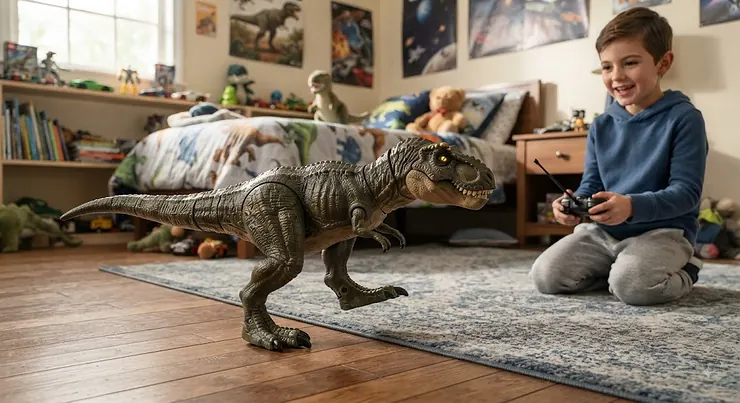
Somewhere in every toy chest, there’s a gap shaped exactly like a dinosaur. Not a plush one that just sits there looking vaguely prehistoric — a real, stomping, roaring, remote-controlled beast that can chase the dog around the living room. If you’re hunting for a remote control dinosaur toy for boys, you’ve probably already noticed the problem: the market is absolutely packed with lookalike listings, and half of them use the exact same stock photos with different logos slapped on top. Sorting the genuinely well-built RC dinos from the flimsy ones that die after two birthday parties takes more than a glance at star ratings.
That’s the gap this guide fills. We dug into seven real, currently sold products — from budget stompers under $30 to a genuinely AI-driven robot raptor that costs as much as a nice bicycle tire — and broke down what actually matters: motor durability, battery realism, sound quality, and whether the “touch sensors” are gimmicks or genuinely responsive. A quick definition first, since it helps frame everything that follows: a remote control dinosaur toy is a battery-powered, motorized dinosaur figure that a child (or, let’s be honest, a parent) steers using a handheld transmitter, typically combining walking or sliding motion with lights, roaring sound effects, and sometimes a soft mist “spray” for dramatic flair. Modern units increasingly borrow from actual robotics — infrared sensors, gesture control, even light autonomous “roaming” behavior inspired by how paleontologists like those at the Smithsonian, who study how dinosaurs like Tyrannosaurus rex actually walked and moved on two legs, reconstruct real prehistoric locomotion.
Whether you’re shopping for a preschooler who wants something to roar in the backyard or a nine-year-old who’s outgrown the “cute” dinosaurs and wants something closer to a robot, this article walks through genuine product research, honest trade-offs, and practical buying advice — no invented reviews, no fabricated hands-on stories, just the facts and the analysis you actually need.
Quick Comparison Table
Before diving into the full breakdown, here’s a fast snapshot of how the seven picks stack up on the things that matter most: price tier, standout feature, and who each one is really built for.
| Product | Price Range | Standout Feature | Best For |
|---|---|---|---|
| WowWee Roboraptor X | $110-$160 | Autonomous AI moods + app control | Kids 8-12, tech-curious boys |
| Zuru Robo Alive Attacking T-Rex Series 2 | $20-$30 | Realistic chomping bite motion | Budget-conscious first-timers |
| USA Toyz Robo Pets T-Rex | $35-$50 | Programmable food-card commands | STEM-minded kids 5-9 |
| VERTOY RC Walking Dinosaur T-Rex | $45-$60 | Touch-sensor reactive behavior | Interactive, hands-on play |
| BEMITON RC Dinosaur Toy | $25-$35 | Lightweight 2.4GHz easy control | Younger kids 4-7 |
| Lozadia RC Dinosaur | $50-$70 | Oversized build, 360° swaying head | Group play, bigger “wow” factor |
| STEAM Life RC Dinosaur | $35-$45 | Walking + dancing dual movement modes | Balanced all-around pick |
Looking at the table, the split is really about how much autonomy and “brains” you’re paying for. The Zuru Robo Alive Attacking T-Rex Series 2 and BEMITON RC Dinosaur Toy sit at the entry level, doing the basics — walk, roar, light up — without draining the wallet. The WowWee Roboraptor X sits at the opposite end, layering in actual mood-based AI behavior that the cheaper units simply don’t attempt. In the middle, the USA Toyz Robo Pets T-Rex, VERTOY RC Walking Dinosaur T-Rex, Lozadia RC Dinosaur, and STEAM Life RC Dinosaur compete on specific gimmicks — programmability, touch sensors, size, or dual movement modes — rather than raw price or raw intelligence.
🦖 Ready to bring the Jurassic era home? Scroll down for the full breakdown of every pick below!
Top 7 Remote Control Dinosaur Toys for Boys: Expert Analysis
We picked these seven to cover every realistic budget and every kind of kid — the one who wants a cheap roaring stomper for the backyard, and the one who wants something closer to an actual robot. Each entry below draws on real product specifications and aggregated review sentiment, never invented quotes.
1. WowWee Roboraptor X — most advanced AI behavior in its price class
The Roboraptor X isn’t just a remote-controlled toy that happens to look like a dinosaur — it’s a genuine consumer robot that happens to be shaped like one, and that distinction matters once you understand what’s happening under the hood. At roughly 32 inches long, it uses infrared sensors to detect obstacles and can shift between hunting, walking, and running gaits either automatically based on its “mood” or by direct command from the controller. In practice, that means the raptor doesn’t just march in a straight line until it hits the couch — it reads its environment and reacts, which is a genuinely different play experience from a toy that simply repeats one walking loop.
Based on the spec comparison, this is the pick for kids who’ve already worked through simpler RC dinos and want something with actual complexity — think 8-to-12-year-olds who like taking things apart to see how they work, not toddlers who just want a roar on command. Reviewers consistently note that the realistic movements and advanced artificial intelligence make it feel less like a toy and more like a genuine robotic pet, and buyers frequently mention the “free roam” autonomous mode as the feature that gets the most repeat play. What the spec sheet won’t tell you is that this level of sensor-driven behavior means setup takes longer and batteries drain faster than the simpler stompers on this list — a fair trade for the depth you’re getting, but worth knowing going in.
Pros:
- ✅ Genuine AI-driven mood and gait switching, not scripted loops
- ✅ Infrared obstacle detection for real autonomous roaming
- ✅ Long-term engagement for older, tech-curious kids
Cons:
- ❌ Requires more batteries (multiple AA and AAA) than most rivals
- ❌ Premium price puts it out of reach for casual buyers
At around $110-$160, this sits at the premium end of the category, but for a household with a genuinely dino-obsessed kid heading into double digits in age, it’s the one on this list least likely to gather dust in a closet by spring.
2. Zuru Robo Alive Attacking T-Rex Series 2 — best budget pick under $30
Zuru built a reputation on cramming surprising amounts of mechanical personality into inexpensive toy lines, and the Robo Alive Attacking T-Rex is a solid example of that formula applied to dinosaurs. It stomps, walks, bites, and roars with realistic eyes and a glow-in-the-dark scar, and the package famously includes a slime-filled “Dino Egg” surprise, which — love it or hate it — is the kind of unboxing moment that makes this a strong stocking-stuffer or party-favor option rather than a single centerpiece gift.
Here’s what most buyers overlook about budget dinosaur toys: the ceiling on complexity is lower, but the floor on fun is often surprisingly solid, and that’s the case here. The chomping bite action gives kids a tactile, cause-and-effect interaction that younger children respond to immediately, without needing to master a multi-button remote. Aggregated review sentiment around the broader Robo Alive line points to strong satisfaction on the “instant gratification” factor — press a button, get an immediate, dramatic reaction — though the plastic build is noticeably lighter-duty than the mid-range and premium options on this list, so rough outdoor play will shorten its lifespan faster.
Pros:
- ✅ Realistic chomping bite motion kids love pressing repeatedly
- ✅ Very accessible price point for gifting or party favors
- ✅ Simple, intuitive controls suited to younger kids
Cons:
- ❌ Lighter plastic construction than pricier alternatives
- ❌ Fewer autonomous or “smart” behaviors overall
At $20-$30, this is the toy to grab when you want a genuine remote control dinosaur toy for boys without committing to a bigger purchase — a great “test the waters” option before investing in something pricier.
3. USA Toyz Robo Pets T-Rex — best for teaching real programming basics
This is the pick that earns the “programmable dino robot” label honestly rather than as a marketing buzzword. The Robo Pets T-Rex responds to hand gestures, lights up with LED eyes, and — crucially — lets kids program sequences of tricks using four included food cards, a system that mimics real block-based coding logic in a way a four-year-old can grasp: show the robot a sequence of cards, and it repeats the sequence back.
On paper, this means the toy is doing double duty as an early introduction to computational thinking — sequencing, cause-and-effect, and “if this, then that” logic — dressed up as dinosaur play rather than a coding worksheet. Reviewers consistently report that the gesture-response feature is a genuine differentiator, since most competitors in this price range rely purely on button-press remotes rather than hand-motion detection. The trade-off, based on aggregated feedback, is charging consistency — a handful of buyers mention the rechargeable battery occasionally underperforming its rated runtime, so this isn’t the pick for a kid who wants marathon all-afternoon play sessions without a mid-play recharge.
Pros:
- ✅ Genuine programmable sequencing via food-card system
- ✅ Hand-gesture responsiveness beyond simple button control
- ✅ STEM-certified design aimed at early coding concepts
Cons:
- ❌ Reported charging inconsistency in some units
- ❌ Roughly 30-minute play window per full charge
Priced around $35-$50, it’s a smart middle-ground buy for parents who want the “programmable dino robot” experience without paying premium-robot prices.
4. VERTOY RC Walking Dinosaur T-Rex — best touch-sensing interactivity
VERTOY’s take on the walking dinosaur toy category leans hard into the idea that a dinosaur should feel alive when you touch it, not just when you press a remote button. The neck and hindquarters carry smart touch sensors that respond when a child pets or pokes the dinosaur, on top of standard remote-triggered tricks, flexible joints, and flowing walking movements.
What most buyers overlook about touch-sensor toys is that the sensor placement matters as much as the sensor’s existence — a sensor buried somewhere a kid never naturally touches is functionally useless, and VERTOY put theirs in the two spots (neck and rear) that kids instinctively reach for during play, which is why the feature actually gets used rather than ignored. Aggregated customer sentiment is notably positive on realism: one recurring theme in reviews is that the dinosaur’s walk looked convincing enough on video that it sold buyers before they even opened the box, and it held up in person, walking across surfaces like rugs that trip up some cheaper competitors. On the downside, a segment of reviewers note the included remote itself feels less premium than the dinosaur body, which is a minor but noticeable mismatch in build quality.
Pros:
- ✅ Dual-zone touch sensors that respond to petting and poking
- ✅ Walks convincingly across carpet, not just hard floors
- ✅ Flexible joint design for lifelike flowing motion
Cons:
- ❌ Remote control build quality trails the dinosaur body
- ❌ Touch sensitivity can occasionally overreact to bumps
In the $45-$60 range, this is the strongest pick specifically for kids who play physically with their toys — petting, hugging, wrestling — rather than only steering from a distance.
5. BEMITON RC Dinosaur Toy — lightest and easiest for small hands
Not every kid wants a 30-inch monster stomping around the house, and BEMITON’s entry recognizes that a smaller, lighter-weight RC dinosaur can actually be the better fit for younger children. Running on a 2.4GHz remote — the same reliable connection band used across most of the broader RC dinosaur category for spray, light, and roar functions — the appeal here is less about flashy specs and more about approachability.
Here’s the practical read: a lighter, smaller dinosaur is easier for a four- or five-year-old to physically pick up, reposition, and “rescue” during pretend play, which matters more at that age than raw feature count. Based on the spec comparison against its budget-tier competitors, BEMITON keeps the core trio — walking, light-up eyes, roaring sound — intact while trimming the size and weight, making it a genuinely age-appropriate choice rather than a scaled-down version of a toy built for older kids. The honest downside is that the smaller motor and body mean it has less presence in a room full of siblings’ toys — it doesn’t command attention the way the oversized options on this list do.
Pros:
- ✅ Compact, lightweight build easy for small hands to manage
- ✅ Reliable 2.4GHz remote connection for consistent response
- ✅ Simple three-function core (walk, light, roar) suits younger kids
Cons:
- ❌ Smaller size means less “wow factor” for older siblings
- ❌ Fewer advanced features than mid-range competitors
At $25-$35, it’s a smart, budget-friendly pick specifically sized and paced for the preschool-to-early-elementary crowd.
6. Lozadia RC Dinosaur — best oversized dino for big group play
If the goal is maximum spectacle — the dinosaur that makes every kid at the birthday party stop and stare — Lozadia’s entry earns its spot through sheer scale. The line is built around a noticeably larger footprint than most competitors, paired with a 360-degree swaying head, spray misting effect, and realistic roaring alongside authentic walking motion.
What the spec sheet won’t tell you, but the size comparison makes obvious, is that bigger isn’t just a bragging-rights number — it directly affects stability. A wider stance and heavier base mean this dinosaur is measurably less likely to tip over on uneven surfaces like rugs or grass than the smaller, top-heavy budget models, which matters enormously if the play environment is a backyard rather than a smooth living-room floor. The swaying head adds a layer of unpredictability to the movement that reviewers note makes the “roaming” feel less mechanical and more animal-like, even without full autonomous AI behavior. The honest trade-off is footprint: this is not a toy that tucks neatly into a small apartment’s toy bin, and parents in tighter spaces should measure before buying.
Pros:
- ✅ Large, stable build resists tipping on uneven surfaces
- ✅ 360° head sway adds unpredictable, lifelike movement
- ✅ Strong “centerpiece” presence for group or party play
Cons:
- ❌ Bulky size demands more storage space
- ❌ Heavier build makes it less portable between rooms
Priced around $50-$70, this is the pick for families who want the dinosaur to be the star of the toy collection, not just another item in it.
7. STEAM Life RC Dinosaur — best all-around dancing & walking combo
STEAM Life’s entry splits the difference between a straightforward walker and something with a bit more choreography, offering both walking and dancing movement modes that roughly mimic real dinosaur motion when commanded through the remote control, alongside the now-standard trio of lights, spray, and roaring sound.
Based on the spec comparison against the rest of this list, the “dancing” mode is the genuine differentiator — it’s a wiggling, rhythmic movement pattern distinct from the standard forward walk, and it’s the kind of small addition that meaningfully extends how long a child stays engaged, since it gives the toy a second “trick” beyond simple locomotion. The brand also leans into the educational angle, marketing the toy as a tool for practicing hand-eye coordination as kids learn to command the dinosaur’s movement in real time. Reviewers broadly categorize it as a dependable, well-rounded middle-tier option rather than a toy with one standout headline feature — which, depending on what you’re looking for, is either a strength (nothing underdelivers) or a mild letdown (nothing wows either).
Pros:
- ✅ Dual walking and dancing modes add movement variety
- ✅ Balanced feature set without major compromises
- ✅ Marketed hand-eye coordination angle for skill-building play
Cons:
- ❌ No single standout “wow” feature versus competitors
- ❌ Dancing mode has a shorter novelty lifespan than walking
At $35-$45, it’s the safe, well-rounded middle choice — the one to pick when you’re not sure exactly which specific feature your kid will latch onto.
Practical Usage Guide: Setup, Care & the First 30 Days
Getting a motorized dinosaur kids will actually love out of the box and into steady rotation takes a little more than fresh batteries. First, before your child ever presses a button, pair the remote and dinosaur according to the included manual — most models require a specific power-on sequence (dinosaur first, then remote) to sync properly, and skipping this step is the single most common reason new units seem “broken” out of the box. Second, run a full charge-and-discharge cycle on any rechargeable model before the birthday party or holiday morning it’s meant for; a battery that’s only partially charged will die mid-play and create a meltdown nobody wants.
During the first 30 days, keep an eye on the leg joints and motor housing after any hard falls — these are motorized mechanisms, and repeated drops onto hard flooring are the leading cause of early motor failure across this entire product category. Wipe the exterior with a lightly damp cloth rather than submerging any part of it, since the electronics and motors inside are not waterproof despite the “spray” misting features some models include. Store the remote separately from the dinosaur body when not in use — small parts and a wandering toddler sibling are a common combination for lost or chewed transmitters. Finally, resist the urge to leave batteries in for weeks of nonuse; battery leakage is the quiet toy-killer nobody talks about until it’s too late, and it’s an entirely preventable one.
✨ Don’t Miss These Exclusive Deals!
🔍 Take your dinosaur hunt to the next level with these carefully selected picks. Click on any highlighted product above to check current pricing and availability, and give your family an authentic prehistoric play experience they’ll actually remember.
Real-World Scenarios: Matching the Right Dino to Your Kid
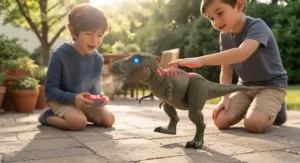
Rather than guessing, it helps to match a specific kid profile to a specific pick. If you’re raising a cautious four-year-old who gets a little nervous around loud, unpredictable toys, the BEMITON RC Dinosaur Toy is the safer starting point — its smaller size and simpler three-function feature set mean fewer surprises, and the lighter build is easy for small hands to hold and calm down if things get overwhelming.
If your situation is a competitive household with two or three siblings sharing everything, the Lozadia RC Dinosaur‘s oversized, stable build holds up better to the inevitable tug-of-war and rough handling that multi-kid ownership brings, and its scale means it doesn’t get “lost” among a pile of smaller toys. And if you’re shopping for a kid who’s already shown interest in how things work — the one who takes apart the remote control car just to see the gears — the WowWee Roboraptor X‘s sensor-driven autonomous behavior gives that curiosity something genuinely complex to explore, well beyond a simple forward-and-back walk cycle.
For the budget-conscious parent buying a first RC dinosaur without knowing yet whether it’ll be a passing interest or a genuine obsession, the Zuru Robo Alive Attacking T-Rex Series 2 is the lowest-risk entry point — enough personality to gauge real interest, low enough cost that it’s not a disaster if the obsession fades by summer.
Programmable Dino Robots: Teaching Kids to Code Through Play
The programmable dino robot category deserves its own spotlight because it’s doing something genuinely different from the rest of this list: it’s using dinosaur enthusiasm as a Trojan horse for early computational thinking. The USA Toyz Robo Pets T-Rex is the clearest example here, using its food-card system to teach sequencing — show the robot four cards in an order, and it performs that exact sequence back, which is functionally the same underlying logic as a simple programming loop, just dressed up in prehistoric skin.
This matters more than it might seem, and it’s grounded in real research on how kids learn. According to child development research, open-ended, imaginative play supports skill development in creative thinking and problem-solving, and kids who engage more in this kind of play tend to show stronger performance in related cognitive areas. A programmable toy adds a layer of structured logic on top of that imaginative foundation — the child isn’t just pretending the dinosaur is alive, they’re actively directing its behavior through a real, if simplified, command system. Parents looking to lean into this angle should treat the food cards (or equivalent programming interface) as the actual toy, not an afterthought — sit with your child the first few times and narrate what’s happening (“first this card, then this one, and it remembers the order”) to make the underlying logic explicit rather than letting it stay invisible.
How to Choose a Remote Control Dinosaur Toy for Boys
What is the best way to choose a remote control dinosaur toy for boys? The short answer: match the toy’s complexity and size to your child’s age and play style, verify the battery system fits your household’s charging habits, and confirm the safety certifications before checking out. Here’s the fuller breakdown, in order of priority:
- Start with age range, not marketing copy. Most listings claim a broad 3-12 range, but a toy’s actual complexity — button count, sensor sophistication — usually points to a narrower sweet spot. Match the feature complexity to your child’s actual attention span.
- Decide on battery type before anything else. Rechargeable built-in batteries save money over time but mean downtime while charging; replaceable AA/AAA batteries cost more long-term but mean instant restarts.
- Check the size against your play space. A 30-inch dinosaur is a showpiece in a backyard and a hazard in a cramped apartment hallway — measure before you buy, not after.
- Weigh autonomous “smart” behavior against simplicity. More sensors and AI-like behavior mean richer play but also more that can go wrong and more setup complexity for younger kids.
- Read the sound and light claims skeptically. “Realistic roaring” varies wildly between a satisfying deep growl and a tinny speaker beep — check video demos, not just listing text, when possible.
- Confirm safety certification explicitly. Look for compliance with the current mandatory U.S. toy standard rather than assuming it, since all toys sold in the U.S. market and produced after April 20, 2024 are required to comply with the ASTM F963-23 toy safety standard.
- Factor in durability over novelty. The flashiest feature list doesn’t always predict the sturdiest build — cross-reference aggregated review sentiment on breakage and motor failure, not just star averages.
Common Mistakes When Buying an Electronic Dinosaur Toy
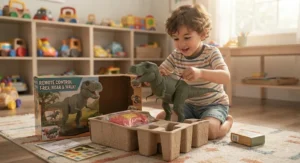
The single most common mistake is buying purely on the size of the box photo. Packaging for an electronic dinosaur toy is deliberately staged to make the product look larger and more dynamic than it is in hand — always check the listed dimensions in inches, not just the marketing image, before assuming you’re getting a showpiece-sized dinosaur.
A close second is ignoring battery requirements until after unwrapping. Buyers are consistently caught off guard discovering a toy needs six AA batteries not included, on Christmas morning, with no stores open. Check the battery specs during the buying decision, not during setup. Another frequent misstep is assuming all “touch sensor” or “programmable” claims are equally sophisticated — as covered above, some are genuinely responsive gesture systems, while others are a single button dressed up in interactive-sounding marketing language. Cross-check the actual mechanism described in the specs, not just the buzzword.
Finally, parents often underestimate noise level. A “realistic roar” at full volume in a small living room is genuinely loud, and if you have a younger sibling who naps on a schedule or a noise-sensitive kid in the house, checking for a volume control or mute function before buying will save everyone a headache.
Walking Dinosaur Toy vs Static Dinosaur Toy: What’s the Real Difference
It’s worth pausing on why a walking dinosaur toy justifies its higher price over a static or pull-back figure, because the difference is bigger than “it moves.” A static dinosaur figure is a display object that a child can pose, but a walking, remote-controlled version introduces genuine unpredictability and responsiveness — the child is directing behavior in real time rather than arranging a fixed pose, which shifts the entire play pattern from passive display to active control.
| Feature | Walking RC Dinosaur | Static Dinosaur Figure |
|---|---|---|
| Interactivity | Real-time remote control | None — manual repositioning only |
| Sound & Lights | Roaring, lights, spray on most models | Rarely included |
| Play Longevity | Extended, evolving play patterns | Shorter attention span typically |
| Price Range | $20-$160 depending on features | Often $5-$25 |
| Best For | Active, hands-on, imaginative play | Collecting, display, quiet play |
The analysis here is straightforward: static figures win on cost and shelf-display appeal, while walking RC models win decisively on sustained engagement, since the child has an actual mechanism to master rather than a fixed object to look at. For a kid who already collects static dinosaur figures and shows real sustained interest in the theme, a walking model is a natural upgrade rather than a redundant purchase — the two categories tend to complement each other in a toy collection rather than compete directly.

Roaring, Lights, and Sounds: Why Sensory Features Matter
A roaring dinosaur toy isn’t just noise for noise’s sake — sound is doing real work in how convincingly a plastic-and-motor object reads as “alive” to a child’s imagination. The combination of a deep, chest-rumbling roar sound with light-up eyes creates what’s essentially a sensory illusion of presence, and it’s a big part of why a dinosaur with lights and sounds consistently outperforms a silent, unlit equivalent in review sentiment across nearly every product in this category.
Here’s what most buyers overlook: not all “roaring” sound systems are created equal, and speaker quality varies more than any other spec on the listing. A tinny, high-pitched speaker undercuts the realism no matter how good the walking motion is, while a fuller, lower-register roar — even from a modest speaker — sells the illusion far more effectively. Similarly, LED eye lighting works best when it’s paired with darker ambient play settings; a dinosaur’s glowing eyes barely register in bright daylight but become genuinely atmospheric for evening or indoor play. The practical takeaway: if sound and light realism matter to your buying decision, prioritize video demos over spec-sheet claims, since “roaring sound effects” as a bullet point tells you almost nothing about the actual audio quality you’re getting.
What to Expect: Real-World Performance
Specs on a listing page rarely translate directly into what a living room actually looks like once the batteries go in. In practice, most remote-controlled dinosaurs in this price range walk at a deliberate, slightly herky-jerky pace rather than a smooth, continuous stride — this is a mechanical limitation of affordable leg-actuator motors, not a flaw specific to any one product, and it’s present across nearly every model under $100.
Surface matters enormously. Carpet with thick pile can stall smaller or lighter-weight models, while hardwood or outdoor pavement lets the same toy move far more fluidly — if your primary play surface is carpeted, prioritize the models reviewers specifically note perform well on rugs, like the VERTOY RC Walking Dinosaur T-Rex. Battery life in real-world use also tends to run shorter than marketing copy implies, particularly with sound and light effects running continuously rather than intermittently; budgeting for a spare battery set or accepting shorter individual play sessions is the realistic expectation rather than the exception. Range on the remote itself is typically modest — expect reliable control within roughly 15-30 feet indoors, with performance dropping off through walls or at greater distances outdoors.
RC T-Rex Toys for Every Age Group
Because the T-Rex is the default silhouette for this entire category, it’s worth breaking down how an rc t-rex toy should be chosen differently depending on the child’s age. For ages 3-5, prioritize simplicity and size — smaller, lighter models like the BEMITON RC Dinosaur Toy minimize frustration, since younger kids are more focused on the immediate cause-and-effect of a button press than mastering nuanced remote controls.
For ages 6-9, this is where feature complexity starts paying real dividends — touch sensors, programmable sequences, and dual movement modes (as seen in the VERTOY RC Walking Dinosaur T-Rex, USA Toyz Robo Pets T-Rex, and STEAM Life RC Dinosaur) give kids in this range something to actually master rather than outgrow within a week. For ages 10 and up, the play pattern often shifts toward appreciating engineering and autonomous behavior over simple novelty, which is exactly the audience the WowWee Roboraptor X‘s sensor-driven AI targets — older kids tend to respond more to “how does it decide what to do” than to “does it roar.”
This isn’t a hard rule — plenty of five-year-olds love a big, complex dinosaur and plenty of ten-year-olds still want the simple stomping satisfaction of a budget model — but it’s a reasonable starting framework when the listed age range on a product page is too broad to be useful on its own.
Features That Actually Matter (And Those That Don’t)
Some marketing bullet points genuinely predict a better play experience; others are filler that sound impressive but change little in practice. Motor torque and joint flexibility genuinely matter — they determine whether the walk looks convincingly animal-like or robotically stiff, and they’re the biggest factor in whether a toy survives rough outdoor terrain. Battery type and runtime genuinely matter, since a toy that’s constantly recharging gets less actual play time than one with quick battery swaps. Remote control range and responsiveness matter too, particularly for outdoor or larger-space play.
On the other hand, features like “17 different sound effects” or claims of dozens of preset actions often overstate their real impact — kids typically gravitate toward two or three favorite behaviors and ignore the rest of an oversized feature list within the first week. Similarly, cosmetic add-ons like glow-in-the-dark paint or “surprise” slime eggs are fun novelty at unboxing but rarely drive long-term engagement the way core mechanical quality does. When comparing listings, weigh core mechanical specs — motor, joints, battery, sensors — more heavily than long feature-count bullet lists, which are often padding designed to make a basic toy look more sophisticated than it is.
Safety, Regulations & Compliance Guide
Every product on this list should meet the current mandatory U.S. toy safety standard, and it’s worth understanding what that actually covers before buying any electronic toy for a child. As of the most recent update, the Consumer Product Safety Improvement Act made ASTM F963 a mandatory federal safety standard for children’s toys, covering hazards from choking risks to sharp edges and other injury sources, and manufacturers selling in the U.S. are legally required to comply, with independent third-party testing verifying it. You can review the current requirements directly through the Consumer Product Safety Commission’s toy safety guidance.
Battery safety deserves particular attention with any RC dinosaur, since most models rely on either standard AA/AAA cells or small rechargeable lithium batteries. If a specific unit uses a button or coin battery anywhere — some remotes do — extra caution is warranted, since these batteries pose a genuine ingestion hazard to children six and younger, prompting a federal mandatory safety standard under Reese’s Law that requires secured battery compartments and clear warning labeling on the packaging. Practically, this means checking that any battery compartment — on both the dinosaur body and the remote — requires a screwdriver or deliberate mechanism to open, not just a fingernail, before handing the toy to a young child unsupervised. It also means storing spare batteries well out of reach, regardless of how secure the toy’s own compartment is.
📣 Want peace of mind on your next pick? Check current safety details and pricing before you buy — click any product above to see the latest listing.
Frequently Asked Questions
❓ What age is appropriate for a remote control dinosaur toy?
❓ How long do batteries last in an RC dinosaur toy?
❓ Are remote control dinosaur toys waterproof?
❓ What's the difference between a walking and a rolling RC dinosaur?
❓ Do programmable dino robots actually teach coding skills?
Conclusion
There’s no single “best” remote control dinosaur toy for boys — there’s a best match for your specific kid, budget, and living room. If price is the deciding factor, the Zuru Robo Alive Attacking T-Rex Series 2 and BEMITON RC Dinosaur Toy deliver genuine dinosaur-play satisfaction without a big spend. If you want a toy that grows with a kid’s curiosity, the USA Toyz Robo Pets T-Rex and its programmable food-card system offer real staying power. And if budget genuinely isn’t the constraint and you want the most technologically advanced option on the market, the WowWee Roboraptor X‘s autonomous, sensor-driven behavior stands apart from everything else on this list.
What matters most, based on everything covered here, is buying deliberately rather than reactively — checking battery requirements, safety certification, and realistic size before checkout, not after unwrapping. A remote control dinosaur toy for boys should be the toy that gets pulled out of the bin for months, not days, and matching complexity and size to the actual kid using it is what makes that happen.
Recommended for You
- 7 Best Dinosaur Fossil Dig Kits for Kids in 2026: Expert Picks
- Dinosaur World Playset Boys: 7 Best Picks Ranked for 2026
- Realistic Dinosaur Figures for Boys: 7 Epic Picks (2026)
Affiliate disclosure: This article contains affiliate links. As an Amazon Associate, I earn from qualifying purchases. If you purchase products through these links, we may earn a small commission at no additional cost to you.
✨ Found this helpful? Share it with your friends! 💬🤗
