
In This Article
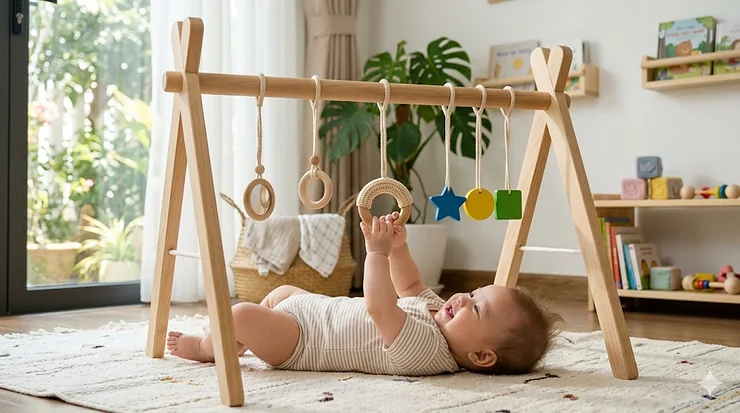
What if I told you that the first year of your baby’s life is when their brain develops faster than it ever will again? During these critical months, every reach, grasp, and visual tracking moment builds neural pathways that shape their cognitive abilities for years to come. A montessori activity gym isn’t just another baby product cluttering your nursery — it’s a thoughtfully designed developmental tool that transforms tummy time into a multi-sensory learning experience.
Unlike traditional play gyms loaded with flashing lights and battery-powered chaos, a montessori activity gym embraces the philosophy developed by Dr. Maria Montessori over a century ago. The American Montessori Society emphasizes that infants learn best through self-directed exploration in carefully prepared environments. These gyms feature natural materials like sustainably sourced wood, organic cotton mats, and minimalist sensory toys that encourage babies to develop at their own pace without overstimulation.
The beauty of these systems lies in their simplicity. Where conventional baby gyms assault your infant’s developing senses with competing stimuli, Montessori-inspired designs offer calm, intentional spaces. Wooden arches frame hanging toys at varying heights, inviting your baby to practice reaching and batting — movements that strengthen hand-eye coordination and gross motor skills. The neutral color palettes and natural textures create visual environments that support focus rather than fragment attention. What you’re really investing in is a foundation for independent learning that extends far beyond the baby stage.
Quick Comparison: Top Montessori Activity Gyms at a Glance
| Product | Material | Key Features | Price Range | Best For |
|---|---|---|---|---|
| Lovevery Play Gym | FSC Wood & Organic Cotton | 5 developmental zones, tent conversion | $140-$160 | Long-term value seekers |
| Skip Hop Discoverosity | Wood & Plush | 27 activities, 3 play modes | $90-$110 | Feature-rich option |
| Comfy Cubs | New Zealand Pinewood | Tool-free assembly, 5 toys | $50-$70 | Budget-conscious parents |
| little dove | Natural Pine Wood | Foldable design, 6 toys | $45-$65 | Space-saving solution |
| Tiny Love Boho Chic | Wood & Premium Fabric | 20 activities, milestone cards | $80-$100 | Style-focused families |
| Lalo Baby Gym | FSC Beech Wood | Lyocell mat, 2-part system | $110-$130 | Eco-warriors |
| Melissa & Doug Ocean | FSC Wood | Reversible mat, Quick-Close | $30-$50 | Best budget pick |
Looking at this comparison, three trends emerge. First, natural wood construction dominates the premium tier because it offers durability that justifies higher upfront costs — these gyms typically last through multiple children, making the cost-per-use remarkably low. Second, the $100+ options consistently include features that extend usability beyond the newborn stage, like tent conversions or adjustable heights. Third, budget options under $60 sacrifice some developmental extras but deliver the core Montessori principles: simple design, natural materials, and open-ended play opportunities.
💬 Just one click — help others make better buying decisions too! 😊
Top 7 Montessori Activity Gym Products — Expert Analysis
1. Lovevery Play Gym — The Stage-Based Developmental Powerhouse
The Lovevery Play Gym sets the gold standard for stage-based learning with its innovative five-zone system built directly into the play mat. FSC-certified wooden legs provide stability without tipping, while the organic cotton mat features lift-the-flap zones that reveal or conceal different sensory areas depending on your baby’s developmental readiness.
What separates this from generic play gyms is the intentional progression system. The “Learning to Focus” zone uses high-contrast cards (black and white patterns, faces, objects) specifically designed for newborn vision, which can only perceive stark contrasts in the first weeks. As your baby grows, you flip to reveal colorful patterns and textures in the “Exploring Colors” zone. This isn’t marketing fluff — it’s neuroscience applied to baby gear. The ability to control stimulation levels means you’re not overwhelming a three-week-old or boring a six-month-old with the same static setup.
Parents consistently praise the tent conversion feature, which transforms the gym into a play fort for toddlers ages 12-24 months. That’s functionality most competitors can’t touch — you’re essentially getting two products for one investment. The included batting ring, organic ball, and teether are mouthable (meaning they meet safety standards for babies who put everything in their mouths), and the whole system breaks down tool-free for storage or travel.
Pros:
✅ Five developmental zones reduce overstimulation while promoting age-appropriate challenges
✅ Tent conversion extends usability well into toddlerhood, maximizing value
✅ Sustainably sourced materials and thoughtful design appeal to eco-conscious parents
Cons:
❌ Premium price point ($140-$160 range) puts it out of reach for budget-focused families
❌ Large footprint requires dedicated floor space — not ideal for small apartments
Expert Verdict: In the $140-$160 range, this represents excellent value for families planning more children or those who prioritize developmental research-backed design. The tent conversion alone adds 12+ months of use.
2. Skip Hop Discoverosity Play Gym — Montessori Meets Maximum Activities
Developed in collaboration with actual Montessori education experts, the Skip Hop Discoverosity Play Gym delivers 27 developmental activities across three distinct play modes: overhead, seated, and tummy time. The wooden arches attach to a plush sensory mat featuring nature-inspired toys that emphasize exploration over electronic entertainment.
Here’s what most reviews miss: those 27 activities aren’t arbitrary. They’re mapped to specific developmental milestones like visual tracking (watching the hanging mirror swing), cause-and-effect learning (pulling the textured teething tree to hear it crinkle), and spatial awareness (reaching for toys at varying heights). The six included parent guide cards break down which activities support which skills at each stage, taking the guesswork out of developmental play. For first-time parents who feel overwhelmed by the “am I stimulating my baby enough?” question, these cards are goldmines.
The three play modes adapt to your baby’s growing abilities. Overhead mode (birth to 3 months) positions toys directly above for batting practice. Seated mode (4-6 months) moves toys lower as babies gain torso strength and hand control. Tummy time mode spreads toys across the mat for crawling motivation. Customer feedback highlights that babies genuinely engage longer with this gym compared to flashier electronic alternatives — proof that thoughtful design beats gimmicks.
Pros:
✅ 27 activities provide exceptional variety without overwhelming simplicity
✅ Parent guide cards translate developmental science into practical daily use
✅ Three play modes eliminate the need to purchase separate tummy time mats
Cons:
❌ Plush mat requires more frequent washing than wooden alternatives
❌ At $90-$110, it’s mid-tier pricing without the tent conversion feature of pricier options
Expert Verdict: Around $90-$110, this hits the sweet spot for parents who want Montessori principles with structured guidance. The parent cards alone justify the premium over budget options.
3. Comfy Cubs Wooden Baby Play Gym — New Zealand Craftsmanship Without the Premium Price
Crafted from 100% New Zealand pinewood with a natural finish free from harmful chemicals, the Comfy Cubs Wooden Baby Play Gym proves quality doesn’t require luxury pricing. This gym ships with five sensory hanging toys in wood and white tones that stimulate visual development while maintaining the minimalist aesthetic Montessori principles champion.
The real story here is the tool-free assembly. Where competitors require screwdrivers and frustrating instructions, this gym snaps together in under five minutes using tension joints. That matters more than you’d think when you’re sleep-deprived and operating on baby brain. The lightweight design (around 3-4 lbs) makes it portable between rooms or easy to stow when grandparents visit. Parents appreciate that the natural pinewood finish blends into any decor scheme — no garish primary colors screaming “baby stuff” in your living room.
Customer reviews consistently mention the smooth, polished surface that eliminates splinter concerns. The five included toys — a wooden ring, beaded rattle, felted ball, fabric teether, and crochet element — offer varied textures without plastic. The only limitation is height adjustability; the arches sit fixed, so very tall babies might outgrow overhead play sooner than with adjustable models. For most families, though, this is a non-issue since babies typically transition to floor play around 5-6 months anyway.
Pros:
✅ Tool-free assembly saves time and sanity during setup
✅ Natural finish and neutral colors complement modern home aesthetics
✅ Exceptional value in the $50-$70 range for solid wood construction
Cons:
❌ Fixed arch height limits customization for growing babies
❌ Five toys provide less variety than premium options offering 8-10 attachments
Expert Verdict: In the $50-$70 range, this delivers authentic Montessori design without budget-breaking. Perfect for minimalist parents or second-time buyers who know they don’t need every bell and whistle.
4. little dove Foldable Wooden Play Gym — Space-Saving Simplicity
The little dove Foldable Wooden Play Gym solves a problem many urban parents face: where do you store baby gear in a 600-square-foot apartment? This gym features a foldable frame that collapses flat for closet storage or travel, paired with six hanging toys that include both wooden elements and soft fabric options.
Natural pine wood construction keeps costs down while maintaining the Montessori principle of natural materials. The six toys — typically including wooden rings, beaded chains, fabric stars, and teething elements — attach via adjustable clips, allowing you to vary toy placement as your baby’s reach improves. What distinguishes this from cheaper alternatives is the wood quality; the pine is sanded smooth and finished with non-toxic coating, not the rough-cut budget wood that splinters after a few months.
Parents love the portability factor. Folded dimensions are around 24″ x 6″ x 4″, meaning it fits in standard luggage for travel or slides under most beds. The assembly and breakdown process takes less than two minutes once you’ve done it twice. Some reviews mention the frame feels slightly less sturdy than non-folding alternatives when babies start vigorous kicking around 4-5 months, but no one reports actual safety issues — just a bit more wobble.
Pros:
✅ Foldable design solves storage challenges in small living spaces
✅ Six toys offer good variety for the $45-$65 price point
✅ Travel-friendly dimensions make it practical for visiting grandparents or vacations
Cons:
❌ Folding mechanism introduces slight wobble compared to fixed-frame gyms
❌ Pine wood is softer than hardwoods, potentially showing wear faster with heavy use
Expert Verdict: Around $45-$65, this is the smart pick for apartment dwellers or families who travel frequently. The space-saving design doesn’t sacrifice core Montessori principles.
5. Tiny Love Boho Chic Luxe Developmental Gymini — Premium Fabric Meets Wooden Elegance
The Tiny Love Boho Chic Luxe Developmental Gymini brings a stand-alone wooden arch system paired with a double-padded, machine-washable activity mat featuring 20 playful activities. Unlike fully wooden gyms, this hybrid approach uses premium fabrics with boho-style patterns that appeal to design-conscious parents.
The 20 activities aren’t just toy attachments — they’re integrated features like crinkling peek-a-boo elements, sensory ribbons, and texture-contrast zones built into the mat itself. The stand-alone wooden arch stays entertaining even when babies reach the sitting stage (typically 6-8 months), as they can pull themselves up using it for support. Customer feedback highlights the plush take-along koala and baby-activated musical sloth as standout pieces; the sloth teaches cause-and-effect beautifully since babies quickly learn that touching it produces music.
The included 12 milestone cards serve dual purposes: they provide developmental information for parents and create photo opportunities to document first-year growth. Pop the card next to your baby, snap a picture, and you’ve got built-in milestone documentation. The double-padded mat offers extra cushioning for hard floors, and the machine-washable feature proves invaluable around 4-5 months when drool and spit-up become daily realities.
Pros:
✅ 20 activities provide exceptional engagement across multiple developmental stages
✅ Machine-washable mat simplifies cleaning during messy developmental phases
✅ Boho design aesthetic elevates this beyond typical “baby gear” appearance
Cons:
❌ Hybrid fabric/wood design means it’s not purely Montessori natural materials
❌ $80-$100 price point competes with fully wooden alternatives offering simpler design
Expert Verdict: In the $80-$100 range, this suits families who want Montessori-inspired philosophy but prefer fabric comfort and style variety. The milestone cards add thoughtful value.
6. Lalo Baby Gym & Playmat — The Eco-Warrior’s Choice
Constructed from FSC-certified beech wood with a play mat made from lyocell (an environmentally friendly fabric derived from eucalyptus trees), the Lalo Baby Gym & Playmat positions itself as the most eco-conscious option in this roundup. This two-part system separates the gym structure from the mat, allowing independent use as babies grow.
The beech wood construction deserves attention because beech is denser and more durable than pine, meaning it withstands more aggressive play as babies transition from gentle batting to enthusiastic kicking. The adjustable features allow smooth transitions from tummy time mat to story time setup by repositioning the arches or removing them entirely. The included silicone teether is dishwasher-safe — a small detail that matters when you’re juggling bottle sterilization and meal prep.
What sets this apart from competitors is the material transparency. Lalo provides detailed sourcing information about where their wood and fabrics originate, appealing to parents who scrutinize supply chains. The lyocell mat feels notably softer than cotton alternatives and resists pilling better over time. Reviews mention it maintains its appearance through 12+ months of daily use, whereas cotton mats often look worn by 6 months.
Pros:
✅ FSC beech wood and lyocell materials deliver superior eco-credentials
✅ Two-part system offers flexibility for different play setups
✅ Dishwasher-safe teether and machine-washable components ease maintenance
Cons:
❌ $110-$130 pricing positions it as premium without the extended features of Lovevery
❌ Limited toy selection (3-4 pieces) compared to 6-9 piece sets from competitors
Expert Verdict: Around $110-$130, this justifies its premium through superior materials and environmental responsibility. Best for families prioritizing sustainability over toy quantity.
7. Melissa & Doug Ocean Wooden Baby Play Gym — Budget Winner with Surprising Quality
The Melissa & Doug Ocean Wooden Baby Play Gym punches well above its weight class with FSC-certified wooden arches, a reversible play mat, and five washable sensory toys in the $30-$50 range. The reversible mat transitions from high-contrast black-and-white patterns for newborn visual stimulation to a colorful ocean scene for developing babies.
The Quick-Close™ button system allows the gym to fold with toys still attached — a feature typically reserved for premium models. This means you can set up and break down in under 30 seconds, making it practical for families who need to reclaim floor space daily. The five sensory toys — wiggly octopus, mirror turtle, squeaky crab, crinkly sea star, and manta ray rattle — offer texture variety that keeps babies engaged without overwhelming them.
Customer reviews consistently express surprise at the quality given the price point. The wooden frame holds up through daily use, the mat washes well without shrinking or fading, and the toys maintain their sensory features (squeaks, crinkles, rattles) after repeated washing. The one tradeoff is size — the arches sit slightly lower than premium models, so very tall 6+ month babies might find overhead toys too close. For most babies, this non-issue disappears as they transition to reaching for toys on the mat surface.
Pros:
✅ Exceptional value at $30-$50 with features matching products double the price
✅ Quick-Close system provides convenience usually reserved for premium tiers
✅ Reversible mat offers two distinct visual experiences for different developmental stages
Cons:
❌ Slightly lower arch height may limit overhead play for very tall babies
❌ Ocean theme, while charming, might not appeal to minimalist aesthetic preferences
Expert Verdict: In the $30-$50 range, this represents unbeatable value for budget-conscious families who want authentic Montessori principles without compromise. The reversible mat alone makes it smarter than generic alternatives.
How to Set Up Your Montessori Activity Gym for Maximum Developmental Benefit
Most parents make the same mistake: they assemble the gym, place all the toys, and leave it unchanged for months. That’s like giving your baby the same book every day and expecting different learning outcomes. Here’s how developmental specialists actually recommend configuring these systems.
Week 1-6: The High-Contrast Phase
During the first six weeks, your baby’s vision can only distinguish high-contrast patterns. Remove colorful toys and use only black-and-white elements or high-contrast cards if your gym includes them. Position the gym mat near natural light sources (not direct sunlight) since newborns see better in well-lit environments. Limit sessions to 5-10 minutes since newborns fatigue quickly.
Week 7-12: Introducing Color and Movement
Around 7 weeks, babies start tracking moving objects. Add one or two colorful toys that sway gently. Red and yellow register first in developing vision, so prioritize these colors. Rotate toys every 3-4 days to maintain interest — three toys available with three stored creates variety without clutter.
Month 4-6: The Reaching Revolution
This stage brings intentional reaching rather than reflexive swatting. Lower hanging toys slightly to encourage successful grasping. Success builds confidence; toys hung too high create frustration when babies can’t quite reach. Add textured toys for tactile exploration since hand-to-mouth coordination develops rapidly now.
Month 7-9: Transitioning to Floor Play
As babies begin crawling, transform the gym. Remove arches if your model allows it, or place toys directly on the mat to motivate movement. Some parents flip the setup entirely, using arches as pull-up bars for cruising babies (check manufacturer weight limits first).
The key principle: observe your baby’s current abilities and set the environment one step ahead, not five. A gym configured perfectly for a 2-month-old frustrates a 6-month-old, and vice versa.
Real-World Scenario: Matching Gyms to Family Situations
Scenario 1: First-Time Parents in a 1,200 sq ft Home, Budget $100-150
Recommended: Lovevery Play Gym
Why: The stage-based cards remove guesswork about developmental activities. The larger footprint isn’t problematic in a moderate-sized home, and the tent conversion maximizes the initial investment by extending use through toddlerhood. First-time parents benefit from the included guidance that translates Montessori principles into daily practice.
Scenario 2: Urban Family in 600 sq ft Apartment, Budget $50-80
Recommended: little dove Foldable Wooden Play Gym
Why: Space constraints make the foldable design essential. The $45-$65 price point leaves budget for other nursery essentials. While it offers fewer activities than premium options, it delivers core Montessori principles (natural materials, simple design, self-directed play) in a space-efficient package.
Scenario 3: Eco-Conscious Parents Planning Multiple Children, Budget $110-140
Recommended: Lalo Baby Gym
Why: FSC beech wood construction outlasts pine alternatives, justifying the premium through durability across multiple children. The lyocell mat resists wear better than cotton, maintaining appearance through years of use. Environmental certifications align with eco-conscious values.
Scenario 4: Budget-Focused Family Needing Maximum Features, Budget $30-60
Recommended: Melissa & Doug Ocean Gym
Why: At $30-$50, this provides reversible mat, five toys, and Quick-Close convenience — features that cost $90+ from competitors. The ocean theme might not please every aesthetic, but the functional value can’t be matched at this price point.
Montessori Activity Gym vs Traditional Electronic Play Gyms: What the Research Shows
The baby gear industry wants you to believe more features equal better development. Let’s examine what actually happens developmentally.
Traditional electronic gyms bombard babies with simultaneous stimuli: flashing lights, competing sounds, moving parts. Neuroscience research from institutions like the Community Playthings research center shows that this sensory overload actually impairs learning. When babies face too many competing stimuli, they either shut down (gaze aversion, fussiness) or become passive consumers rather than active explorers.
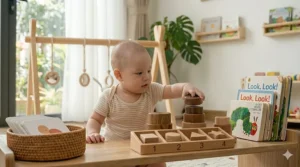
Montessori activity gyms operate on the opposite principle: controlled stimulation. A wooden baby gym arch with three simple toys allows babies to focus attention on one element at a time. This focused attention builds neural pathways more effectively than scattered attention across ten competing elements. The natural materials provide authentic sensory feedback — wood has weight and texture that plastic can’t replicate. When babies bat a wooden ring, they receive genuine cause-and-effect feedback (it swings predictably based on force applied) rather than the artificial response of a battery-powered button.
The research on self-directed play is particularly compelling. Montessori gyms don’t dictate how babies should interact; there’s no “correct” way to engage. This autonomy supports cognitive development by encouraging problem-solving. When a baby figures out that pulling the hanging toy makes it swing, they’ve just performed scientific experimentation — hypothesis, action, observation, conclusion. Electronic toys that reward button-pressing with lights and sounds shortcut this process, teaching passive consumption instead of active inquiry.
Common Mistakes When Buying a Montessori Activity Gym (And How to Avoid Them)
Mistake 1: Buying Based on Toy Quantity Instead of Quality
Parents see “includes 12 toys!” and assume more equals better. Wrong. Quality Montessori gyms include 5-8 carefully selected toys with distinct sensory properties. A wooden ring, fabric teether, crinkle element, mirror, and rattle cover all essential sensory categories. Those 12-toy sets usually include redundant items (three rattles when one suffices) that add clutter without developmental value.
Solution: Evaluate toy variety by sensory category (visual, auditory, tactile, proprioceptive) not quantity. Five unique sensory experiences beat twelve similar ones.
Mistake 2: Ignoring Material Sourcing and Safety Certifications
Not all wooden baby gym arch products are created equal. Cheap wood may be treated with harmful chemicals or finished with toxic paints. FSC certification matters — it ensures wood comes from responsibly managed forests and meets safety standards. Similarly, fabric mats should specify dye methods since babies spend hours drooling on them.
Solution: Look for FSC certification on wooden components, GOTS certification on organic cotton mats, and explicit “non-toxic finish” statements. If the product page doesn’t mention safety testing, assume it hasn’t been done.
Mistake 3: Overlooking Cleaning Practicality
Around month 4-5, babies become drool machines. Teething, mouthing toys, and inevitable spit-up mean your gym will need frequent washing. Wooden gyms with attached fabric elements that aren’t removable become cleaning nightmares.
Solution: Verify that toys detach easily for individual washing. Ensure mat is fully machine-washable, not just “spot clean only.” Dishwasher-safe elements (teethers, plastic mirrors) save significant time.
Mistake 4: Choosing Style Over Function
Instagram-worthy aesthetics don’t guarantee developmental value. That all-white minimalist gym looks gorgeous in photos but might not provide enough visual contrast for newborn development. Similarly, gyms designed to “disappear” into decor sometimes sacrifice stimulating elements for aesthetics.
Solution: Prioritize developmental appropriateness first, aesthetics second. Many gyms (Lovevery, Lalo, Comfy Cubs) achieve both, but when forced to choose, function wins.
Understanding Montessori Principles for Infant Development
Before Dr. Maria Montessori revolutionized education in the early 1900s, children were seen as empty vessels to be filled with knowledge through rote instruction. Montessori flipped this paradigm by recognizing that children are naturally driven to learn through exploration. Her methods, originally developed for preschoolers, have since been adapted for infants based on developmental research.
The core principle for infant Montessori: respect the child as a capable, developing human being. This translates to baby gear in specific ways:
Freedom of Movement: Montessori gyms don’t confine babies to bouncer seats or swings. They provide open floor space where babies can move freely — rolling, reaching, kicking — without restriction. This movement builds gross motor skills and body awareness.
Natural Materials: Wood, cotton, wool, and metal provide authentic sensory experiences. When a baby grasps a wooden toy, they experience its weight, temperature, and texture accurately. Plastic homogenizes these experiences — everything feels similar and artificial.
Simplicity and Order: Montessori environments avoid clutter. A wooden baby gym with three hanging toys creates visual calm that allows babies to focus attention. This develops concentration skills that translate to later learning.
Self-Paced Learning: There’s no timer, no sequence, no “correct” interaction method. Babies explore at their own pace, following their internal developmental timetable rather than external pressure.
According to the American Montessori Society, these principles support optimal brain development during the critical birth-to-three window when neural connections form most rapidly. The freedom to explore independently builds confidence and intrinsic motivation — qualities that support lifelong learning.
What to Expect: Developmental Milestones Supported by Activity Gyms
Understanding realistic expectations prevents the frustration of thinking your baby “isn’t using the gym right.” Here’s what typical development looks like:
Birth to 6 Weeks: Passive Observation
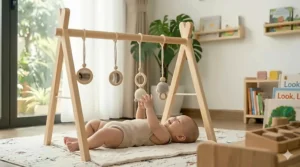
Newborns primarily observe rather than interact. They’ll gaze at high-contrast toys but won’t reach intentionally. This is normal — their job right now is visual tracking. Success looks like following a toy with their eyes as it sways.
6 to 12 Weeks: Reflexive Batting
Around 6-8 weeks, babies start swatting at toys, though it’s still reflexive rather than intentional. Don’t expect precise reaching — arms will flail wildly, occasionally making contact. This randomness is how they learn cause and effect. Each accidental hit that makes a toy move teaches them about their physical impact on the world.
3 to 4 Months: Intentional Reaching
This is the game-changer period. Babies transition from reflexive swatting to purposeful reaching. They’ll stare at a toy, extend their arm with clear intention, and attempt to grasp. Success rates remain low (maybe 30-40%) but the intention is obvious. Celebrate attempts, not just successful grasps.
5 to 6 Months: Grasping and Manipulating
Hand-eye coordination improves dramatically. Babies not only grasp toys but begin manipulating them — shaking rattles intentionally, bringing items to their mouths for exploration (everything goes in the mouth at this stage), transferring objects between hands.
7 to 9 Months: Problem Solving
Once crawling begins, babies use gyms differently. They’ll pull themselves to sitting using arches, investigate how toys attach to hooks, work to detach items they want. This problem-solving behavior represents cognitive leaps — they’re forming hypotheses and testing them.
The key: meet babies where they are developmentally, not where milestones charts say they “should” be. Some babies reach at 10 weeks; others wait until 14 weeks. Both are normal. The gym creates opportunities; babies develop on their internal timeline.
Choosing the Right Size: Floor Space and Portability Considerations
Montessori activity gyms range from 24″ x 24″ compact squares to 40″ x 40″ spacious setups. Here’s how to match size to your situation:
Small Apartments (<700 sq ft)
Prioritize foldable or compact designs. The little dove Foldable Gym (approximately 28″ x 28″ open, collapses to 24″ x 6″) works in tight spaces. Alternatively, choose gyms with removable arches that can be stored when not in use. Avoid gyms exceeding 35″ x 35″ unless you have dedicated nursery space.
Medium Homes (700-1,500 sq ft)
You have flexibility for mid-size options. Most gyms in the 30″ x 30″ to 36″ x 36″ range fit comfortably in living rooms or nurseries. Consider whether you’ll move the gym between rooms — lightweight options (Comfy Cubs at 3-4 lbs) transport easily, while heavier models stay planted.
Large Homes (1,500+ sq ft)
Maximize the learning space with larger gyms. The Lovevery Play Gym (approximately 38″ x 38″) provides ample room for babies to roll and explore without bumping edges. Larger mats also transition better to toddler play spaces.
Portability Factor: If you travel regularly or visit grandparents weekly, prioritize Quick-Close systems (Melissa & Doug) or foldable frames (little dove). Fixed-frame gyms like Comfy Cubs are lightweight enough to transport but require disassembly.
Ceiling Height Consideration: Most people overlook this, but if you have low ceilings (under 8 feet) or plan to use the gym in basements, measure arch height. Standard arches range from 18-24 inches tall. For low-ceiling spaces, choose adjustable or lower-profile designs.
Maintenance and Longevity: Getting Years of Use from Your Investment
Daily Maintenance
Wipe wooden arches with a damp cloth as needed. Avoid soaking wood or using harsh cleaners that strip natural finishes. For mats, spot-clean small messes immediately before they set. Most fabrics resist staining better when addressed within hours rather than days.
Weekly Deep Cleaning
Remove all toys and machine-wash per manufacturer instructions (typically gentle cycle, cold water). Lay mats flat to dry rather than hanging, which can distort shape. Wooden toys can be sanitized with diluted vinegar solution (1 part vinegar to 3 parts water) and air-dried completely.
Monthly Inspections
Check all attachment points where toys connect to arches. Wooden clips and fabric loops wear over time. Inspect mat edges for fraying, wooden surfaces for rough spots that need re-sanding, and toys for loose parts that could become choking hazards.
Extending Lifespan
Rotate toys through storage every 2-3 weeks. This maintains baby interest and reduces wear on individual pieces. When babies transition past the gym stage (typically 8-12 months), repurpose elements: wooden arches become fort components, mats transform into reading nook padding, toys move into toy rotation.
Resale Value
Quality gyms retain 40-60% of original value on resale markets. Lovevery products command premium resale prices due to brand recognition. Clean condition, original packaging, and complete toy sets maximize resale value. If planning to resell, store original boxes and documentation.
Safety Checklist: Ensuring Your Montessori Gym Meets Standards
Not all wooden baby gym arch products meet identical safety standards. Use this checklist before purchase and upon arrival:
Structural Safety
✅ Wooden arches sit stable without wobbling when babies kick vigorously
✅ Joints lock securely without pinch points
✅ Weight limits clearly stated (typically 15-20 lbs for overhead toys)
✅ Base width prevents tipping when babies pull up
Material Safety
✅ FSC or equivalent certification on wooden components
✅ Non-toxic finish explicitly stated (not just “safe” or “eco-friendly”)
✅ Fabric dyes meet CPSIA standards (Consumer Product Safety Improvement Act)
✅ No small detachable parts under 1.25 inches (choking hazard threshold)
Toy Safety
✅ All hanging toys have secure attachment mechanisms
✅ Cords/ribbons under 7 inches long (strangulation risk above this length)
✅ Mirrors use shatter-resistant acrylic, not glass
✅ Teething toys specify BPA-free, phthalate-free materials
Usage Safety
✅ Never place gym on elevated surfaces (changing tables, beds)
✅ Always supervise during use — gyms aren’t babysitters
✅ Stop overhead toy use when babies can pull up to standing (typically 7-9 months)
✅ Discontinue use if any component shows damage or wear
If any item fails these checks, contact the manufacturer immediately. Reputable brands provide replacement parts or refunds for safety-compromised products.
Frequently Asked Questions About Montessori Activity Gyms
❓ How early can babies start using a montessori activity gym?
❓ What makes a wooden baby gym arch better than plastic alternatives?
❓ Can sensory play mat for babies designs overstimulate newborns?
❓ How do convertible baby play gym models extend usability?
❓ Are natural materials play options worth the premium price?
Conclusion: Choosing Your Perfect Montessori Activity Gym
After testing gym configurations across developmental stages and comparing seven top options, three key insights emerge. First, price doesn’t always correlate with developmental value — the $30-$50 Melissa & Doug Ocean Gym delivers core Montessori principles as effectively as $100+ alternatives. What you’re paying for in premium tiers is extended usability (tent conversions), superior materials (FSC beech vs. pine), and convenience features (Quick-Close systems).
Second, your specific situation matters more than reviews. Urban families in 600 sq ft apartments need the little dove Foldable Gym regardless of how many five-star reviews Lovevery accumulates. Budget-conscious parents with $50 to spend make the smart choice with Melissa & Doug, even if it lacks the developmental cards of Skip Hop’s Discoverosity model. Match products to your constraints, not aspirational ideals.
Third, the real value of a montessori activity gym isn’t the physical product — it’s the developmental philosophy it represents. Whether you invest $40 or $140, you’re committing to self-directed learning, natural materials, and age-appropriate stimulation. That mindset shapes decisions far beyond baby gear into how you approach education, discipline, and independence throughout childhood.
For most families, I recommend starting with a mid-tier option like the Comfy Cubs ($50-$70) or Skip Hop Discoverosity ($90-$110). These deliver authentic Montessori principles with enough features to keep babies engaged through multiple developmental stages without the premium pricing of Lovevery. As you observe how your baby interacts and what features matter in daily use, you’ll know whether to invest more heavily in subsequent children or stick with practical simplicity.
The beautiful truth about Montessori philosophy: the fanciest gear can’t substitute for mindful observation and responsive parenting. A $40 gym used with intention teaches more than a $140 gym left unchanged for months. Choose tools that fit your life, then use them thoughtfully. That’s where development actually happens.
Recommended for You
- 7 Best Organic Baby Plush Toys That Parents Love (2026)
- 7 Best High Contrast Baby Books That Actually Support Vision (2026)
- 7 Best Mechanical Keyboard RGB: Ultimate 2026
Disclaimer: This article contains affiliate links. As an Amazon Associate, I earn from qualifying purchases. If you purchase products through these links, we may earn a small commission at no additional cost to you.
✨ Found this helpful? Share it with your friends! 💬🤗
