
In This Article
Your 9-month-old is entering one of the most exciting developmental stages—sitting independently, exploring objects with curiosity, and maybe even attempting those first wobbly crawls. At this age, the right toys for 9 month old babies aren’t just playthings; they’re essential tools that support crucial developmental milestones like fine motor coordination, cause-and-effect understanding, and sensory exploration.
According to the CDC’s developmental milestones, babies at this age should be moving things from hand to hand, picking up small objects, and exploring their environment with incredible determination. I’ve spent countless hours researching and testing products to bring you this comprehensive guide featuring real toys currently available on Amazon in 2026.
Whether you’re looking for toys for 10 month old development or focusing specifically on 9-month milestones, this guide covers budget-friendly options starting around $10 and premium developmental kits reaching $80. We’ll explore interactive walkers, sensory balls, musical instruments, and shape sorters that’ll keep your little explorer engaged while supporting their growth.
Quick Comparison Table
| Product | Type | Price Range | Key Feature | Age Range |
|---|---|---|---|---|
| VTech Sit-to-Stand Walker | Activity Walker | $45-55 | Detachable panel + walker | 9m-3y |
| Fisher-Price First Blocks | Shape Sorter | $9-12 | 10 shapes + bucket | 6m+ |
| Fat Brain Toys Dimpl | Sensory Toy | $14-17 | 5 silicone bubbles | 10m+ |
| Baby Einstein Tunes | Musical Toy | $10-13 | 10 classical melodies | 3m+ |
| Lovevery Explorer Kit | Complete Set | $80 | 8 developmental toys | 9-10m |
| Infantino Ball Set | Textured Balls | $8-11 | 6 sensory balls | 6m+ |
| Manhattan Toy Winkel | Teether/Rattle | $14-16 | Refrigerable loops | 0m+ |
💬 Just one click – help others make better buying decisions too! 😊
Top 7 Toys for 9 Month Old: Expert Analysis
1. VTech Sit-to-Stand Learning Walker
This multi-functional walker has become a staple in thousands of homes, boasting over 83,000 five-star reviews on Amazon. What makes the VTech Sit-to-Stand Learning Walker exceptional is its adaptability—it transitions seamlessly from floor play to walking support as your baby grows.
The detachable activity panel features five piano keys, three light-up shape sorters, spinning gears, three colorful rollers, and a pretend telephone. Everything lights up and plays cheerful melodies that teach shapes, colors, animals, and numbers. The walker section has adjustable wheel resistance, allowing you to customize the speed as your baby builds confidence.
Parents rave about how this toy keeps babies engaged for months. One reviewer mentioned her 8-month-old loved the activity board during tummy time, then transitioned to using it as walking support by 10 months. The product includes 2 AA batteries for demo purposes (new batteries recommended for regular use).
✅ Pros:
- Grows with baby from sitting to walking stages
- Removable activity panel for portable play
- Educational content with music and lights
❌ Cons:
- Wheels may slide on tile floors
- Phone handset can get lost (no tether)
Price: $45-55 | Recommended for: Active babies ready to practice standing
2. Fisher-Price Baby’s First Blocks
Sometimes the simplest toys are the most brilliant. Fisher-Price Baby’s First Blocks has earned over 42,000 five-star ratings and remains a timeless favorite that’s been delighting babies since the 1980s. This classic set includes 10 colorful blocks in various shapes and a bucket with a shape-sorting lid.
The chunky, easy-to-grasp blocks are perfect for little hands still developing their pincer grasp. At 9 months, your baby will love dropping blocks through the lid openings, shaking them to hear the rattling sounds, and simply mouthing the smooth plastic surfaces. As they approach 12-15 months, they’ll start matching shapes to the correct holes—a significant cognitive leap.
The bucket features a convenient carry handle, making cleanup easy and transport simple for grandma’s house visits. Multiple reviewers mention buying this exact toy for their own children in the 1980s and now purchasing it again for grandchildren—that’s serious staying power.
✅ Pros:
- Exceptional value under $10
- Develops problem-solving and hand-eye coordination
- Durable construction that lasts generations
❌ Cons:
- Shape-sorting may be too advanced until 12+ months
- Lid can be challenging for some babies
Price: $9-12 | Recommended for: Budget-conscious parents wanting educational value
3. Fat Brain Toys Original Dimpl
The Fat Brain Toys Original Dimpl proves that brilliant design doesn’t need to be complicated. This compact sensory toy features five vibrant silicone bubbles in varying sizes built into a sturdy frame. Babies are instantly captivated by the satisfying “pop” sensation when pushing the bubbles from one side to the other.
Made from 100% food-grade silicone that’s BPA-free, this toy is completely safe for teething babies. The different bubble sizes provide varied resistance levels, encouraging finger strength development. At just 5.5 x 5 x 1 inches, it fits perfectly in diaper bags for restaurant outings or long car rides.
Parents consistently report that Dimpl becomes their “go-to” distraction tool. One mother shared that her daughter sat quietly for 10 minutes straight during her first church service thanks to this toy. The manufacturer recommends ages 10 months and up, though many parents introduce it earlier under supervision.
✅ Pros:
- Portable and lightweight for travel
- Encourages cause-and-effect learning
- Safe for teething and mouthing
❌ Cons:
- Recommended for 10m+ (slightly older than 9m)
- Some babies prefer smaller bubbles
Price: $14-17 | Recommended for: Sensory-seeking babies who love tactile exploration
4. Baby Einstein Take Along Tunes Musical Toy
With over 30 million units sold worldwide, the Baby Einstein Take Along Tunes Musical Toy is a legitimate phenomenon. This handheld musical instrument introduces babies to 10 classical masterpieces from composers like Mozart, Chopin, and Vivaldi—all at the press of one large, baby-friendly button.
The colorful lights dance across the screen in rhythm with each melody, creating a multi-sensory experience that captivates visual and auditory development simultaneously. The volume control feature is a parent-saver, allowing you to enjoy the music without overwhelming your eardrums during long car trips.
The ergonomic handle design makes this perfect for babies just developing their grasp. At 9 months, your little one will love shaking it like a rattle, pressing the button repeatedly to change songs, and watching the mesmerizing light display. The toy measures just 5.0″H x 4.8″W x 1.1″L, fitting easily into any bag.
✅ Pros:
- Introduces classical music appreciation early
- Easy-grasp handle perfect for developing motor skills
- Parent-friendly volume control
❌ Cons:
- Batteries (2 AA) drain relatively quickly
- Same 10 songs may become repetitive
Price: $10-13 | Recommended for: Music-loving families wanting educational entertainment
5. Lovevery The Explorer Play Kit
If you’re willing to invest in premium developmental toys, the Lovevery Explorer Play Kit delivers exceptional value. This Montessori-inspired collection includes 8 carefully researched toys designed specifically for 9-10 month developmental windows, plus a detailed play guide explaining how each item supports growth.
The kit includes items like the Montessori egg cup (teaching object permanence), stainless steel toy keys (safe for teething with realistic jingle), first blocks (introducing spatial reasoning), and play scarves (for peek-a-boo games). Each toy is crafted from sustainable materials with attention to safety and aesthetics.
What sets Lovevery apart is the accompanying learning materials. The play guide explains developmental milestones your baby is experiencing and provides age-appropriate play ideas that evolve with your child. Parents consistently mention that individual pieces remain favorites for years, making the $80 investment worthwhile.
✅ Pros:
- Comprehensive developmental approach
- High-quality, sustainable materials
- Educational parent resources included
❌ Cons:
- Significant upfront investment at $80
- Some items (like egg cup) have limited longevity
Price: $80 | Recommended for: Parents prioritizing research-backed, Montessori-style development
6. Infantino Textured Multi Ball Set
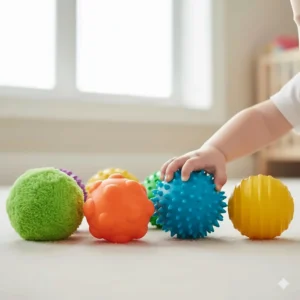
The Infantino Textured Multi Ball Set delivers outstanding sensory variety at an unbeatable price point. This collection includes 6 balls in different shapes, sizes, and textures—from bumpy to smooth, from squishy to firm. Each ball offers unique tactile feedback that encourages babies to explore and compare.
At 9 months, babies are developing their raking grasp and transitioning toward the pincer grasp. These lightweight balls are perfectly sized for little hands to grab, squeeze, and mouth. The varied textures provide different sensory inputs, stimulating neural pathway development while keeping playtime interesting.
Parents love that these balls are easy to wipe clean and remain engaging across multiple developmental stages. A 2-year-old will enjoy throwing and catching them just as much as a 6-month-old enjoys grasping and mouthing. The set typically comes in vibrant rainbow colors, though some reviewers note color variations may differ from product photos.
✅ Pros:
- Affordable multi-pack under $10
- Encourages tactile exploration and comparison
- Grows with baby through toddler years
❌ Cons:
- Material slightly thinner than premium options
- Color selection may vary from images
Price: $8-11 | Recommended for: Parents wanting variety without breaking the budget
7. Manhattan Toy Winkel Rattle & Sensory Teether
The award-winning Manhattan Toy Winkel has been soothing fussy teethers for over 25 years with its ingenious design. This sensory toy features a maze of soft, continuous BPA-free loops in stunning colors that instantly capture baby’s attention. The center cube contains a quiet rattle, providing auditory stimulation without overwhelming little ears.
What makes the Winkel exceptional is its refrigerator-safe design. When teething pain strikes, simply pop it in the fridge for 10-15 minutes, then hand it to your baby for soothing relief. The loops are made from soft, pliable polyurethane tubing that’s gentle on sore gums while being durable enough to withstand vigorous chewing.
The mesmerizing loop design encourages two-handed play and develops gross motor skills. At 5″ x 4″ x 3.5″, it’s compact enough for diaper bags yet substantial enough that babies can easily grasp it. Reviewers consistently praise how this becomes baby’s favorite companion during difficult teething periods.
✅ Pros:
- Refrigerable for teething relief
- Promotes bilateral coordination
- Time-tested design with 25+ years of success
❌ Cons:
- Cannot be fully submerged for cleaning
- Some babies prefer specific loop sizes
Price: $14-16 | Recommended for: Teething babies needing soothing relief
Understanding 9 Month Developmental Milestones
Before diving deeper into toy selection, it’s crucial to understand what your 9-month-old is developmentally capable of achieving. According to the Centers for Disease Control and Prevention, babies at this age typically demonstrate several key milestones across different developmental domains.
Social and Emotional Development
Your 9-month-old may show stranger anxiety, clinging to you when unfamiliar people approach. They recognize favorite people and toys, displaying clear preferences. This is when peek-a-boo becomes endlessly entertaining because babies are beginning to understand object permanence—the concept that things exist even when out of sight.
Cognitive Abilities
At this stage, babies watch the path of falling objects and actively look for items they’ve seen you hide. They’re experimenting with cause and effect, like banging two blocks together to create noise. This cognitive leap makes toys with buttons, levers, and moving parts particularly engaging.
Physical Development
Most 9-month-olds can sit without support and get into a sitting position independently. They move objects from one hand to the other with increasing coordination and use their fingers to “rake” food toward themselves. Some babies are crawling, pulling to stand, or even taking supported steps.
Language and Communication
Babbling intensifies at this age, with babies producing consonant-vowel combinations like “mama,” “baba,” and “dada” (though not necessarily with meaning yet). They understand simple words like “no” and respond to their names.
Understanding these milestones helps you select toys for 9 month old babies that challenge without frustrating and engage without overwhelming.
How to Choose the Perfect Toys for 9 Month Old Babies
Selecting appropriate toys requires more than just grabbing what looks cute. Here’s a comprehensive framework for making informed decisions:
1. Prioritize Safety Above Everything
According to the American Academy of Pediatrics, toys should be larger than 1.25 inches in diameter and 2.25 inches long to prevent choking hazards. Avoid toys with small parts, sharp edges, or strings longer than 12 inches. Always check for BPA-free certifications and non-toxic materials, as everything goes into baby’s mouth at this age.
2. Match Developmental Stages
The best toys for 9 month old development target skills they’re currently building. Look for toys encouraging sitting balance, hand-eye coordination, bilateral coordination (using both hands together), and fine motor skills. Toys slightly above their current level challenge growth, while toys at their level build confidence.
3. Encourage Multi-Sensory Exploration
Babies learn through all their senses simultaneously. Ideal toys combine visual interest (bright colors, lights), auditory feedback (rattles, music), and tactile variety (different textures, temperatures). The brain creates stronger neural connections when multiple senses engage together.
4. Support Independent Play
While interactive play is wonderful, babies also need toys encouraging independent exploration. Simple cause-and-effect toys (press button → hear sound) allow babies to feel competent and develop problem-solving skills without constant adult intervention.
5. Consider Longevity and Versatility
The most valuable toys grow with your child across developmental stages. A simple set of blocks serves as a teething toy at 9 months, a stacking challenge at 12 months, and an imaginative building tool at 2 years. This approach saves money while reducing toy clutter.
6. Read Reviews from Real Parents
Before purchasing, scroll through verified customer reviews on Amazon. Look for comments from parents with babies specifically 9-12 months old, as their feedback will be most relevant. Pay attention to durability complaints and safety concerns mentioned repeatedly.
7. Avoid Over-Stimulation
While bells, whistles, and lights can be engaging, too much sensory input overwhelms developing brains. Choose toys with volume controls and the option to turn off lights. Sometimes simpler is genuinely better for sustained engagement and focused learning.
Benefits of Age-Appropriate Toys for 9-10 Month Development
Investing in quality toys for 10 month old babies and their 9-month-old counterparts yields remarkable developmental dividends across multiple domains:
Cognitive Development Enhancement
Toys encouraging problem-solving—like shape sorters and stacking cups—build spatial reasoning and logic skills. When babies figure out which block fits through which hole, they’re developing critical thinking abilities that form the foundation for later academic learning. Studies show that hands-on manipulation of physical objects strengthens abstract thinking capabilities.
Fine Motor Skill Refinement
The progression from raking grasp to pincer grasp (using thumb and forefinger) happens primarily between 8-10 months. Toys with small knobs, textured surfaces, and varied shapes accelerate this development. Strong fine motor skills correlate with better handwriting, self-feeding abilities, and independence in toddlerhood.
Gross Motor Confidence Building
Push toys and activity centers encourage babies to pull up, stand, and eventually walk. The VTech Sit-to-Stand Walker, for instance, provides just enough support while allowing babies to control their movement, building both physical strength and psychological confidence.
Language Acquisition Support
Musical toys and books with simple words expose babies to language patterns and vocabulary. Even before speaking, babies absorb linguistic rules and word meanings. The repetition in songs helps cement phonetic patterns that emerge later as first words.
Social-Emotional Intelligence
Toys supporting interactive play—like balls for rolling back and forth—teach turn-taking, sharing, and social reciprocity. Dolls and stuffed animals allow babies to practice nurturing behaviors, building empathy foundations.
Safety Considerations When Selecting Baby Toys
The Consumer Product Safety Commission recalls toys regularly for safety violations, making vigilant toy selection crucial for protecting your baby.
Choking Hazards Prevention
Any toy or toy part small enough to fit inside a toilet paper tube (roughly 1.25 inches diameter) poses a choking risk. This includes button batteries, small magnets, and detachable toy eyes. Always inspect toys thoroughly before giving them to babies, checking for loose parts or components that could break off.
Toxic Material Avoidance
Ensure all toys are labeled as BPA-free, phthalate-free, and lead-free. Painted toys manufactured before 1978 may contain lead paint and should never be given to babies. Choose toys specifically labeled “non-toxic” and from reputable manufacturers with established safety records.
Strangulation Risks
Avoid toys with strings, cords, or ribbons longer than 12 inches, as these present strangulation hazards. If a toy has a string, either cut it to safe length or supervise all play sessions. Never tie toys across cribs or playpens where babies could become entangled.
Sharp Edge and Point Inspection
Run your fingers carefully over all surfaces before giving toys to babies. Broken plastic can create razor-sharp edges, while wooden toys may develop splinters over time. Regularly inspect toys for wear and discard any showing signs of deterioration.
Button Battery Dangers
Button batteries cause severe internal injuries if swallowed, as they can burn through tissue within hours. Choose toys with battery compartments requiring screwdrivers to open, and immediately seek medical attention if you suspect battery ingestion.
Age-Appropriate Labeling
Pay attention to manufacturer age recommendations—these reflect safety testing results, not just developmental appropriateness. A toy labeled for ages 3+ likely contains small parts unsafe for babies, regardless of how “advanced” your 9-month-old seems.
Best Sensory Toys for 9 Month Old Explorers
Sensory development forms the foundation for all future learning. The right sensory toys create rich exploratory experiences that wire baby’s brain for optimal growth.
Textured Balls and Objects
The Infantino Textured Multi Ball Set exemplifies excellent sensory design with its variety of surfaces—bumpy, ridged, smooth, and squishy. When babies touch different textures, their brains create distinct neural pathways for each sensation. Encourage exploration by describing what baby feels: “That ball is bumpy!” or “This one is smooth and soft!”
Musical and Sound Toys
Auditory stimulation supports language development and rhythm recognition. The Baby Einstein Take Along Tunes introduces classical music’s complex patterns, training babies’ ears to distinguish different melodies and instruments. Expose your baby to varied musical styles—classical, jazz, folk, world music—to broaden auditory processing capabilities.
Visual Stimulation Toys
High-contrast colors, moving parts, and light-up features captivate developing vision. Babies can now see distances of several feet and track moving objects smoothly. Toys combining movement with color changes provide excellent visual exercise. The VTech walker’s light-up buttons offer this multi-sensory visual feast.
Tactile Exploration Opportunities
The Manhattan Toy Winkel’s refrigerable loops provide unique temperature variation alongside texture variety. Temperature is often an overlooked sensory dimension, yet babies respond enthusiastically to novel thermal sensations. Consider offering (supervised) exploration of cold teethers, warm washcloths, and room-temperature toys to expand sensory repertoire.
Budget-Friendly Toys for 9 Month Old Development
Quality developmental toys don’t require massive budgets. Several excellent options deliver outstanding value under $15:
Fisher-Price Baby’s First Blocks ($9-12)
This classic proves that simple, well-designed toys outperform flashy gimmicks. For less than most coffee shop visits, you’re investing in problem-solving practice that’ll engage your baby for years.
Infantino Textured Multi Ball Set ($8-11)
Six diverse sensory experiences for under $11 makes this set an incredible value. The per-ball cost is less than $2, yet each provides unique developmental benefits.
Baby Einstein Take Along Tunes ($10-13)
Introducing classical music appreciation and cause-and-effect learning for the price of lunch represents exceptional value. The durability means this often becomes a hand-me-down treasure.
DIY Sensory Solutions
Don’t overlook household items as free sensory toys. Empty plastic bottles filled with rice or beans (sealed tightly) create fascinating rattles. Wooden spoons and safe metal bowls allow musical exploration. Clean sponges offer interesting textures. Always supervise these activities and regularly inspect homemade toys for safety.
Premium Investment Toys Worth the Splurge
While budget options serve wonderfully, certain premium toys justify higher price points through superior quality, longevity, and developmental impact:
Lovevery Explorer Play Kit ($80)
This comprehensive system removes the guesswork from toy selection. Each item undergoes extensive play testing, and the included educational materials help parents maximize developmental benefits. Many families report using Lovevery toys daily for years, making the per-use cost remarkably low.
VTech Sit-to-Stand Learning Walker ($45-55)
Though pricier than basic push toys, this walker’s versatility and durability make it excellent value. The detachable activity panel serves as a standalone toy, essentially providing two products in one. Families often use these walkers through multiple children.
Common Mistakes Parents Make When Buying Baby Toys
Avoid these frequent pitfalls to make smarter purchasing decisions:
Mistake #1: Buying Too Many Toys at Once
Overwhelmed babies play less effectively than those offered limited, rotated selections. Purchase 3-5 quality toys rather than 20 mediocre ones. Rotate toys weekly to maintain novelty without accumulating clutter.
Mistake #2: Ignoring Age Recommendations
“My baby is advanced” doesn’t override safety testing. Age guidelines exist primarily for safety, not intelligence assessment. A toy with small parts labeled 3+ contains choking hazards regardless of your baby’s development.
Mistake #3: Prioritizing Flashiness Over Function
Elaborate electronic toys with dozens of buttons often provide less developmental value than simple wooden blocks. Batteries don’t equal better learning. Sometimes the quietest toys foster the deepest concentration and longest engagement.
Mistake #4: Forgetting About Storage and Cleanup
Consider where toys will live when not in use. Toys without easy storage solutions create household chaos. Choose options with built-in storage (like the Fisher-Price blocks bucket) or that stack neatly.
Mistake #5: Skipping Safety Inspections
Never assume a toy is safe just because it’s sold in stores. Regularly check toys for loose parts, sharp edges, or damage. Promptly discard broken toys rather than attempting unsafe repairs.
Frequently Asked Questions About Toys for 9 Month Old Babies
❓ What are the safest materials for toys for 9 month old development?
❓ How many toys should a 9 month old have at one time?
❓ Can toys for 10 month old babies work for 9 month olds?
❓ What's the difference between developmental toys and regular toys for babies?
❓ How do I know if a toy is too advanced for my 9 month old?
Conclusion: Making Smart Choices for Your 9 Month Old’s Development
Selecting the perfect toys for 9 month old babies combines safety awareness, developmental understanding, and practical consideration of your family’s unique needs and budget. Whether you invest in the comprehensive Lovevery Explorer Play Kit at $80 or choose budget-friendly classics like Fisher-Price blocks at $10, what matters most is providing safe, engaging opportunities for your baby to explore and grow.
Remember that the best toy is often the one your baby will actually use. Pay attention to what captures their interest—some babies love musical toys while others prefer tactile exploration. Don’t be afraid to try different categories before settling into favorites.
As you shop for toys for 10 month old development and beyond, keep safety paramount, choose quality over quantity, and remember that your engaged presence provides more developmental benefit than any toy ever could. The toys simply facilitate the magic of discovery that happens when curious babies explore their expanding world.
Your 9-month-old is on an incredible developmental journey. With the right toys supporting their natural curiosity and your loving guidance, they’ll reach each milestone with confidence and joy.
Recommended for You
- 7 Best Sensory Toys for Infants 2026: Expert Development Guide
- 7 Best 24v Ride On Toys 2026 (Expert Tested)
- 7 Best Excavator Ride On Toys 2026
Disclaimer: This article contains affiliate links. If you purchase products through these links, we may earn a small commission at no additional cost to you.
✨ Found this helpful? Share it with your friends! 💬🤗
