
In This Article
✨Was this helpful? Spread the word! 🚀
Montessori Toys for 3 Year Olds
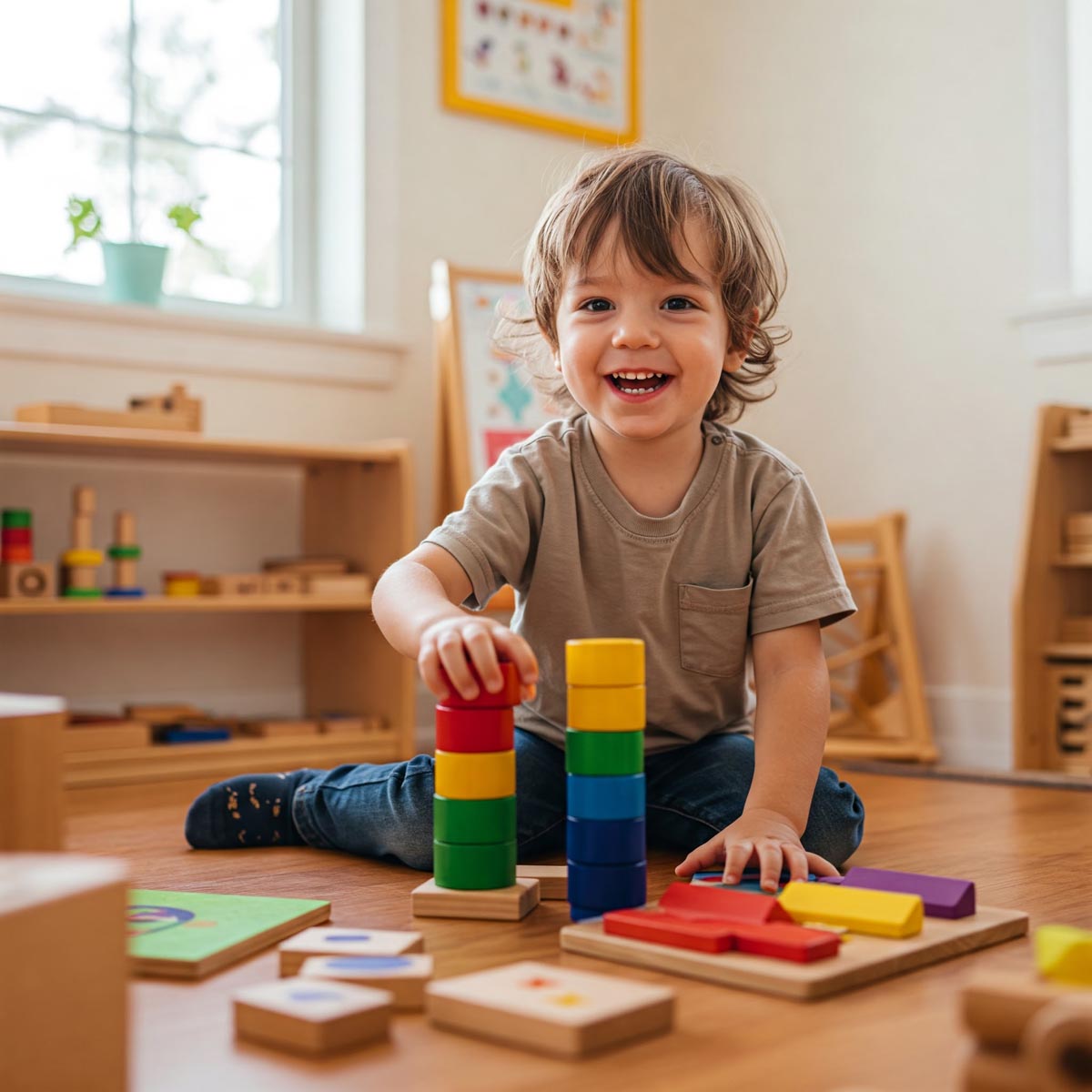
The magical age of three represents a remarkable developmental milestone in a child’s life. At this stage, children are bursting with curiosity, developing independence, and eager to explore the world around them. Montessori toys for 3 year olds are specifically designed to harness this natural enthusiasm while supporting crucial developmental milestones. Unlike conventional toys that often overstimulate with flashing lights and electronic sounds, Montessori materials focus on simplicity, purpose, and child-led discovery.
According to research published in the Journal of Early Childhood Research, educational toys that align with Montessori principles can significantly enhance cognitive development, fine motor skills, and concentration in preschool-aged children. These toys aren’t just entertaining—they’re carefully crafted learning tools that respect your child’s innate developmental timeline.
In this comprehensive guide, we’ll explore the fascinating world of Montessori toys for 3 year olds, why they matter for your child’s development, and which specific materials can best support your three-year-old’s growing mind and body. Whether you’re new to Montessori education or looking to expand your child’s collection of purposeful playthings, this article will equip you with the knowledge to make informed choices that nurture your child’s natural love of learning.
Understanding the Montessori Approach for 3-Year-Olds
The Montessori method, developed by Dr. Maria Montessori over a century ago, continues to revolutionize how we understand childhood development and education. At its core, this approach honors children as naturally curious beings who learn best through hands-on experiences and self-directed activities.
For 3-year-olds specifically, Montessori education recognizes this age as part of what Dr. Montessori termed the “sensitive period” for order, language, refinement of movement, and sensory exploration. According to the American Montessori Society, these sensitive periods represent windows of opportunity when children are particularly receptive to developing specific skills and knowledge.
Key Principles of Montessori Education for Preschoolers
✅ Child-Led Learning: Montessori toys allow children to follow their interests and work at their own pace, fostering independence and internal motivation.
✅ Hands-On Exploration: Three-dimensional materials engage multiple senses and help children grasp abstract concepts through concrete experiences.
✅ Purpose and Simplicity: Each Montessori material has a clear purpose and focuses on one skill at a time, minimizing overwhelm and confusion.
✅ Reality-Based: Materials reflect real-world objects and concepts rather than fantasy, helping children connect to their environment.
✅ Beauty and Quality: Montessori toys are typically made from natural materials like wood, with aesthetic appeal that instills respect for objects.
As Dr. Angeline Lillard, a leading researcher in Montessori education, notes in her study published in Science magazine, children in Montessori environments often demonstrate enhanced executive function, social cognition, and academic readiness compared to peers in conventional settings. The carefully designed materials play a significant role in these outcomes.
Benefits of Montessori Toys for Three-Year-Olds
When you introduce appropriate Montessori toys for 3 year olds into your home environment, you’re not just providing entertainment—you’re supporting crucial developmental milestones. These purposeful materials offer numerous advantages over conventional toys:
Cognitive Development
Montessori toys for this age group often involve problem-solving, pattern recognition, and logical thinking. Simple puzzles, matching games, and sorting activities strengthen neural connections related to reasoning and memory. Research from the National Institute of Early Education Research indicates that hands-on learning materials can boost cognitive flexibility and working memory in preschoolers.
Fine Motor Skills
Three-year-olds are rapidly developing finger dexterity and hand-eye coordination. Montessori materials like threading beads, using tweezers, and manipulating small objects provide the precise fine motor practice children need at this stage. These skills form the foundation for later writing ability and everyday self-care tasks.
Concentration and Focus
In our distraction-filled world, the ability to concentrate is increasingly valuable. Montessori toys are designed to captivate children’s attention through interesting challenges that match their developmental capabilities. The Center on the Developing Child at Harvard University has highlighted how sustained attention during early childhood correlates with academic success in later years.
Independence and Confidence
Well-designed Montessori materials allow three-year-olds to work without constant adult intervention. When children successfully complete activities independently, they develop a powerful sense of accomplishment and self-efficacy. This confidence becomes the foundation for tackling future challenges.
Language Development
Many Montessori toys incorporate language elements through classified cards, vocabulary building, and storytelling components. These materials support the verbal explosion typical of three-year-olds, who can learn up to ten new words daily according to developmental linguists.
Mathematical Mind
Montessori recognized that even young children have a mathematical mind. Materials that introduce counting, numerical relationships, and geometric concepts provide concrete experiences with mathematical principles. According to research in the Early Childhood Education Journal, children exposed to math-focused manipulatives during play show stronger number sense when entering kindergarten.
Key Features to Look for in Montessori Toys for 3 Year Olds
When selecting Montessori toys for your three-year-old, certain characteristics align more closely with Montessori principles. Here’s what to prioritize:
Natural Materials
Authentic Montessori materials typically utilize wood, cotton, metal, and other natural elements rather than plastic. These materials provide varied sensory feedback—the weight of wood, the coolness of metal—that synthetic materials cannot replicate. They also connect children to the natural world and tend to be more durable and environmentally friendly.
Open-Ended Use
The best Montessori toys for 3 year olds can be used in multiple ways, allowing children to explore different possibilities and adapt the material as their skills grow. This contrasts with single-purpose toys that quickly become redundant once mastered.
Self-Correcting Design
Many Montessori materials have built-in control of error, meaning children can see for themselves if they’ve completed an activity correctly without adult intervention. This feature promotes independence and builds problem-solving skills.
Reality-Based Concepts
Maria Montessori emphasized the importance of connecting children to reality before introducing fantasy. Toys that represent real objects and activities—like miniature cleaning tools or realistic animal figurines—help three-year-olds make sense of their world.
Child-Sized Proportions
Materials designed specifically for small hands with appropriate weight and dimensions respect children’s physical capabilities and make activities more accessible and enjoyable.
Minimal Visual Stimulation
Unlike toys with flashing lights and bright patterns, Montessori materials typically feature subdued colors that allow children to focus on the activity rather than becoming overstimulated by the toy itself.
Top 10 Montessori Toys for 3 Year Olds in 2025
After researching dozens of options and consulting with Montessori educators, we’ve compiled this carefully curated selection of Montessori-aligned toys that are perfect for three-year-olds. Each recommendation supports specific developmental needs while adhering to Montessori principles.
1. Sensory and Practical Life Development
Melissa & Doug Wooden Lacing Beads is an excellent choice for developing fine motor coordination while introducing patterns and colors. This set includes 27 wooden beads and 2 laces for creating sequences and designs. The wooden beads are perfectly sized for small hands, and the activity helps children refine their pincer grip—a crucial pre-writing skill.
What makes this truly Montessori-aligned is how it allows children to work independently at their own pace while offering the satisfaction of completing a tangible project. The natural wooden material provides a pleasant sensory experience during manipulation.
Price: Around $16.99 on Amazon
✅ Develops fine motor skills and hand-eye coordination
✅ Introduces pattern recognition and sequencing
✅ Made from natural wood with non-toxic finishes
✅ Self-contained activity with clear beginning and end
❌ Laces may fray with heavy use
❌ Some beads may have rough edges that need sanding
2. Mathematical Mind Development
Montessori Counting Bears with Sorting Cups offers a concrete introduction to early mathematical concepts. This set includes 60 colorful counting bears, 6 matching sorting cups, and tweezers for an added fine motor challenge. The bears can be sorted by color, counted in groups, used for pattern creation, or employed in simple addition and subtraction scenarios.
Children naturally gravitate toward this versatile material that grows with their mathematical understanding. Starting with simple color sorting, three-year-olds can progress to counting, creating patterns, and eventually basic arithmetic operations.
Price: Around $24.99 on Amazon
✅ Introduces counting, sorting, and classification
✅ Includes tweezers for fine motor development
✅ Versatile material that evolves with child’s abilities
✅ Durable plastic is easy to clean
❌ Bears are small and could pose a choking hazard if left unsupervised
❌ Color sorting cups may vary in size slightly
3. Language Development
Matching Objects and Letters Board provides an engaging introduction to phonics and letter recognition. This wooden board features raised letters alongside corresponding objects that begin with each letter sound. This multi-sensory approach allows children to see the letter shape, feel its outline, and connect it with concrete objects they recognize.
According to literacy experts at the International Literacy Association, connecting letters with tangible objects significantly enhances letter-sound association in young children. This material respects how three-year-olds learn—through concrete experiences rather than abstract instruction.
Price: Around $29.99 on Amazon
✅ Introduces phonetic awareness through multiple senses
✅ Features uppercase and lowercase letter matching
✅ Made from sustainable wood with non-toxic paint
✅ Self-correcting design promotes independence
❌ Some letters may have limited object associations
❌ Smaller pieces could get lost without proper storage
4. Fine Motor Development
Wooden Montessori Screw Board is designed specifically to develop the wrist and finger movements needed for writing. The board features various sizes of screws and bolts that children must turn and match appropriately. This activity strengthens the same muscles used in pencil grip while introducing concepts like size gradation and matching.
The material offers a perfect level of challenge for three-year-olds—difficult enough to engage their interest but achievable with concentration. The satisfaction of successfully tightening each screw provides immediate feedback and builds confidence.
Price: Around $32.99 on Amazon
✅ Strengthens wrist rotation and finger muscles for pre-writing
✅ Teaches size discrimination and matching
✅ High-quality wooden construction built to last
✅ Natural progression of difficulty across different screws
❌ Metal components require occasional maintenance
❌ Heavier than some other Montessori materials
5. Sensorial Development
Rainbow Wooden Stacking Blocks consist of colorful wooden arches that can be arranged in countless configurations—from rainbow bridges to balancing structures, spatial arrangements, or color gradation activities. This open-ended material allows three-year-olds to explore concepts of balance, symmetry, and creative design.
What distinguishes this as a Montessori-aligned toy is its versatility and aesthetic appeal. The smooth, vibrantly colored wooden pieces invite exploration while developing spatial awareness and creative thinking. Children often return to this material daily, discovering new possibilities with each use.
Price: Around $39.99 on Amazon
✅ Develops spatial reasoning and creative problem solving
✅ Beautiful, natural wood with non-toxic water-based colors
✅ Open-ended material with countless configurations
✅ Supports both independent and collaborative play
❌ Smaller arches could become projectiles if thrown
❌ Higher price point than plastic alternatives
How to Set Up a Montessori-Inspired Play Space for Your 3-Year-Old
Creating an environment that supports independent exploration is central to Montessori philosophy. Here’s how to arrange an effective play space for your three-year-old:
Accessible Storage
Place materials on low shelves where children can see all options and select activities independently. Clear, shallow baskets work well for keeping related items together. Consider using picture labels so your child can return materials to their proper place.
Orderly Arrangement
Organize toys by category (practical life, sensorial, language, etc.) and display them neatly with adequate space between options. This visual clarity helps children focus on one choice at a time rather than feeling overwhelmed.
Rotation System
Instead of making all toys available simultaneously, rotate materials every few weeks based on your child’s interests and developmental needs. This practice maintains novelty and prevents overstimulation.
Dedicated Workspace
Include a child-sized table and chair where concentrated work can take place. A small rug or mat can define floor spaces for larger activities, teaching children to respect workspace boundaries.
Natural Elements
Incorporate plants, natural light, and nature-inspired decorations to create a calming atmosphere that connects children to the natural world. Research from the Environmental Protection Agency suggests that natural elements in learning environments can improve concentration and reduce stress.
Minimal Decoration
Avoid cluttering walls with overly stimulating decorations. Instead, hang a few high-quality art pieces at child height or display nature items collected during outdoor explorations.
Comparing Different Types of Montessori Toys for 3 Year Olds
| Toy Category | Developmental Benefits | Best For | Average Price Range | Longevity |
|---|---|---|---|---|
| Practical Life Toys | Fine motor skills, independence, concentration | Daily skills mastery | $15-40 | 1-3 years |
| Sensorial Materials | Visual discrimination, dimension concepts | Refined sensory perception | $25-60 | 2-4 years |
| Language Materials | Vocabulary, phonetic awareness | Early literacy foundation | $20-45 | 2-3 years |
| Mathematical Toys | Number sense, counting, patterns | Early math concepts | $25-50 | 2-4 years |
| Science & Nature | Classification, natural world understanding | Developing scientific thinking | $15-40 | 2-5 years |
💬 Just one click – help others make better buying decisions too!😊
More Essential Montessori Toys for 3-Year-Old Development
6. Practical Life Skills
Child-Sized Cleaning Set includes a miniature broom, dustpan, mop, and cleaning cloth sized perfectly for three-year-old hands. This set allows children to participate meaningfully in household care—a core aspect of Montessori practical life exercises.
Dr. Montessori observed that children take great pride in caring for their environment when given appropriate tools. This Child-Sized Cleaning Set not only develops coordination and movement sequencing but also instills a sense of contribution and responsibility. Three-year-olds particularly benefit from activities that mirror adult work, which this set accomplishes beautifully.
Price: Around $27.99 on Amazon
✅ Encourages participation in real household activities
✅ Develops coordinated movement and sequencing
✅ Builds confidence through meaningful contribution
✅ Durable construction stands up to regular use
❌ Storage may be challenging without dedicated space
❌ Some components may require occasional replacement
7. Science and Nature Exploration
Wooden Magnifying Glass and Collection Box provides the perfect tools for budding scientists to observe natural objects with care and attention. This set includes a child-safe wooden magnifying glass and compartmentalized box for collecting and sorting nature finds like stones, leaves, or seeds.
This material supports the three-year-old’s natural tendency to collect and categorize, while introducing scientific observation skills. According to early childhood educators at the National Association for the Education of Young Children, early scientific exploration lays the groundwork for later scientific thinking and environmental stewardship.
Price: Around $21.99 on Amazon
✅ Encourages detailed observation and classification
✅ Connects children to the natural world
✅ Introduces scientific concepts through concrete experience
✅ Durable wooden construction with child-safe glass
❌ Magnification level is moderate rather than powerful
❌ Box compartments may be too small for larger finds
8. Creative Expression
Wooden Pattern Blocks and Boards include geometric shapes and design cards that allow children to recreate patterns or invent their own designs. This material bridges mathematical thinking and artistic expression, as children explore symmetry, spatial relationships, and color combinations.
For three-year-olds developing longer attention spans, this activity provides just the right level of challenge. Children can work independently to complete designs, experiencing the satisfaction of creating something beautiful while developing crucial visual discrimination skills.
Price: Around $29.99 on Amazon
✅ Develops geometric recognition and spatial awareness
✅ Strengthens visual discrimination and pattern recognition
✅ Open-ended material that grows with the child
✅ High-quality wooden blocks with vibrant colors
❌ Small pieces require careful storage
❌ Design cards may show wear with frequent use
🛍️ Find the Perfect Montessori Toys for Your 3-Year-Old Today! 🧸
Take your child’s development to the next level with these carefully selected Montessori materials. Click on any highlighted toy to check current pricing and availability. These educational toys are specifically designed to match your three-year-old’s sensitive periods of development!
9. Music and Sound Awareness
Wooden Rhythm Instruments Set introduces children to sound creation and musical concepts through simple, high-quality instruments. This collection typically includes a tambourine, claves, bell, and small drum—all sized appropriately for young children and made from natural materials.
Music education specialists from the National Association for Music Education emphasize that early musical experiences enhance auditory discrimination, coordination, and even mathematical thinking. This set allows three-year-olds to explore different sounds, create rhythms, and develop auditory refinement in an engaging way.
Price: Around $34.99 on Amazon
✅ Develops auditory discrimination and rhythm awareness
✅ Encourages self-expression and creativity
✅ Introduces concert concepts through hands-on experience
✅ Wooden instruments produce authentic, quality sounds
❌ May require noise management in shared spaces
❌ Smaller instruments could become misplaced
10. Gross Motor Development
Indoor Balance Stepping Stones provide an excellent way to develop coordination, balance, and spatial awareness within the home environment. These colorful, textured “stones” can be arranged in various configurations to create movement challenges that three-year-olds find irresistible.
Physical development specialists at the Society of Health and Physical Educators note that balance activities strengthen core muscles crucial for posture and later academic readiness. This material allows children to create their own movement paths, developing confidence in their physical capabilities while engaging their problem-solving skills.
Price: Around $42.99 on Amazon
✅ Develops dynamic balance and coordination
✅ Strengthens core muscles and spatial awareness
✅ Allows for creative arrangement and difficulty adjustment
✅ Non-slip bottoms ensure safety during active play
❌ Requires adequate floor space for full benefit
❌ May be noisy on hard flooring surfaces
DIY Montessori-Inspired Activities for 3-Year-Olds
While high-quality Montessori materials offer tremendous benefits, you can also create effective learning opportunities using everyday items. Here are some budget-friendly activities that align with Montessori principles:
Pouring Station
Set up a simple pouring activity using small pitchers and cups. Start with dry materials like rice or beans before progressing to water. This develops concentration, coordination, and prepares children for self-serving at mealtimes.
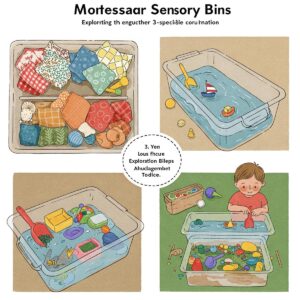
Sensory Bins
Create themed sensory bins using base materials like rice, pasta, or sand along with related objects for exploration. For example, a “farm” bin might include grain, small animal figurines, and scoops for transfer activities.
Button Sorting
Collect various buttons and provide small containers for sorting by color, size, or number of holes. Add tweezers for additional fine motor challenge. This simple activity develops classification skills and finger strength.
Nature Matching
Gather pairs of natural items (two pinecones, two acorns, etc.) and create a matching game. This can later evolve into memory games as your child develops greater cognitive abilities.
Practical Life Corner
Designate an area with child-sized tools for real practical activities: washing vegetables, folding napkins, or polishing shoes. These meaningful activities develop independence and coordination while building confidence.
Integrating Montessori Principles Beyond Toys
While quality Montessori toys for 3 year olds provide valuable learning opportunities, the Montessori approach extends beyond materials to encompass how we interact with children and structure their environment:
Respect for the Child
Speak to your three-year-old with the same respect you’d show an adult. Avoid baby talk, give them time to process information, and honor their efforts even when results aren’t perfect. This respect builds confidence and communication skills.
Freedom Within Limits
Offer appropriate choices rather than unlimited options. For example, “Would you like to wear the blue shirt or the red shirt?” This balanced approach respects autonomy while providing necessary structure.
Observation Before Intervention
Before jumping in to help, observe your child working through challenges. Often they can solve problems with a bit more time and concentration. This builds resilience and problem-solving abilities.
Connection to Reality
While imaginative play has its place, ground your three-year-old in reality through authentic experiences. Visit real places (farms, bakeries, libraries), use proper terminology for objects, and provide real tools sized for children.
Consistency and Routine
Establish predictable daily rhythms that help children feel secure. Consistent meal times, sleep schedules, and activity patterns help three-year-olds develop internal order and time awareness.
Common Questions About Montessori Toys for 3 Year Olds
Parents often wonder how to best implement Montessori principles at home. Here are answers to frequently asked questions:
Q: How many Montessori toys should my three-year-old have? A: Quality matters more than quantity. Start with 8-12 carefully selected materials organized on accessible shelves, then rotate options based on your child’s interests and development. Too many choices can overwhelm young children and decrease engagement.
Q: Are electronic toys ever appropriate in Montessori education? A: Traditional Montessori environments minimize electronic toys, especially those that entertain passively. However, thoughtfully selected technology that requires active participation and problem-solving can occasionally complement (but not replace) hands-on materials.
Q: My child seems frustrated with some Montessori materials. Should I help? A: Productive struggle is valuable for development. Observe first—is the material appropriately challenging or truly beyond current abilities? Offer minimal assistance only when necessary, perhaps demonstrating once slowly before allowing independent practice.
Q: How do I know if a toy is truly ‘Montessori’ when companies use the term loosely? A: Look beyond marketing labels to assess whether the toy embodies core Montessori principles: natural materials, clear purpose, appropriate challenge level, self-correcting features, and reality-based concepts. The American Montessori Society offers guidelines for evaluating educational materials.
Q: Can Montessori toys be combined with conventional toys? A: Yes, but consider creating separate spaces or times for different play approaches. The key is maintaining some areas where concentrated work with purposeful materials can occur without distraction from overstimulating toys.
🔍 Finding the Perfect Montessori Materials for Your Child’s Unique Journey 🌱
Every child develops at their own pace and shows individual interests. The ideal Montessori toys for your 3 year old will match their current developmental needs while offering just enough challenge to maintain engagement. Click through our recommended products to find materials that will grow with your child through this crucial developmental period!
Conclusion
Montessori toys for 3 year olds represent far more than simple playthings—they are carefully designed tools that support natural development during this crucial period. By providing materials that align with your three-year-old’s innate tendencies toward order, independence, concentration, and movement, you create an environment where learning flourishes naturally.
Whether you invest in classic Montessori materials or create your own activities inspired by these principles, the key lies in respecting your child’s developmental journey. Through purposeful play with appropriate materials, three-year-olds develop the cognitive, physical, and social foundations that will serve them throughout life.
Remember that the most important aspect of the Montessori approach isn’t the materials themselves but the respect and intention behind them—recognizing children as capable, motivated learners who deserve beautiful, purposeful tools for exploring their world. By embracing these principles, you empower your child to develop confidence, independence, and a lifelong love of learning.
🎁 Ready to Transform Your Child’s Learning Experience? 🚀
Browse our carefully selected Montessori toys for 3 year olds now! These developmentally appropriate materials make perfect gifts that will continue supporting your child’s growth for years to come. Click any product link to check current availability and pricing!
More FAQs:
❓ How long do Montessori toys typically last compared to conventional toys?
❓ What's the ideal budget for starting a Montessori toy collection for a 3-year-old?
❓ Can I find authentic Montessori toys for 3 year olds on Amazon?
❓ How do I know when my 3-year-old is ready for more advanced Montessori materials?
❓ What's the best way to introduce a new Montessori toy to my 3-year-old?
Recommended for You:
- 15 Best Montessori Toys for 2 Year Olds That Boost Development in 2025
- 15 Best Montessori Toys 1 Year Old Babies Will Love in 2025
- 15 Best Toys for 10 Month Olds: Complete Development Guide for 2025
Disclaimer: This article contains affiliate links. If you purchase products through these links, we may earn a small commission at no additional cost to you.
